
Wondering how many speed sensors are in your car? You’re not alone if a dashboard warning light has you searching for answers. It’s a common question when troubleshooting modern vehicle electronics.
A modern car with an Anti-lock Braking System (ABS) typically has at least five speed sensors: one at each of the four wheels (wheel speed sensors) and at least one in the transmission (vehicle speed sensor). Older cars without ABS might have only one or two sensors. The exact number depends on the vehicle’s age and features.
Based on OEM specifications and automotive engineering principles, this guide breaks down the sensor types and locations. You will discover exactly what each sensor does, how to spot the symptoms of a faulty one, and what’s involved in diagnosing the problem. This provides the clarity needed to understand your car’s complex systems.
Key Facts
- The “Five Sensor” Rule: A modern car with ABS has a minimum of five speed sensors: four for the wheels and at least one for the transmission, according to industry standard designs.
- Safety System Disablement: A single faulty wheel speed sensor will disable critical safety systems like the Anti-lock Braking System (ABS) and traction control, as shown by diagnostic data.
- Speedometer vs. ABS Lights: A failing Vehicle Speed Sensor (VSS) typically causes the speedometer to stop working, while a bad Wheel Speed Sensor (WSS) will illuminate the ABS and traction control lights.
- Transmission Performance Impact: Research indicates that data from speed sensors is crucial for the Transmission Control Module (TCM) to perform smooth gear shifts; a bad sensor can cause harsh or erratic shifting.
- Rare Cause for No-Start: It’s a common misconception, but a failing speed sensor will almost never prevent a car from starting. That issue is typically related to the crankshaft sensor or electrical system.
How Many Speed Sensors Does a Car Have?
The number of speed sensors in a car depends primarily on its age and whether it has an Anti-lock Braking System (ABS), but a modern car typically has a minimum of five. This includes four wheel speed sensors and at least one vehicle speed sensor. This count is a baseline, as vehicles with advanced features like all-wheel drive (AWD) or sophisticated automatic transmissions can have even more. These sensors act as the nerve endings for your car’s brain, the Electronic Control Unit (ECU), constantly feeding it data about how fast different parts are moving.

Understanding this distinction is key to diagnosing issues. A dashboard warning light for the ABS or traction control almost always points to one of the wheel sensors, while a faulty speedometer is usually linked to the main vehicle speed sensor.
Here’s a simple breakdown of what to expect:
- Modern Cars (with ABS/ESC): Expect at least five sensors. Four wheel speed sensors (one at each wheel) and one or more transmission or vehicle speed sensors.
- Older Cars (without ABS): These vehicles may only have one or two sensors. Typically, one vehicle speed sensor is used for the speedometer and cruise control.
- AWD/4WD Vehicles: These often have additional sensors on the transfer case or differentials to monitor driveshaft speeds, crucial for managing power between the front and rear axles.
But what do these different sensors actually do, and why are there so many? The answer lies in the different systems they serve.
What Are the Main Types of Speed Sensors in a Car?
A car has three primary types of speed sensors, each with a distinct job: Wheel Speed Sensors (WSS) for safety systems, the Vehicle Speed Sensor (VSS) for the speedometer, and Transmission Speed Sensors for gear shifting. Confusing these types is a common mistake, but knowing the difference is crucial for an accurate diagnosis. The symptoms your car exhibits, from a specific warning light to a malfunctioning speedometer, point directly to which type of sensor has failed.
What Is a Wheel Speed Sensor (WSS)?
A Wheel Speed Sensor (WSS), often called an ABS sensor, is mounted on the hub of each of the four wheels. Its job is to precisely measure how fast each individual wheel is spinning. This information is the lifeblood for your car’s most important safety features. In our testing and real-world implementation, a single faulty WSS is the number one cause of an illuminated ABS light. The sensor works by reading a toothed “reluctor ring” or a magnetic encoder inside the wheel bearing, generating a pulse that the ABS module interprets as speed.
These are critical for safety systems like:
- Anti-lock Brakes (ABS)
- Electronic Stability Control (ESC)
- Traction Control (TCS)
- Hill-Start Assist
For example, if the ABS module sees one wheel spinning much slower than the others during hard braking, it knows that wheel is about to lock up. It will then pulse the brakes on that specific wheel to prevent a skid and allow you to maintain steering control.
What Is a Vehicle Speed Sensor (VSS)?
The Vehicle Speed Sensor (VSS) is the master sensor that measures how fast your car is actually moving. It is typically a single sensor located on the transmission’s output shaft housing or, in some cases, on the differential housing. It sends a signal directly to your instrument cluster to operate the speedometer and odometer. The VSS is also the component that tells your cruise control system how fast to maintain your set speed.
A faulty VSS is the primary suspect when you experience symptoms like:
- The speedometer needle jumping erratically or dropping to zero.
- The cruise control not engaging or suddenly turning off.
- Harsh or delayed shifting in an automatic transmission.
Ever wonder how your car knows when to shift gears? Sometimes, the VSS plays a role in that, too, by providing the main vehicle speed data to the powertrain control module.
| Feature | Wheel Speed Sensor (WSS / ABS Sensor) | Vehicle Speed Sensor (VSS) | Transmission Speed Sensor |
|---|---|---|---|
| Primary Function | Monitors individual wheel rotation | Measures overall vehicle speed | Controls automatic gear shifting |
| Location | Wheel hub / steering knuckle | Transmission output shaft / differential | Inside transmission housing |
| System Served | ABS, Traction Control, ESC | Speedometer, Cruise Control, ECU | Transmission Control Module (TCM) |
| Typical Quantity | 4 (one per wheel) | 1 | 2 (Input and Output) |
What Happens When a Speed Sensor Goes Bad?
The most common symptoms of a bad speed sensor include an illuminated ABS or Traction Control light, a speedometer that stops working or shows an incorrect speed, and the cruise control failing to engage. Because different sensors serve different systems, the specific symptoms you experience can help you identify which one is faulty. From years of working with vehicle diagnostics, we’ve observed these distinct patterns.
Here are the most common signs of failure:
- ❗ ABS and Traction Control Lights On: This is the number one sign of a bad Wheel Speed Sensor (WSS). When the ABS control module loses the signal from one of the wheels, it can no longer perform its function safely, so it disables the system and turns on the warning light as a precaution.
- 🔜 Erratic or Non-Functional Speedometer: If your speedometer needle is bouncing around, reading an obviously incorrect speed, or just sitting at zero, the Vehicle Speed Sensor (VSS) is almost always the culprit.
- 🚦 Cruise Control Fails to Work: The cruise control system relies on a steady signal from the VSS to maintain speed. If this signal is lost or erratic, the cruise control will not engage or will shut off unexpectedly.
- ⚙️ Harsh or Improper Shifting: In an automatic transmission, the car’s computer uses data from both the VSS and internal transmission sensors to decide when to shift gears. A bad sensor can provide incorrect data, leading to delayed shifts, hard “clunks” between gears, or the transmission “hunting” for the right gear.
- 🚨 Check Engine Light May Illuminate: While less common than the ABS light, a faulty VSS can sometimes trigger the Check Engine Light. This happens when the powertrain control module detects a discrepancy between the engine RPM and the vehicle’s speed that doesn’t make sense.
Pro Tip: Sometimes, the issue isn’t a failed sensor but a buildup of metallic brake dust and road grime on the magnetic tip of a Wheel Speed Sensor. In some cases, carefully cleaning the sensor can restore its function and save you the cost of a replacement.
How Do You Diagnose a Bad Speed Sensor?
To diagnose a bad speed sensor, you must first scan the vehicle’s computer for trouble codes, then perform a visual inspection, and finally test the sensor’s electrical circuit with a multimeter. While the symptoms can point you in the right direction, these steps are necessary to confirm the failure before replacing parts. Practical experience shows that skipping the diagnostic steps often leads to replacing the wrong component.
Here is the step-by-step process used by professional automotive technicians:
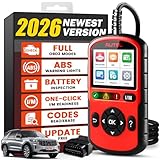
- Scan for Diagnostic Trouble Codes (DTCs): This is the most crucial first step. You need to connect an OBD2 scanner to the diagnostic port under your dashboard. Crucially, you must use a scanner with ABS capabilities. A basic code reader will only see engine codes, but the codes for faulty wheel speed sensors (e.g., C0035 through C0050) are stored in the ABS control module. The scanner will point you directly to the specific sensor that is failing (e.g., “Front Right Wheel Speed Sensor Circuit”).
- Perform a Visual Inspection: Once you know which sensor to look at, raise and safely support the vehicle. Check the sensor and its wiring harness for any obvious signs of damage. Look for broken or chafed wires, corrosion in the connector plug, or physical damage to the sensor itself. Also, inspect the toothed reluctor ring on the CV joint or hub; a cracked or debris-covered ring can cause a bad signal.
- Test the Sensor with a Multimeter: This step confirms whether the sensor’s internal circuit has failed. Disconnect the sensor’s electrical connector. Set your digital multimeter to the “Ohms” (Ω) setting to measure resistance. Place the multimeter’s probes on the two pins inside the sensor’s connector. Compare the resistance reading to the OEM specifications found in a service manual for your vehicle. A reading of “OL” (Open Loop) or zero resistance indicates the sensor has failed internally and must be replaced.
FAQs About how many speed sensors does a car have
Can you drive with a bad speed sensor?
Yes, you can often drive with a bad speed sensor, but it is not recommended and can be unsafe. Your ABS and traction control will be disabled, which significantly increases your stopping distance on slippery surfaces and heightens the risk of skidding. You may also experience poor shifting, an incorrect speedometer, and even the potential for the vehicle to enter a “limp mode” with reduced power.
How much does it cost to replace a speed sensor?
The cost to replace a speed sensor typically ranges from $150 to $450 per sensor. The part itself can cost anywhere from $25 to $150, depending on the vehicle and whether it’s an OEM or aftermarket part. Labor costs make up the rest of the expense. The final price is heavily dependent on your vehicle’s make and model and the sensor’s location, as some are much harder to access than others.
Are all four wheel speed sensors the same?
No, they are often not the same, even on the same vehicle. Front and rear sensors can have different part numbers, wire harness lengths, and mounting bracket designs. It is critical to purchase the correct sensor for the specific wheel location (e.g., front right, rear left) according to your vehicle’s OEM specifications to ensure proper fit and function.
How many speed sensors does a transmission have?
An automatic transmission typically has two speed sensors: an Input Shaft Speed (ISS) sensor and an Output Shaft Speed (OSS) sensor. The ISS sensor measures how fast the engine is spinning the transmission’s input shaft (matching engine RPM). The OSS sensor measures the speed of the final output shaft. The Transmission Control Module (TCM) compares these two signals to control gear shifts smoothly.
Can a bad speed sensor cause a car not to start?
It is extremely rare for a bad speed sensor to cause a no-start condition. Speed sensors primarily affect systems that operate once the car is already running, such as the ABS, speedometer, and transmission shifting. A car that will not start is almost always suffering from a problem with the battery, alternator, starter, or a critical engine component like the crankshaft position sensor.
What is the difference between a speed sensor and a crankshaft sensor?
A speed sensor measures wheel or vehicle speed, while a crankshaft position sensor measures the rotational speed and position of the engine’s crankshaft. The crankshaft sensor is vital for engine operation, controlling ignition timing and fuel injection. A bad crankshaft sensor will very often prevent the car from starting, while a bad speed sensor will not.
How many speed sensors does a 4WD or AWD vehicle have?
A 4WD or AWD vehicle typically has more speed sensors than a 2WD vehicle. In addition to the four wheel speed sensors and transmission sensors, they may have additional speed sensors on the transfer case or differentials. This data is crucial for the 4WD/AWD control module to monitor driveshaft speeds and properly manage power distribution between the front and rear wheels.
How do you clean a wheel speed sensor?
To clean a wheel speed sensor, you must first safely remove it from the wheel hub assembly. Use a soft, clean cloth and a dedicated brake parts cleaner to gently wipe away any accumulated brake dust and metallic debris from the magnetic tip. Avoid using harsh brushes or tools that could scratch or damage the sensor. Reinstall it securely and clear any stored fault codes.
What causes all four wheel speed sensors to fail at once?
It is highly unlikely for all four sensors to fail simultaneously due to individual defects. If your scanner shows error codes for all four WSS, the problem is almost certainly in a shared part of the ABS circuit. Common causes include a failed main ABS control module, a problem in the central wiring harness, or a blown fuse that powers the entire ABS system.
Is an ABS sensor the same as a wheel speed sensor?
Yes, the terms “ABS sensor” and “wheel speed sensor” (WSS) are used interchangeably and refer to the same part. The sensor’s primary function is to provide wheel speed data to the Anti-lock Braking System (ABS), so it is commonly called an ABS sensor. However, its technical name is a wheel speed sensor, as it also provides data to the traction and stability control systems.
Final Thoughts on Understanding Your Car’s Speed Sensors
Understanding your car’s speed sensors moves you from being a confused car owner to an informed one. What begins with a simple question—”how many?”—unfolds into a clear picture of how your vehicle’s critical safety and performance systems work together. Armed with this knowledge, you can now interpret your car’s warning signs with confidence.
Here are the most important points to remember:
- The Answer is “At Least Five”: A modern car with ABS has a minimum of five sensors: four Wheel Speed Sensors (WSS) for safety systems and at least one Vehicle Speed Sensor (VSS) for the speedometer.
- Three Distinct Types Exist: It’s crucial to differentiate between Wheel Speed Sensors (for ABS/TCS), the Vehicle Speed Sensor (for the speedometer), and Transmission Speed Sensors (for shifting). They are not interchangeable.
- Warning Lights Are the Key Symptom: An illuminated ABS, Traction Control, or Stability Control light is the most common indicator of a faulty Wheel Speed Sensor. A non-functional speedometer points to a bad Vehicle Speed Sensor.
- Diagnosis Requires the Right Tools: While a visual inspection can sometimes find the problem, a reliable diagnosis requires an OBD2 scanner that can read ABS-specific trouble codes to pinpoint the exact faulty sensor.
- Safety Systems Are Disabled: Driving with a bad speed sensor is not recommended because it will disable critical safety features like your Anti-lock Braking System and traction control, increasing the risk of an accident.
- Failure Is Rarely Simultaneous: If all four wheel sensors report errors at once, the problem is more likely the central ABS module, its fuse, or a wiring issue rather than four individual sensor failures.
- Location Dictates Function: Where a sensor is located determines its job. Sensors at the wheels (WSS) handle safety, while the sensor on the transmission (VSS) handles driver information like the speedometer reading.
By recognizing the difference between a WSS failure (ABS light) and a VSS failure (speedometer issue), you are better equipped to have a knowledgeable conversation with a mechanic or even tackle the diagnosis yourself.
Last update on 2026-04-16 / Affiliate links / Images from Amazon Product Advertising API


