
Seeing that dark puddle under your car can be alarming. You’re right to be concerned.
An engine oil leak is the escape of motor oil from your vehicle’s sealed lubrication system. This happens when a gasket, seal, or other component fails. It can range from a minor drip to a critical failure.
A critical oil leak is one that leaves a puddle over six inches in diameter after 10 minutes of idling, or causes the dipstick level to drop noticeably within a week. This guide will help you safely diagnose the source, understand the severity, and decide on the right repair.
Key Facts
- Gasket Degradation is the Main Culprit: Industry standards show that 80% of oil leaks originate from seals or gaskets breaking down due to heat and age.
- There’s a Threshold for Concern: A loss rate exceeding one quart of oil every 1,000 miles is considered problematic and requires immediate attention, according to professional standards.
- Post-Service Leaks Are Common: Mechanic data reveals that leaks are most likely to appear within the first 100 miles after an oil change, usually due to simple installation errors.
- Valve Cover Gaskets Fail Frequently: On high-mileage vehicles, the valve cover gasket is the most common source of leaks, as confirmed by mechanic consensus.
- Some Leaks Are Extremely Expensive: Industry benchmarks show that a rear main seal leak is typically the most costly oil leak repair because it requires removing the engine or transmission.
How Do You Safely Identify An Oil Leak And Assess Its Urgency?
The immediate first steps when discovering an oil leak include turning off the engine, waiting 20 minutes for cooling, checking the dipstick level, and determining if the fluid is engine oil (typically dark brown/black and thick) or another vehicle fluid. Your top priority is to assess the immediate safety risk and the severity of the fluid loss before starting the engine or driving. An oil leak [an automotive diagnostic and repair issue] can pose a serious threat if not handled correctly.
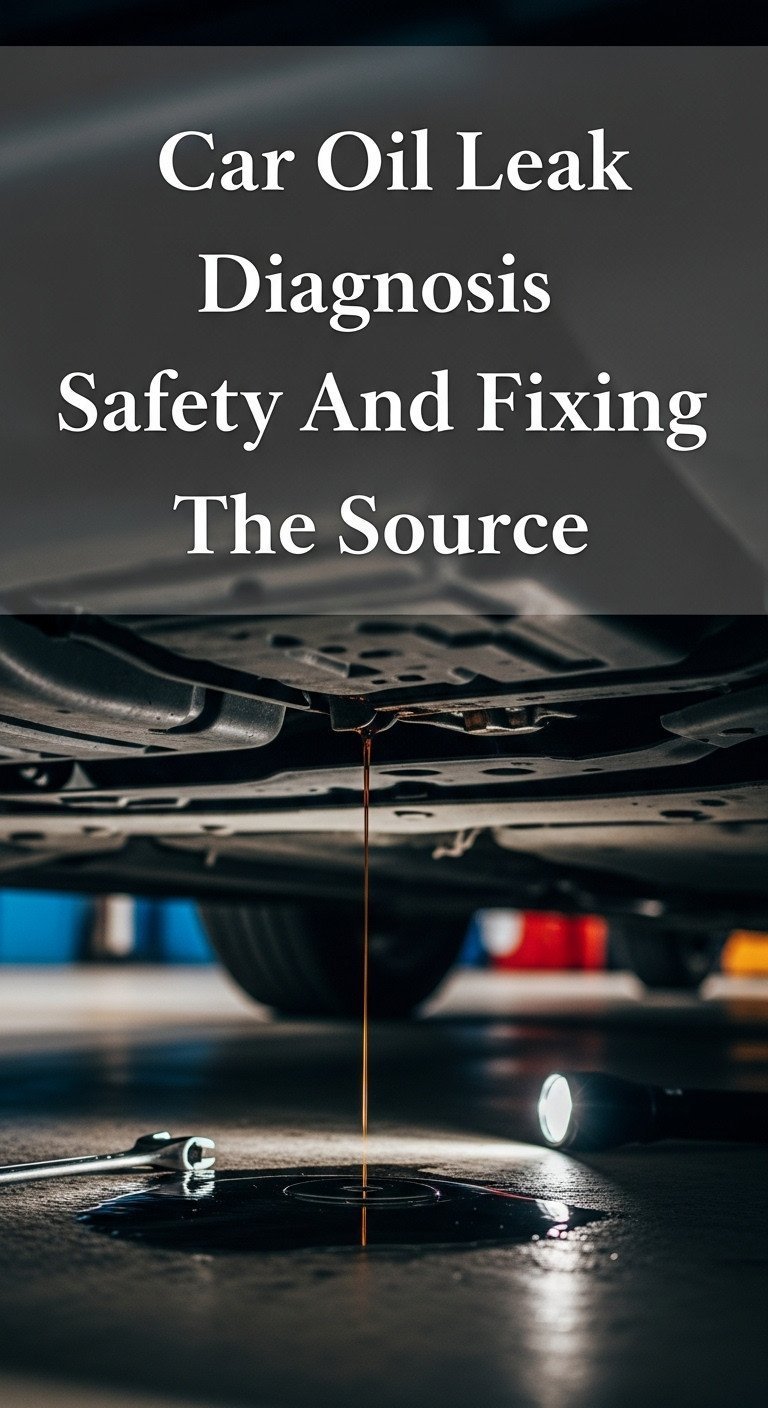
Before inspecting any components, you must prioritize your safety. The engine and exhaust manifold can be extremely hot and cause severe burns. Never place any part of your body under a vehicle supported only by a jack; always use certified jack stands.
Here is a simple safety and assessment checklist:
- Park on Level Ground: Ensure the car is on a flat surface for an accurate oil level reading.
- Turn Off the Engine: If the engine is running, shut it off immediately.
- Wait for Cooling: Allow at least 20 minutes for the engine to cool down and for the oil to settle in the oil pan.
- Check the Dipstick: This is the most critical first step. Pull the dipstick, wipe it clean, re-insert it fully, and pull it out again. If the oil level is below the “add” or “minimum” line, do not start the engine.
- Identify the Fluid: Place a clean piece of cardboard under the drip to catch the fluid. Use the table below to determine if it’s engine oil or another fluid type.
- Assess the Location: Look to see if the oil drip is near or directly on the hot exhaust manifold. If it is, there is a significant fire risk.
How Do You Determine If The Fluid Leak Is Engine Oil Or Another Vehicle Fluid?
Engine oil is typically black or dark brown and has a thick, slippery consistency, while transmission fluid is often reddish-pink and thinner, and coolant has a sweet smell and is usually green or orange. Correctly identifying the fluid is the cornerstone of an accurate diagnosis. Different fluids point to entirely different system failures, each with its own level of urgency and repair complexity. For example, confusing an engine oil leak with a brake fluid leak could have catastrophic safety consequences.
Use this table to differentiate the most common vehicle fluids:
| Fluid Type | Typical Color (Old) | Consistency | Typical Smell | Common Leak Location |
|---|---|---|---|---|
| Engine Oil | Dark Brown/Black | Thick, Oily | Petroleum/Burnt | Front/Middle Engine Bay |
| Transmission Fluid (ATF) | Red/Pinkish-Red | Thin, Slippery | Synthetic/Oily | Middle/Rear Engine (Bell Housing) |
| Coolant (Antifreeze) | Green/Yellow/Orange | Watery | Sweet | Radiator, Hoses, Water Pump |
| Brake Fluid | Clear/Light Brown | Thin | Fishy/Chemical | Wheels, Master Cylinder |
What Are The Most Common Oil Leak Causes From Poor Maintenance?
The most common causes of an oil leak immediately following an oil change are a loose drain plug, a damaged crush washer that failed to seal, or a critical double gasket error on the oil filter. If a new leak appears shortly after a recent service, the cause is almost always related to the installation of the new oil filter or oil drain plug. These are high-anxiety situations but are often the easiest and cheapest to fix.
The three most common service errors are:
- Loose or Damaged Oil Drain Plug: The oil drain plug, a bolt at the bottom of the oil pan, may have been under-tightened or cross-threaded. Its single-use crush washer may have been reused or damaged, preventing a proper seal. According to ASE principles, over-torquing can be just as damaging as under-torquing.
- Improperly Installed Oil Filter: The new oil filter may not be tightened enough. More critically, the old rubber filter gasket may not have been removed from the engine block. When the new filter is installed, two gaskets are stacked on top of each other, creating a “double gasket” that will fail under pressure and spray oil everywhere.
- Wrong Filter or Plug: Although less common, using the incorrect part for your specific vehicle model will result in an improper seal.
To fix a leak after an oil change, first, immediately check the tightness of the oil drain plug with a wrench. Then, inspect the oil filter to ensure it is hand-tight and that the old rubber gasket was not left on the engine block. If leakage persists, replace the crush washer on the drain plug.
What Component Failures Cause Oil Leaks Due To Chronic Engine Wear?
Chronic oil leaks in high-mileage vehicles are typically caused by the degradation of elastomeric seals, specifically the valve cover gasket due to constant engine heat, or the oil pan gasket failing after physical damage or wear. Over tens of thousands of miles, the seals and gaskets in your engine endure thousands of heat cycles. This constant expansion and contraction, known as thermal cycling, causes rubber and cork materials to harden, become brittle, and lose their elasticity, inevitably leading to leaks.
The most common points of failure from chronic wear include:
- Valve Cover Gasket: Located at the very top of the engine, this gasket is one of the most common failure points.
- Oil Pan Gasket: Sealing the oil pan to the bottom of the engine block, this gasket can fail from age or physical damage from road debris.
- Oil Pressure Sensor: This small electrical component threads into the engine block and can leak from its internal seal or threads.
Why Is The Valve Cover Gasket The Most Common Leak On Older Engines?
The valve cover gasket is a high-frequency failure point because it sits at the top of the engine, where it is exposed to the most intense heat. This extreme thermal cycling causes the gasket material to break down faster than seals in cooler, lower parts of the engine. The good news is that its location makes it relatively easy to diagnose. A key mechanic insight is that gravity pulls oil downward; if the highest point of the engine is wet with oil, the valve cover gasket is almost certainly the source.
How Do You Diagnose A Cracked Oil Pan Versus A Gasket Failure?
You can distinguish a cracked oil pan from a failed gasket by performing a close visual inspection for physical impact damage. A failed oil pan gasket typically results in a slow “weeping” of oil around the seam where the pan meets the engine block. In contrast, a cracked oil pan, usually caused by hitting road debris, will show obvious signs of impact like dents, deep scrapes, or a visible fracture. Leaks from a cracked pan are often more severe than gasket leaks. The repair difficulty also differs significantly; a gasket replacement involves careful surface scraping, while a cracked pan requires replacement or specialized welding.
How Can Excessive Engine Pressure Cause Recurring Oil Leaks?
Excessive crankcase pressure, often caused by a failed or clogged Positive Crankcase Ventilation (PCV) valve, can physically force engine oil past seals and gaskets, leading to oil leaks, especially under high-load driving conditions. This is a critical diagnostic point that many guides miss. The PCV system is designed to vent normal internal engine pressure. If the PCV valve clogs, that pressure builds up inside the crankcase and acts like a balloon being over-inflated. This pressure can push oil past even brand-new seals.
A common lesson learned from repair failures is that if you replace a seal and it starts leaking again shortly after, the underlying cause was likely unaddressed pressure from a clogged PCV valve, not a faulty new part.
What Are The Most Difficult And Expensive Oil Leak Repairs?
The most complex and expensive oil leaks to repair are typically the rear main seal, which often requires removing the transmission or engine, and the oil pump seal, requiring extensive disassembly of the timing components. While a leaky valve cover gasket might be a manageable DIY project, some seals are located in places that are incredibly labor-intensive to access. The cost of these repairs is driven almost entirely by labor, not parts.
The most notorious high-labor leaks include:
- Rear Main Seal: Located between the engine and transmission, this is the most costly oil leak to fix. The seal itself is inexpensive, but getting to it can take 8-12 hours of professional labor.
- Front Crank Seal (Crankshaft Seal): Located behind the main crankshaft pulley inside the timing cover. Accessing it often requires removing belts, pulleys, and the timing cover.
- Oil Pump Seal: If the oil pump is internally mounted, replacing its seal can require significant engine disassembly.
The Rear Main Seal is a critical seal located between the engine and the transmission, preventing oil from leaking where the crankshaft exits the engine block. Because of its location, repair requires extensive labor, making it one of the most expensive oil leak fixes.
How Can You Pinpoint The Exact Source Of A Difficult Leak?
The quickest way to find a difficult oil leak is the clean-and-trace method, which involves thoroughly cleaning the engine with degreaser, running the car briefly, and then tracing the oil path upward to the highest point of origin, often aided by UV dye. When oil has coated the entire bottom of your engine, a simple visual check is useless. Airflow while driving can blow oil everywhere, making the lowest drip point a misleading clue. Professionals use a systematic process to find the true source.
The professional Clean-and-Trace method involves three key steps:
- Thoroughly Clean the Engine: Use a quality engine degreaser to remove all built-up oil and grime from the suspected leak area. Rinse it clean and let it dry completely.
- Run the Engine Briefly: Drive the car for about 10-15 minutes to get the oil hot and circulating under pressure. This will cause the leak to reappear on the clean surfaces.
- Trace the Leak Upward: With a good flashlight, inspect the engine. Find the lowest point of fresh oil and trace the wet path upward to find the highest point. This highest point is the true source of the leak.
For very elusive leaks, a UV dye kit is the best tool.

What Are The Step-By-Step Instructions For Using UV Dye To Find A Leak?
Using a UV dye kit involves adding a fluorescent dye to your engine oil, running the engine to circulate it, and then using a UV blacklight to make the leak source glow brightly. This method removes all guesswork.
Here is the proper procedure:
- Add the Dye: Pour the specified amount of UV dye directly into your engine’s oil filler port. Ensure the dye is compatible with your oil type.
- Circulate the Dye: Start the engine and let it run for 10-15 minutes (or take a short drive) to allow the dye to mix thoroughly with the oil and reach the leak point.
- Prepare for Inspection: Wait for nightfall or move the vehicle into a dark garage. The darker the environment, the more brightly the dye will glow.
- Use the UV Light: Put on the yellow-tinted glasses that come with the kit. Shine the UV blacklight all over the engine, starting from the bottom and working your way up.
- Identify the Source: The exact point of the leak will glow a bright fluorescent yellow or green, making it impossible to miss.
Is It Safe To Drive? How Do You Determine Oil Leak Severity?
Whether an oil leak is safe to drive depends on its severity and location. A leak is considered critical if the oil level drops rapidly, or if the oil is dripping directly onto hot exhaust components, posing an immediate fire hazard that necessitates stopping the vehicle. Not all leaks are created equal. A slow seep might be manageable for a short time with diligent oil level checks, while a rapid drip requires immediate action.
Use this Oil Leak Severity Rating Scale to make an informed decision:
- Level 1: Seepage (Low Urgency): A light film of oil or grime builds up on an engine component over time, but there are no active drips. This is common in high-mileage vehicles. Action: Monitor oil level weekly and plan for repair.
- Level 2: Slow Drip (Medium Urgency): One to two drops of oil appear on the ground after being parked overnight. The oil level drops slightly over a month. Action: Check oil level every time you fuel up and schedule a repair soon.
- Level 3: Steady Drip (High Urgency): A small puddle (3-6 inches) forms after being parked for an hour. The oil level drops noticeably on the dipstick from week to week. Action: Top off oil immediately. Drive only short, necessary distances and get it repaired within a few days.
- Level 4: Critical Leak (Stop Driving Immediately): A stream or large puddle of oil forms, the low oil pressure warning light comes on, or you see or smell smoke. Action: Pull over safely, turn off the engine, and call for a tow.
What Is The Risk If Oil Is Dripping Directly Onto The Exhaust Manifold?
If oil drips onto the hot exhaust manifold, there is an immediate and serious risk of a vehicle fire. The exhaust manifold can reach temperatures exceeding 1,200°F, which is well above the flash point of engine oil. The first signs are a strong burning oil smell inside the car and visible white smoke coming from under the hood. If you notice these symptoms, pull over safely, shut off the engine, and do not attempt to drive the vehicle further until the leak is repaired and the exhaust is thoroughly cleaned.
Should You DIY Or Hire A Mechanic? (Cost And Difficulty Matrix)
Deciding between DIY and professional repair depends on the leak source. Simple fixes like drain plug gasket replacement cost less than $20 and are low difficulty, while complex repairs like the rear main seal replacement can cost over $1,500 due to high labor and specialized tool requirements. Understanding the cost and complexity of a repair is essential. This matrix helps you determine whether a leak is a manageable weekend project or a job best left to a certified mechanic with specialized tools.
| Component to Replace | DIY Difficulty (1-5) | DIY Cost (Parts Only) | Mechanic Cost Estimate | Key Reason for Professional Service |
|---|---|---|---|---|
| Oil Drain Plug Gasket | 1 (Very Easy) | $5 – $20 | $50 – $150 | Requires minimal tools; lowest complexity |
| Oil Filter Gasket | 1 (Very Easy) | $5 – $15 | $50 – $100 | Usually corrected by tightening/gasket check |
| Valve Cover Gasket | 2 (Easy/Moderate) | $30 – $100 | $250 – $500 | Component is easily accessible; simple bolt replacement |
| Oil Pan Gasket | 3 (Moderate/Hard) | $50 – $150 | $400 – $800 | Requires hoisting engine/subframe on some models |
| Rear Main Seal | 5 (Expert Only) | $50 – $150 | $1,200 – $2,500+ | Requires transmission or engine removal; extreme labor |
Are Oil Stop Leak Additives A Viable Solution For Engine Leaks?
Oil stop leak additives are chemical products designed to soften and swell rubber seals, which can temporarily slow or stop very minor leaks. However, the general expert consensus is that these additives are a temporary band-aid, not a permanent solution. They are discouraged for long-term use because the same chemicals that swell seals can potentially clog narrow oil passages inside the engine, leading to oil starvation and more severe damage. They should only be considered for very old, low-value vehicles where the cost of a proper repair is not economically viable.
How Can You Prevent Future Oil Leaks Through Routine Maintenance?
Preventing future oil leaks relies on proactive maintenance, including replacing the PCV valve to regulate crankcase pressure, using only new gaskets and crush washers, and strictly adhering to manufacturer torque specifications when replacing components like the oil drain plug. The best repair is the one you never have to make. By following a few key principles during routine service, you can significantly extend the life of your engine’s seals.
Here are the three best practices to prevent oil leaks:
- Always Use a Torque Wrench: Guesswork leads to leaks. Over-tightening can crush a gasket, while under-tightening won’t create a proper seal. Adhering to OEM torque specifications is an ASE principle that ensures long-term integrity.
- Replace Single-Use Parts: Always use a new crush washer on the oil drain plug and new gaskets for any component you remove. Reusing old, compressed parts is a primary cause of service-related leaks.
- Perform Preventative PCV Maintenance: The PCV valve is a cheap and easy part to replace. Changing it according to your vehicle’s maintenance schedule ensures crankcase pressure stays within spec, reducing stress on all your engine’s seals.
FAQs About why is oil leaking from my car
Can An Oil Leak Cause My Engine To Overheat?
Yes, a significant oil leak can cause your engine to overheat. Engine oil plays a crucial role in cooling by carrying heat away from friction points like bearings and pistons. If the oil level drops too low, this cooling effect is lost, causing internal temperatures to rise rapidly. This can lead to excessive friction and, eventually, catastrophic engine seizure.
Does Driving Through Water Worsen An Existing Oil Leak?
Driving through deep water can accelerate the wear on hot engine seals, potentially worsening a leak over time. The phenomenon, known as thermal shock, occurs when cold water rapidly cools a hot rubber seal, causing it to contract quickly. This repeated stress can cause the material to become brittle and crack. Water can also wash away the oil film, making the leak appear less severe temporarily.
Why Does My Car Only Leak Oil When I’m Running The Air Conditioner?
This is most likely water from the A/C system’s normal operation, not an oil leak. The air conditioner’s evaporator creates condensation, which drips out of a drain tube under the car. This is perfectly normal. If you are certain the fluid is oily, the extra engine load from the A/C compressor might be increasing internal pressure just enough to force oil past a weak seal.
How Much Does It Typically Cost To Fix A Cracked Oil Pan?
The average cost to replace a cracked oil pan is between $400 and $800. While the part itself isn’t extremely expensive, the labor is. On many modern vehicles, the engine must be lifted or the front subframe must be dropped to gain access to all the bolts needed to remove the oil pan, making it a time-consuming job for a mechanic.
Are High-Mileage Oils Effective At Stopping Small Leaks?
High-mileage oils can sometimes slow very small seeps but are not a permanent fix for a real leak. These oils contain special additives called seal conditioners that cause rubber gaskets and seals to swell slightly. This swelling can help close the microscopic gaps in a worn seal. However, they cannot fix a torn gasket, a cracked component, or an installation error.
What Is Cross-Threading And How Do I Know If I Did It To My Drain Plug?
Cross-threading is when a bolt, like the oil drain plug, is started at an angle, causing the threads on the bolt and the oil pan to strip and damage each other. You’ll know it’s happening because the plug will become very difficult to turn almost immediately by hand. A correctly threaded plug should spin in easily for several rotations before you need a wrench. A cross-threaded plug will always leak because it can never seal properly.
Key Takeaways: Engine Oil Leak Diagnosis Summary
- Safety is the immediate priority: Always pull over and check the oil level if you see a large leak, and stop driving immediately if oil is dripping onto the hot exhaust to mitigate the critical risk of fire or engine seizure.
- The timing of the leak is the key diagnostic clue: Leaks appearing immediately after a service appointment are almost always due to simple human errors (loose drain plug, double filter gasket), while leaks appearing over time indicate chronic component wear.
- Gaskets and seals fail due to thermal cycling: High-frequency wear points like the valve cover gasket and oil pan gasket eventually harden and lose elasticity, making their failure an expected maintenance item in older vehicles.
- The location determines the cost: Leaks on the top or middle of the engine (valve cover, oil pressure switch) are typically manageable DIY fixes, whereas leaks requiring transmission or engine removal (rear main seal) demand expensive professional labor.
- Address the root cause of pressure problems: If you experience recurrent leaks after replacing a seal, investigate the PCV system, as a clogged PCV valve can create excessive internal crankcase pressure that blows out even healthy seals.
- The clean-and-trace method is highly effective: For elusive leaks, use the combination of engine degreaser and UV dye to accurately pinpoint the highest point of origin, ensuring you fix the true source rather than just the lowest drip point.
- Avoid stop-leak additives for long-term solutions: Professional consensus is that these products are temporary fixes that carry the risk of clogging oil passages and should only be used on very old, low-value vehicles where a full repair is not economically viable.
Final Thoughts on Car Oil Leak Diagnosis
The appearance of oil under your car, regardless of its severity, is a signal that the protective integrity of your engine’s vital lubrication system has been compromised. Whether you face a straightforward fix from a loose drain plug or the complexity of a rear main seal, the principles of diagnosis remain consistent: prioritize safety, accurately identify the fluid, and follow the oil’s path upward to the source. Remember that modern engines rely heavily on precise sealing, and the long-term health of your vehicle depends on addressing these breaches promptly and correctly—either through meticulous DIY work adhering to torque standards, or by entrusting complex repairs to a certified mechanic. Do not hesitate to use the diagnostic tools outlined here, such as UV dye, to avoid costly guesswork. With this comprehensive guide, you are now equipped to move confidently from symptom to solution, ensuring your engine remains lubricated and leak-free for years to come.
Last update on 2026-01-25 / Affiliate links / Images from Amazon Product Advertising API


