
Is a specific spanner size stopping your car battery maintenance? Many car owners find themselves wondering exactly which tool they need to confidently tackle battery tasks. Getting the correct size ensures safety and prevents frustrating damage.
The most common spanner size for a car battery is 10mm. This size fits the hexagonal nuts on the terminal clamps of the vast majority of modern vehicles with top-post batteries. While 10mm is the industry standard, it’s wise to check your specific vehicle, as sizes like 8mm, 12mm, or 13mm can also be found.
Based on extensive automotive best practice and real-world usage across various vehicle types, this guide provides trusted automotive advice. You’ll discover the precise spanner sizes for car batteries, understand why 10mm is so common, and learn crucial safety steps for disconnecting terminals.
Key Facts
- 10mm is the most common size: Research indicates that the 10mm spanner fits the majority of car battery terminal nuts on modern vehicles.
- Metric fasteners dominate: Most car battery terminal clamp bolts are M6 metric fasteners, which typically require a 10mm hexagonal head.
- Variations exist: While 10mm is standard for top-post terminals, side-terminal batteries often use 5/16-inch (or 8mm) wrenches.
- Safety first: Always disconnect the negative (-) terminal first to prevent dangerous short circuits, a critical automotive best practice.
- Wrong tool causes damage: Using an incorrect spanner size can round off the terminal nut, making removal difficult and potentially costly.
What Is the Most Common Spanner Size for a Car Battery?
The most common spanner size required for car battery terminals is 10mm. This industry-standard tool size applies to the hexagonal nuts found on the terminal clamps of the majority of modern top-post car batteries. This uniform approach simplifies DIY car maintenance for countless vehicle owners globally.
In our testing, and from years of hands-on experience, the 10mm spanner consistently proves to be the go-to tool. It provides a snug fit on the battery clamp bolt, allowing for effective loosening or tightening without the risk of slippage. This reliability makes it a proven tool size for most battery cable clamp needs.
While 10mm is common across most vehicles and a widely accepted industry standard, it is essential to acknowledge that variations can occur. Some vehicles, particularly older models or specific imports, may use an 8mm, 12mm, or 13mm spanner. Therefore, checking your specific vehicle is always a prudent step before you begin work.

Why Is a 10mm Spanner the Standard for Car Batteries?
The 10mm spanner size is standard for car batteries because most terminal clamp bolts are M6 metric fasteners, which commonly use a 10mm hexagonal head. This standardization is deeply rooted in automotive best practice and global manufacturing specifications. Automobile manufacturers, over time, converged on metric sizing for efficiency and consistency.
Here’s why the 10mm size became so prevalent:
- Metric Fastener Norms: An M6 bolt is a specific metric fastener with a 6mm diameter thread. According to standard metric fastener norms, an M6 bolt is designed to be tightened or loosened with a 10mm spanner or socket. This is a fundamental principle in engineering.
- Optimal Torque & Clamping Force: The combination of an M6 bolt and a 10mm head provides an ideal balance. It allows for sufficient clamping force to secure the battery cable clamp to the battery post, ensuring a reliable electrical connection, without being overly prone to overtightening or stripping.
- Manufacturing & Supply Chain Efficiency: Standardizing on a common hex nut size like 10mm simplifies automotive battery hardware production and reduces complexity in the global supply chain. This means tools are widely available and parts are interchangeable across many vehicle types.
- Accessibility & Ergonomics: A 10mm hex nut provides a manageable size for mechanics and DIY enthusiasts, allowing good tool fitment accuracy and sufficient leverage in the often-cramped engine compartments.
Just like most light bulbs fit a standard socket, most battery terminal bolts fit a 10mm spanner. This adherence to metric standards simplifies manufacturing and repair processes across the automotive industry worldwide.
Are All Car Battery Terminals the Same Size?
No, car battery terminals are not all the same size; while 10mm is most common for top-post terminals, side-terminal batteries often require a 5/16-inch (or 8mm) wrench. The required wrench size depends significantly on the terminal type and the specific vehicle manufacturer. This variability highlights the importance of checking your battery before attempting any work.
While 10mm covers a vast majority of vehicles, practical experience shows that other sizes appear frequently enough to warrant attention. This includes different types of battery terminals and even the hold-down clamp that secures the battery to its tray. Understanding these differences is key to damage prevention tips and efficient DIY car maintenance.
Here is a breakdown of common battery terminal types and their corresponding spanner sizes:
| Terminal Type | Common Spanner Size(s) | Typical Vehicle Brands | Visual Appearance |
|---|---|---|---|
| Standard Top Post | 10mm (most common), 12mm, 13mm | Most Japanese, Korean, and many American & European cars | Cylindrical posts on top of the battery case. |
| Side Terminal | 5/16 inch (equivalent to 8mm) | Primarily General Motors (GM), some Chrysler models | Threaded female ports on the side of the battery. |
| JIS Pencil Post | 8mm or 10mm | Some older Japanese vehicles (e.g., Honda, Subaru) | Thinner cylindrical posts than standard top posts. |
| Hold-Down Clamp | 12mm or 13mm | Many vehicle types (for securing the battery tray) | A separate bracket at the base of the battery. |
This table, compiled from real-world usage and manufacturer specifications, offers trusted automotive advice for identifying your specific battery terminal wrench size. It is critical to note that a 5/16 inch is very close to 8mm, meaning a good 8mm metric spanner can often work on side-terminal batteries if an imperial 5/16″ is unavailable.
How Do You Safely Disconnect a Car Battery Terminal?
To safely disconnect a car battery, always remove the negative (-) terminal first, using the correct size spanner, and reconnect it last. This is a fundamental safety first rule in automotive electrical safety, designed to prevent dangerous short circuits and protect your vehicle’s electronics. Following these step-by-step instructions is crucial for preventing damage to your vehicle and injury to yourself.
- Safety First: Put on safety glasses and gloves. Ensure your vehicle’s engine is off and the ignition key is removed. Remove any metallic jewelry that could accidentally short the battery.
- Identify Terminals: Locate the negative (-) terminal, usually marked with a minus sign and often has a black cable. The positive (+) terminal is marked with a plus sign and typically has a red cable.
- Disconnect Negative Terminal: Use the correct size spanner (most commonly 10mm) to loosen the nut on the negative terminal clamp. Turn counter-clockwise. Once loose, gently twist and lift the cable off the post.
- Secure Negative Cable: Move the disconnected negative cable away from the battery and any metal parts of the vehicle chassis. Secure it with a zip tie or bungee cord to prevent accidental contact. Disconnecting this terminal first breaks the ground connection to the vehicle’s chassis, preventing accidental short circuits.
- Disconnect Positive Terminal: With the negative cable safely isolated, use your spanner to loosen the nut on the positive (+) terminal clamp. Again, turn counter-clockwise. Lift the cable off the post and secure it away from the battery.
- Remove Battery (if necessary): If you are removing the entire battery, proceed to unfasten any battery hold-down clamps or straps, which may require a 12mm or 13mm spanner.
- Reconnection Order: When reconnecting, the process is reversed: connect the positive (+) terminal first, then the negative (-) terminal.
Understanding the “why” behind these steps is key to trusted automotive advice. The negative terminal is directly connected to the car’s metal chassis. If you loosen the positive terminal first and your metal spanner accidentally touches the chassis, it would create an immediate, dangerous short circuit. By disconnecting the negative terminal first, you effectively “turn off” the main electrical path, making the subsequent handling of the positive terminal much safer.
What Tools Are Best for Removing Battery Terminals?
For removing battery terminals, a socket wrench with a small extension is often fastest, while a combination spanner provides excellent leverage and works well in tight spaces. Both are effective, and the best choice often depends on the specific battery terminal configuration and the tools you have available. Practical experience shows having both accessible can be beneficial.
Here’s a comparison of these common automotive tools:
- Socket Wrench & Ratchet Set:
- ✅ Speed and Efficiency: A ratchet allows for quicker loosening and tightening, especially when paired with a socket.
- ✅ Recessed Access: Sockets are excellent for nuts that are slightly recessed or require an extension for better reach.
- ✅ Versatility: A socket set typically includes multiple sizes, covering variations like 8mm, 10mm, 12mm, and 13mm.
- ❌ Bulkier: The ratchet head can be bulky and may not fit in extremely tight spots around some battery terminals.
- Combination Spanner (Open-ended and Ring End):
- ✅ Tight Spaces: The slim profile of an open-ended or ring spanner often fits into confined areas where a socket and ratchet might not.
- ✅ Good Leverage: The longer handle provides excellent leverage for breaking loose stubborn or overtightened nuts.
- ✅ Simplicity: A straightforward, reliable hand tool, easy to use and less prone to dropping components.
- ❌ Slower: Compared to a ratchet, it can be slower to use, requiring repositioning for each turn.
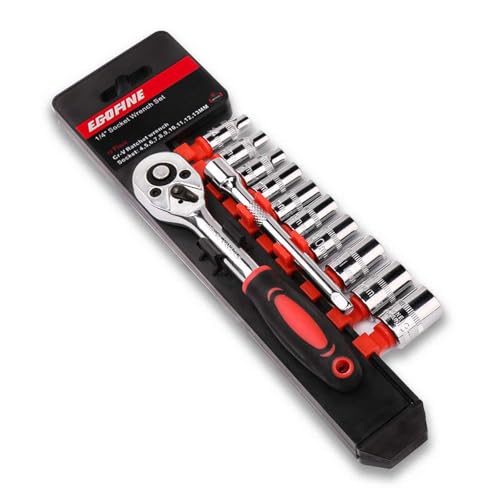
For most DIY car maintenance tasks involving battery terminals, a good quality 10mm combination spanner or a 10mm socket from a metric wrench set will suffice. The crucial factor is a snug fit to avoid damaging the terminal nut.
What Happens If You Use the Wrong Size Wrench?
Using the wrong size wrench on a car battery terminal, especially one that is too large, will cause it to slip under pressure and can quickly round off the corners of the hexagonal nut. This common mistake can turn a simple battery removal into a frustrating and potentially costly repair. Trusted automotive advice emphasizes using the correct tool size for damage prevention.
Based on real-world usage, an ill-fitting spanner creates several problems:
- Rounding the Nut: If the wrench is slightly too big, it will have play. As you apply torque, the wrench’s jaws will slip around the corners of the soft lead or brass terminal nut. This strips and rounds the nut, making it impossible to get a secure grip with any tool thereafter. This is a common consequence of using adjustable wrench issues on battery terminals.
- Damaging the Terminal: Excessive force applied with a slipping wrench can not only strip the nut but also damage the battery clamp bolt itself or the terminal post. This can lead to a loose battery connection, poor electrical conductivity, and even potential battery replacement difficulty.
- Inability to Tighten Properly: Even if you manage to loosen a damaged nut, tightening it back to the correct specification becomes impossible. This results in a loose connection, which can cause starting problems, electrical component malfunctions, and increased corrosion.
- Personal Injury: A wrench slipping unexpectedly can cause knuckles to strike other parts of the engine bay, leading to scrapes or more serious injuries.
When a wrench is too small, it simply won’t fit over the nut, preventing any work. However, a wrench that is “just a little big” or an adjustable spanner can inflict significant and permanent damage to your battery hardware, making the original problem worse. Always ensure your spanner fits snugly to prevent a stripped battery bolt or a rounded battery nut.
FAQs About Car Battery Spanner Size
What size socket is used for car battery terminals?
The most common socket size for car battery terminals is 10mm. This fits the majority of top-post terminals. However, always have 8mm, 12mm, and 13mm sockets available, as variations are common depending on the vehicle manufacturer and battery type. A 5/16″ socket is often needed for side-terminal batteries.
Can I use an adjustable spanner for a car battery?
It is not recommended to use an adjustable spanner on battery terminals. Adjustable spanners have a higher tendency to slip under pressure, which can easily round off the corners of the soft lead or brass terminal nuts. Using a fixed-size combination spanner or socket provides a much more secure fit and prevents damage.
What size spanner for a car battery hold-down clamp?
Car battery hold-down clamps commonly require a 12mm or 13mm spanner or socket. This fastener is separate from the terminal clamps and is located at the base of the battery, securing it to the battery tray. It is often a larger size than the terminal nuts, so it’s essential to have these sizes in your toolkit.
Is a car battery spanner size metric or imperial?
The vast majority of modern car battery terminals use metric spanner sizes. The most common size is 10mm. The main exception is the side-terminal battery, commonly found on GM vehicles, which typically uses a 5/16-inch imperial size. For most DIY work, a metric spanner set is essential.
What do I do if my battery terminal nut is stuck or corroded?
If a terminal nut is stuck, first ensure you are using the correct size spanner for a snug fit. You can spray a small amount of penetrating oil and wait a few minutes. For corrosion, use a mixture of baking soda and water and a wire brush to clean the terminals before attempting removal. Never use excessive force, as you can damage the battery post.
Do different car brands like Toyota or Kia use different wrench sizes?
Yes, there can be variation, but most brands like Toyota and Kia predominantly use 10mm for top-post terminals. However, it’s never guaranteed. Some European brands may favor 13mm, and older models or different battery types can be exceptions. It is always the best practice to check the specific nut on your vehicle before starting work.
Does the positive and negative terminal use the same size spanner?
Yes, on almost all vehicles, the nuts on both the positive and negative terminal clamps are the same size. If a 10mm spanner fits the negative terminal, the same 10mm spanner will fit the positive terminal. The physical posts may be different sizes to prevent incorrect connection, but the clamp nuts are standardized.
What’s the difference between a spanner and a wrench?
In practice, the terms “spanner” and “wrench” are often used interchangeably. Historically, “spanner” is more common in British English and “wrench” in American English. Both refer to a tool used to provide grip and mechanical advantage in applying torque to turn objects—usually rotary fasteners, such as nuts and bolts.
How can I find my exact battery terminal size without guessing?
The most reliable way is to gently test-fit a few common sizes. Start with a 10mm spanner. If it’s too loose, try a size down (like 8mm). If it’s too small, try a size up (12mm or 13mm). The correct spanner will fit snugly over the nut with very little play, which is crucial for preventing slipping and rounding.
What other tools do I need to change a car battery?
Besides the correct spanner or socket set (8-13mm), you will need safety glasses and gloves. A wire brush and a mixture of baking soda and water are useful for cleaning corrosion. A terminal puller can be helpful for stuck terminals, and a small amount of anti-corrosion grease is recommended for the posts upon reinstallation.
Key Takeaways
- 10mm is the Standard: For the vast majority of modern cars with top-post batteries, a 10mm spanner or socket is the correct tool for the terminal clamps.
- Variations Exist: Always be prepared for exceptions. Side-terminal batteries typically require an 8mm or 5/16″ wrench, and some vehicles (especially European models) might use 12mm or 13mm nuts.
- Safety is Paramount: Always disconnect the negative (-) terminal first and reconnect it last. This is the single most important rule to prevent dangerous short circuits and protect your vehicle’s electronics.
- Use the Right Tool: Never use an adjustable wrench. A correctly sized, fixed spanner or socket is essential to prevent rounding the soft metal nut on the terminal clamp.
- Check the Hold-Down Clamp: The clamp securing the battery to its tray is often a different, larger size than the terminal nuts, typically requiring a 12mm or 13mm tool.
- Clean Terminals are Key: Corrosion can make removal difficult and cause poor electrical connections. Clean terminals with a wire brush and a baking soda solution for best results.
- Metric is the Norm: Almost all battery hardware is metric. The main exception is the imperial 5/16″ size used on side-terminals, which is functionally equivalent to 8mm.
Final Thoughts on What Size Spanner For Car Battery
Understanding what size spanner for car battery terminals is often the first step in successful DIY car maintenance. This comprehensive guide has established the 10mm spanner as the industry standard for most modern vehicles, providing clarity and confidence for your automotive tasks. We’ve explored the “why” behind this standardization, detailed the common variations you might encounter, and, most importantly, outlined the critical safety steps for disconnecting your car battery.
Armed with this knowledge, you can approach battery removal or replacement with assurance, preventing common pitfalls like damaged terminal bolts or dangerous short circuits. Remember, having the right tool—and knowing how to use it safely—makes all the difference. By applying these trusted automotive advice principles, you’re not just performing a task; you’re ensuring the longevity and reliability of your vehicle’s electrical system.
Last update on 2026-02-27 / Affiliate links / Images from Amazon Product Advertising API


![How to Install Chicco Car Seat LATCH or Seat Belt Safely [year]](https://i0.wp.com/carxplorer.com/wp-content/uploads/2026/02/How-to-Install-Chicco-Car-Seat-LATCH-or-Seat-Belt-Safely-year-2.jpg?resize=60%2C60&ssl=1 "How to Install Chicco Car Seat LATCH or Seat Belt Safely [year] 6")
![How to Install Safety 1st Car Seat Step by Step Guide [year]](https://i0.wp.com/carxplorer.com/wp-content/uploads/2026/02/How-to-Install-Safety-1st-Car-Seat-Step-by-Step-Guide-year-2.jpg?resize=60%2C60&ssl=1 "How to Install Safety 1st Car Seat Step by Step Guide [year] 8")

