
Wondering what size hail will damage a car? You’re not alone. Many drivers worry when they hear hailstones start to fall, unsure if they need to panic or if the threat is minimal. This uncertainty can be stressful during a storm.
Generally, hail needs to be 1 inch (the size of a quarter) or larger to cause significant, visible damage to a car. While smaller hail, like pea or marble-sized, can cause minor cosmetic issues like paint scratches, the 1-inch threshold is widely considered the point where dents on body panels become a primary concern. This is the official classification for “severe” hail.
Based on an analysis of meteorological data and insurance industry reports, this guide provides clear damage thresholds. You will learn not just which sizes cause damage, but also the other crucial factors that determine severity. This will help you accurately assess your risk and know what to look for after a storm passes.
Key Facts
- The Critical Threshold: Hail measuring one inch in diameter (the size of a U.S. quarter) is the standard where significant vehicle damage becomes likely, according to meteorological standards.
- Total Loss is Possible: A car can be declared a total loss from hail if repair costs exceed its value, which is common with widespread damage from hail larger than a golf ball.
- Paint Damage Leads to Rust: Beyond dents, hail can chip paint, exposing the metal underneath and leading to long-term rust problems if not repaired, industry analysis reveals.
- Wind is a Major Factor: High winds can dramatically increase the impact energy of hail, causing smaller stones to inflict damage typically associated with larger sizes.
- Protection Varies Widely: While garages offer complete protection, parking under a tree is unreliable and risky, as falling branches can cause more damage than the hail itself.
What Size Hail Will Damage a Car?
The critical threshold at which hail begins to cause significant, visible damage to a car is when it reaches 1 inch in diameter, which is approximately the size of a U.S. quarter. While smaller hailstones can create minor issues under specific conditions, this 1-inch mark is the meteorological standard for “severe hail.” At this size, the combination of mass and falling speed is sufficient to create noticeable dents on a vehicle’s horizontal surfaces, such as the hood, roof, and trunk.

Understanding this threshold helps you move from uncertainty to informed assessment during a weather event. Damage from hail is typically categorized as either cosmetic or structural. Hail smaller than one inch, like pea-sized hail (¼ inch), is highly unlikely to cause any lasting marks. Marble-sized hail (½ inch) might create very small, shallow dings on softer aluminum panels but rarely affects steel. Once hail reaches the quarter-sized (1-inch) milestone, you enter the realm of definite cosmetic damage.
The real concern escalates quickly from this point. It’s essential to understand that the destructive potential isn’t linear; it grows exponentially with size. This transition from minor cosmetic concerns to significant structural risk is why understanding the different size categories is so important for any car owner. But how exactly does the damage escalate as a quarter-sized hailstone grows into the size of a golf ball or even a baseball?
How Does Hail Damage Potential Change With Size?
As hail increases in diameter, its damage potential grows exponentially due to increases in both mass and terminal velocity—the maximum speed it reaches while falling. A small jump in size, for instance from a quarter to a golf ball, results in a much greater impact energy. This is why larger hailstones don’t just create more dents; they create deeper dents and introduce new types of damage, such as cracked glass and paint.
To make this clear, our analysis breaks down the specific threats posed by common hail sizes. This table serves as a practical guide to help you quickly assess the risk to your vehicle during a hailstorm.
| Hail Common Name | Diameter (Approx.) | Terminal Velocity (Approx.) | Expected Vehicle Damage Potential |
|---|---|---|---|
| Pea Size | Up to ¼ inch (6.4 mm) | ~20 mph | Very Low: Unlikely to cause dents. May cause microscopic paint scratches. Generally considered harmless. |
| Marble / Mothball | ½ inch (12.7 mm) | ~25 mph | Low: Can cause minor, shallow dents on aluminum panels (hoods). Steel panels are typically resistant. |
| Dime / Penny | ¾ inch (19 mm) | ~35 mph | Moderate: Small but visible dents are possible, especially on horizontal surfaces. Damage is often inconsistent. |
| Quarter Size | 1 inch (25.4 mm) | ~40 mph | High: This is the “severe” threshold. Expect noticeable dents on the roof, hood, and trunk. Minor paint damage possible. |
| Golf Ball Size | 1.75 inches (44.5 mm) | ~50-60 mph | Very High: Causes significant, deep dents. High probability of paint cracking and chipping. Windshield cracking is common. |
| Baseball Size | 2.75 inches (70 mm) | ~70-80 mph | Extreme: Widespread, severe body damage. Shattered windows and windshields are almost certain. Can total a vehicle. |
| Grapefruit / Softball | 4 – 4.5 inches | >100 mph | Catastrophic: Punctures body panels. Will shatter all glass and severely deform the vehicle’s structure. |
From practical experience, the jump from quarter-sized to golf ball-sized hail is where damage transitions from a purely cosmetic issue to a significant financial and safety problem. A car caught in a storm with golf ball-sized hail will almost certainly have hundreds of deep dents and a high likelihood of a cracked windshield, making it much more costly and complicated to repair.
What Types of Car Damage Can Hail Actually Cause?
Hail damage on a car primarily appears as cosmetic dents, chips in the paint, and cracks or breaks in the glass. While dents are the most common and visible effect, the other types of damage can have more severe long-term consequences if not addressed. Understanding what to look for allows you to perform a thorough inspection after a storm and identify all potential issues.
Here are the primary forms of hail damage you might find on your vehicle:
- Cosmetic Dents and Dings: The most frequent result of hail, these are depressions in the vehicle’s metal body panels.
- Paint and Finish Damage: Caused by the sharp impact of larger hailstones, this can expose the metal underneath.
- Glass Damage: This ranges from small chips and “starburst” cracks on the windshield to completely shattered side or rear windows.
- Damage to Plastic and Trim: Hail can also crack or break plastic components like mirror caps, grilles, and body moldings.
What Are Cosmetic Dents and Dings?
Hail dents are typically round depressions left on a vehicle’s metal panels after an impact, most commonly appearing on the roof, hood, and trunk. Unlike dings from a car door, they are often numerous and lack any paint transfer. The severity of these cosmetic dents can range from small, shallow dimples that are only visible in certain lighting to deep, distinct craters from larger hailstones.
In our experience with vehicle assessments, spotting these dents requires a specific technique. To spot shallow dents, it’s best to view the panel from a low angle, allowing a light source to reflect off the surface. The interruptions in the reflection will reveal the dimples.
The number of dents can range from a few isolated impacts to hundreds covering every horizontal panel, often described as looking like the surface of a golf ball. Fortunately, most of these dents, as long as the paint is not broken, can be fixed using a method called Paintless Dent Repair (PDR). This is a specialized technique where technicians use tools to gently push the metal back to its original shape from behind the panel.
How Does Hail Affect Car Paint and Glass?
Large or sharp-edged hail can impact a car with enough force to chip the paint or create cracks in the glass, leading to issues that go beyond simple dents. These secondary damages are often more critical to address quickly.
Paint Damage and Rust Risk
When a hailstone’s impact is severe enough, it can break the flexible bond of your car’s paint and clear coat. This creates a chip that exposes the primer or, worse, the bare metal of the body panel. When the metal is exposed to moisture and air, it begins to oxidize, which is what causes rust to form over time.
Warning: A small paint chip from a hailstone can evolve into a significant rust spot within months. Repairing paint chips promptly is crucial to prevent much more expensive rust remediation work down the line.
Glass Chips and Cracks
Your car’s glass components have different reactions to hail. A car’s windshield is made of laminated safety glass, which consists of two layers of glass with a plastic interlayer. This construction prevents it from shattering. When struck by hail, it will typically form a small chip, a bullseye, or a starburst-shaped crack. Side and rear windows, however, are usually made of tempered glass, which is designed to shatter into thousands of small, granular pieces upon a strong impact to prevent sharp shards.
What Factors Besides Size Influence Hail Damage Severity?
While hail size is the primary indicator of damage potential, it is not the only factor; wind speed, the hail’s density, and the vehicle’s body material all play a crucial role. This explains why two cars can experience the same storm with similar-sized hail yet sustain vastly different levels of damage. Understanding these variables gives you a more complete picture of the real risk.
Here are the key factors beyond size that influence hail damage:
- Wind Speed: This is arguably the most significant secondary factor. Hailstones typically fall at their terminal velocity. However, strong winds during a thunderstorm can add a powerful horizontal velocity component. This combined speed drastically increases the kinetic energy (Impact Force = ½ * mass * velocity²) of the hailstone upon impact. Think of it this way: a stone tossed gently won’t hurt, but that same stone fired from a slingshot can cause serious damage. Wind acts like a slingshot for hail.
- Hail Density and Shape: Not all hailstones are created equal. Some are solid, dense balls of clear ice, while others might be softer, slushy, or have irregular shapes. Denser, harder ice concentrates more force into a smaller impact point, causing deeper dents. Softer or partially melted hail may flatten on impact, distributing the force over a wider area and causing less damage.
- Vehicle Material (Aluminum vs. Steel): The materials used in your car’s body panels matter significantly. Many modern vehicles use aluminum for hoods, roofs, or trunk lids to save weight and improve fuel efficiency. Aluminum is softer and more malleable than traditional steel, meaning it dents much more easily. A ½-inch hailstone that might bounce harmlessly off a steel roof could leave a noticeable dent on an aluminum hood.
What Are the Best Ways to Protect Your Car From Hail Damage?
The best and most effective way to protect your car from hail is to park it in a fully enclosed structure like a garage. If that isn’t an option, several other proactive and emergency measures can significantly reduce or prevent damage. Knowing these options ahead of time allows you to act quickly when a hailstorm is in the forecast.
Here are the best ways to protect your car, ordered from most to least effective:
- Park in a Garage or Carport: This is the only foolproof method. A solid roof provides complete protection from hail of any size. If you have a garage, use it. This is the simplest and most effective hail protection strategy.
- Use a Padded Hail Protection Car Cover: If you lack covered parking, a specialized hail cover is the next best thing. These are not standard car covers; they feature a thick layer of padding (often up to ¼ inch thick) designed to absorb the impact of hailstones. While bulky, they are highly effective against small to medium-sized hail.
- Find Temporary Covered Shelter: When a storm is approaching, be resourceful. Public parking garages, gas station awnings, and even bank drive-thrus can serve as emergency shelters. If you are on the road when a storm hits, pulling over under a sturdy highway overpass is a safe option.
- Use Blankets, Comforters, or Floor Mats: In a true last-minute emergency with no other options, you can use thick blankets, quilts, or even your car’s own floor mats as a makeshift shield. Focus on covering the most vulnerable horizontal surfaces and glass—the hood, roof, trunk, and windshield. While not perfect, this layer of padding can help absorb some of the impact energy.
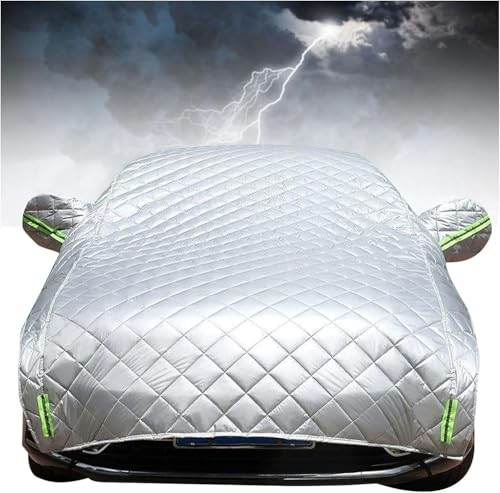
It’s far better to have a plan in place than to react in the middle of a storm. Consider your typical parking situation and decide which of these solutions is most practical for you before the next storm warning is issued.
FAQs About what size hail will damage car
Will dime-sized hail (¾ inch) damage a car?
Dime-sized hail is on the cusp of causing damage and results are often inconsistent. It can cause small, shallow dents, particularly on thinner aluminum hoods or if driven by strong winds. However, on most modern cars with steel panels and without significant wind, dime-sized hail will often leave no visible damage. It is the first size where you should inspect your vehicle closely after a storm.
Can my car be totaled from hail damage?
Yes, a car can be declared a total loss from hail damage if the cost of repair exceeds a certain percentage (often 70-80%) of the vehicle’s actual cash value. This is most common with older, lower-value cars that sustain widespread damage from large hail (golf ball-sized or bigger), as the cost of repairing hundreds of dents and replacing glass can quickly add up.
Is it safe to drive in a hailstorm?
It is not safe to drive in a hailstorm, especially with hail quarter-sized or larger. The hail can shatter your windshield, severely limiting visibility and creating a safety hazard. Furthermore, hailstorms are often accompanied by heavy rain and strong winds, making driving conditions treacherous. The best course of action is to pull over to a safe, covered location like a gas station or parking garage.
Does car insurance cover hail damage?
Hail damage is typically covered by car insurance if you have a comprehensive coverage policy. This is an optional coverage that protects against non-collision events, including weather, theft, and vandalism. Liability-only policies do not cover hail damage. It’s important to check your specific policy details to understand your deductible and coverage limits.
How much does it cost to fix hail damage on a car?
The cost to fix hail damage can range from a few hundred dollars to over $10,000. Minor damage with a few dozen small dents may cost $1,500 – $3,000 to fix with paintless dent repair (PDR). Severe damage from large hail requiring panel and glass replacement can easily exceed $10,000 and may lead to the vehicle being totaled by the insurance company.
What’s worse: long, small hail or short, large hail?
A short burst of large hail is almost always worse for a car than a long storm of small hail. Vehicle damage increases exponentially with hailstone size and impact energy. While prolonged small hail (pea-sized) is annoying, it’s unlikely to cause dents. A brief, two-minute storm with golf ball-sized hail can cause thousands of dollars in damage.
Are certain car colors more prone to showing hail damage?
Darker colored cars, such as black, dark blue, or dark gray, tend to show hail damage more clearly than lighter colored cars like white, silver, or beige. The shadows created by the dents contrast more sharply against the dark paint, making them more visible to the naked eye, especially under fluorescent lights or direct sunlight. The damage is the same, but the visibility changes.
Can I fix hail damage myself?
Fixing minor hail damage yourself is extremely difficult and not recommended for beginners. Professional techniques like paintless dent repair (PDR) require specialized tools and years of skill to manipulate the metal without damaging the paint. DIY kits often lead to cracked paint or high spots, making the damage worse and more expensive for a professional to correct later.
Does hail damage show up on a CARFAX report?
Yes, if a comprehensive insurance claim is filed to repair hail damage, it will likely appear on a vehicle’s history report like CARFAX. The report may list it as “Vehicle damage reported” with “hail” noted as the cause. This can impact the vehicle’s resale value, which is why proper, professional repair is crucial.
I parked under a tree, is my car safe from hail?
Parking under a tree offers minimal and unreliable protection from hail. While it might block some smaller hailstones, larger stones can still get through the leaves. More importantly, hailstorms often come with high winds that can break branches, causing them to fall on your car and potentially creating worse damage than the hail itself.
Key Takeaways: What Size Hail Will Damage a Car Summary
- The 1-Inch Rule is Key: Hail measuring 1 inch in diameter (quarter-sized) is the critical threshold where you can expect visible, significant dents on your car.
- Size Escalates Damage Exponentially: While pea-sized hail is harmless, golf ball-sized (1.75 inches) hail causes deep dents and cracks glass, and baseball-sized hail can total a vehicle. A small increase in size dramatically increases destructive power.
- It’s Not Just Size: Wind speed, hail density, and your car’s body material (aluminum vs. steel) are crucial factors. High winds can make smaller hail much more destructive.
- Damage Goes Beyond Dents: Look for paint chips, which can lead to rust, and check all glass for cracks or “starburst” impact marks. Don’t forget plastic trim and mirrors.
- Protection is Possible: The only guaranteed protection is a solid structure like a garage. A padded hail cover is the next best option, while blankets are a last-resort emergency measure.
- Insurance is Your Safety Net: Hail damage is covered under comprehensive auto insurance. If you only have liability coverage, you are not protected from hail damage repair costs.
Final Thoughts on Assessing and Preventing Hail Damage
Understanding what size hail will damage your car empowers you to assess risk accurately and take protective action. Remember the 1-inch rule as your baseline for concern, but always consider the other critical factors like wind. The difference between a minor inconvenience and a major insurance claim often comes down to preparation.
The best approach is a proactive one. Review your auto insurance policy today to ensure you have comprehensive coverage. Formulate a simple plan for where you will shelter your vehicle during the next severe weather warning. By combining this knowledge with a little foresight, you can significantly reduce the financial and emotional stress that comes with a hailstorm.
Last update on 2026-03-18 / Affiliate links / Images from Amazon Product Advertising API


