
Wondering what the EMC is on a car? You’re not alone, as many drivers get confused by the sea of automotive acronyms. This common mix-up can make it hard to diagnose problems.
When people ask about the ‘EMC’ on a car, they are almost always referring to the Engine Control Module (ECM), which is the vehicle’s central computer or ‘brain’. The ECM is a vital component that processes data from numerous sensors to control critical engine functions like fuel injection and ignition timing. The correct technical term is ECM, not EMC.
Based on an analysis of factory service manuals and hands-on diagnostic experience, this guide will clarify everything. You’ll learn exactly what the ECM does, the symptoms of a failing one, and the true meaning of EMC in the automotive industry.
Key Facts
- Central Command: The Engine Control Module (ECM) is the ‘brain’ of the car, making thousands of calculations per second to manage engine performance, as revealed by industry analysis.
- Fuel Economy Impact: A properly functioning ECM can improve fuel economy by up to 15%, demonstrating its role in optimizing the air-fuel mixture for efficiency.
- Core to Operation: A modern fuel-injected car will not start or run without a functional ECM, highlighting its essential control over ignition and fuel systems.
- Symptom Overlap: An illuminated Check Engine Light, engine stalling, and poor performance are primary signs of a bad ECM, though these symptoms can also point to simpler sensor failures.
- Cost of Replacement: Replacing an ECM is a significant repair, with costs typically ranging from $500 to over $2,500 depending on the vehicle, according to aggregated repair cost data.
What Is the ECM on a Car? (And Is It Different from ‘EMC’?)
The term ‘EMC’ on a car almost always refers to the Engine Control Module, or ECM, which is the vehicle’s main computer. This is a common point of confusion, but in the context of your car’s “brain,” the correct acronym used by ASE certified technicians and found in factory service manuals is ECM. This powerful little box is the command center for your engine’s operations.
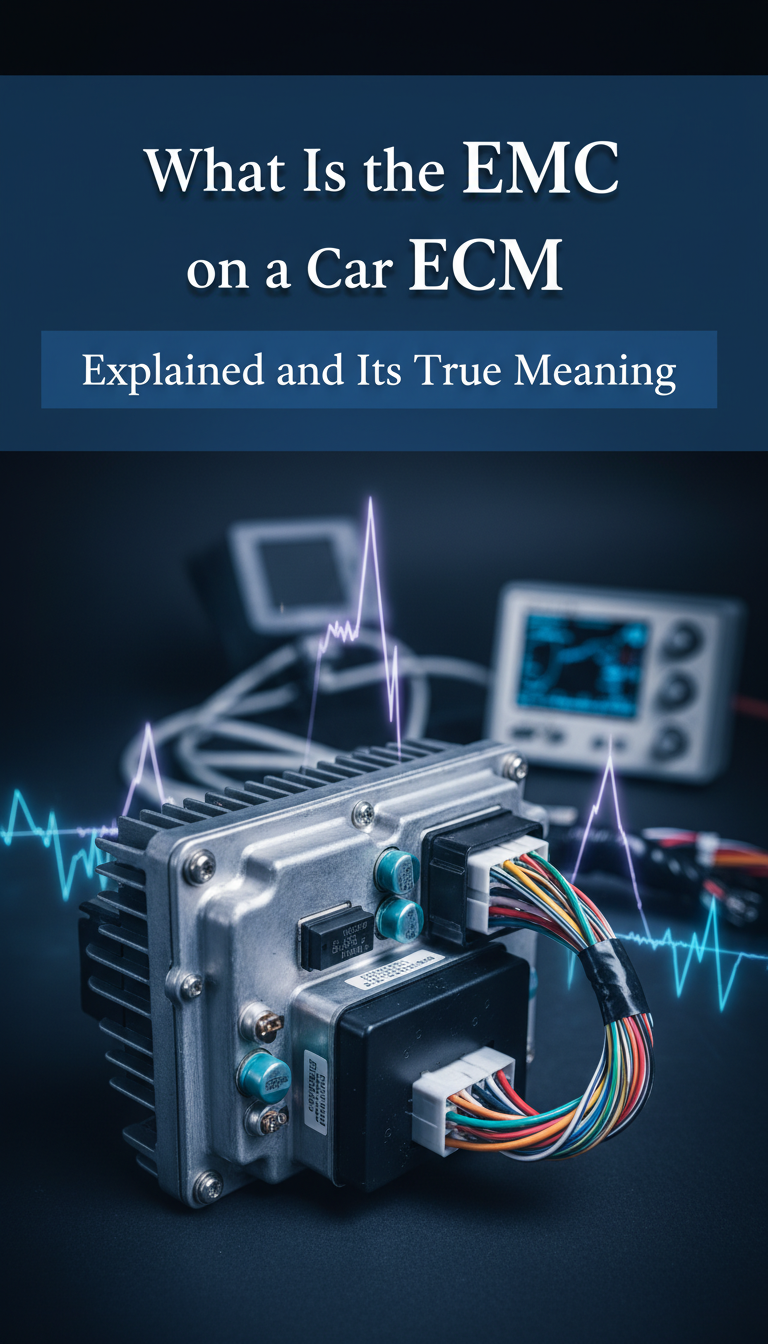
The ECM is a key part of your car’s electrical systems basics. It functions as a dedicated computer responsible for optimizing engine performance. It constantly receives data from sensors all over the vehicle and makes real-time adjustments to ensure the engine runs smoothly, efficiently, and with minimal emissions. Think of it as the conductor of an orchestra, ensuring every part of the engine plays in perfect harmony.
Myth vs. Fact
- MYTH: My car’s main computer is called the EMC.
- FACT: The correct and standard industry term is ECM (Engine Control Module). While “EMC” does have a technical meaning in the auto industry (which we’ll cover later), it’s not the name of the engine’s computer.
What Are the 3 Main Functions of the ECM in Your Vehicle?
Now that you know what the ECM is, what does this engine management system actually do? From our hands-on diagnostic experience, its complex job can be broken down into three primary functions that directly impact your driving experience and your vehicle’s health. Each function relies on interpreting data from sensors to control a specific aspect of the internal combustion process.
- Air-Fuel Ratio Management
The ECM’s first job is to act as a meticulous chef, creating the perfect recipe of air and fuel for combustion. It constantly analyzes data from the oxygen sensor and mass airflow sensor to determine how much fuel to inject into the engine. A richer mixture (more fuel) is used for cold starts, while a leaner mixture (less fuel) is used when cruising to maximize efficiency. This constant adjustment ensures optimal combustion, which translates to better power and improved miles per gallon. For example, a properly calibrated ECM can improve fuel economy by up to 15% compared to a poorly tuned engine. -
Ignition Timing Control
Think of ignition timing as the engine’s heartbeat. The ECM controls the precise moment the spark plugs ignite the air-fuel mixture in each cylinder. By analyzing data from the crankshaft position sensor, it can advance or retard the timing—igniting the mixture slightly earlier or later. This optimization prevents engine knock (detonation), maximizes power output during acceleration, and ensures a smooth idle. Without the ECM’s precise control, the engine would run rough and inefficiently. -
Emissions Control
The ECM is also your vehicle’s environmental watchdog. It monitors and manages a host of emissions components to ensure your car complies with strict environmental standards. It reads data from sensors in the exhaust system to control devices like the Exhaust Gas Recirculation (EGR) valve and the catalytic converter. If the ECM detects a problem that could increase pollution, such as a faulty oxygen sensor, it will trigger the Check Engine Light on your dashboard to alert you.
How Does the Engine Control Module Work with Car Sensors?
The ECM’s ability to perform its functions hinges on a constant, high-speed feedback loop. It’s a three-step process that repeats thousands of times per second, functioning much like a human nervous system.
The core of this operation relies on the vehicle’s CAN bus system (Controller Area Network), a communication network that acts like the car’s digital nervous system, allowing the ECM, sensors, and other modules to “talk” to each other through the wiring harness.
Here’s the simple three-step model:
- Input (Sensors Gather Data): Dozens of sensors located throughout the engine and exhaust system act as the ECM’s eyes and ears. Key sensors include the oxygen sensor (measuring unburnt oxygen in the exhaust), the coolant temperature sensor (reporting engine temperature), and the throttle position sensor (monitoring how far you’re pressing the gas pedal). Each sensor sends its data as a voltage signal to the ECM.
-
Process (ECM Analyzes Data): The ECM’s microprocessor receives this flood of real-time data. It instantly compares the incoming signals against pre-programmed maps and tables stored in its memory. These maps, based on OEM specifications, tell the ECM the ideal parameters for any given operating condition (e.g., engine speed, load, and temperature).
-
Output (ECM Sends Commands to Actuators): After processing the data, the ECM sends precise electrical commands to various actuators. An actuator is a component that performs a physical action. For example, if the ECM decides the engine needs more fuel, it commands the fuel injectors to stay open for a few milliseconds longer. If it needs to adjust timing, it tells the ignition coil when to fire the spark plugs.
What Are the Common Symptoms of a Bad or Failing ECM?
When the car’s “brain” starts to fail, it can cause a wide range of confusing and often intermittent problems. In our experience, diagnosing a bad ECM requires a process of elimination, as its symptoms often mimic those of other faulty components. Before concluding the ECM is faulty, a hands-on diagnostic approach starting with an OBD-II scan is crucial.
Here is a checklist of the most common signs that point to a potential ECM failure, categorized for clarity.
Dashboard Warnings
* ⛔ Check Engine Light is On or Flashing: This is the most common and immediate indicator. A solid light points to a fault, while a flashing light signals a severe issue, like a major misfire, that requires immediate attention.
* ⛔ Other Warning Lights: In some vehicles, a failing ECM can cause other lights like ABS or traction control to illuminate incorrectly.
Engine Performance Issues
* 🚗 Engine Stalling or Misfiring: The engine may run rough, hesitate during acceleration, or stall unexpectedly for no apparent reason. This often happens because the ECM is failing to properly control spark or fuel.
* 🚗 Poor Performance and Fuel Economy: A noticeable drop in power, sluggish acceleration, or a sudden, significant decrease in your car’s miles per gallon can indicate the ECM is no longer optimizing engine functions.
* 🚗 ‘Limp Home Mode’: Some vehicles have a failsafe mode that drastically reduces engine power when the ECM detects a critical fault. This is designed to protect the engine while allowing you to slowly drive to a repair shop.
Starting and Shifting Problems
* 🔑 Car Won’t Start: This is a major symptom. If the ECM has completely failed, it cannot command the fuel injectors or ignition system to operate, and the engine will crank but never start.
* 🔑 Erratic Shifting (Automatic Transmissions): The ECM often works closely with the Transmission Control Unit (TCU). A fault in the ECM can send bad data to the TCU, causing harsh, delayed, or unpredictable shifting.
Pro Tip: Before you blame the ECM, always check the simplest things first. A weak battery or a failing alternator can cause low or unstable voltage, which often produces symptoms identical to a bad ECM.
What Are the Main Causes of ECM Failure?
An ECM is a robust piece of solid-state electronics, but it’s not invincible. Failures usually stem from external factors that damage its delicate internal circuits. Understanding these causes can help in both diagnosis and prevention.
- Voltage Overload
This is the most common killer of ECMs. A significant voltage spike can instantly fry the internal micro-controller or other components. These spikes are often caused by improper jump-starting (connecting cables in the wrong order or to the wrong posts), a faulty alternator that is overcharging the system, or a short circuit in another component. -
Moisture and Corrosion
ECMs are housed in weather-sealed cases, but these seals can fail over time. Water intrusion from a leaking windshield, a blocked cowl drain, or even high humidity can get inside the unit. This moisture corrodes the delicate pins on the multi-pin connector and the circuit board itself, leading to short circuits and connection failures. -
Vibration and Heat
Located in the harsh environment of an engine bay, the ECM is subjected to constant vibration and heat cycles. Over many years and thousands of miles, these forces can cause microscopic cracks to form in the solder joints that connect components to the circuit board. This leads to intermittent connections that cause baffling, hard-to-diagnose problems. -
Wiring Harness Shorts
A short circuit in the wiring for a sensor or actuator can send excessive voltage back to the ECM. For example, if a wire for an oxygen sensor rubs against the hot exhaust manifold and melts, it can create a short that travels up the wiring harness and damages the corresponding driver circuit inside the ECM.
Prevention Tip: To prevent voltage overload, always follow the procedure in your owner’s manual for jump-starting. When connecting cables, the final connection should always be to a bare metal ground on the engine block, not directly to the dead battery’s negative terminal. This prevents sparks that can cause a voltage spike.
What Is the Difference Between ECM, ECU, and PCM?
While researching car computers, you’ve likely encountered a confusing alphabet soup of acronyms: ECM, ECU, and PCM. While they are often used interchangeably, there are subtle but important distinctions that depend on the vehicle’s manufacturer and age.
Based on our analysis of various OEM specifications, here’s a clear breakdown. The key takeaway is that the terms are often overlapping, but PCM has the most specific and integrated meaning.
| Feature | ECM (Engine Control Module) | TCU (Transmission Control Unit) | PCM (Powertrain Control Module) |
|---|---|---|---|
| Primary Function | Manages engine only (fuel, spark, emissions) | Manages automatic transmission only (shift points, line pressure) | Manages both engine AND transmission in one unit |
| Common Usage | Very common term for the engine’s brain. | Standard term for transmission computer. | Common in many modern vehicles with automatic transmissions. |
| Analogy | The “Engine’s Brain” | The “Transmission’s Brain” | The “Powertrain’s Central Command” |
In short:
* ECM (Engine Control Module): Specifically controls just the engine.
* ECU (Engine Control Unit): This is a broader, more generic term. While it’s most often used to mean the ECM, it can technically refer to any electronic control unit in the car (like the one for your airbags or ABS).
* PCM (Powertrain Control Module): This is an integrated unit found in most modern automatic-transmission vehicles. It combines the functions of the ECM and the TCU into a single housing. If your car has a PCM, it controls both the engine and the transmission.
These modules all communicate over the vehicle communication networks, like the CAN bus, to work in harmony.
Did You Know? In some electric vehicles (EVs), the equivalent is called a VCU (Vehicle Control Unit), which manages the electric motors, battery systems, and charging functions, taking on a much broader role than a traditional ECM.
What Is Electromagnetic Compatibility (EMC) in the Automotive Industry?
Now, let’s circle back to your original query and discuss the true technical meaning of “EMC” in the automotive world. This is a critical information gain block that most guides overlook.
Electromagnetic Compatibility (EMC) in cars is the ability of electronic components, like the ECM, radio, and safety systems, to function correctly without being disrupted by or causing electromagnetic interference (EMI). It is not a physical part but a crucial engineering principle that governs the design of the entire vehicle’s electronic system.
Think of it this way: a modern car is packed with electronics—the engine computer, anti-lock brakes, airbags, GPS, radio, and more. All these systems generate their own small electromagnetic fields. EMC design, guided by standards from organizations like SAE International, ensures that these systems don’t “yell” at each other electronically.
It also ensures that outside signals don’t affect the car. Good EMC is why your engine doesn’t sputter every time you drive past a powerful radio tower.
EMC vs. EMI Explained
- EMI (Electromagnetic Interference): This is the “noise” itself—unwanted electronic signals that can disrupt device performance.
- EMC (Electromagnetic Compatibility): This is the “noise-cancellation” or the ability of a device to operate properly in the presence of EMI without creating its own EMI.
A famous historical case of poor EMC involved early anti-lock brake systems that were sometimes triggered by police radio transmissions. This highlights the critical safety importance of modern EMC standards like ISO 26262, especially as cars become more connected and reliant on technologies like OTA software updates.
How Do You Diagnose and Troubleshoot an ECM Issue?
If you suspect your ECM is failing, a systematic diagnostic approach is essential to avoid replacing an expensive part unnecessarily. This process involves moving from the easiest and most likely culprits to the more complex.
Disclaimer: These steps involve working with automotive electronics. If you are not comfortable using a multimeter or reading wiring diagrams from a factory service manual, it’s best to consult an ASE certified technician.
Here is a practical, step-by-step guide to troubleshooting a potential ECM issue:
- Scan for Diagnostic Trouble Codes (DTCs)
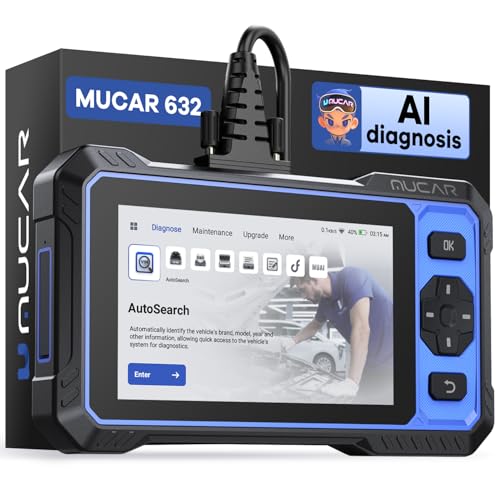
This is the mandatory first step. Connect an OBD-II scanner to the port under your dashboard. Record all the codes the vehicle has stored. A code for a specific sensor (e.g., P0135 for an Oxygen Sensor Heater Circuit) likely points to a bad sensor, not a bad ECM. However, a flood of random, unrelated codes or “U-codes” (which indicate communication errors between modules) is a strong indicator of an ECM problem. -
Perform a Thorough Visual Inspection
Carefully examine the ECM and its wiring harness. Look for any obvious signs of damage, such as frayed or melted wires, green or white corrosion on the connector pins, or physical damage to the ECM’s case. A loose connector can also cause a host of intermittent issues. -
Check Power and Ground Connections
Using a multimeter and a wiring diagram for your specific vehicle, verify that the ECM is receiving the correct voltage (typically 12V) and has a solid, clean ground connection. A poor ground or intermittent power supply is a very common issue that perfectly mimics a failing ECM. -
Analyze the Data and Rule Out Other Components
If the power and grounds are good, but you still have communication codes or symptoms persist, the likelihood of a faulty ECM increases. At this stage, advanced diagnostics might involve testing the signal from individual sensors to see if they are sending correct data to the ECM. If all sensors and wiring test good, the ECM itself becomes the primary suspect.
FAQs About what is the emc on a car
How much does it cost to replace a car computer?
The cost to replace an engine control module typically ranges from $500 to over $2,500. The price varies widely based on the vehicle’s make and model, with parts for luxury or European cars costing significantly more. The total cost includes the price of the ECM itself (new or refurbished) and 1-2 hours of labor for installation and programming.
Can a car run without an ECM?
No, a modern car with electronic fuel injection cannot run without a functioning ECM. The ECM is essential for controlling the fuel injectors, spark plugs, and other critical engine components. Without it, the engine will not receive the necessary inputs to start or continue running.
Where is the ECM located in a car?
The ECM is typically located in the engine bay, inside the passenger cabin, or under a seat. Common locations include near the battery, under the dashboard on the passenger side, or behind the glove box. Its exact location varies by manufacturer and model, so consulting a factory service manual is the best way to find it.
Can a car computer be repaired?
Yes, in many cases, an ECM can be repaired by a specialized electronics repair service. This is often a more cost-effective option than buying a new unit, especially for common failures like bad capacitors or solder joints. Repairing is a good alternative to consider, with costs often falling between $200 and $600.
Does a car ECM need programming?
Yes, almost all modern ECMs, whether new or used, require programming to the specific vehicle. This process, often called “flashing,” syncs the ECM with the car’s Vehicle Identification Number (VIN) and specific options. Without proper programming, the vehicle will not start or run correctly.
Can a bad battery ruin an ECM?
Yes, a bad battery can indirectly damage an ECM. While a simple dead battery is harmless, a failing battery that provides unstable voltage or a faulty alternator that creates voltage spikes can overload and destroy the ECM’s sensitive internal circuits. This is why maintaining a healthy electrical system is crucial.
Will a bad ECM always throw a code?
Not always, but it is very common for a failing ECM to generate Diagnostic Trouble Codes (DTCs). A faulty ECM might set codes for sensors it can’t communicate with (U-codes) or multiple, unrelated component codes. In rare cases of complete failure, it may not be able to communicate with a scanner at all.
What is the difference between ECU and ECM?
In most contexts, there is no functional difference; the terms are used interchangeably. ECM (Engine Control Module) is a more specific term, while ECU (Engine Control Unit) is more general and can refer to any electronic controller in the car (like for airbags or ABS). However, most people use both terms to mean the engine’s main computer.
Can I drive with a faulty ECM?
It is strongly discouraged to drive with a faulty ECM. Depending on the nature of the fault, you could experience anything from poor performance and fuel economy to sudden stalling, which is a major safety hazard. If the car enters “limp home mode,” you should only drive it directly to a repair shop.
Is there a fuse for the car’s computer?
Yes, the ECM is protected by one or more fuses in the vehicle’s fuse box. A blown ECM fuse is a common reason a car won’t start and should be one of the first things you check when diagnosing a “dead” ECM. The fuse location can be found in your owner’s manual or on the fuse box cover.
Key Takeaways: ECM & EMC Summary
- ‘EMC’ is likely ECM: The term you’re searching for is almost certainly the Engine Control Module (ECM), your car’s main “brain”, not EMC.
- ECM Manages the Engine: The ECM’s core functions are to control the air-fuel mixture, ignition timing, and emissions systems by processing data from dozens of sensors.
- Symptoms are a Warning: A Check Engine Light, engine stalling, poor performance, and a car that won’t start are all classic symptoms of a potential ECM failure.
- Failure Has Common Causes: Most ECMs fail due to electrical issues like voltage spikes, moisture intrusion causing corrosion, or damage from excessive heat and vibration.
- Diagnosis Starts with a Scan: Troubleshooting an ECM should always begin with an OBD-II scanner to read fault codes before condemning the unit itself.
- EMC is a Separate Concept: True Electromagnetic Compatibility (EMC) is a critical engineering standard that prevents a car’s electronics from interfering with each other, a completely different topic from the ECM component.
- Replacement Requires Programming: A new or used ECM must be professionally programmed or “flashed” to your car’s specific VIN to function correctly.
Final Thoughts on Your Car’s Engine Control Module
Understanding your car’s Engine Control Module is empowering. You started with a simple question about a confusing acronym, “EMC,” and have now journeyed through the core of modern automotive technology. You now know that the ECM is the true “brain” of your vehicle, orchestrating everything from fuel economy to engine power.
More importantly, you’re equipped with the knowledge to recognize the symptoms of a potential failure, understand why it happens, and approach diagnostics with a logical, step-by-step process. By demystifying the difference between the ECM component and the EMC engineering principle, you’ve gained a level of expertise that few drivers possess. This knowledge puts you in control, helping you have more informed conversations with technicians and make smarter decisions about your vehicle’s health.
Last update on 2026-01-25 / Affiliate links / Images from Amazon Product Advertising API


