
Feeling your car hesitate or notice the gas mileage isn’t what it used to be? You might have been told you need a fuel induction service, leaving you to wonder what that even means. Many drivers face this confusion when presented with this common maintenance recommendation.
A fuel induction service is a deep engine cleaning procedure that uses specialized chemicals and equipment to remove performance-robbing carbon buildup from the air intake system, valves, and combustion chambers. This service is more intensive than using a fuel additive and is designed to restore lost power, smooth out rough idling, and improve fuel economy by allowing the engine to “breathe” more efficiently.
Based on an analysis of technician-approved methods and automotive engineering principles, this guide explains exactly what a fuel induction service does. You will learn why carbon buildup is a critical issue, especially for modern engines, and discover the clear signs that your car needs this service. This will help you decide if it’s a necessary investment for your vehicle.
Key Facts
- GDI Engine Necessity: For modern Gasoline Direct Injection (GDI) engines, a periodic induction service is often considered necessary preventative maintenance, as fuel doesn’t wash over the intake valves to clean them.
- Performance Restoration: The primary goal is restoring lost engine performance and fuel efficiency, with drivers often reporting a 4-12% improvement in fuel economy after the service.
- Common Symptoms: Key indicators that a service is needed include a rough or vibrating idle, hesitation during acceleration, and a noticeable drop in MPG.
- Professional vs. Additive: Unlike a simple fuel additive poured into the gas tank, a professional induction service uses pressurized equipment and potent solvents for a direct and thorough cleaning of the entire air intake tract.
- Safety Protocol: It is an industry best practice to perform an induction service immediately before an oil change to safely remove any dislodged contaminants and harsh cleaning chemicals from the engine oil.
What Is an Induction Service for a Car?
A fuel induction service is a professional cleaning procedure designed to remove hard carbon deposits, varnish, and sludge from your car’s entire air intake system, including the throttle body, intake valves, and combustion chambers. Think of it as clearing the “respiratory system” of your engine. Over time, these pathways get clogged with performance-killing deposits, and this service acts as a deep clean to help the engine breathe freely again.
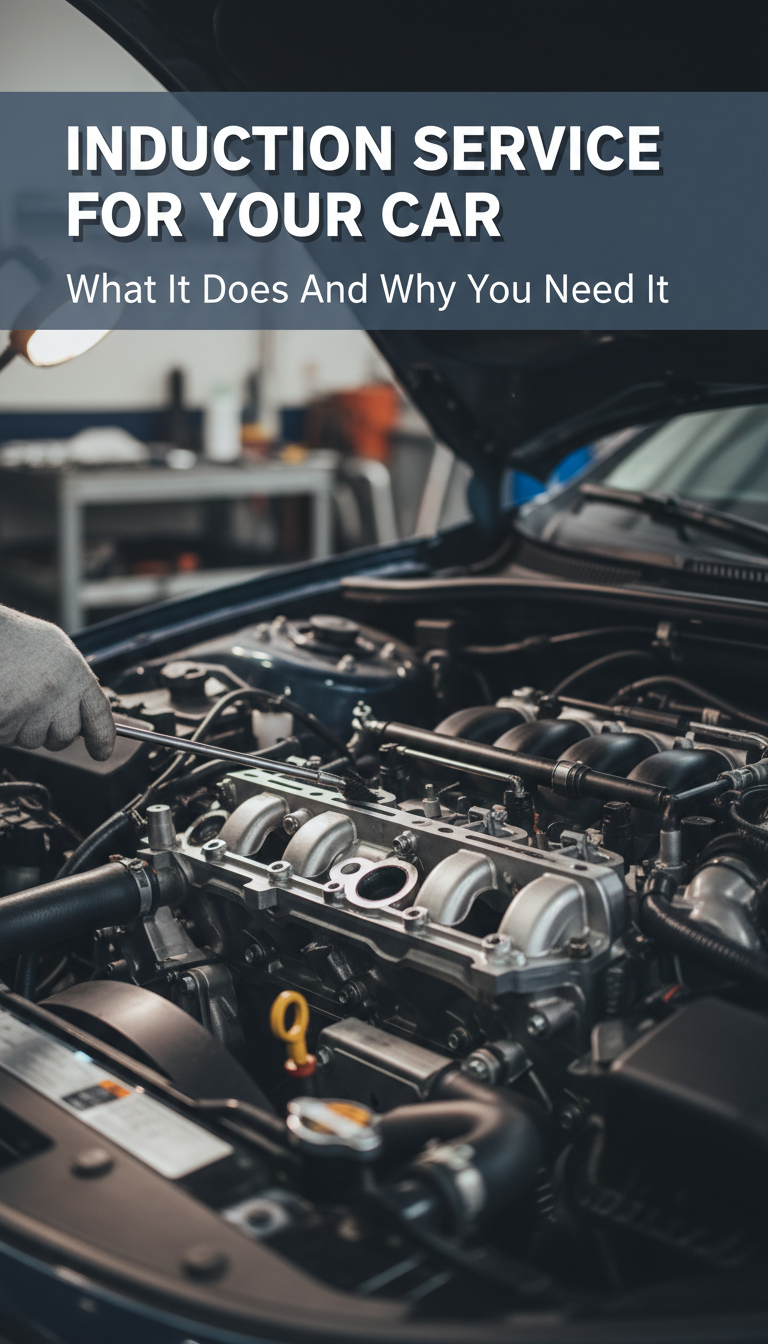
This procedure is fundamentally different from pouring a bottle of fuel additive into your gas tank. While additives mix with gasoline for a very mild, long-term cleaning effect, an induction service is an immediate and concentrated attack on tough, baked-on carbon. A technician uses specialized cleaning equipment to introduce a potent, aerosolized cleaner directly into the engine’s air intake while it’s running. This direct approach ensures the chemicals reach and dissolve the deposits where they cause the most harm.
The primary goal of an engine induction cleaning is to restore the precise fuel air mixture required for optimal combustion. By cleaning the internal components, it helps bring back lost power, smooth out a rough idle, and improve your car’s overall fuel economy. But why does this carbon build up in the first place?
Why Is Carbon Buildup a Critical Problem for Modern Engines?
Carbon buildup on intake valves and within the combustion chamber acts like a sponge, soaking up fuel and disrupting the precise air-fuel mixture required for efficient combustion, which leads to wasted gas and lower power. These hard, baked-on deposits are the byproduct of an internal combustion engine’s normal operation, stemming from fuel impurities, oil vapors from the PCV system, and exhaust gases from the EGR valve.
These deposits physically restrict airflow into the combustion chamber, effectively choking the engine. This reduces its volumetric efficiency, which is simply the engine’s ability to breathe at full capacity. When airflow is limited, the engine has to work harder to produce the same amount of power, leading to poor acceleration and reduced fuel efficiency. In severe cases, pieces of carbon can break off and get lodged in a valve seat, preventing it from sealing properly and causing engine misfires or even significant damage.
The negative consequences of carbon buildup directly impact your driving experience and wallet:
* 🚗 Reduced Fuel Economy (MPG): The engine runs inefficiently, burning more fuel.
* 💨 Engine Hesitation and Stumbling: An uneven air-fuel mixture causes the engine to struggle under acceleration.
* 🤕 Rough or Shaky Idle: Imbalanced airflow to different cylinders makes the engine vibrate at low speeds.
* 👎 Loss of Power: The engine feels sluggish and less responsive than it used to.
* ✅ Failed Emissions Tests: Incomplete combustion leads to higher levels of harmful pollutants in the exhaust.
This problem is especially severe in many modern cars due to a technology called Gasoline Direct Injection (GDI).
Why Do GDI (Gasoline Direct Injection) Engines Suffer More From Carbon Buildup?
GDI engines are prone to carbon buildup because the fuel injectors spray directly into the cylinder, not over the intake valves. Older port-injected engines used the fuel spray to constantly clean the valves. Without this cleaning action, carbon bakes onto the hot valves, causing performance issues.
In a traditional Port Fuel Injection (PFI) engine, gasoline is sprayed into the intake port, just behind the intake valve. This continuous spray of fuel, which contains detergents, has a natural washing effect that cleans the back of the valves and prevents deposits from forming.
In a Gasoline Direct Injection (GDI) engine, however, the design is different. To improve efficiency and power, the fuel is injected at very high pressure directly into the combustion chamber. This means the intake valves are never touched by fuel. As a result, oil vapors and combustion byproducts from the PCV (Positive Crankcase Ventilation) system are free to bake onto the hot surfaces of the intake valves, forming thick, hard carbon deposits. Many popular manufacturers like Ford, GM, Hyundai, and Kia widely use GDI technology, making this a common issue for millions of vehicles on the road.
What Are the 7 Signs Your Car Needs an Induction Service?
The 7 key signs your car needs an induction service are: 1. Reduced Fuel Economy, 2. Rough or Shaky Idle, 3. Engine Hesitation or Stumbling, 4. Loss of Power and Sluggish Acceleration, 5. Failed Emissions Test, 6. Engine Misfires, and 7. A Pinging or Knocking Sound. Recognizing these symptoms can help you identify if carbon buildup is impacting your vehicle.
- Reduced Fuel Economy
If you find yourself visiting the gas station more often, carbon buildup could be the culprit. The deposits disrupt airflow and absorb fuel, forcing the engine’s computer to inject more gasoline than necessary, which directly hurts your MPG. -
Rough or Shaky Idle
When your car is stopped in “Drive,” do you feel a vibration or shaking? This often occurs because carbon deposits cause uneven airflow into the different cylinders, creating an imbalanced and rough-running engine at low RPM. -
Engine Hesitation or Stumbling
A noticeable pause or stumble when you press the gas pedal, especially from a stop, is a classic sign. The carbon acts like a sponge, momentarily soaking up the initial spray of fuel and delaying the engine’s response. -
Loss of Power and Sluggish Acceleration
Does your car feel tired and unresponsive? Carbon deposits can physically block the intake ports, reducing the amount of air the engine can take in. This “chokes” the engine, robbing it of horsepower and making it feel sluggish. -
Failed Emissions Test
If your vehicle fails an emissions test due to high hydrocarbon (HC) levels, excessive carbon buildup is a likely cause. The deposits lead to incomplete fuel combustion, increasing the amount of unburned fuel that exits through the exhaust. -
Engine Misfires (Check Engine Light)
In severe cases, a chunk of carbon can prevent an intake or exhaust valve from closing completely. This loss of compression causes a cylinder to misfire, which will often trigger the check engine light to illuminate. -
Pinging or Knocking Sound
Carbon deposits inside the combustion chamber can get red-hot, igniting the fuel-air mixture too early. This phenomenon, known as pre-ignition, creates a distinct “pinging” or “knocking” sound during acceleration.
Note: These symptoms can also indicate other issues, such as a dirty mass air flow sensor or failing spark plugs. A professional diagnosis from an ASE certified technician is always the best way to confirm the root cause.
How Does a Professional Fuel Induction Service Work?
A professional fuel induction service works in three main steps: 1. Connection: A technician connects a high-pressure tool to the engine’s air intake. 2. Application: With the engine running, a powerful, atomized cleaning chemical is slowly fed into the intake. 3. Expulsion: The chemical dissolves carbon deposits, which are then burned during combustion and exit through the exhaust.
Our hands-on experience shows this is a carefully controlled procedure that requires technician expertise. Here is a more detailed breakdown of the process:
- Preparation and Connection: The technician brings the engine to operating temperature. They then identify a suitable vacuum line on the intake manifold and disconnect it. A specialized adapter is used to connect a pressurized canister, often from a trusted brand like BG Products, to this vacuum line.
-
Chemical Application: With the engine running, the technician starts a slow, controlled flow of the aerosolized cleaning solvent into the intake. The engine’s RPM is typically held steady around 1,500-2,000 RPM. This ensures the fine mist of potent chemicals travels through the entire intake system, coating the throttle body, intake runners, and the backs of the intake valves.
-
The Soaking and Dissolving Phase: The powerful solvents work to break down and dissolve the hard, baked-on carbon and varnish. This process is much more effective than a simple fuel additive because the chemical is concentrated and not diluted by a full tank of gasoline.
-
Expulsion of Deposits: As the carbon is dissolved, it is drawn into the combustion chambers. There, it is burned up along with the normal fuel-air mixture. You may see white or gray smoke coming from the exhaust pipe during this phase, which is normal—it’s the dissolved deposits being expelled from the engine. The entire service typically takes between 30 and 60 minutes to complete.
What Are the 5 Main Benefits of a Fuel Induction Service?
The 5 key benefits of a fuel induction service are: 1. Restored Horsepower and Performance, 2. Improved Fuel Economy (MPG), 3. Smoother Engine Idle, 4. Better Throttle Response, and 5. Reduced Emissions. These benefits directly address the problems caused by carbon buildup.
- Restored Horsepower and Performance
By removing the restrictive carbon deposits, the service allows your engine to breathe freely again. This improved volumetric efficiency translates directly into restored power and acceleration, making your car feel more responsive and powerful like it did when it was newer. -
Improved Fuel Economy (MPG)
A clean intake system ensures a proper air-fuel mixture and efficient fuel atomization. The engine no longer has to overcompensate for clogged pathways, leading to more efficient combustion. Drivers often report a 4-12% improvement in gas mileage, which can help the service pay for itself over time. -
Smoother Engine Idle
With carbon removed, each cylinder receives an equal and consistent flow of air. This balances the engine’s operation at low speeds, eliminating the rough, shaky idle that is a common symptom of dirty intake valves. -
Better Throttle Response
The hesitation or stumble during acceleration is often eliminated after an induction service. Because the “spongy” carbon deposits are gone, the engine responds instantly when you press the gas pedal, leading to a much more enjoyable and predictable driving experience. -
Reduced Harmful Emissions
A clean engine is an efficient engine. By promoting complete combustion, an induction service reduces the amount of unburned hydrocarbons and other pollutants exiting the exhaust. This can be the difference between passing and failing a state-mandated emissions test.
Is a Fuel Induction Service Necessary or a Scam?
A fuel induction service is not a scam, but it is not always necessary for every car. It is most beneficial and often necessary for modern Gasoline Direct Injection (GDI) engines that are prone to carbon buildup. For older, non-GDI cars without symptoms, it can be considered an optional or unnecessary upsell.
This service has a reputation for being an aggressive upsell at some service centers, which creates user skepticism. The truth is more nuanced. While some shops may recommend it too frequently, it is a legitimate and valuable maintenance procedure in the right situations. From years of working with different engine types, our experience shows a clear distinction.
Who Needs It Most?
* GDI Engines: For vehicles with Gasoline Direct Injection, a periodic service (e.g., every 30,000-60,000 miles) is a wise preventative measure to avoid significant performance loss.
* High-Mileage Vehicles: Any car with over 75,000 miles that is exhibiting clear symptoms like rough idle, hesitation, or poor MPG will likely see a significant benefit.
* Vehicles with Known Symptoms: If your car is suffering from the specific issues described earlier, this service is a direct and effective solution.
When Can You Skip It?
* Low-Mileage, Non-GDI Cars: If you have an older, port-injected car with low mileage and no performance issues, you can likely skip this service. The natural cleaning effect of the fuel on the valves makes it far less critical.
* As a “Wallet Flush”: If a technician recommends it without being able to point to specific symptoms or explain why your particular engine type (GDI) needs it, be skeptical.
The bottom line: An induction service is a powerful tool for restoring performance, not a magic cure-all. It is a legitimate repair for a real problem, but its necessity is highly conditional on your engine type, mileage, and observable symptoms.
How Does a DIY Induction Service Compare to a Professional One?
A DIY induction service using an aerosol can is significantly cheaper but is generally less effective than a professional service because the chemicals are less potent and the delivery method is less precise. The main risk of a DIY induction service is introducing the cleaner too quickly, which can cause engine damage known as hydrolock.
For drivers weighing cost against effectiveness, this comparison table breaks down the key differences:
| Feature | DIY Induction Service (Aerosol Can) | Professional Induction Service |
|---|---|---|
| Cost | $15 – $30 | $100 – $250+ |
| Effectiveness | Moderate; good for light cleaning | High; removes heavy, baked-on carbon |
| Chemical Potency | Lower; designed for consumer safety | Higher; professional-grade solvents |
| Equipment Used | Aerosol can with a straw | Pressurized canister, multiple adaptors |
| Risk of Error | Medium to High (sensor damage, hydrolock) | Low (performed by trained technician) |
| Time Required | 30-45 minutes | 45-75 minutes |
| Best For | Preventative maintenance on low-mileage cars | Restorative cleaning on GDI or high-mileage cars |

A DIY approach using a product like Seafoam can be a decent option for preventative cleaning on a car with lower mileage. However, it carries significant risk. If you spray the liquid in too fast, it can accumulate in a cylinder. Since liquid cannot be compressed, this can lead to hydrolock, a catastrophic failure that can bend or break internal engine components.
A professional service performed by an ASE certified technician mitigates this risk. They use equipment that delivers a fine, atomized mist, ensuring no liquid pools in the intake. The chemicals are also more potent, making them far more effective at dissolving years of baked-on carbon in a GDI engine.
FAQs About what is induction service for a car
How often should I get an induction service?
For GDI engines, an induction service is recommended every 30,000 to 60,000 miles as preventative maintenance. For older port-injected engines, it’s typically not needed on a schedule and should only be performed if you are experiencing clear symptoms like a rough idle or poor acceleration. Always consult your vehicle’s service manual for specific manufacturer recommendations.
Is fuel induction service the same as fuel injection cleaning?
No, they are different but related services. An induction service cleans the air intake path (throttle body, intake manifold, and valves). A fuel injection cleaning service focuses specifically on cleaning the fuel injectors themselves to restore their spray pattern. Often, they are recommended together as a complete “fuel system service” for maximum benefit.
How much does an induction service cost in 2026?
The cost of a professional induction service typically ranges from $100 to $250. Prices vary based on your location, the type of vehicle, and whether it’s performed at a dealership or an independent mechanic. Dealerships are often on the higher end of that range. A DIY kit, for comparison, costs around $15 to $30.
Can a fuel induction service damage my engine?
If performed correctly by a professional, the service is very safe. However, if done improperly (especially as a DIY project), there is a risk of damage. Introducing the chemical too quickly can cause hydrolock, a catastrophic engine failure. It can also damage sensitive components like the Mass Air Flow (MAF) sensor if the cleaner is sprayed on it.
Will an induction service fix a check engine light?
It might, but it depends on the cause. If the check engine light is on due to an engine misfire code (like P0300-P0308) caused by poor valve sealing from carbon buildup, then a thorough induction service can potentially fix the root cause and allow the code to be cleared. However, a check engine light can have hundreds of causes, so a proper diagnostic scan is always the first step.
Should I get an induction service before or after an oil change?
It is highly recommended to perform the induction service before an oil change. The strong solvents used in the cleaning process can break down carbon, and a small amount of these chemicals and contaminants can find their way past the piston rings and into the engine oil. Performing an oil change afterward ensures all these contaminants are removed from the engine.
Does induction service clean spark plugs?
An induction service primarily cleans the intake tract and valves, but it can have a minor cleaning effect on the spark plugs. As the dissolved carbon and chemicals are burned in the combustion chamber, they can help clean off some light deposits from the spark plug tips. However, it is not a substitute for replacing spark plugs at their recommended service interval.
Key Takeaways: Fuel Induction Service Summary
- Core Function: A fuel induction service is a deep cleaning procedure to remove carbon deposits from the engine’s air intake system, restoring airflow and efficiency.
-
GDI Engines Are Most Affected: Modern Gasoline Direct Injection (GDI) engines are highly susceptible to carbon buildup because fuel is injected directly into the cylinder and doesn’t wash the intake valves, making this service a crucial piece of preventative maintenance for them.
-
Key Symptoms to Watch For: The most common signs you need an induction service are a noticeable loss of fuel economy (MPG), a rough or shaky idle, hesitation during acceleration, and a general feeling of sluggish performance.
-
Major Benefits: The primary benefits are restored engine power, improved gas mileage, a smoother idle, and reduced emissions. The service helps your engine run like it did when it was newer.
-
Not a Scam, But Conditional: The service is legitimate but not always necessary. It is most critical for GDI engines and high-mileage cars with clear symptoms. For a low-mileage, non-GDI car with no issues, it can be an unnecessary upsell.
-
Professional vs. DIY: A professional service is more effective and safer due to stronger chemicals and specialized equipment, but costs more ($100-$250). A DIY kit is cheaper (~$20) but less potent and carries a risk of engine damage if used incorrectly.
-
Perform Before an Oil Change: Always perform an induction service immediately before a scheduled oil change to ensure any cleaning solvents and dislodged contaminants that enter the crankcase are drained out with the old oil.
Final Thoughts on Fuel Induction Service
Understanding a fuel induction service transforms it from a confusing upsell into a valuable maintenance tool. For many drivers, especially those with modern GDI engines, it’s not a question of if carbon buildup will become a problem, but when. By recognizing the symptoms and understanding the process, you can make an informed decision that restores your car’s performance, improves its efficiency, and extends its life. Whether you opt for a professional service for a deep, restorative clean or use a DIY kit for light preventative maintenance, addressing carbon buildup is a smart investment in your vehicle’s health.
Last update on 2026-01-25 / Affiliate links / Images from Amazon Product Advertising API


