Ever wonder what is considered a muscle car, truly? You’ve heard the term thrown around, but the line between a muscle car, a sports car, and a pony car seems blurry, sparking endless debates among enthusiasts.
A muscle car is traditionally defined as a mid-size, American-made, two-door car featuring a large-displacement V8 engine and rear-wheel drive, designed for high-performance straight-line speed at an affordable price. This distinguishes it from sports cars, which prioritize handling, and pony cars, which are more compact.
Based on an analysis of American automotive heritage and industry standards, this guide provides the definitive criteria to end the confusion. You will discover the exact formula that separates a true American production car built for power from all the pretenders, allowing you to classify any high-performance vehicle with expert confidence.
Key Facts
- The First True Muscle Car: While the 1949 Oldsmobile Rocket 88 was a predecessor, the 1964 Pontiac GTO is widely credited as the first true muscle car, establishing the formula of placing a large V8 into a mid-size car.
- The “Big Three” Dominance: The muscle car phenomenon was driven almost exclusively by America’s “Big Three” manufacturers: General Motors (GM), Ford Motor Company, and Chrysler (Mopar), who competed for performance supremacy.
- Engine Philosophy: The core principle was “no replacement for displacement,” meaning power came from a large V8 engine, making engine size the most critical defining attribute of the classic era.
- Category Distinction is Crucial: A Ford Mustang is not a muscle car; it is a “pony car,” a smaller, more stylish category it created. This distinction is a key piece of automotive classification.
- End of an Era: The classic muscle car era largely concluded by the early 1970s due to the 1973 oil crisis, stricter emissions regulations, and soaring insurance costs for high-performance vehicles.
What Is Considered a Muscle Car? The Definitive Criteria
A muscle car is a high-performance vehicle born from a simple and effective formula: place the largest possible V8 engine into a mid-size, two-door, rear-wheel-drive American car. This category emerged from the unique optimism and engineering focus of the post-war American auto industry. The primary goal was not balanced performance or track-day agility; it was the pursuit of maximum straight-line acceleration, made accessible to the average buyer. This focus on affordable, brute-force power is what separates it from every other type of performance coupe.
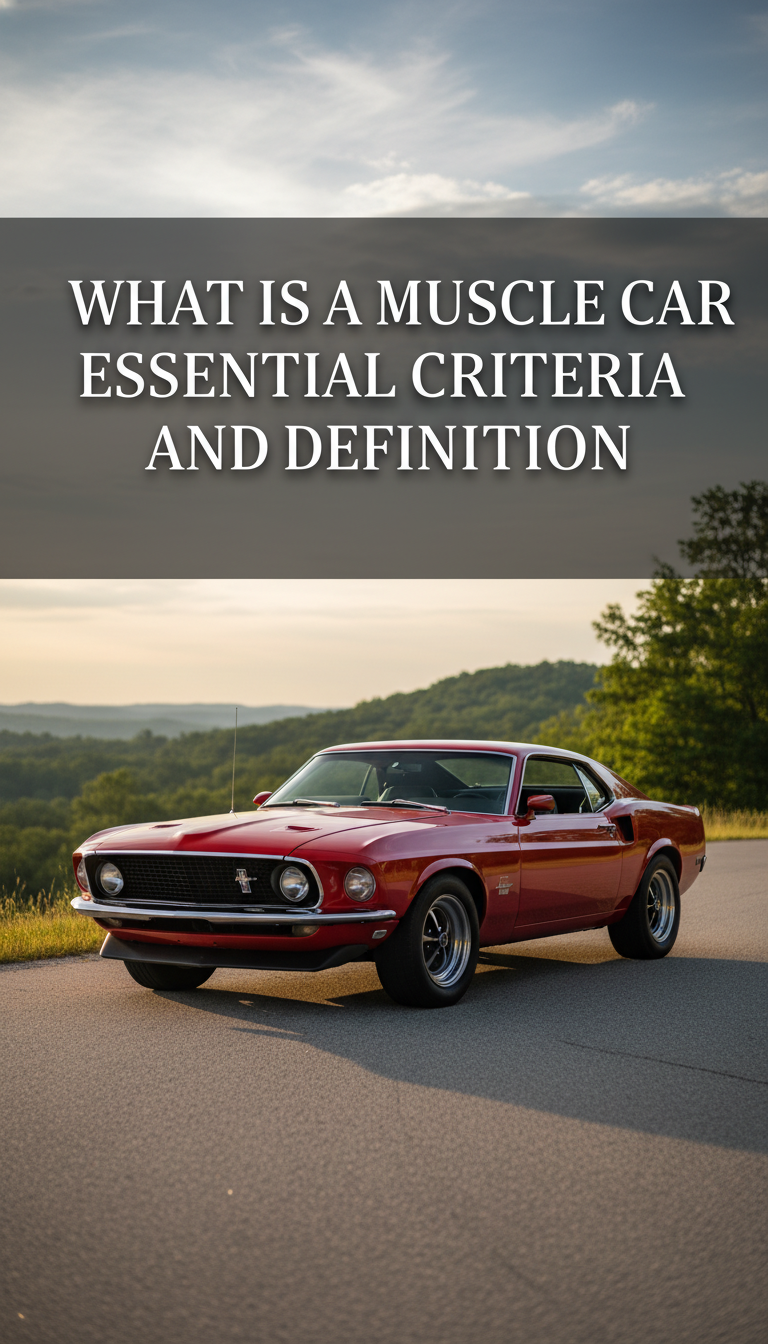
This vehicle classification is deeply rooted in American car history. Understanding its definition requires looking beyond horsepower figures and examining a specific set of rules that defined an entire generation of automotive engineering and car culture. These cars were not just machines; they were cultural symbols of power and freedom on the open road.
But what specific, verifiable traits separate a true muscle car from the pretenders? Let’s break down the essential criteria that automotive experts use for classification.
What Are The 5 Essential Criteria of a True Muscle Car?
To move beyond gut feelings and into expert classification, you need a clear set of rules. From years of analyzing manufacturer specifications and historical data, automotive experts agree on five non-negotiable criteria for the classic muscle car. Think of this as the definitive checklist to identify a real piece of American iron.
1. Why Must It Be an American Manufacturer?
The term ‘muscle car’ specifically refers to vehicles from American manufacturers because it describes a uniquely American automotive phenomenon. The category is intrinsically tied to the market conditions and engineering battles of the post-war Detroit auto industry. The entire concept was born from the fierce competition between the “Big Three” and a few other domestic players.
These key manufacturers defined the era:
* General Motors (Chevrolet, Pontiac, Oldsmobile, Buick)
* Ford Motor Company (Ford, Mercury)
* Chrysler Corporation (Dodge, Plymouth), known as Mopar
* American Motors Corporation (AMC)
While other countries produced powerful cars, they don’t fit the muscle car formula, which is as much a cultural definition as a technical one. The identity is rooted in American-made production cars.
2. Why Is a Mid-Size, 2-Door Body Required?
Classic muscle cars were based on mid-size platforms to maximize the power-to-weight ratio, a core part of the performance formula. The strategy was simple but effective: take a heavy, powerful engine from a full-size car and drop it into a lighter mid-size frame (like a Chevrolet Chevelle or Dodge Coronet). This created explosive acceleration that a heavier, full-size sedan couldn’t match.
The two-door coupe or hardtop body style was essential for several reasons. It projected a sporty, aggressive image that appealed to the target demographic of young buyers. It also offered better structural rigidity than a four-door sedan, which was beneficial for handling the torque of a big engine. While modern interpretations have challenged this, for the classic era, a two-door body is a requirement.
3. What Is the Significance of Rear-Wheel Drive (RWD)?
Rear-wheel drive (RWD) was a crucial muscle car characteristic because it was the most effective drivetrain layout of the era for handling immense torque and providing maximum traction. During a hard launch, the car’s weight naturally shifts to the back. In a RWD car, this weight transfer pushes the rear tires into the pavement, increasing grip and launching the car forward with more force. This is the fundamental physics behind drag racing performance.
This RWD setup, often paired with a simple and robust solid rear axle, was also responsible for the iconic tire-smoking burnouts that became synonymous with muscle car culture. A front-wheel-drive car simply cannot replicate this performance dynamic, making RWD a foundational engineering requirement.
4. Why Is a Large-Displacement V8 Engine the Heart of the Muscle Car?
The large-displacement V8 engine is the heart of the muscle car, reflecting the era’s engineering philosophy that raw power and high torque came directly from engine size. The mantra was “there’s no replacement for displacement.” For a classic car to be considered a muscle car, a V8 isn’t just an option; it’s the defining feature. This is why a V6-powered car from that period cannot be a true muscle car.
Understanding the engine requires knowing a few key terms:
* Cubic Inch Displacement (CID): This measures the engine’s size. More cubic inches meant more room for air and fuel, resulting in a more powerful explosion and more horsepower.
* Big Block: These were the largest, heaviest, and most powerful V8 engines, like the 454-CID Chevy or the 426-CID Chrysler Hemi. They were the top-tier powerplants.
* Small Block: These were lighter V8 engines that were still very powerful but generally offered a better balance of power and weight.
For instance, the legendary 426 Hemi V8 from Chrysler was a 7.0-liter engine that dominated both the street and the drag strip, cementing the V8’s place as the soul of the machine.
5. What Was the Role of “Affordable Performance”?
Affordable performance was a key criterion that made muscle cars a cultural phenomenon, distinguishing them from expensive, elite sports cars. Unlike a European exotic car that cost a fortune, a muscle car was designed to deliver incredible “bang-for-the-buck.” Manufacturers achieved this by building them on existing mid-size family car platforms, which kept production costs low.
Often, a buyer could walk into a dealership and order a basic, no-frills trim level with very few options but specify the most powerful V8 engine available. This democratic approach to speed put incredible power within reach of the average young person. A potent muscle car in the late 1960s could be purchased for under $3,000, while a Ferrari cost far more.
What Is The Difference Between a Muscle Car, a Sports Car, and a Pony Car?
The core differences between muscle cars, sports cars, and pony cars can be summarized by their design philosophy, engineering priorities, and typical size. This is one of the most common areas of confusion for enthusiasts. Using the criteria we’ve established, we can draw clear lines between these categories.
A muscle car is a heavyweight boxer, built for a knockout punch in a straight line. A sports car is a nimble martial artist, focused on balance, agility, and technique. A pony car is the popular welterweight, stylish and athletic, offering a taste of performance in a more compact and accessible package.
This is why a Chevrolet Corvette, with its purpose-built chassis and focus on handling, is a true sports car, not a muscle car. The table below breaks down the definitive differences.
| Feature / Aspect | Muscle Car | Sports Car | Pony Car |
|---|---|---|---|
| Primary Philosophy | Brute force; straight-line speed | Balance; handling and agility | Style and affordable performance |
| Chassis Origin | Mid-size sedan platform | Often a purpose-built chassis | Compact car platform |
| Engine Focus | Large-displacement V8 (Big Block) | High-revving, balanced V8, V6, or I6 | Small-block V8 or smaller (V6, I4) |
| Handling | Secondary concern; often heavy | Primary focus; nimble and precise | Good balance; better than muscle cars |
| Key Metric | Quarter-mile time; 0-60 mph | Lap times; braking distance | Sales volume; customization options |
| Classic Example | Pontiac GTO, Chevrolet Chevelle | Chevrolet Corvette, Porsche 911 | Ford Mustang, Chevrolet Camaro |
How Do You Identify If a Specific Car Is a Muscle Car? (A Quick Checklist)
Now that you have the rules, let’s apply them. This section acts as a practical guide to settle the most common debates you’ll hear at car shows or online. We’ll take the most frequently disputed models and run them through our five-point checklist to deliver a final verdict.
So, Is a Ford Mustang a Muscle Car?
Verdict: Pony Car. A Ford Mustang is the original pony car. It was built on a smaller compact platform (from the Ford Falcon) and marketed for its style and affordability. While high-performance versions like the Boss 429 had a massive muscle car engine, they were put in a pony car body, creating a legendary hybrid. The Mustang’s smaller size and different chassis origin mean it created its own category rather than joining the mid-size muscle car class.
What About the Chevrolet Corvette?
Verdict: Sports Car. The Chevrolet Corvette has always been America’s quintessential sports car. It features a two-seat layout, a lightweight fiberglass body, a purpose-built chassis, and a design philosophy that has always prioritized balanced handling and aerodynamics. If a muscle car is a heavyweight boxer, a Corvette is a nimble martial artist. It does not meet the “mid-size sedan platform” criterion and its primary goal is cornering, not just straight-line speed.
Is the Modern Dodge Challenger a True Muscle Car?
Verdict: Yes, a Modern Muscle Car. The modern Dodge Challenger is arguably the purest expression of the classic muscle car formula on the road today. It is large, American-made, has rear-wheel drive, and its identity is built around powerful Hemi V8 engine options like the Hellcat. It unabashedly prioritizes horsepower and aggressive, straight-line performance over nimble handling, directly echoing the classic philosophy. Even its 4-door sibling, the Dodge Charger, is widely accepted as a modern muscle car, showing how the “2-door” rule has relaxed over time.
FAQs About what is considered a muscle car
What was the first muscle car ever made?
The 1964 Pontiac GTO is widely credited as the first true muscle car, though the 1949 Oldsmobile Rocket 88 is often seen as its spiritual predecessor. The GTO perfected the formula by taking a large 389 cubic-inch V8 from a full-size car and placing it in a lighter, mid-size Tempest frame, then marketing it specifically for its performance.
Why are they called muscle cars?
They are called muscle cars because the name evokes an image of raw power and brute force, directly reflecting the car’s primary trait: its large, powerful V8 engine. The “muscle” is the engine, which demonstrates its strength through overwhelming horsepower and straight-line acceleration, setting it apart from cars built for agility or finesse.
Can a V6 engine be in a muscle car?
For the classic era, the answer is a definitive no; a large-displacement V8 was a non-negotiable criterion. However, the definition has blurred with modern cars. While most enthusiasts maintain a true muscle car requires a V8, base models of the Ford Mustang and Chevrolet Camaro offer potent V6 engines that can outperform many classic V8s.
What is the difference between a muscle car and a hot rod?
A muscle car is a factory-produced performance model, whereas a hot rod is a heavily modified or custom-built car, typically based on a pre-1950s vehicle. You could buy a muscle car with a warranty directly from a manufacturer like Ford or GM. Hot rods are unique creations built by enthusiasts, often by putting a modern engine into a much older, lighter car body.
What horsepower is considered a muscle car?
There is no exact horsepower number; the key is having a disproportionately large and powerful engine for the car’s size and price. In the classic era, this ranged from 300 to over 425 gross horsepower. Today, modern V8 muscle cars typically start around 450 horsepower and can exceed 800 horsepower in high-end models like the Dodge Challenger SRT Hellcat.
Can a sedan be a muscle car?
Traditionally, no; the classic definition strictly requires a two-door coupe body style. However, the modern era has introduced “muscle sedans” like the Dodge Charger. These cars have four doors but otherwise follow the muscle car formula: American-made, rear-wheel drive, and a massive V8 engine. Many now accept these as a modern evolution of the category.
Is a Chevrolet Camaro a muscle car or a pony car?
The Chevrolet Camaro is technically a pony car. It was introduced in 1967 as General Motors’ direct competitor to the Ford Mustang. It shares the same core concept: a compact, stylish body with a long hood, a short rear deck, and a wide range of available engines. High-performance models like the Z/28 have muscle-car-like power but in a pony car package.
Why did the classic muscle car era end?
The classic muscle car era concluded in the early 1970s due to a “perfect storm” of factors. These included the 1973 oil crisis that made gas-guzzling V8s impractical, strict new government emissions regulations from the Clean Air Act, and skyrocketing car insurance premiums that made high-performance vehicles unaffordable for their young target market.
What are the “Big Three” muscle car manufacturers?
The “Big Three” refers to the three largest American automobile manufacturers that dominated the muscle car market: General Motors (GM), Ford Motor Company, and Chrysler (and its Mopar performance division). GM produced icons like the Pontiac GTO and Chevrolet Chevelle, Ford had the Torino, and Mopar created legends like the Dodge Charger and Plymouth Road Runner.
Are muscle cars good for daily driving?
Classic muscle cars are generally poor daily drivers by modern standards. They suffer from low fuel economy, imprecise handling, and a lack of safety features like airbags or anti-lock brakes. Modern muscle cars, however, are far more practical. They are engineered with reliability, comfort, and safety in mind, making them perfectly suitable for daily use if you can afford the fuel.
Final Thoughts on Defining the American Muscle Car
Understanding what is considered a muscle car is about appreciating a specific formula of American engineering, market positioning, and cultural history. It’s more than just horsepower; it’s a celebration of brute force, born from an era of optimism and cheap gasoline. The rules are clear: an American-made, mid-size, RWD car with a big V8 heart, all offered at a price that put incredible power in the hands of the people.
By learning to distinguish a muscle car from a sports car or a pony car, you gain a deeper appreciation for the unique design philosophies that shaped automotive history. While the classic era may be over, its spirit lives on in modern machines that continue to prioritize straight-line thrills above all else. Ultimately, the muscle car is a testament to an era when affordable performance ruled the American road.