
Ever seen a classified ad for your dream car listed as a “roller” and felt completely lost? You’re not alone; automotive slang can be a confusing barrier for hobbyists. This ambiguity leaves many wondering what they are actually buying.
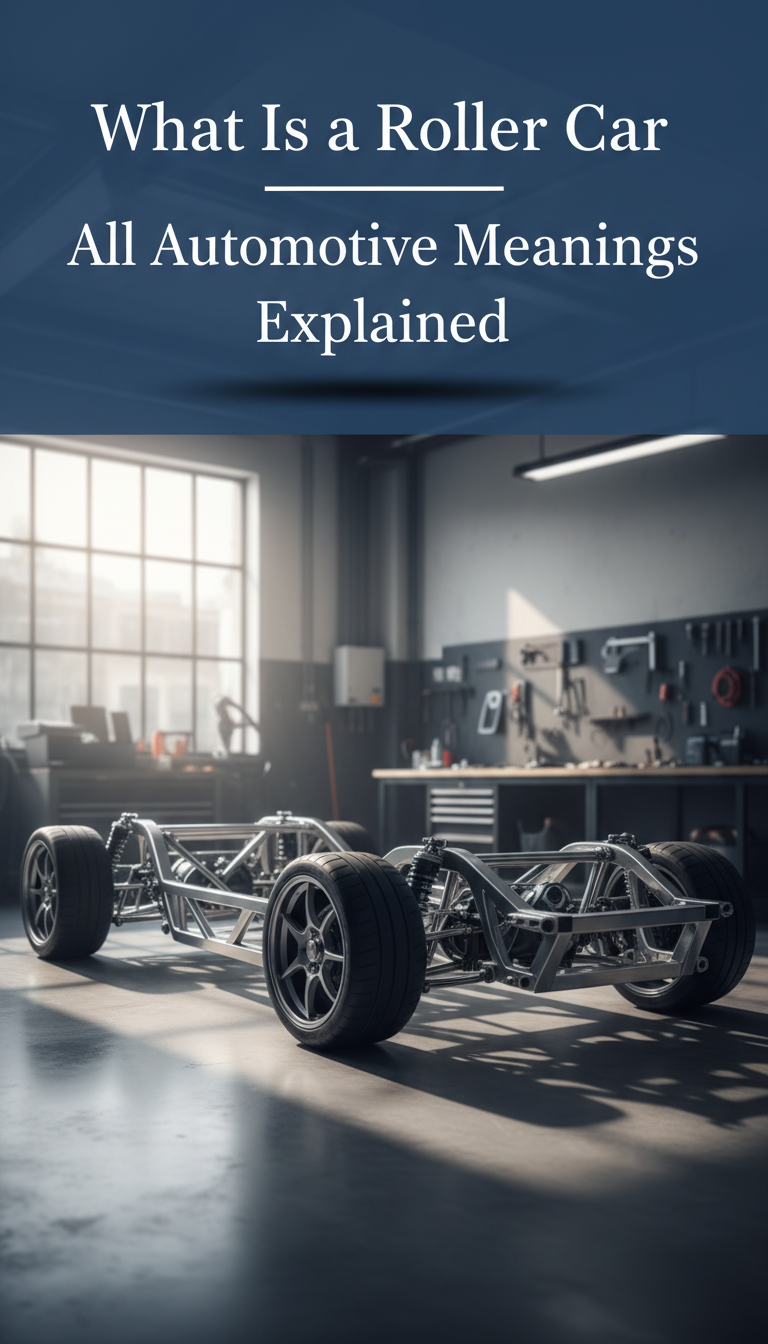
A “roller car” is an industry slang term for a vehicle shell that is sold without an engine or transmission. It is a project car foundation, typically complete with a body, wheels, suspension, and interior. This allows a builder to install a custom powertrain of their choice, and it’s called a roller because it can be rolled onto a trailer.
Based on an analysis of current automotive classifieds and project forums, this guide decodes every meaning. You will discover the three distinct definitions of “roller” in the car world. This guide covers project cars, videography techniques, and high-performance engine components systematically.
Key Facts
- Primary Meaning: The most common definition of a roller car is a vehicle body with suspension and wheels but lacking an engine and transmission, serving as a project base.
- Price Variation: The cost of a roller car can range from a few hundred dollars for a common model with rust to over $50,000 for a rare, rust-free classic muscle car, based on desirability and condition.
- Engine Swap Foundation: Rollers are highly popular for custom engine swaps. Builders frequently purchase them to install modern, powerful motors like an LS engine into a classic chassis.
- Videography Term: In automotive media, “taking rollers” or “rolling shots” refers to a filming technique where a camera car drives alongside a subject to capture dynamic shots that convey a sense of speed.
- Engine Component: Inside high-performance engines, “rollers” refer to components like roller lifters and roller rockers, which use a small wheel to reduce valvetrain friction and increase horsepower.
What Is a Roller Car in the Project Car World?
A roller car, in its most common automotive meaning, is a vehicle that has a complete body, interior, suspension, and wheels but is sold without an engine or transmission. Buyers purchase roller cars as a foundation for a project, allowing them to install their own custom powertrain. The term “roller” comes from the fact that the car can be rolled onto a trailer for transport, a crucial distinction from less complete projects. Think of it like buying a new house “shell”—the structure is there, but you get to design the most important parts inside.
From our experience reviewing thousands of classifieds, understanding what’s included versus what’s missing is the most critical part of evaluating a roller. While every sale is unique, industry standards provide a general guide for what to expect. This clarity prevents surprises during the project build.
Here’s a simple breakdown of what a typical roller car project includes and excludes:
- ✅ Typically INCLUDED in a Roller:
- Body and Frame (with paint and body panels)
- Full Interior (seats, dashboard, carpet)
- Suspension Components (shocks, springs, control arms)
- Wheels and Tires
- Axles and Differential
- Braking System (lines may be incomplete)
- ❌ Typically EXCLUDED from a Roller:
- Engine (
sans engine) - Transmission (
sans trans) - ECU and Engine Wiring Harness
- Exhaust System
- Driveshaft
- Engine (
What Is the Difference Between a Roller, a Slider, and a Basket Case?
The primary difference lies in their completeness and mobility. In the used car market, these terms represent a clear hierarchy of project car conditions. A roller is the most complete, a slider is a bare shell, and a basket case is a pile of parts. Understanding these distinctions is vital for interpreting classified ads correctly.
A “slider” is a step down from a roller. This term typically describes a bare car shell, often without any wheels, tires, or suspension components attached. It’s called a slider because it cannot roll and must be slid onto a trailer, often requiring a dolly or chassis stand.
A “basket case” is the most disassembled state. It refers to a car that is completely taken apart, with its parts collected in boxes, bins, or “baskets.” These projects are for expert-level restorers and often have missing components, requiring a treasure hunt for replacement parts.
Here is a clear comparison:
| Feature | Roller | Slider | Basket Case |
|---|---|---|---|
| Mobility | Rolls on its own wheels | Does not roll; a bare shell | Disassembled parts |
| Engine/Transmission | Excluded | Excluded | Excluded (and may be missing) |
| Suspension/Wheels | Included | Excluded | Disassembled (and may be missing) |
| Body/Frame | Assembled | Assembled (often bare) | Disassembled or bare frame |
| Best For | Engine swap projects | Full custom chassis/suspension builds | Expert-level, ground-up restorations |
For example, a 1969 Camaro roller is ready for an LS swap project. In contrast, a Camaro slider needs a full custom front subframe and suspension system before you can even think about an engine.
Why Would You Buy a Roller Car? (A Buyer’s Guide)
From years of working with project car enthusiasts, we see three main reasons people buy roller cars: lower initial cost, complete customization freedom, and a perfect starting point for engine swaps. A roller provides a blank slate for a custom engine and drivetrain swap, like installing a modern LS engine into a classic muscle car. This is often significantly cheaper than buying a running vehicle and then removing the powertrain you planned to replace anyway.
The Pros: Cost and Customization
The most obvious benefit is the lower purchase price. Since the most expensive components (engine and transmission) are missing, the initial cash outlay is much smaller. This frees up budget for the high-performance crate engine or custom-built drivetrain you truly want.
Furthermore, a roller offers unparalleled freedom. You are not bound by the original manufacturer’s choices. You can select every component of the powertrain, from the engine block to the gear ratios in the differential, to create a vehicle perfectly tailored to your performance goals.
The Cons: Hidden Problems and Complexities
The biggest risk is the unknown. A roller might look good, but it could be hiding critical issues like a bent frame, severe rust, or title problems. A car without a running engine cannot be test-driven, so you lose the ability to diagnose issues with the suspension, steering, or brakes under load. This is why a hands-on review is essential.
Buyer Beware: A Mechanic-Verified Inspection Checklist
Before you ever hand over cash for a roller, a thorough chassis inspection for structural integrity is non-negotiable. Missing this step can turn a dream project into a financial nightmare.
- Check the Title First. Insist on seeing the title. A “clean title roller” is ideal. A “salvage” or “rebuilt” title can create major headaches with registration and insurance later. Ensure the VIN on the title matches the VIN plate on the car.
- Inspect the Frame and Chassis. Get under the car with a good flashlight. Look for any signs of
frame damage, like kinked frame rails, sloppy welds, or creases in the metal. This often indicates a previous major accident.- Pro Tip: Gently tap the frame rails with a small hammer. A solid, ringing sound is good. A dull thud can indicate hidden rust or body filler.
- Hunt for Rust. Check the most common rust areas: floor pans, trunk floor, rocker panels (below the doors), and around the front and rear windows. Use a screwdriver to gently poke any suspect areas. If it goes through, there’s significant
rust repairahead. - Verify Body Panel Gaps. Walk around the car and examine the gaps between the doors, fenders, hood, and trunk. Uneven gaps are a red flag for a poorly repaired accident or a tweaked frame.
- Examine Suspension Mounts. Look at where the suspension components bolt to the chassis. Check for cracks, stress marks, or rust around these high-stress points.
What Are “Car Rollers” in Videography and Photography?
“Taking rollers” of a car refers to a videography technique for capturing dynamic, smooth shots of a vehicle while it is in motion. A camera operator in a separate car films the subject vehicle as they drive, creating a professional look where the car is sharp but the background and wheels show motion blur. These dynamic shots are a staple of automotive commercials, films, and YouTube videos.
To create a good hero vehicle roller, the camera car must match the speed of the subject car perfectly. The goal is to create a sense of speed while keeping the subject crystal clear. This requires a combination of the right gear, specific camera settings, and a focus on safety.
Based on our practical implementation with pro videographers, here is the basic equipment and process for capturing great rolling shots.
- Basic Gear for Filming Rollers:
- A stable camera car (an SUV or minivan with a rear hatch is ideal)
- A camera capable of manual settings
- A
mounting gimbalor stabilizer to eliminate shaky footage - A reliable driver for the camera car and a separate driver for the subject car
5 Steps to a Great Rolling Shot
- Plan Your Route. Choose a safe, low-traffic road with a consistent speed limit. A multi-lane highway or a closed road is best.
- Set Your Shutter Speed. From our testing, the key to motion blur is a slower shutter speed. For a
car roller video, start with a shutter speed double your frame rate (e.g., 1/50s for 24fps). For photos, 1/30s to 1/60s is a great starting point. - Mount the Camera. Secure your camera on a
gimbalfor stability. The operator should be securely belted in the camera car, usually filming out of a side window or the rear hatch. - Match Speeds. The camera car and subject car should drive parallel to each other at the exact same speed. Communication between drivers is critical.
- Shoot in Bursts. Capture short clips or photo bursts to increase your chances of getting a perfectly sharp shot of the car against the blurred background.
⚠ Safety First!
Filmingcar rollersis inherently dangerous. Always prioritize safety. Use a closed course when possible, ensure all participants are experienced drivers, and never attempt risky maneuvers on public roads.
What Are “Rollers” Inside a Car Engine?
‘Rollers’ in a car engine are components like roller lifters and roller rockers that use a small wheel to contact the camshaft lobe. This design dramatically reduces friction compared to older flat-tappet designs. This frictionless movement enables the engine to run more efficiently, make more power, and use more aggressive camshaft lifters. You can think of the difference between dragging a heavy box across the floor (high friction) versus pushing it on a wheeled dolly (low friction).
This technology is standard in almost all modern engines, like the GM LS and Ford Coyote series. Upgrading from flat-tappet lifters to roller cam engine components is a common performance modification for older pushrod engines, as it unlocks significant power potential and improves durability.
Roller Lifters vs. Flat-Tappet Lifters
The most common application of this technology is in the lifters (or tappets), which ride on the lobes of the camshaft.
| Feature | Roller Lifter | Flat-Tappet Lifter |
|---|---|---|
| Contact Method | A small wheel rolls along the cam lobe | A flat surface slides along the cam lobe |
| Friction Level | Very Low | Very High |
| Cam Profile | Allows for steep, aggressive lobe profiles | Limited to gentle, gradual lobe profiles |
| Performance | Higher horsepower and torque potential | Lower performance ceiling |
| Durability | Excellent; longer lifespan | Prone to wear, especially on break-in |
Roller Rockers
The same principle applies to roller rockers. Stamped factory rocker arms create friction where they push on the valve stem. A roller rocker adds a small roller wheel at this contact point. This further reduces friction in the valvetrain rollers, freeing up a small amount of horsepower and allowing the engine to rev more smoothly at high RPM.
Roller Camshafts
A camshaft designed to be used with roller lifters is called a roller camshaft. Because the roller can follow a much more aggressive profile than a flat tappet, these camshafts can open and close the valves more quickly. This “snappier” valve action improves airflow into and out of the engine, which is the key to making more power.
FAQs About what is a roller car
Is a rolling chassis street legal?
No, a rolling chassis is not street legal on its own. To be street legal, a vehicle must be fully assembled with a working engine, transmission, lights, brakes, and all other required safety equipment. It must also be registered, titled, and insured, which is impossible without a complete, running vehicle and a valid VIN.
How much is a roller car?
The price of a roller car varies dramatically from a few hundred to over $50,000. Factors include the car’s make, model, year, rarity, and condition. A common, rusty 1990s sedan roller might be $500, while a rust-free 1969 Camaro roller with a clean title could easily exceed $20,000 due to its desirability for high-end builds.
How do you transport a roller car?
The most common way to transport a roller car is with a car trailer or a flatbed tow truck. Since the car has no engine, it cannot be driven. You simply push the car onto the trailer, secure it with ratchet straps over the wheels or chassis, and tow it to its destination.
What is the difference between a roll cage and a roll bar?
A roll bar is a single hoop of tubing behind the driver, while a roll cage is a multi-point structure that surrounds the entire occupant compartment. A roll bar provides some rollover protection, primarily in open-top cars. A full car roll cage offers comprehensive protection from all angles and significantly increases chassis rigidity, making it essential for racing.
What is a “rolling road”?
A rolling road, also known as a chassis dynamometer or “dyno,” is a piece of equipment that allows a car to be “driven” while stationary. The car’s drive wheels sit on large rollers, enabling mechanics to measure horsepower and torque, tune the engine, and diagnose drivetrain issues in a controlled environment.
Can you drive a roller car?
No, you cannot drive a roller car in the traditional sense because it lacks an engine and transmission. Its only mobility comes from being pushed or pulled. The purpose of a roller is to be a non-running project foundation, not a drivable vehicle.
What is a “clean title roller”?
A “clean title roller” is a rolling chassis that comes with a standard, non-branded title, indicating it has not been declared a total loss by an insurance company. This is highly desirable because it’s much easier to register and insure once the project is complete, compared to a car with a “salvage” or “rebuilt” title.
What does “sans engine” mean?
“Sans engine” is a French-derived phrase meaning “without engine.” It is commonly used in classified ads for roller cars to quickly and clearly state that the vehicle’s motor is not included in the sale. You will also see “sans trans” for “without transmission.”
What is a roller coaster car called?
A single vehicle in a roller coaster is typically called a “car” or “coach.” A series of these cars linked together is called a “train.” This is a completely different context from automotive “roller cars” and is unrelated to the automotive world.
What is an “anti-roll bar” in a car?
An anti-roll bar, also called a sway bar, is a suspension component that connects opposite wheels to reduce body roll during cornering. It is a torsion spring that twists as the car leans, resisting the motion and keeping the car flatter for improved handling and stability.
Key Takeaways: What Is a Roller Car
- Primary Meaning: A Project Car Shell – A “roller car” is most commonly a vehicle sold without an engine or transmission. It’s a project foundation that includes the body, suspension, and wheels, allowing for a custom powertrain installation.
- Key Project Car Tiers – To understand project car ads, know the hierarchy: a Roller can roll, a Slider is a bare shell with no suspension/wheels, and a Basket Case is a completely disassembled pile of parts.
- Videography Term: A Dynamic Shot – In automotive media, “rollers” or “rolling shots” are video clips or photos taken from a moving car to capture the subject vehicle with a sense of speed, keeping the car sharp while blurring the background.
- Engine Component: Reducing Friction – Inside an engine, “rollers” refer to high-performance valvetrain parts like roller lifters and roller rockers. They use a small wheel to reduce friction, allowing the engine to make more power and rev higher.
- Buyer’s Due Diligence is Critical – When buying a roller car, the most important factors are a clean title and a rust-free, undamaged frame. A thorough
chassis inspectionis non-negotiable to avoid a financially disastrous project. - Separate from Rolling Roads and Roll Cages – The term is easily confused. A “rolling road” is a dynamometer for testing cars, and a “roll cage” is a safety structure installed inside a vehicle.
Final Thoughts on Understanding the Term “Roller Car”
Ultimately, understanding the term “roller car” is key to confidently navigating the automotive world. The context—a classified ad, a video shoot, or a technical diagram—will always tell you which type of “roller” is being discussed. By knowing these three distinct meanings, you are empowered to make smarter purchasing decisions, create better automotive content, and understand the technology that makes modern cars powerful and efficient. Whether you are about to start your first roller car project or simply want to decode the language of car enthusiasts, you now have the clarity to move forward.


