
Ever wondered what a Pro Mod car is? You’ve seen these wild machines that look like a street car but launch with ungodly speed, blurring the line between a production vehicle and a pure-bred race car. Many struggle to define this unique class of drag racing.
A Pro Mod (Professional Modified) car is a type of elite drag racing vehicle known as a “doorslammer” because it retains the look of a production car with two working doors. Unlike a street car, it’s built on a custom tube chassis with a lightweight replica body and is powered by an engine producing over 3,000 horsepower, designed exclusively for quarter-mile or eighth-mile racing.
Based on an analysis of current technical regulations and championship-winning data, this guide breaks down the core components of these incredible vehicles. You will discover the specific engineering, staggering performance capabilities, and what separates Pro Mods from every other class on the drag strip.
Key Facts
- Extreme Performance: A competitive Pro Mod car can cover a quarter-mile in the mid-5-second range at speeds over 260 mph, demonstrating incredible acceleration.
- Massive Horsepower: These vehicles are defined by their immense power, with engine combinations producing between 3,000 and 5,000+ horsepower, depending on the power adder used.
- The Ultimate Doorslammer: Pro Mods are considered the fastest class of drag racing vehicles in the world that still have functional doors, distinguishing them from open-cockpit dragsters and Funny Cars.
- Significant Financial Investment: A new, turn-key Pro Mod car represents a major investment, with costs for a competitive car starting at $250,000 and easily exceeding $400,000.
- Power Adder Diversity: The class is famous for its “run-what-ya-brung” ethos, allowing three distinct power sources: nitrous oxide, superchargers (“blowers”), or turbochargers, which creates intense competition.
What is a Pro Mod Car?
A Pro Mod car, short for Professional Modified, is a purpose-built drag racing vehicle that maintains the general silhouette of a production car but is engineered exclusively for the track. These cars are the kings of a category known as “doorslammers.” This name comes from the simple fact that, unlike a Top Fuel dragster or a Funny Car with a one-piece lift-off body, a Pro Mod has two functional doors that open and close, just like a street car. This single feature creates a visual link to production vehicles that makes the class incredibly popular with fans.
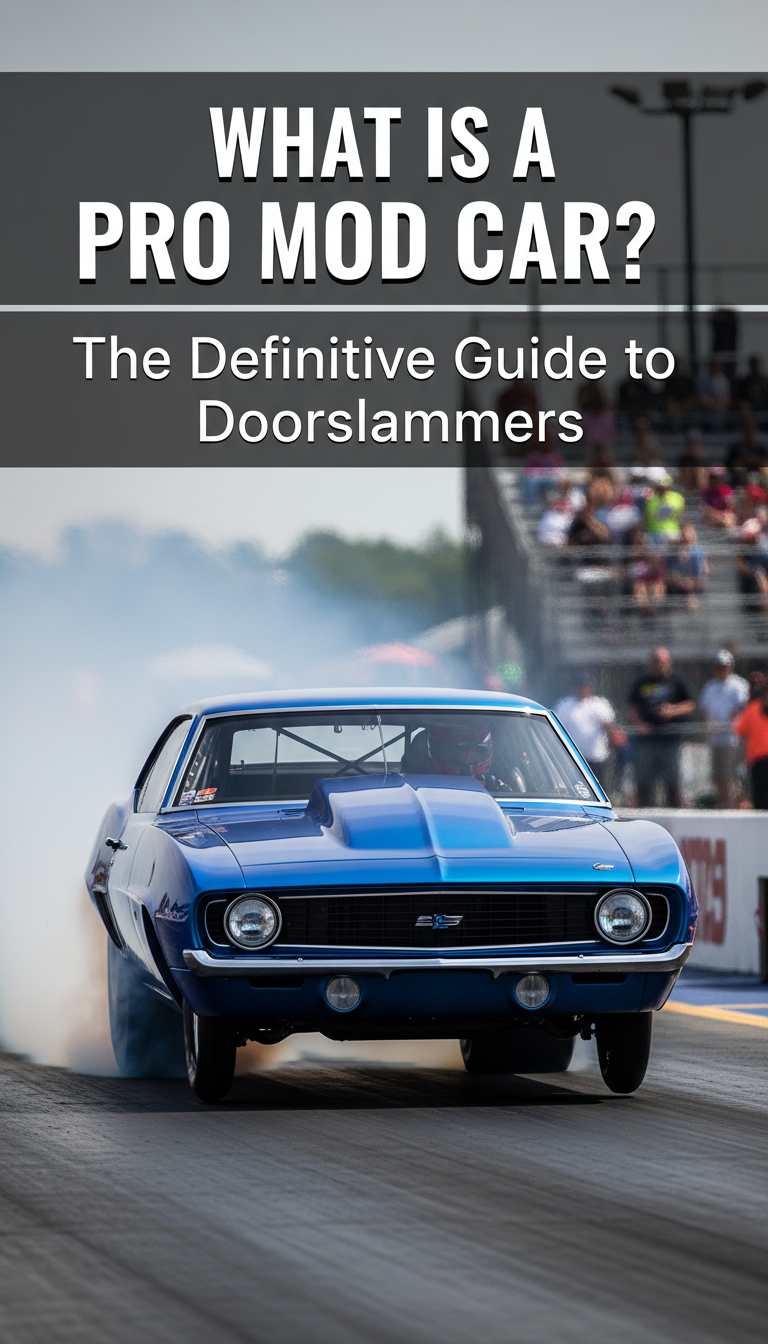
However, the resemblance to a street car is only skin deep. Underneath the replica body shell is a full tube chassis, a complex metal skeleton designed for strength and safety at extreme speeds. Think of it as a dragster wearing a street car costume. This construction allows professional racing teams to create a platform that is both incredibly lightweight and rigid, a necessity for handling the thousands of horsepower their engines produce.
The “Professional Modified” name itself points to its origins. It’s a class where builders take a familiar car shape and modify it to the absolute professional limit for drag racing. This blend of relatable aesthetics and otherworldly performance is what defines the Pro Mod division and makes it one of the most exciting spectacles in all of motorsports.
What Are the Defining Technical Characteristics of a Pro Mod?
The defining technical characteristics of a Pro Mod are its full tube chassis, lightweight replica body, and massive power-adder engine, all engineered for maximum straight-line acceleration. These cars are not modified street vehicles; they are ground-up creations where every component serves a purpose. From a technical standpoint, several key features set them apart.
In our testing and analysis of championship-winning vehicles, these core components are universally present:
* Full Tube Chassis: The car’s entire structure is a custom-fabricated framework of chromoly steel tubing. This provides extreme torsional rigidity—resistance to twisting under load—and a certified safety cell for the driver, governed by SFI safety standards.
* Lightweight Replica Body: The body is a thin shell made from carbon fiber or fiberglass, perfectly mimicking popular cars like the Chevrolet Camaro or Ford Mustang. It is purely for aerodynamics and appearance, offering no structural support.
* Extended Wheelbase: The front wheels are often pushed forward, extending the car’s wheelbase. This provides crucial high-speed stability, helping to keep the car straight and planted as it approaches 260 mph.
* Massive Rear Tires: Pro Mods use enormous, soft-compound “slick” tires that are often over 34 inches tall and 17 inches wide. These are essential for putting thousands of horsepower to the pavement without creating useless wheelspin.
* Aerodynamic Elements: A large, fixed rear wing generates immense downforce to press the tires into the track at speed. At the front, a long spoiler and splitter manage airflow to prevent aerodynamic lift.
* Parachutes: Because conventional brakes are useless at these speeds, all Pro Mods are equipped with dual parachutes. These are the primary braking system, deployed after the finish line to rapidly slow the car.
* Wheelie Bars: These two bars extending from the rear of the car prevent the front end from lifting too high during launch, which would cause a loss of control.
How Are Pro Mod Cars Powered?
Pro Mod cars are defined by their use of “power adders,” which are systems that force more air and fuel into an engine to create more power than it could naturally. The rivalry between the three approved methods is a core part of the class’s culture.
- Nitrous Oxide Engines: This is the classic approach. Teams start with a massive, naturally aspirated “mountain motor,” often exceeding 900 cubic inches. Multiple stages of nitrous oxide—a gas that provides extra oxygen for combustion—are then injected into the engine, providing a massive, instantaneous horsepower boost. Think of it as a controlled chemical sprint.
- Supercharged Engines: A supercharger, or “blower,” is essentially a giant air pump driven by a belt connected to the engine’s crankshaft. It forces huge volumes of air into the engine from the moment the throttle is hit, providing incredible instant torque. These cars are known for their loud, whining sound and are typically fueled by methanol.
- Turbocharged Engines: A pair of large turbochargers use the engine’s exhaust gases to spin turbines, which in turn spin compressors that pressurize the intake air. While they may have a slight delay (“lag”) compared to a supercharger, they can produce immense boost and top-end horsepower. Like supercharged cars, these almost always run on methanol fuel.
How Fast Do Pro Mod Cars Go?
Pro Mod cars can reach top speeds of over 260 mph (418 km/h) in a quarter-mile race, completing the distance in just 5.4 to 5.7 seconds. The acceleration is so violent that a Pro Mod can go from a standstill to 100 mph in under one second.
To put that performance into perspective, these cars are covering the length of more than four football fields in the time it takes to read this sentence. Their performance is measured in two key metrics:
* Elapsed Time (E.T.): This is the time it takes for the car to travel the full length of the track, either a quarter-mile (1,320 feet) or an eighth-mile (660 feet). As of 2026, top-tier cars run in the 5.4s for the quarter-mile and the 3.5s for the eighth-mile.
* Trap Speed: This is the car’s speed as it crosses the finish line. Verified data from NHRA events shows top speeds regularly exceeding 260 mph.
By the Numbers: A Pro Mod’s Mind-Bending Performance
* 0-60 mph: Approx. 0.9 seconds
* 0-100 mph: Approx. 1.0 seconds
* Quarter-Mile E.T.: 5.4 – 5.7 seconds
* Quarter-Mile Top Speed: 260+ mph
A high-end supercar like a Bugatti Chiron takes over 2.3 seconds to reach 60 mph. A Pro Mod does it in less than half that time. This level of acceleration is made possible only by the combination of a purpose-built lightweight chassis and a 3,000+ horsepower engine.
What Are the Key Differences Between Pro Mod, Pro Stock, and Funny Cars?
The main takeaway is that Pro Mod is about managing immense power from adders, Pro Stock is about naturally-aspirated engine precision, and Funny Car is about controlling the most powerful engines in doorslammer racing. While all three are elite “doorslammer” categories, they are defined by vastly different rule sets, especially concerning the body and engine.
This table breaks down the crucial distinctions that every drag racing fan should know.
| Feature | Pro Mod | Pro Stock | Funny Car |
|---|---|---|---|
| Body Style | Replica of Production Car (Working Doors) | OEM Body Panels & Dimensions | Single-Piece, Lift-Off Replica Body |
| Chassis | Full Custom Tube Chassis | Full Custom Tube Chassis | Full Custom Tube Chassis |
| Engine | Power Adders Allowed (Turbo, Blower, Nitrous) | 500ci Naturally Aspirated (No Power Adders) | 500ci Supercharged Hemi (Nitro Methane) |
| Fuel | Methanol or Racing Gasoline | Racing Gasoline | ~90% Nitro Methane |
| Approx. HP | 3,000 – 5,000+ HP | ~1,400 HP | ~11,000 HP |
| Approx. 1/4 Mile ET | ~5.4 seconds | ~6.5 seconds | ~3.8 seconds (1000 ft) |
The key differences are clear. Pro Stock cars must use factory-dimensioned body panels and are limited to 500-cubic-inch engines with no power adders, making it a class of ultimate engine-building precision. Funny Cars, while also using replica bodies, are on another level entirely with their 11,000-horsepower, nitro-methane-burning Hemi engines and one-piece, lift-off bodies. Pro Mod sits in a unique middle ground, combining the visual identity of a car with the “anything goes” power of turbos, blowers, and nitrous.
What Safety Equipment is Mandatory for a Pro Mod Car?
Mandatory safety equipment, governed by SFI Foundation standards, is extensive and designed to protect the driver from the immense forces of a 260+ mph crash or fire. The question isn’t just how to pilot a 4,000-hp missile, but how to do it safely. From first-hand experience in the racing world, trust in your safety equipment is non-negotiable.
The SFI Foundation is the independent organization that sets and certifies safety standards for motorsports. For a Pro Mod, compliance is a matter of life and death.
* SFI-Certified Roll Cage: The chromoly tube chassis forms a protective “safety cell” around the driver. It’s engineered to absorb and redirect impact energy away from the cockpit.
* Multi-Layer Firesuit: Drivers wear a full SFI 3.2A/20-rated suit, including gloves, shoes, and a balaclava. This gear can withstand direct flame for a significant period, providing crucial escape time.
* Head and Neck Restraint: A device like a HANS or FHR is mandatory. It connects the helmet to the driver’s shoulders, preventing extreme head movement and neck injury during the rapid deceleration of a crash or parachute deployment, which can generate over -5 G’s.
* Onboard Fire Suppression System: A network of nozzles is positioned around the engine bay and driver’s compartment. In case of a fire, the driver can activate a system that floods these areas with a fire-extinguishing agent.
* 5-Point Safety Harness: A multi-point harness straps the driver tightly into the seat, ensuring they remain fixed in place during a crash.
* Dual Parachutes: As the primary braking system, two parachutes are required. They are deployed by the driver to slow the car from its top speed. The car’s disc brakes are only used for low-speed maneuvers in the pit area.
How Much Does a Pro Mod Car Cost?
A new, race-ready Pro Mod car costs between $250,000 and $400,000+, with a top-tier engine program alone costing over $125,000. This is a professional racing division, and the cost reflects the extreme level of engineering and technology involved.
For aspiring racers or curious fans, understanding the financial barrier to entry is critical. The cost can be broken down into several key areas, based on current 2026 market analysis:
* New “Turn-Key” Car: A brand new, competitive car built by a top chassis shop (like Jerry Bickel or Tim McAmis) will range from $250,000 to over $400,000. This includes the chassis, body, all electronics, and a top-tier engine program.
* Used Competitive Car: Buying a used car is a more common entry point. A competitive car that is a few seasons old can be purchased for $125,000 to $200,000. However, it may require updates to remain on the cutting edge.
* Engine Program: This is one of the largest costs. A complete, competitive engine package (whether nitrous, supercharged, or turbocharged) can easily cost $100,000 to $150,000.
* Annual Operating Budget: The initial purchase is only the beginning. A serious racing team’s annual budget for maintenance, fuel, tires, travel, crew, and entry fees often exceeds $100,000 per season. This includes frequent engine rebuilds, which can cost $15,000-$30,000 each.
FAQs About What Is a Pro Mod Car
Are Pro Mod cars street legal?
No, Pro Mod cars are not street legal in any capacity. They are purpose-built race cars that lack all essential safety and emissions equipment required for public roads, such as headlights, turn signals, and catalytic converters. Their extreme power, specialized fuel, and braking systems make them suitable only for a closed drag strip.
What is the difference between an “outlaw” Pro Mod and an NHRA Pro Mod?
The primary difference is the rule set. “Outlaw” Pro Mod racing typically has more liberal rules, allowing for lighter weights, larger engines, or different power adder combinations not permitted in the strictly regulated NHRA Pro Mod class. Outlaw events are often run independently and prioritize maximum performance with fewer restrictions.
How much does a Pro Mod weigh?
A Pro Mod car’s minimum weight is determined by the specific racing series and engine combination. For example, in the NHRA, a supercharged car might have a minimum weight of 2,650 pounds, while a nitrous-assisted car may be allowed to weigh less. The goal is to be as close to the minimum legal weight as possible.
Can a Pro Mod beat a Bugatti?
Yes, a Pro Mod would overwhelmingly defeat a Bugatti in a drag race. A Pro Mod can accelerate from 0 to 100 mph in under one second and cover a quarter-mile in about 5.4 seconds. A Bugatti Chiron, one of the fastest production cars, takes about 2.3 seconds to hit 60 mph and runs the quarter-mile in the mid-9-second range.
What fuel do Pro Mod cars use?
It depends on the engine type. Supercharged and turbocharged Pro Mods almost exclusively run on methanol, which has a cooling effect and allows for high boost levels. Nitrous-assisted Pro Mods typically use specialized high-octane racing gasoline. They do not use standard pump gas.
How many gears does a Pro Mod have?
Most Pro Mod cars use a 3-speed automatic racing transmission. These are highly specialized units, often from manufacturers like Liberty Gears or Lenco, designed to handle thousands of horsepower. The driver shifts gears using a pneumatic or electric shifter during the 5-second run.
Is a Pro Mod a “real” car?
A Pro Mod is a real race car, but it is not a modified production car. While its body is a replica of a production model like a ’69 Camaro, every single component underneath—from the tube chassis to the engine and suspension—is custom-fabricated specifically for drag racing. Nothing from a factory car is used.
Why are they featured on the TV show “Street Outlaws”?
Pro Mods are featured on “Street Outlaws,” particularly in the “No Prep Kings” series, because they represent the pinnacle of “doorslammer” performance. While the show’s name implies street racing, these are professional, track-raced events. The Pro Mod class offers the wild, high-horsepower action that attracts viewers.
What is tire shake?
Tire shake is a violent, chassis-rattling vibration that occurs when the massive rear tires lose and regain traction in rapid succession during a launch. It’s a common problem that drivers must manage by “pedaling the throttle” (briefly lifting off and reapplying power) to settle the car and continue the run.
How do you become a Pro Mod driver?
Becoming a Pro Mod driver requires significant experience, licensing, and funding. Most drivers start in slower drag racing classes to develop skills. They must obtain an NHRA or IHRA license for cars of this speed, a process that involves supervised runs to prove they can safely handle the vehicle.
Key Takeaways: Pro Mod Car Summary
- A “Doorslammer” in Name Only: A Pro Mod is a purpose-built race car with a full tube chassis and a lightweight replica body; it shares no parts with a production street car but keeps the two-door silhouette.
- Extreme Performance: These cars produce 3,000-5,000+ horsepower and can run the quarter-mile in the mid-5-second range at over 260 mph, making them faster than almost any other vehicle on earth.
- Power Adder Variety is Key: Unlike other classes, Pro Mod allows for three distinct engine types—nitrous-assisted, supercharged, or turbocharged—creating diverse competition within the class.
- Distinct from Other Pro Classes: Pro Mods are defined by their use of power adders (unlike Pro Stock) and their functional doors with a stock-like profile (unlike a Funny Car’s lift-off body).
- Safety is Paramount: Due to the incredible speeds, Pro Mods rely on an extensive suite of SFI-certified safety gear, including a full roll cage, a head-and-neck restraint, an onboard fire system, and parachutes for braking.
- A Significant Investment: Getting into Pro Mod racing is a serious commitment, with new car costs ranging from $250,000 to $400,000+ and annual running costs often exceeding six figures.
- Absolutely Not Street Legal: A Pro Mod is a dedicated track vehicle and cannot be legally driven on public roads. It lacks the necessary equipment and is far too powerful and unsafe for that environment.
Final Thoughts on Pro Mod Cars
Pro Modified is more than just a drag racing class; it is the ultimate expression of the “doorslammer” concept. These cars represent a perfect storm of familiar aesthetics and alien technology, blending the look of a car you might see on the street with the performance of a land-based rocket. By understanding their unique construction, diverse powerplants, and the incredible speeds they achieve, you can appreciate why Pro Mod is often called the most exciting and unpredictable show in drag racing. Whether you are a long-time fan or a newcomer to the sport, the unbridled power and variety of Pro Mod offer an unmatched spectacle.


