
Wondering what a downpipe on a car is and why tuners are so obsessed with it? You’re likely trying to understand its role in the exhaust system and how it unlocks performance in a turbocharged engine. This isn’t just another piece of pipe; it’s a critical performance component.
A downpipe is a section of exhaust tubing in a turbocharged car that connects the turbocharger’s exhaust housing directly to the catalytic converter or the rest of the exhaust system. Its primary function is to channel hot, high-velocity exhaust gases away from the turbo’s turbine, and its design significantly impacts turbo efficiency, engine backpressure, and overall horsepower.
Based on detailed analysis of automotive engineering principles, this guide breaks down exactly what a downpipe does and why it’s one of the most effective upgrades for a turbo vehicle. You will learn the critical differences between types, the performance gains you can expect, and the essential steps required for a safe installation.
Key Facts
- Turbo-Exclusive Component: Downpipes are found exclusively on vehicles with turbocharged engines, connecting the turbo’s “hot side” to the exhaust. Naturally aspirated cars use headers or exhaust manifolds instead.
- Significant Power Gains: Upgrading a stock, restrictive downpipe with a high-flow aftermarket version can increase horsepower by 10-25 HP, according to aggregated dyno-tested results.
- Backpressure is the Enemy: The primary performance benefit comes from
back pressure reduction. A larger diameter allows exhaust gases to escape more freely, letting the turbo spool faster and the engine breathe more efficiently.- Tuning is Mandatory: Installing an aftermarket downpipe requires a corresponding
ECU tuningto adjust air-to-fuel ratios and prevent engine damage, a fact supported by SAE standards for engine calibration.- Legality Varies Greatly: “Catless” downpipes are not street legal in most areas as they violate EPA emissions standards. High-flow “catted” options are often required to remain
EPA compliant.
What Is a Downpipe on a Car?
A downpipe on a car is the specific section of exhaust tubing that connects the outlet of the turbocharger’s turbine housing to the next component in the exhaust system, which is typically the catalytic converter or mid-pipe. It is a fundamental part of any turbocharged vehicle, serving as the first exit path for spent exhaust gases after they have spun the turbo’s turbine wheel. You will not find a downpipe on a naturally aspirated (non-turbo) car.
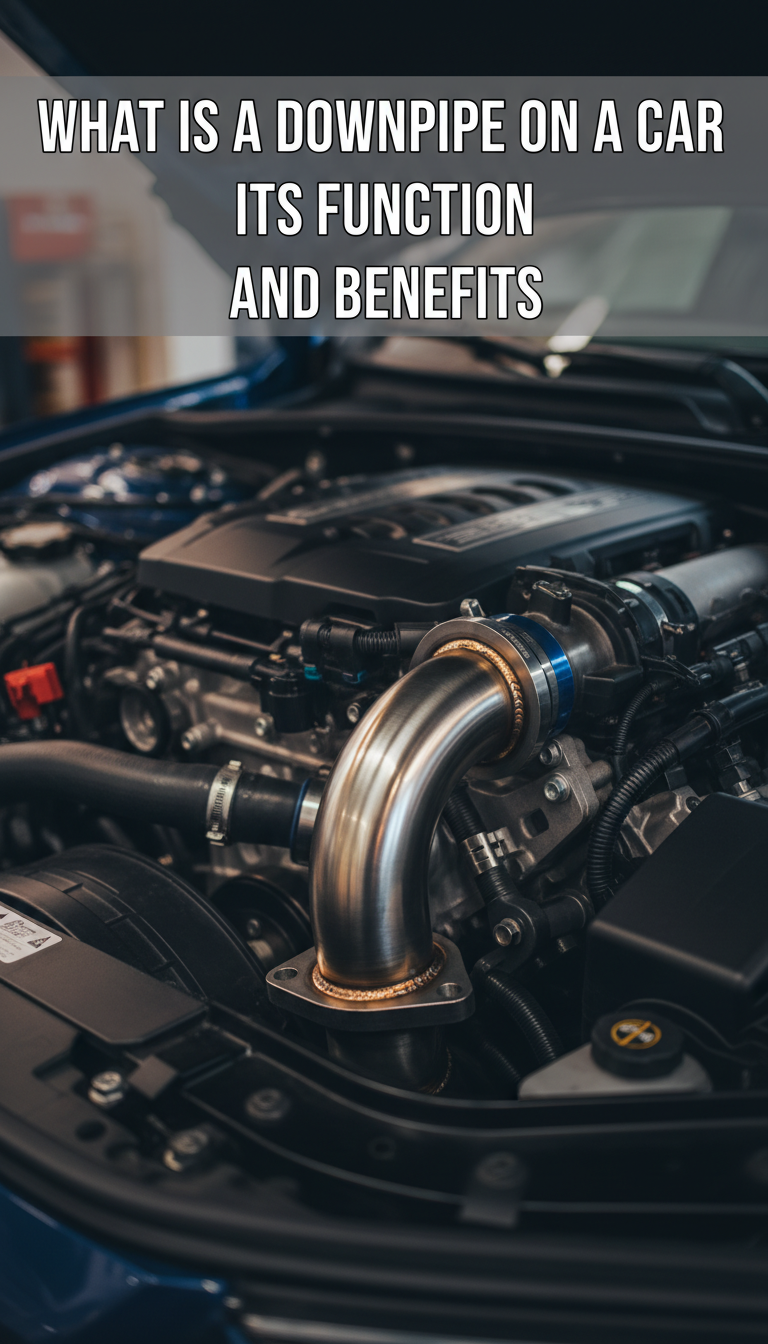
Think of the exhaust gas flow like traffic leaving a stadium. The turbo’s turbine is the main event, and the downpipe is the first, most important exit ramp. If that ramp is narrow and congested, traffic backs up, causing problems. In an engine, this “traffic jam” is called backpressure. The downpipe’s job is to provide a wide, clear path to prevent this.
Stock downpipes are often designed with restrictions. They may have smaller diameters, tight crush-bends, and highly restrictive catalytic converters to meet strict noise and emissions regulations. An aftermarket performance downpipe, often made from high-quality T304 stainless steel with smooth mandrel-bent tubing, is designed to maximize flow and unlock the engine’s true potential.
Why Is an Upgraded Downpipe a Popular Performance Modification?
Upgrading a downpipe is a popular modification because it delivers one of the best “bang-for-your-buck” performance increases on a turbocharged engine by significantly reducing backpressure. A larger diameter and smoother, mandrel-bent design allow spent exhaust gas to exit the turbine housing much faster. This improvement in efficiency leads directly to several key benefits.
This modification is a cornerstone of what many tuners call “Stage 2” power levels. Real-world, dyno-tested results consistently show measurable improvements. Here’s what you can expect:
- 🔥 Increased Horsepower and Torque: By reducing the restriction right after the turbo, the engine can exhale more freely. This improves
volumetric efficiencyand typically results in a noticeableincrease in horsepowerand torque, often in the range of 10-25 HP depending on the vehicle and supporting modifications. - 🚀 Faster Turbo Spool and Throttle Response: High backpressure forces the turbo’s turbine wheel to work harder. By reducing this pressure, the turbine can spin up to speed much more quickly. This directly addresses
turbo lag, making the car feel more responsive and eager the moment you press the throttle. - 🔊 More Aggressive Exhaust Sound: The stock downpipe, with its thick insulation and restrictive catalytic converter, does a lot to muffle the engine’s true sound. An aftermarket downpipe, especially a catless version, allows more of the raw exhaust note and turbo whistle to come through, creating a deeper, more aggressive tone.
What Is the Difference Between a Catted and Catless Downpipe?
When choosing an aftermarket downpipe, the biggest decision is whether to get a “catted” or “catless” version. A catted downpipe includes a high-flow catalytic converter built into it, while a catless downpipe is essentially a straight-through pipe with no converter. This choice has major implications for performance, sound, and legality.
A high-flow catted downpipe is the go-to choice for most street-driven cars. It uses a catalytic converter with a less dense internal structure (e.g., a 200-cell core vs. 400+ in a stock unit) to improve flow while still treating exhaust gases to reduce harmful emissions. This often allows the vehicle to remain emissions control compliant.
A catless downpipe, sometimes called a test pipe, removes the catalytic converter entirely for maximum possible exhaust gas flow. While this offers the highest potential for power gains, it is not street legal in most jurisdictions and is intended for off-road or track use only. It will also cause a strong, unburnt fuel smell and guarantee a check engine light without a proper tune.
Here is a direct comparison to help you decide:
| Feature / Aspect | High-Flow Catted Downpipe | Catless Downpipe (Test Pipe) |
|---|---|---|
| Performance Gain | Good to Excellent (e.g., +15 hp) | Maximum Possible (e.g., +20-25 hp) |
| Exhaust Sound | Deeper, more aggressive tone | Loudest, most aggressive, more rasp |
| Emissions Legality | Often street legal (check local laws, “EPA compliant”) | Not street legal in most areas (for off-road use only) |
| Check Engine Light (CEL) | Less likely, but possible without a tune (“P0420 code”) | Guaranteed without an ECU tune or O2 spacer |
| Exhaust Smell | Minimal to no smell | Strong, unburnt fuel smell |
| Cost | More expensive | Less expensive |
| Best For | Daily drivers, street-tuned cars | Dedicated track cars, maximum competition builds |
Ultimately, for any car driven on public roads, a high-quality catted downpipe is the responsible and practical choice, balancing impressive performance gains with environmental and legal compliance.
Can You Install a Downpipe Without a Tune?
No, you should not run an aftermarket downpipe without a corresponding ECU tuning. While you can physically bolt the part onto the car, an ECU (Engine Control Unit) tune is a critical and mandatory step to ensure the engine runs safely and you actually realize the performance benefits. Skipping this step can lead to poor performance, a constant check engine light, and even catastrophic engine damage.
From years of working with tuned vehicles, we’ve seen firsthand what happens when hardware is changed without adjusting the software. The car’s engine management system is calibrated from the factory for the restrictive stock downpipe. Installing a high-flow part dramatically changes the dynamics of the exhaust gas flow, and the ECU must be told how to adapt.
Here’s why a tune is absolutely essential:
- To Prevent Engine Damage: A high-flow downpipe allows the turbo to move more air, more easily. Without a tune, the ECU doesn’t know to add more fuel to match this increased airflow. This creates a “lean” air/fuel ratio, which can drastically increase engine temperatures and lead to engine failure. It can also cause issues like “boost creep,” where the turbo over-boosts beyond safe limits.
- To Actually Gain Power: The advertised
horsepower increasefrom a downpipe is only achievable once the ECU is tuned to take advantage of the reduced backpressure. The tune will adjust fuel delivery, ignition timing, and boost pressure targets to optimize performance with the new hardware. - To Eliminate Check Engine Lights (CEL): An aftermarket downpipe, especially a catless one, will almost certainly trigger a
check engine light(often aP0420code for catalyst inefficiency). A proper “Stage 2” tune recalibrates theO2 sensorparameters to prevent these codes from appearing.
Expert Warning: Do not mistake an O2 sensor spacer or “defouler” for a proper tune. These devices only trick the sensor and do not address the dangerous air/fuel ratio and boost control issues. A professional ECU tune is the only safe and effective method.
FAQs About what is a downpipe on a car
Does a downpipe make your car louder?
Yes, an upgraded downpipe will almost always make your car’s exhaust note louder and more aggressive. A catless downpipe creates the most significant increase in volume and turbo sound. A high-flow catted version provides a more moderate, deeper tone that is louder than stock but more refined than a fully catless setup.
Is a downpipe the same as a header?
No, they serve a similar purpose on different types of engines. Headers (or exhaust manifolds) collect exhaust gas from the engine cylinders on a naturally-aspirated car. A downpipe serves the same initial exhaust-channeling function but specifically on a turbocharged car, where it connects to the outlet of the turbocharger.
How much does a downpipe cost?
The cost for a downpipe can range from around $250 to over $1,500. The price depends heavily on the brand, vehicle model, material (e.g., T304 stainless steel), and whether it is a high-flow catted or catless version. Catted downpipes from premium manufacturers are typically the most expensive due to the cost of the precious metals in the converter.
Will an upgraded downpipe void my car’s warranty?
It can give a dealership a reason to deny a warranty claim on related parts. While it won’t void the entire warranty, if your engine, turbo, or transmission fails, the manufacturer could argue the modification contributed to the failure. Always be aware of your rights under the Magnuson-Moss Warranty Act, but understand the risk involved.
What are the symptoms of a cracked or failing downpipe?
Common signs include a loud exhaust leak noise (ticking or hissing), the smell of exhaust fumes in the cabin, a visible crack on the pipe, and a potential loss of power or erratic turbo performance. A check engine light can also be triggered due to incorrect readings from the O2 sensor.
What size downpipe do I need?
For most modern 4-cylinder and 6-cylinder turbo engines, a 3-inch downpipe diameter is the most common and effective size. Going too large can sometimes hurt performance by slowing exhaust gas velocity. It’s best to follow the recommendations of your tuner or a reputable parts manufacturer for your specific vehicle and power goals.
Does a downpipe improve fuel economy?
Theoretically, it can, but in practice, it’s unlikely. By improving engine efficiency, a downpipe can lead to slightly better MPG under controlled, steady driving. However, the added performance and sound often encourage a more spirited driving style that completely negates any potential fuel savings. Don’t install a downpipe for fuel economy.
Is a downpipe better than a muffler delete?
A downpipe provides a vastly superior performance gain. A downpipe reduces backpressure at the most critical point in the system, unlocking significant horsepower. A muffler delete is an inexpensive mod that primarily increases sound volume with little to no performance benefit, as the muffler is far downstream and less of a restriction.
Can a downpipe damage your engine?
Yes, if it is installed without a proper ECU tuning. Running a high-flow downpipe without recalibrating the engine’s software can lead to dangerous lean air/fuel conditions or overboosting, which can cause severe engine damage. With a professional installation and a quality tune, it is a safe and reliable modification.
Where does the downpipe connect to?
The downpipe bolts directly to the turbine housing outlet of the turbocharger at its top end. At its bottom end, it connects to the next section of the exhaust, which is either the mid-pipe or the cat-back exhaust system. The connection points are sealed with gaskets to prevent leaks.
Final Thoughts
An aftermarket downpipe stands as one of the most effective and rewarding modifications for any turbocharged vehicle. It directly addresses the primary bottleneck in a factory exhaust system, unlocking significant gains in power, throttle response, and sound. By improving the exhaust gas flow right at the source, it allows the entire engine to operate with greater efficiency.
However, this is a modification that demands a complete approach. The decision between a high-flow catted and catless downpipe has critical legal and practical consequences. More importantly, remember that ECU tuning is not an optional extra; it is a mandatory requirement for safety and performance. By pairing a quality downpipe with a professional tune, you can reliably transform the character and capability of your car. Now that you understand the what, why, and how, you’re better equipped to make an informed decision for your build.


