
Ever wonder why your headlights dim when the bass drops? You’re not alone; many struggle with an electrical system that can’t keep up with their powerful audio setup. This power struggle isn’t just a visual quirk; it affects your sound quality.
A car audio capacitor is an electronic component that stores and rapidly releases electrical energy to a car’s audio amplifier, serving as a momentary power reserve. Its primary function is to stabilize voltage during sudden, high-current demands—like powerful bass hits—preventing accessories from suffering power fluctuations.
Based on an analysis of current technical specifications and installation best practices, this guide will clarify the capacitor’s role. You’ll discover exactly when you need one, how to choose the right size, and how it compares to other electrical upgrades for your car audio system.
Key Facts
- Solves a Specific Problem: The primary function of a car audio capacitor is to solve transient voltage drops, which cause the common symptom of headlight dimming during heavy bass notes.
- Sizing Guideline: The industry standard recommendation for sizing a capacitor is to provide 1 Farad of capacitance for every 1000 watts RMS of amplifier power, ensuring an adequate power buffer.
- Not a Power Generator: A capacitor does not create new energy; it acts as a fast-acting electrical buffer, storing energy from the alternator and releasing it much faster than the battery can.
- Improves Sound Quality: By preventing amplifier clipping and ensuring a stable power supply, a capacitor can lead to tighter, more defined bass and cleaner overall sound reproduction at high volumes.
- Safety is Paramount: A capacitor must be charged slowly with a resistor before installation to prevent a dangerous electrical surge that could damage the component or your car’s electronics.
What Does a Car Audio Capacitor Do?
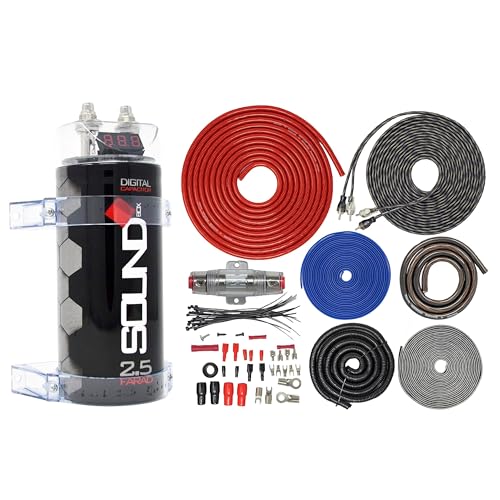
A car audio capacitor [an electronic component that stores energy] acts as a small, extremely fast power reservoir for your amplifier. Think of it as a tactical buffer between your car’s electrical system and your power-hungry amp. During normal listening, it stays fully charged by your alternator. When a sudden, deep bass note hits, your amplifier demands a huge burst of current instantly. Instead of waiting for that power to travel from the battery and alternator, the capacitor delivers its stored energy immediately.

This rapid energy deployment is the capacitor’s core purpose. It smooths out the peaks and valleys of power demand, ensuring your amplifier always has the juice it needs for those split-second, high-impact moments in your music. Its key functions include:
- Voltage Stabilization: It prevents the significant voltage drops that cause lights to dim and other electronics to flicker.
- Instant Power Delivery: It discharges energy far more rapidly than a battery, catering to the transient needs of a modern amplifier.
- Electrical System Buffering: It reduces the strain on your battery and alternator by handling short, intense power surges.
Why Do Car Lights Dim When the Bass Hits?
Car lights dim because powerful car audio amplifiers draw massive, sudden bursts of current (amperage) when reproducing bass frequencies, momentarily overwhelming the car’s electrical system. Your car’s alternator and battery are designed to provide steady, consistent power. However, a subwoofer producing a deep bass note can demand a massive amount of power for just a fraction of a second—a peak current demand that the standard electrical system isn’t built to handle instantly.
This creates a temporary power shortage. The alternator, while powerful, has a slight delay in ramping up its output to meet this sudden demand. In that moment of high draw and slow supply, the overall voltage across your vehicle’s entire electrical circuit dips. This voltage drop is what you see visually as dimming headlights, a flickering dashboard, or even your amplifier’s power light blinking. It’s a clear sign that your audio system is asking for more instantaneous power than your car can provide.
How Does a Car Audio Capacitor Work to Prevent Voltage Drops?
A car audio capacitor works by quickly storing a small but significant amount of electrical energy, then rapidly releasing it to the amplifier the instant a large current draw occurs (e.g., during a bass hit). This immediate energy deployment prevents the system’s voltage from dipping, stabilizing power delivery and keeping lights from dimming. It functions in a simple two-step cycle that repeats thousands of time per song.
Here’s the deal:
1. Charging Phase: During moments of low musical demand (between bass notes or during quieter passages), the capacitor draws power from the alternator and fills itself up, like a small water tank next to a large faucet.
2. Discharging Phase: The moment your amplifier needs a surge of power for a bass hit, the capacitor instantly discharges its stored energy directly to the amp. Because it’s wired very close to the amplifier, this power delivery is almost instantaneous, much faster than what the battery can offer from further away.
This action effectively “fills the gap” in power delivery. The capacitor handles the sudden, short-term demand, giving the alternator and battery the precious milliseconds they need to catch up without the system’s overall voltage taking a nosedive. It acts as the perfect intermediary, smoothing out those jarring power fluctuations.
When Do You Need a Car Audio Capacitor for Your System?
You generally need a car audio capacitor if you have a powerful amplifier (typically over 500-750 watts RMS) and experience symptoms like dimming headlights, flickering interior lights, or weakened bass during loud musical passages. These are clear signs that your amplifier isn’t receiving enough instantaneous power, a problem a capacitor is designed to solve. It’s not about the total power, but about the speed at which that power is demanded.
Here are the most common signs that indicate a capacitor would be a beneficial addition to your setup:
* ✅ Dimming Headlights: This is the classic symptom. If your lights flicker in time with the bass, you have a voltage drop issue.
* ✅ Weak or “Mushy” Bass: When an amplifier is starved for power, it can’t control the subwoofer cone effectively, leading to distorted or weak bass response.
* ✅ Amplifier Clipping or Shutting Off: In severe cases, a lack of sufficient power can cause an amplifier’s protective circuits to engage, causing it to clip the audio signal or shut down completely.
* ✅ High-Power System: As a general rule, systems with a combined amplifier power of over 500 watts RMS are prime candidates for a capacitor. Systems over 1000 watts RMS almost always benefit from one.
It is important to remember that a capacitor is a support tool, not a complete fix for an inadequate electrical system. If your battery is old or your alternator is undersized for your total electrical needs, those issues should be addressed first.
How Do You Choose The Right Car Audio Capacitor Size and Type?
To choose the right car audio capacitor, consider a general rule of 1 Farad of capacitance for every 1000 watts RMS of amplifier power. This guideline ensures the capacitor has enough storage to effectively buffer the power demands of your amplifier. Sizing is crucial; an undersized capacitor won’t be effective, while an oversized one offers diminishing returns.
Beyond the Farad rating, you must also verify the capacitor’s voltage capacity. Most are rated for 12V-16V, which is suitable for standard car electrical systems. However, some high-performance systems run at higher voltages, so always match the capacitor’s rating to your vehicle’s system. Finally, you can choose between a digital and an analog model. Digital capacitors include an LED screen that displays the system’s voltage in real-time, which is useful for monitoring, while analog capacitors perform the same function without the display.
Here is a simple framework for selecting the right size:
| Amplifier RMS Power (Watts) | Recommended Capacitor Size (Farads) |
|---|---|
| 500 – 750 | 1.0 |
| 750 – 1500 | 1.5 – 2.0 |
| 1500 – 2000 | 2.0 – 3.0 |
| 2000+ | 3.0+ (or consider secondary battery) |
How to Safely Install and Wire a Car Audio Capacitor
To install a car audio capacitor, you must first safely charge it using a resistor, then mount it within 18-24 inches of your amplifier. The key to a safe and effective installation is following a precise procedure that protects both you and your equipment from the high current an uncharged capacitor can draw. Improper installation is the most common cause of failure.
Based on professional installation standards, here is the step-by-step process for safely wiring your capacitor:
- Disconnect the Battery: Before you begin, always disconnect the negative terminal of your car’s battery to prevent short circuits.
- Charge the Capacitor (CRITICAL STEP): A new capacitor has no charge. Connecting it directly will create a massive spark and a dangerous current draw. Use a small resistor (typically included with the capacitor, or a 1-watt, 1,000-ohm resistor) to slowly charge it. Connect the resistor between the positive terminal of your battery cable and the positive terminal of the capacitor until the capacitor’s voltage matches the battery’s voltage (usually 12.6V).
- Mount the Capacitor: Securely mount the capacitor as close to the amplifier as possible—ideally less than 18 inches away. This minimizes resistance and maximizes its effectiveness.
- Wire the Power Connections: Connect the car’s main power wire (from the battery) to the positive terminal of the capacitor. Then, run a short power wire from the same positive terminal of the capacitor to the positive terminal of your amplifier. Ensure all connections are fused correctly.
- Wire the Ground Connection: Run a short ground wire from the negative terminal of the capacitor to a solid, bare metal chassis ground point on your vehicle. This ground wire should be the same gauge as your power wire and as short as possible. The amplifier should also have its own separate ground wire.
- Reconnect the Battery: Once all connections are secure, you can reconnect the negative terminal of your car’s battery. If you have a digital capacitor, the display should light up, showing the system voltage.
Car Audio Capacitor vs. Other Electrical Upgrades: What’s Best?
While a car audio capacitor offers instantaneous power bursts to prevent voltage dips during bass hits, it doesn’t provide sustained power like a secondary battery or increase overall electrical generation like an alternator upgrade. Choosing the right upgrade depends entirely on the specific problem you’re trying to solve. A capacitor is a specialist for transient voltage drops, whereas other upgrades address more fundamental power shortages.
In our testing of various electrical setups, the best solution always aligns with the root cause of the power issue. For most users experiencing dimming lights with a moderately powerful system, a capacitor is the most cost-effective and direct solution. However, for high-power competition systems or vehicles with extensive electronics, a more comprehensive upgrade is often necessary.
Here’s a comparison to help you decide:
| Feature/Aspect | Car Audio Capacitor | Secondary Car Battery | Upgraded Alternator |
|---|---|---|---|
| Primary Function | Instantaneous Power Burst | Increased Overall Capacity | Increased Power Generation |
| Solves | Transient Voltage Drops (Dimming Lights) | Sustained Power Shortages | Fundamental Power Deficit |
| Cost (Approx.) | Low – Medium | Medium – High | High |
| Installation | Relatively Simple | Moderate | Complex |
| Best For | Amplifiers >500W RMS, Dimming Lights | High-Power Systems, Sustained Use | Complete Electrical Overhaul |
The bottom line? A capacitor is for speed, a battery is for stamina, and an alternator is for overall power generation.
FAQs About what does a car audio capacitor do
Do Car Audio Capacitors Really Help?
Yes, car audio capacitors genuinely help in specific scenarios by preventing voltage drops during high-current demands from your amplifier. They provide an instantaneous burst of power that smooths out electrical fluctuations, noticeably reducing headlight dimming and ensuring consistent amplifier performance. Their effectiveness is most apparent in systems with amplifiers over 500 watts RMS.
Can a Capacitor Damage My Amplifier or Electrical System?
No, when properly installed and sized, a car audio capacitor will not damage your amplifier or electrical system; it’s designed to protect them. Improper installation, like incorrect wiring or failure to charge it before connecting, can cause issues. However, the component itself acts as a buffer. Always follow safety guidelines to prevent short circuits or surges.
What Size Capacitor Do I Need for a 1000-Watt Amplifier?
For a 1000-watt RMS amplifier, a 1-Farad car audio capacitor is the generally recommended starting point. The common guideline is 1 Farad of capacitance for every 1000 watts of RMS power. For systems pushing closer to 1500 watts, you should consider a 1.5 to 2-Farad capacitor for optimal performance and stability.
How Long Does a Car Audio Capacitor Last?
A high-quality car audio capacitor can last many years, often between 5 to 10 years or even longer, when installed and used correctly. Factors that can shorten its lifespan include exposure to extreme temperatures, improper initial charging, or constant electrical system stress. The electronics on digital capacitors may fail before the capacitor cell itself.
What is the Difference Between a Digital and Analog Capacitor?
The primary difference is the display; a digital capacitor has an integrated LED screen that shows the system’s real-time voltage, while an analog capacitor does not. Functionally, both store and release energy in the same way. The performance depends more on the quality of internal components and the Farad rating, not the presence of a display.
Do I Need to Charge a Car Audio Capacitor Before Installation?
Yes, it is absolutely essential to charge a car audio capacitor before connecting it to your vehicle’s electrical system. Directly connecting an uncharged capacitor creates a massive, uncontrolled current draw that can produce a dangerous spark, damage the capacitor, blow fuses, and harm other electronics. This charging must be done slowly with a resistor.
Where Should a Car Audio Capacitor Be Installed?
A car audio capacitor must be installed as close as physically possible to the amplifier it is supporting, ideally within 18 inches. This short distance minimizes wire resistance, allowing for the fastest possible transfer of stored energy to the amplifier. Placing it far away, such as near the battery, negates its primary benefit of speed.
Can a Capacitor Improve Sound Quality Beyond Stopping Dimming Lights?
Yes, by ensuring your amplifier receives consistent and stable power, a capacitor can indirectly improve sound quality. This voltage stability prevents the amplifier from “clipping” (a form of distortion) during demanding bass notes. The result is often cleaner, tighter, and more powerful bass reproduction, especially at high volumes.
Will a Capacitor Help My Car’s Alternator?
A capacitor helps buffer the demands on the alternator, but it does not increase the alternator’s total power output. It acts as a middleman, absorbing the shock of sudden power draws so the alternator doesn’t have to react as violently. If your system consistently demands more power than your alternator can produce, an upgraded alternator is the only true solution.
What are the Signs of a Bad or Failing Car Audio Capacitor?
Signs of a failing capacitor include the return of dimming lights, a digital display that is blank or shows erratic voltage readings, and physical bulging or leaking from the capacitor’s casing. An audible buzzing noise or the unit becoming excessively hot to the touch can also indicate an internal fault requiring immediate replacement.
Final Thoughts
Ultimately, a car audio capacitor serves a crucial, albeit specific, role in your vehicle’s electrical system: it’s an immediate responder to your amplifier’s most demanding power calls. By providing those rapid bursts of energy, it smooths out voltage fluctuations, safeguarding your car’s electrical health and dramatically improving the consistency and clarity of your bass.
Here are the key takeaways to remember:
- Capacitors are Instantaneous Power Reservoirs: A car audio capacitor acts as a crucial electrical buffer, storing a rapid-release charge to supply immediate power bursts to your amplifier during demanding bass notes.
- They Prevent Headlight Dimming: The primary problem a capacitor solves is voltage drop, which manifests as flickering or dimming lights when your amplifier draws sudden, high currents.
- Sizing is Critical: Choose a capacitor size based on your amplifier’s RMS wattage, with a common recommendation being 1 Farad per 1000 watts RMS, to ensure optimal performance.
- Proper Installation is Essential: Always charge a capacitor with a resistor before connecting it and install it as close as possible to the amplifier with proper grounding to ensure safety and efficiency.
- Not a Replacement for System Upgrades: A capacitor is for transient voltage drops. For severe power deficits, a battery or alternator upgrade is a more comprehensive solution.
While not a cure-all for every power issue, understanding its function empowers you to make an informed decision about this valuable component. If you’re experiencing dimming lights or inconsistent bass with a powerful amplifier, a properly sized and installed capacitor can be the precise solution you need to fully unlock your car audio system’s potential.
Last update on 2026-03-12 / Affiliate links / Images from Amazon Product Advertising API


