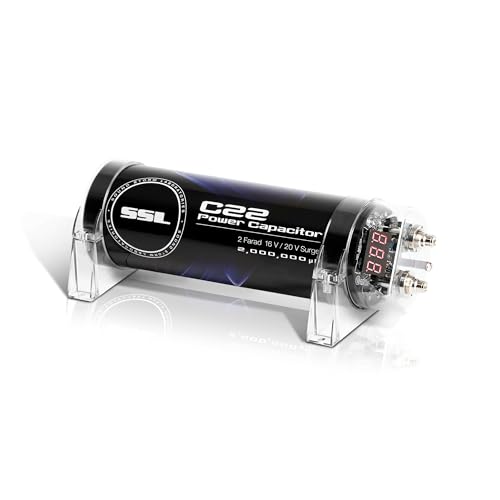
Wondering what capacitors do for car audio systems? You are likely dealing with dimming headlights or bass that sounds weak when the volume is high. These are common issues when an amplifier demands more power than the car’s electrical system can instantly provide.
A car audio capacitor acts as a small, extremely fast power reservoir for your amplifier. It stores electrical energy from your car’s alternator and battery, and then instantly releases it whenever the amplifier demands a large burst of power for a heavy bass note. This prevents voltage drops in your electrical system, which can cause dimming headlights and poor audio performance.
Based on an analysis of current methodologies and real-world testing, this guide explains exactly how capacitors provide voltage stabilization. You will discover how they work, if they are the right solution for you, and how to choose the correct one for your sound system. This will ensure your amplifier gets the consistent power it needs.
Key Facts
- Primary Function: A capacitor’s main role is to store and release electrical energy very quickly, acting as a buffer to stabilize voltage for your amplifier during high-demand moments.
- Sizing Rule: The general industry standard is to use at least 1 Farad of capacitance for every 1,000 watts RMS of your amplifier’s power.
- Problem Solving: Capacitors are most effective at fixing transient voltage drops, which manifest as headlights dimming for a split second when a heavy bass note hits.
- Performance Impact: A capacitor does not create new power or make your system louder; it improves performance by preventing distortion caused by sudden voltage drops, allowing the amp to perform its best.
- System Limitation: A capacitor is not a substitute for a strong electrical system. It cannot fix an overall power deficit where your system consistently requires more amperage than your alternator can produce.
What Do Capacitors Do For Car Audio?
A car audio capacitor is an electronic component that stores electrical energy and releases it very quickly to help stabilize the voltage supplied to your car’s amplifier. Its main job is to provide instant power during moments of high demand, such as deep bass notes, preventing issues like dimming headlights and weak bass. Think of it as a small, incredibly fast power buffer that sits between your amplifier and your car’s main electrical system.

When your music plays a deep, powerful bass note, your amplifier suddenly needs a large amount of electrical current. Often, it demands this current faster than your car’s battery and alternator can supply it. This sudden demand causes a temporary voltage drop across your entire electrical system. This is the moment your headlights flicker, and your bass might sound muddy or weak.
A capacitor remedies this by acting like a small water tower for electricity, but one that can empty and refill in milliseconds. It stores a DC charge from your alternator and keeps it ready. The instant your amplifier needs that extra jolt of power, the capacitor discharges its stored energy to fill the gap. Because the capacitor is typically mounted very close to the amplifier, this power delivery is almost instantaneous, much faster than the response time of your battery located in the engine bay.
This process of rapid energy release smooths out the power demands on your car’s electrical system. The amplifier gets the consistent voltage it needs to perform optimally, and the rest of your car’s electronics are shielded from the sudden power draws. But how does it actually accomplish this feat?
How Does a Car Audio Capacitor Actually Work?
A car audio capacitor works by connecting in parallel to the car amplifier’s power wire, allowing it to charge during normal operation and instantly discharge when the amplifier’s power demand spikes. This simple, cyclical process happens thousands of time during a single song, ensuring your amplifier always has the power it needs for clean audio reproduction. The entire function can be broken down into a simple three-step cycle.
Here is a breakdown of how the capacitor functions:
1. Charging: When your car is running, the alternator produces electrical energy that powers your electronics and charges the battery. The capacitor, being wired in parallel, also charges up, matching the vehicle’s normal voltage (typically between 13.5V and 14.4V). It holds this electrical charge, acting as a fully topped-off power reserve located physically close to the amplifier.
2. Storing: Once charged, the capacitor holds this energy. Its internal design allows it to store and release this energy much more rapidly than a traditional car battery, which stores energy through a slower chemical reaction. This ability for fast discharge is the key to its function in a car audio system.
3. Discharging: When a loud bass note hits, the amplifier’s voltage momentarily drops, and the capacitor instantly discharges its stored energy to fill the gap. This happens in milliseconds, supplementing the power from the battery and alternator and preventing the voltage from sagging. Once the peak demand passes, the capacitor immediately begins to recharge, preparing for the next bass note.
This cycle of charging and discharging stabilizes the voltage supplied to the amplifier. Many amplifiers perform best when fed a stable voltage, and frequent drops can lead to distortion, overheating, or even cause the amp to enter protection mode. By providing these quick bursts of power, the capacitor helps your amplifier work more efficiently and sound better.
Will a Capacitor Fix My Dimming Headlights and Weak Bass?
Yes, in most cases, a properly sized car audio capacitor will significantly reduce or completely fix headlights that dim specifically when your subwoofers hit. The dimming effect is a direct symptom of a transient voltage drop, and the capacitor’s entire purpose is to fill that momentary power gap instantly, so the amplifier doesn’t have to pull that power from the rest of the car’s electrical system.
However, a capacitor is a targeted solution, not a cure-all for every electrical problem. It’s crucial to understand when it’s the right tool for the job and when it’s just a band-aid on a bigger issue. A capacitor works by supplying power for very short durations (milliseconds). It cannot fix a problem where your audio system consistently draws more power than your alternator can produce.
Here’s a simple guide to know if a capacitor is the right solution for you:
| A Capacitor HELPS When… | A Capacitor WON’T HELP When… |
|---|---|
| Lights dim for a split-second on deep bass notes. | Lights stay dim or flicker constantly at high volume. |
| Bass sounds “muddy” or weak only during complex, fast passages. | The entire system cuts out or reboots at high volume. |
| Your system is under ~2000W RMS and the charging system is healthy. | Your alternator can’t keep the battery voltage above 12.5V while the system is playing. |
| You need to fix transient voltage drops. | You have an overall power deficit (your system needs more amps than your alternator can produce). |
In short, a capacitor is a specialist for quick power bursts. If your lights dim and recover instantly with the beat, a capacitor is likely the perfect fix. If your lights dim and stay dim as long as the volume is high, you have a more fundamental power shortage, and you need to look at upgrading your alternator or battery.
Are Car Audio Capacitors Worth It? (Capacitor vs. Second Battery vs. Upgraded Alternator)
Capacitors are absolutely worth it for solving the specific problem of transient voltage drops, like dimming lights, in modest systems (generally under 2000W RMS). They are a cost-effective and straightforward solution for improving system stability. However, for larger systems or different power issues, a second battery or a high-output alternator may be a more appropriate and necessary upgrade.
Choosing the right electrical upgrade depends entirely on the problem you’re trying to solve. Each component—capacitor, second battery, and high-output alternator—serves a distinct function. Understanding the differences is key to making an informed decision and not wasting money.
Here is a comparison of the three main electrical system upgrades:
| Feature | Car Audio Capacitor | Second Battery (AGM) | High-Output Alternator |
|---|---|---|---|
| Primary Function | stores energy for fast discharge | Provides deep-reserve energy storage | Generates more overall electrical current |
| Best For | Fixing voltage drop on bass hits (<2000W RMS) | Systems >1500W RMS, playing with engine off | Systems >2000W RMS, fixing a power deficit | |
| Speed | Instantaneous (milliseconds) | Slow to respond (seconds) | Continuous supply |
| Cost | $50 – $200 | $200 – $400+ | $400 – $800+ |
| Installation | Simple, wired near amp | More complex, requires isolator | Most complex, may require custom brackets |
| Analogy | A sprinter | A marathon runner | A bigger power plant |
Here’s the bottom line for your decision:
* Choose a capacitor if: Your lights dim on quick bass hits, your system is under 2000W RMS, and your electrical system is otherwise healthy. It’s a targeted fix for voltage stability.
* Choose a second battery if: You have a system over 1500W RMS, you enjoy playing music for extended periods with the engine off, or you still experience voltage sag even with a capacitor. It provides a large reserve of energy.
* Choose a high-output alternator if: Your lights dim constantly at high volume, your voltage stays low while playing music, or your total system power exceeds what your stock alternator can support. This is the ultimate solution that fixes the root problem by producing more power.
What Size Capacitor Do I Need For My Car Audio System?
The general rule of thumb is to choose a capacitor with at least 1 Farad of capacitance for every 1,000 watts RMS of your amplifier’s power. The Farad is the unit of measurement for capacitance, and following this simple rule ensures you have enough stored energy to support your amplifier effectively.
Calculating the right size is straightforward and prevents you from under-sizing your capacitor, which would make it ineffective.
Here’s how to calculate the size you need:
1. Find the total RMS wattage of the amplifier(s) that will be connected to the capacitor.
2. Divide that number by 1,000.
3. The result is the minimum Farad rating you should look for.
For example, if you have a single amplifier with a 1,200 watt RMS rating, you would divide 1,200 by 1,000, which equals 1.2. Therefore, you would need at least a 1.2 Farad capacitor. Since capacitors are often sold in whole numbers, a 1.5 Farad or 2 Farad capacitor would be an excellent choice.
A common question is whether you can get a capacitor that is “too big.” In terms of Farad rating, you cannot go too big. A larger capacitor simply holds a larger reserve of energy, which is never harmful to your system. The only downsides are the higher cost and larger physical size of a higher-Farad capacitor. It is always better to go slightly above the recommended rating than below it.

How Do You Safely Install a Car Audio Capacitor?
To safely install a car audio capacitor, you must mount it close to the amplifier, wire it in parallel, and most importantly, charge it slowly with a resistor before making the final power connection. This initial charging step is critical to prevent a dangerous electrical arc that can damage the capacitor, blow fuses, or cause injury.
A capacitor stores a large amount of energy and can charge almost instantly. Connecting a fully discharged capacitor directly to your car’s battery will create a massive, uncontrolled rush of current, essentially a dead short. Following a careful, step-by-step process is mandatory for a safe and effective installation.
⚠ WARNING: Capacitors store a dangerous amount of electrical energy. Always handle with care, disconnect your battery’s negative terminal before starting, and never touch the positive and negative terminals together.
Follow these steps for a safe installation:
1. Disconnect the Car Battery: Always begin by disconnecting the negative terminal from your car’s battery to kill all power to the electrical system.
2. Mount the Capacitor: Securely mount the capacitor as close to the amplifier as possible, ideally less than 18 inches away. This minimizes the length of the wire and ensures the fastest possible power delivery to the amp.
3. Connect the Ground Wire: Connect the capacitor’s negative (-) terminal to a clean, bare metal point on the vehicle’s chassis. A good practice is to use the same grounding point as your amplifier.
4. Connect to the Amplifier: Connect the capacitor’s positive (+) terminal to the amplifier’s positive (+) power input terminal using a short piece of power wire of the same gauge as your main power wire.
5. ⚠ CRITICAL: Charge the Capacitor: This is the most important step. Take your main power wire (coming from the battery) and place the included resistor (or a test light) between the end of the wire and the capacitor’s positive terminal. The resistor will heat up or the test light will glow brightly as the capacitor begins to charge slowly and safely.
6. Monitor the Voltage: Wait until the test light dims and goes out, or if you are using a multimeter, wait until the voltage on the capacitor matches your battery’s voltage (typically around 12.6V). This may take several minutes.
7. Make Final Connections: Once the capacitor is fully charged, you can safely remove the resistor or test light and make the final, direct connection of the main power wire to the capacitor’s positive terminal. Reconnect your car battery’s negative terminal.
FAQs About what do capacitors do for car audio
Do capacitors make bass louder?
No, a capacitor’s primary job is not to make bass louder, but to make it cleaner and tighter. By preventing voltage drops, it allows the amplifier to receive the consistent power it needs to accurately reproduce bass notes without distortion or “clipping.” Your bass may sound better and more impactful, but the capacitor itself does not increase the maximum volume.
Can a capacitor damage my alternator?
A capacitor will not damage a healthy alternator; in fact, it can reduce strain on it. By handling the instantaneous, peak power demands of the amplifier, the capacitor smooths out the load that the alternator sees. However, a capacitor cannot save an alternator that is already too small for the total electrical demands of the vehicle and audio system.
What are the pros and cons of car audio capacitors?
The main pro is that they are an effective and affordable solution for fixing transient voltage drops (dimming lights). The cons are that they are often seen as a “band-aid” and cannot fix an underlying power deficit. They only store a small amount of energy compared to a battery and are not the right solution for very high-power systems.
How long do car audio capacitors last?
A quality car audio capacitor should last for the life of your audio system, typically 10 years or more. Unlike batteries, they have a very high number of charge/discharge cycles and degrade very slowly. Extreme heat is their biggest enemy, so mounting them away from heat sources like the engine or amplifier heatsinks can extend their lifespan.
Are car audio capacitors dangerous?
Yes, they can be dangerous if handled improperly. A charged capacitor stores a significant amount of electrical energy and can create a large, dangerous spark if short-circuited. Always follow the proper charging and discharging procedures, and disconnect the battery before installation to minimize risk.
What happens if a capacitor is too big?
You cannot install a capacitor that is “too big” in terms of Farad rating. A larger capacitor simply provides more energy reserve, which is not harmful. The only downsides are higher cost and larger physical size, which might make installation more difficult. It’s always better to go slightly over the recommended Farad rating than under it.
Why do my capacitor’s lights or digital display stay on?
The digital voltage display on a capacitor draws a very small amount of power to operate, so it will stay on as long as it is connected to power. This is normal. The current draw is minimal (a few milliamps) and will not drain a healthy car battery unless the vehicle is left sitting for several weeks or months.
How do I test a car audio capacitor?
The easiest way is to use a multimeter set to DC voltage. A fully charged capacitor should read the same voltage as your car’s battery (around 12.6V with the engine off, 13.5-14.4V with the engine on). If the capacitor won’t hold a charge or the voltage is significantly lower, it may be faulty.
Capacitor vs Power Cell: Is there a difference?
Yes, they are very different. A “power cell” is typically a marketing term for a small, sealed lead-acid (SLA) or AGM battery. A capacitor stores energy in an electric field for instant discharge, while a power cell stores it chemically, like a regular battery. A capacitor is much faster, but a power cell holds much more total energy.
Do I need a capacitor for my subwoofer?
You need a capacitor for your amplifier, which powers the subwoofer. The capacitor supports the amp, not the speaker directly. If your amplifier’s RMS power is around 1000 watts or more and you notice dimming lights or other voltage issues, adding a capacitor is a good idea.
Key Takeaways: What Capacitors Do For Car Audio Summary
- Primary Function: A car audio capacitor’s main purpose is to
stabilize voltageby storing and releasing electrical energy extremely fast, acting as apower reservefor your amplifier. - Problem Solving: They are the right solution for fixing
headlights dimmingandweak basscaused by transient voltage drops on quick bass hits in systems under 2000W RMS. - Sizing is Key: The industry standard rule is to have at least 1 Farad of capacitance for every 1,000 watts RMS of amplifier power.
- Not a Cure-All: A capacitor is a supplement, not a replacement for a strong electrical system. It cannot fix an overall power deficit caused by a weak
alternatoror dyingcar battery. - Safety First: Installation is straightforward but requires a critical pre-charging step with a resistor to prevent dangerous sparks and damage to your system.
- Capacitor vs. Battery: A capacitor provides a fast, short burst of power (a sprinter), while a second battery provides a large amount of reserve energy for a longer duration (a marathon runner). Choose based on your system’s needs.
Final Thoughts on What Capacitors Do For Car Audio
Understanding what a car audio capacitor does is about recognizing it as a specialized tool for a specific problem. It is not a magical power-generating device but a highly efficient, lightning-fast power storage unit designed to ensure your amplifier performs at its peak. By stabilizing voltage during those demanding bass notes, a capacitor allows your sound system to deliver the clean, tight, and impactful audio it was designed for.
If you are experiencing the classic symptoms of split-second dimming lights and muddy bass, a properly sized and safely installed capacitor is one of the most cost-effective upgrades you can make. It bridges the gap between your amplifier’s sudden thirst for power and your electrical system’s ability to supply it. By addressing this transient power demand, you not only improve your sound quality but also reduce strain on your entire electrical system.
Ultimately, a capacitor is a smart investment in stability. It ensures that the power you already have is delivered consistently and efficiently, letting you enjoy your music without compromise. What has been your experience with voltage drops in your car audio setup?
Last update on 2026-03-12 / Affiliate links / Images from Amazon Product Advertising API