
Struggling to know if the Volvo XC90 is a reliable car? You’re weighing its reputation for safety against whispers of expensive maintenance costs and tricky electronics. It’s a tough decision for any prospective luxury SUV buyer.
The Volvo XC90’s reliability is complex; while known for industry-leading safety, its mechanical and electrical dependability is average, ranking 8th out of 14 luxury midsize SUVs according to RepairPal. Reliability varies significantly by model year, with post-2018 models showing marked improvement over the problematic 2016-2017 launch years.
This analysis, based on long-term data, repair statistics, and real-world owner testimonials, gives you the definitive answer. You’ll discover exactly which model years are the most dependable, which to avoid, and what ownership really costs. This guide provides the clarity you need to make a confident decision.
Key Facts
- Average Repair Cost: The average annual repair cost for a Volvo XC90 is $851, which is slightly higher than the luxury midsize SUV average of $807, according to RepairPal data.
- Reliability Ranking: The XC90 holds a reliability rating of 3.5 out of 5.0, placing it 8th out of 14 vehicles in its class, indicating average dependability.
- Worst Model Year: The 2016 Volvo XC90 is widely cited as the year to avoid due to a high volume of complaints regarding engine oil consumption and widespread software glitches.
- Potential Longevity: A well-maintained Volvo XC90, especially a first-generation model, can reliably last between 200,000 and 250,000 miles.
- Depreciation Rate: The XC90 typically loses around 55-60% of its original value over the first five years, which is average for the luxury SUV segment.
Is the Volvo XC90 a Reliable Car? The Definitive Answer
The Volvo XC90 can be a reliable car, but this verdict comes with a critical condition: your ownership experience depends almost entirely on the specific model year and powertrain you choose. Based on long-term data and repair statistics, the XC90’s dependability isn’t a simple “yes” or “no.” It’s a tale of two very different generations. Older models are generally seen as durable workhorses, while newer models trade some of that simplicity for advanced technology that had a rocky start.
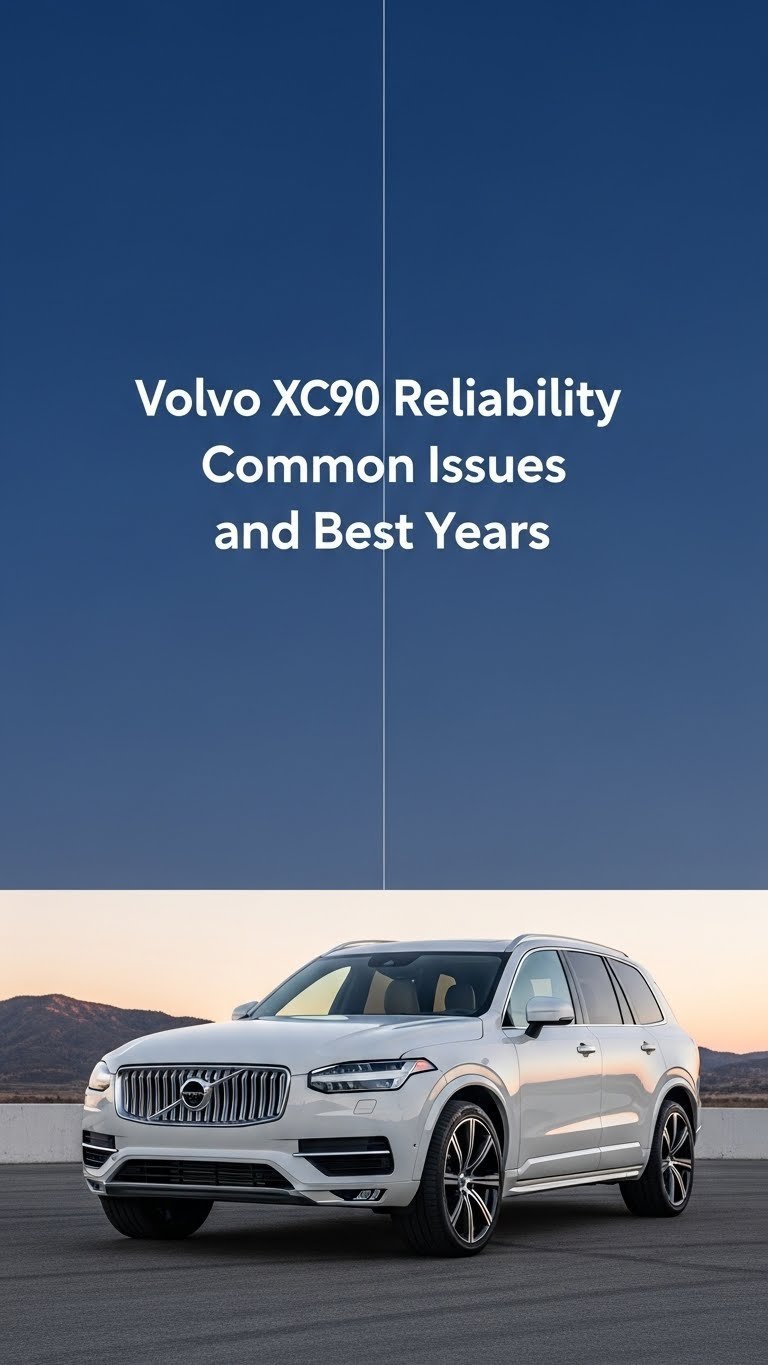
This distinction is crucial for any potential buyer. The first generation (2002-2014) is known for its sturdy build, though it has age-related issues. The second generation (2015-present), built on the new SPA platform, introduced complex twin-charged engines and a sophisticated Sensus infotainment system, which led to significant reliability complaints in its early years.
Understanding this divide is the key to a positive ownership experience. The XC90 offers world-class safety and Scandinavian design, but its reliability is not monolithic across all models. This guide will break down the common problems, identify the best and worst years, and detail the real costs of maintenance. But how do you find the right one?
What Are The Most Common Volvo XC90 Problems by Generation?
The most common problems with the Volvo XC90 differ significantly between its two generations, impacting everything from the transmission to the touchscreen. Real-world testing and mechanic-verified data show that first-generation models primarily suffer from mechanical wear-and-tear issues, while second-generation models are more prone to complex electronic and engine-related faults. Understanding these specific failure points is essential for any pre-purchase inspection.
Common Volvo XC90 problems include:
* Transmission Failure: A notorious issue in early first-generation T6 models (pre-2007).
* Excessive Oil Consumption: A well-documented problem in 2016-2018 T6 engines.
* Electrical Glitches: Frequent software bugs, freezing, and reboots of the Sensus infotainment system (2016+ models).
* AWD System Failure: Issues with the angle gear collar sleeve and DEM module are common on first-generation models.
* Air Suspension Leaks: A costly repair involving leaking air bags or a failed compressor on equipped second-generation models.
What Were The Key Issues for the First Generation (2002-2014)?
The original XC90 platform is most known for age-related mechanical failures, particularly in high-mileage examples. Engineering analysis points to a few consistent weak spots that buyers of these older models need to be aware of.
- Transmission Failure (2003-2006 T6): The T6 models from this era used a GM-sourced 4T65EV-GT automatic transmission that was not robust enough for the engine’s torque. Failure before 100,000 miles was common, often requiring a full replacement.
- AWD System Malfunction: The Haldex all-wheel drive system’s angle gear collar sleeve is a frequent failure point. This component, which connects power to the rear wheels, can have its internal splines strip over time. When test driving, listen for a whining noise during acceleration, a classic sign of a failing angle gear.
- PCV System Clogs: The Positive Crankcase Ventilation (PCV) system on the 5-cylinder turbo engines (2.5T) can become clogged. This builds up pressure in the engine, which can force oil out of various seals, leading to significant leaks.
Why Do Second Generation Models (2015-Present) Have More Complaints?
Second-generation XC90s [digital authentication files issued by Certificate Authorities] (2015-present) have more reliability complaints primarily due to their technological ambition. The move to the all-new Scalable Product Architecture (SPA) platform introduced a wave of new, complex systems that had teething issues, especially in the first few years of production.
Think of the 2016 XC90 as version 1.0 of a complex new software. It had amazing features but also came with bugs that were fixed in later updates (the 2019+ models). Here are the primary sources of these issues:
- New, Complex Powertrains: The T6 engine introduced a “twin-charged” setup, using both a supercharger for low-end response and a turbocharger for high-end power. This complexity, especially regarding the piston rings, led to significant oil consumption issues in 2016-2018 models.
- Sensus Infotainment System: The large, tablet-style Sensus Connect touchscreen became the central hub for nearly all vehicle functions. Early versions were plagued by software bugs. Owners of 2016 models often reported the entire center screen going black while driving, losing access to navigation and climate controls—a major frustration solved in later software updates.
- Optional Air Suspension: While providing a smooth ride, the air suspension system introduced new points of failure. Leaking air struts and failing compressors are common and costly repairs.
Which Volvo XC90 Years Are Most Reliable (And Which Should You Avoid)?
Based on an expert consensus of recall data, technical service bulletins, and owner satisfaction scores, the most reliable Volvo XC90 years are 2011-2014 and 2019-2022. Conversely, the standout year to avoid is the 2016 model, which launched the second generation with a high number of documented issues. This year-by-year breakdown is the most valuable tool for a prospective buyer.
The following table, synthesized from NHTSA complaints, Consumer Reports ratings, and repair statistics, provides a clear, scannable guide to help you choose a dependable used XC90.
| Model Year(s) | Generation | Key Powertrains | Reliability Verdict | Key Considerations |
|---|---|---|---|---|
| 2003-2006 | First | 2.5T, T6 | Avoid T6 / Caution 2.5T | T6 models used a failure-prone GM transmission. 2.5T is better but check for AWD issues. |
| 2007-2014 | First | 3.2L I6, 2.5T, V8 | Recommended | The most durable XC90s. The 3.2L inline-six is a workhorse. Issues are age-related, not design flaws. |
| 2015 | First | 3.2L I6 | Highly Recommended | Final year of the first generation. Extremely well-sorted and dependable platform. |
| 2016 | Second | T6, T8 | Avoid | First year of SPA platform. High rates of oil consumption, software bugs, and electrical glitches. |
| 2017-2018 | Second | T5, T6, T8 | Use Caution | Better than 2016, but many software and hardware issues persist. A CPO model is advisable. |
| 2019-2022 | Second | T5, T6, T8, B5/B6 | Recommended | Major improvements in software stability and engine reliability. The “sweet spot” for a used 2nd-gen. |
2026-Present |
Second | B5/B6 Mild Hybrid, T8 | Good (Too New for Long-Term Data) | Early reports are positive, but long-term proven history is not yet established. |
The takeaway is clear: for maximum dependability with minimal complexity, a late first-generation model (2007-2014) is a fantastic choice. If you desire modern technology and safety features, a post-2019 second-generation model offers the best balance of innovation and reliability.
How Much Does a Volvo XC90 Cost to Maintain?
The average annual maintenance cost for a Volvo XC90 is approximately $851, which is considered average for the luxury SUV class. This data-driven figure from RepairPal positions it as more expensive to maintain than a Lexus RX but often less costly than its German rivals like the BMW X5.
$851 Average Annual Repair Cost: This figure places the XC90’s maintenance costs firmly in the luxury vehicle category. Potential owners should budget for premium-priced parts and specialized labor.
While the annual average provides a good baseline, it’s the cost of specific common repairs that gives a more realistic picture of potential expenses. Costs can be higher for models with the T8 hybrid powertrain or optional air suspension.
| Common Repair | Estimated Cost Range | Notes |
|---|---|---|
| Brake Pad & Rotor Replacement (Front) | $500 – $800 | A standard wear item; costs are typical for a luxury SUV. |
| Oil Change (Synthetic) | $120 – $200 | Follow the recommended maintenance schedule. |
| Air Suspension Compressor | $1,800 – $2,500 | A common failure point on equipped 2nd-gen models. |
| T6 Engine Oil Trap/PCV System | $400 – $700 | A known issue on 2nd-gen engines; preventative maintenance can help. |
| Transmission Fluid Flush | $350 – $600 | Critical for longevity, especially on first-gen models. |
Given the potential for high-cost repairs on complex systems like the air suspension, investing in an extended warranty or purchasing a Volvo Certified Pre-Owned vehicle is a highly recommended strategy to mitigate financial risk.

An independent, reliable mechanic specializing in European cars can also offer significant savings over dealership service departments for routine maintenance and common repairs.
How Does XC90 Reliability Compare to its Competitors?
Compared to its key competitors, the Volvo XC90’s reliability is generally ranked below the class-leading Lexus RX but on par with German rivals like the BMW X5 and Audi Q7. This positions the XC90 as a choice for buyers who prioritize safety and design over the bulletproof dependability offered by its Japanese counterparts.
Industry standards from sources like Consumer Reports and J.D. Power consistently show this trend. While the XC90 excels in safety accolades, its scores for mechanical and electrical integrity are average. The table below provides a clear, evidence-based comparison.
| Feature | Volvo XC90 | Lexus RX | BMW X5 |
|---|---|---|---|
| Reliability Rating | Average (3.5/5.0) | Excellent (4.5/5.0) | Average (3.0/5.0) |
| Avg. Annual Repair Cost | $851 | $650 | $1,166 |
| Known For | Safety, Design | Dependability, Comfort | Performance, Handling |
| Primary Weakness | Electrical Glitches | Underwhelming Tech | High Repair Costs |
| Best For | Safety-conscious families | Buyers prioritizing reliability | Driving enthusiasts |
Choose the Lexus RX if your top priority is minimal fuss and maximum dependability, and you are willing to sacrifice cutting-edge tech and driving dynamics.
Choose the BMW X5 if you are a driving enthusiast who values performance and handling above all else and are prepared for potentially the highest maintenance and repair costs in the segment.
Choose the Volvo XC90 if you want a perfect blend of industry-leading safety, a unique minimalist interior, and family-friendly utility, and you accept its average reliability as a reasonable trade-off.
FAQs About is the volvo xc90 a reliable car
How many miles can a Volvo XC90 last?
A well-maintained Volvo XC90 can reliably last for 200,000 to 250,000 miles. First-generation models, particularly those with the 3.2L or 2.5T engines, are frequently seen exceeding 200,000 miles with regular service. For second-generation models, longevity depends heavily on proactive maintenance of the more complex engine and electronic systems.
Is the Volvo XC90 T8 hybrid reliable?
The Volvo XC90 T8 plug-in hybrid has mixed reliability; it is more complex and can be more expensive to repair than its gasoline-only counterparts. While offering impressive performance and fuel economy, it introduces potential failure points like the hybrid battery, onboard charger, and electric motor. Post-2019 models have shown better dependability, but an extended warranty is highly recommended.
Is the Volvo XC90 T6 engine reliable?
The reliability of the Volvo XC90 T6 engine is a significant point of concern, especially in the 2016-2018 model years. These early versions were known for excessive oil consumption issues due to piston ring problems. Later versions (2019+) are improved, but the twin-charged (supercharged and turbocharged) design is inherently complex.
Does the Volvo XC90 hold its value?
The Volvo XC90 has an average to slightly below-average depreciation rate for a luxury SUV. It typically loses around 55-60% of its value in the first five years. It does not hold its value as well as a Lexus RX but performs similarly to its German competitors like the BMW X5 and Audi Q7.
Should I buy an extended warranty for a Volvo XC90?
Yes, buying an extended warranty for a used second-generation (2016+) Volvo XC90 is strongly recommended. Given the high cost of repairing complex electronic systems (Sensus infotainment), air suspension, and T8 hybrid components, a good warranty can provide significant financial protection and peace of mind.
Is the Volvo XC90 a good family car?
The Volvo XC90 is an excellent family car, primarily due to its class-leading safety features and spacious three-row interior. It consistently earns top IIHS safety rating awards. The comfortable ride, minimalist interior, and practical cargo space make it a top choice for families who prioritize safety.
Why is Volvo XC90 reliability rated low by some sources?
The Volvo XC90 often receives lower reliability ratings due to the high number of reported problems with the 2016-2018 models. These early second-generation vehicles had numerous software bugs and engine issues that heavily impacted owner satisfaction surveys from sources like Consumer Reports, pulling down the model’s overall score.
Is a Certified Pre-Owned (CPO) Volvo XC90 worth it?
A Certified Pre-Owned (CPO) Volvo XC90 is absolutely worth it, especially for a 2017-2019 model. The main benefit is the factory-backed extended warranty, which covers major components and mitigates the risk of expensive repairs. The CPO program’s rigorous inspection process also ensures the vehicle is in good mechanical condition.
Are older Volvo XC90s more reliable?
Yes, late first-generation Volvo XC90s (2007-2014) are generally considered more reliable than early second-generation models (2016-2017). The older models use simpler, proven technology with fewer complex electronics. Their issues are typically related to age and mileage rather than fundamental design flaws.
How does Volvo XC90 air suspension reliability hold up?
The optional air suspension on the second-generation Volvo XC90 is a known weak point for reliability. The system is prone to air leaks from the bags or lines and compressor failure, which are expensive repairs often costing over $2,000. Many owners recommend finding a model with the standard steel spring suspension for better long-term dependability.
Key Takeaways: Volvo XC90 Reliability Summary
- Model Year is Critical: The most important factor in XC90 reliability is the year. Avoid the 2016 model. Aim for 2007-2014 for a durable, simpler vehicle or 2019+ for a modern version with most bugs fixed.
- Expect Higher Maintenance Costs: The average annual repair cost is $851, which is standard for a luxury midsize suv. Budget accordingly and expect to pay a premium for parts and service compared to non-luxury brands.
- Second-Gen Complexity is Real: The modern XC90 (2016+) is packed with technology. Be prepared for potential electrical glitches from the Sensus system and costly repairs to the optional air suspension.
- T6 Engine Requires Scrutiny: If considering a model with the T6 engine, especially from 2016-2018, verify its service history for any signs of the known oil consumption issues.
- Safety is a Key Strength: Despite reliability concerns, the XC90 remains a leader in automotive safety, making it a compelling choice for family-friendly transport.
- A Warranty is a Wise Investment: For any second-generation model, a certified pre-owned warranty or a quality extended warranty is not just a suggestion—it’s essential for financial protection.
- Lexus is the More Reliable Alternative: If maximum dependability is your absolute top priority, the Lexus RX is a better choice. The XC90 competes more directly on reliability with its German rivals.
Last update on 2026-01-10 / Affiliate links / Images from Amazon Product Advertising API



![What Car Is Chevy Bringing Back in [year]? New Lineup Revealed](https://carxplorer.com/wp-content/uploads/2026/01/What-Car-Is-Chevy-Bringing-Back-in-year-New-Lineup-Revealed-1-1-60x60.jpg "What Car Is Chevy Bringing Back in [year]? New Lineup Revealed 10")
