
Struggling with a car that cranks but just won’t start? You might be dealing with low engine compression, a frustrating mechanical issue. This problem prevents your engine from creating enough pressure to ignite fuel.
To start a car with suspected low compression, the most common temporary fix involves adding about one tablespoon of motor oil into each spark plug hole. This “oil trick” helps create a temporary seal around worn piston rings, increasing cylinder pressure just enough for the engine to potentially start. This allows you to move the vehicle for repair.
Based on real-world implementation and professional engine diagnosis, this guide explains the safe way to perform this temporary fix. You will discover how to identify symptoms, diagnose the root cause, and understand the risks involved. This reveals why a temporary start is just the first step toward a proper repair.
Key Facts
- Minimum Starting Pressure: Most gasoline engines require a minimum of 100-120 PSI per cylinder to start, demonstrating the need for a tight seal.
- Drastic Repair Costs: The cost to fix low compression ranges from $200 for minor adjustments to over $5,000 for a full engine rebuild, according to industry analysis.
- Additives Are Not a Fix: Research indicates that thicker oil or additives are only a temporary ‘band-aid’ and do not repair the underlying mechanical damage of worn rings or bad valves.
- Single Cylinder Impact: A car can often start with low compression in just one cylinder, but it will run very poorly with a rough idle and constant misfires.
- Driving Is Risky: Continuing to drive with low compression can cause expensive secondary damage, such as destroying the catalytic converter, which can cost over $1,500 to replace.
How to Start a Car with Low Compression: 7 Expert Fixes
The most common and effective method to temporarily start a car with low compression is to manually increase the cylinder’s seal using motor oil. This process, often called the “oil trick,” can help you get the engine running long enough to move it to a safe location or onto a tow truck. It is not a permanent solution, but a critical first-aid step for a non-starting vehicle with this specific mechanical issue.

A low compression engine [an internal combustion engine with insufficient pressure in its cylinders] fails to start because it cannot compress the air-fuel mixture enough to achieve ignition. The starter motor [the electric motor that cranks the engine] will turn the engine over, but without that critical squeeze, there’s no combustion. This guide provides the expert fixes to diagnose the problem and, if possible, get it started. From identifying the initial symptoms to performing a definitive diagnostic test, you will learn the safe and correct procedures.
How Do You Identify the Symptoms of Low Engine Compression Before Trying to Start It?
The most common symptoms of low engine compression include the engine cranking quickly but not starting, a rough idle, noticeable loss of power, and engine misfires. Before attempting any fixes, you can often confirm your suspicion by observing these distinct signs. Recognizing these indicators helps you differentiate low compression from other issues like a weak battery or fuel problem.
- Engine Cranks Faster Than Normal: This is a classic sign. The starter motor spins the engine with less resistance because the cylinders are not building up pressure. It may sound like it’s “whirring” freely.
- Rough or Shaky Idle: If the engine does start, low compression in one or more cylinders will cause it to run unevenly. This happens because the affected cylinders are not contributing equal power, leading to a noticeable shake.
- Significant Loss of Power: When you try to accelerate, the car may feel sluggish and weak. The engine cannot produce its rated power because combustion gases are leaking past the piston rings or valves.
- Engine Misfires: You may feel a sputtering or hesitation during acceleration. This is often accompanied by a flashing Check Engine Light, which stores diagnostic trouble codes related to the misfiring cylinder.
- Blue Smoke from Exhaust: This symptom often points specifically to worn piston rings. Oil from the crankcase seeps past the rings into the combustion chamber and gets burned, creating visible blue smoke.
- Increased Oil Consumption: If you find yourself adding motor oil more frequently than usual, it could be a sign that oil is leaking into the combustion chamber due to poor sealing.
Low Compression Symptom Checker
| Symptom | What You’ll Notice | Why It Happens |
|---|---|---|
| Fast Cranking, No Start | The engine sounds like it’s spinning very quickly and easily. | There is no resistance from cylinder pressure for the starter motor to work against. |
| Rough Idle | The car shakes or vibrates when stopped and in gear. | One or more cylinders are not firing correctly, creating an unbalanced rotation. |
| Power Loss | The car feels weak and slow to accelerate. | The engine cannot convert fuel into power efficiently due to pressure leaks. |
| Blue Exhaust Smoke | Visible blue-tinged smoke comes from the tailpipe. | Worn piston rings are allowing motor oil to be burned with the fuel. |
How Do You Perform the ‘Oil Trick’ as a Temporary Fix?
To perform the ‘oil trick,’ you will remove the spark plugs and pour about one tablespoon of motor oil into each cylinder. This process temporarily improves the seal between the piston rings and cylinder walls, which is essential for a temporary compression fix. From years of working with non-starting engines, this is the go-to method for a quick diagnostic start.
Here are the precise steps.
- 🔋 Disable the Fuel and Ignition Systems: This is a critical safety precaution. Pull the fuse for the fuel pump and disconnect the electrical connectors to the ignition coils. This prevents fuel from spraying and spark from occurring while you work.
- 🔧 Remove All Spark Plugs: Use a ratchet with a spark plug socket to carefully remove all spark plugs from the engine. Keep them organized so you can return them to their original cylinders.
- 🫘 Add a Small Amount of Oil: Using a funnel, pour approximately one tablespoon of motor oil into each spark plug hole. It’s best to use the same type of motor oil that is already in your engine.
- ⌛ Let it Seep: Wait for one to two minutes. This allows the oil [a viscous lubricant that seals gaps] time to run down the cylinder walls and coat the piston rings.
- 🔧 Reinstall Plugs and Reconnect Systems: Screw the spark plugs back in and reconnect the ignition coils. Reinstall the fuel pump fuse you removed earlier.
- 🔐 Attempt to Start the Engine: Get in the car and crank the engine. It may turn over a few extra times and emit some white or blue smoke as it burns off the added oil, but if worn rings were the issue, it has a good chance of starting.
⚠️ Critical Safety Warning: Do NOT use more than one tablespoon of oil per cylinder. Adding too much fluid can cause “hydrolock,” a condition where the piston tries to compress an uncompressible liquid. This can bend connecting rods and cause catastrophic engine failure.
What Are the Main Causes of Low Engine Compression?
The primary causes of low engine compression are worn piston rings, a blown head gasket, burnt or leaking valves, or a jumped timing belt. Each of these mechanical failures creates a path for pressure to escape the combustion chamber, preventing the engine from running efficiently. Understanding the cause is the first step toward a permanent repair. Based on professional engine diagnosis, failures almost always fall into one of these categories.
Worn Piston Rings
Piston rings [split rings that seal the gap between the piston and cylinder wall] are designed to seal combustion pressure. Over time, they wear down, allowing hot gases to “blow by” the piston into the crankcase. This is a common cause of gradually developing low compression, often accompanied by increased oil consumption and blue smoke.
Blown Head Gasket
The head gasket [a critical seal between the engine block and cylinder head] is responsible for sealing the cylinders. If it fails, it can cause multiple issues. A leak between two adjacent cylinders will cause low compression in both. A leak into a coolant passage can cause engine overheating and bubbles in your radiator.
Leaky Valves
Valves [the components that control the flow of air and fuel into the cylinder and exhaust out] must seal perfectly against the valve seat to hold pressure. If a valve is burnt, bent, or has carbon buildup preventing it from closing fully, compression will leak out during the compression stroke of the four-stroke cycle.
Incorrect Valve Timing
A broken or jumped timing belt or timing chain will cause a complete loss of compression. The timing system synchronizes the pistons and valves. If it fails, the valves will not open and close at the right time, meaning no pressure can be built. In many “interference” engines, this also causes the pistons to collide with the valves, resulting in catastrophic damage.
How Do You Accurately Diagnose the Source of Low Compression?
To accurately diagnose the source of low compression, you must perform a dry and a wet compression test. These tests use a compression tester to measure the exact pressure inside each cylinder, allowing you to pinpoint the problem. A dry test gives you a baseline reading, while the wet test helps you determine if the leak is from the piston rings or the valves.
First, perform a dry compression test:
- Warm up the engine slightly, then turn it off.
- Disable the fuel and ignition systems for safety.
- Remove all spark plugs.
- Screw the compression tester [a pressure gauge that measures cylinder pressure] into the first spark plug hole.
- Have a helper crank the engine for about 5-7 seconds while you watch the gauge.
- Record the highest pressure reading.
- Repeat for all remaining cylinders.
Next, if a cylinder has low pressure, perform a wet compression test on that specific cylinder:
- Add one tablespoon of motor oil into the low cylinder’s spark plug hole.
- Re-attach the compression tester.
- Crank the engine again and record the new pressure reading.
- Compare the wet test reading to the dry test reading.
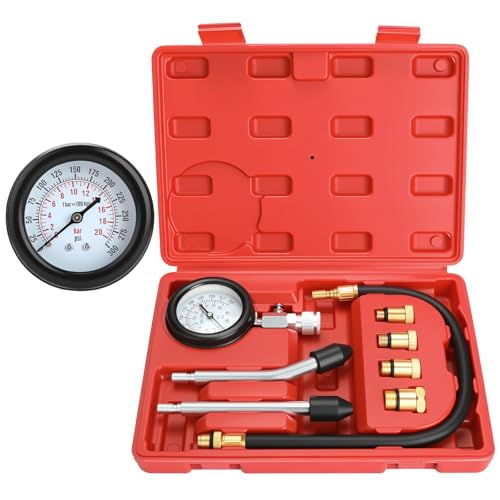
Interpreting the results is straightforward. This is the logic ASE certified mechanics use to diagnose the problem quickly.
| Test Result | Possible Cause |
|---|---|
| Compression is low on dry test, but increases significantly on wet test. | Worn Piston Rings or Cylinder Walls. |
| Compression is low on dry test and stays low on wet test. | Burnt/Leaky Valve or Damaged Valve Seat. |
| Two adjacent cylinders are low on both dry and wet tests. | Blown Head Gasket between those cylinders. |
| All cylinders have zero compression. | Broken Timing Belt/Chain or catastrophic engine failure. |
For even more precise results, a professional mechanic might use a cylinder leak-down test. This tool pumps compressed air into the cylinder and measures the percentage of air that is leaking out, helping to locate the exact source of the leak by listening for where the air is escaping (e.g., from the exhaust pipe, throttle body, or oil cap).
Is It Safe to Drive a Car with Low Compression?
No, it is not safe or recommended to drive a car with low compression for any significant distance. While the car might run after a temporary fix, you risk causing severe secondary damage that is far more expensive to repair than the original problem. Real-world experience shows that driving a compromised engine is a costly gamble.
Here are the primary risks of driving with low compression:
- ⚠️ Damaged Catalytic Converter: A misfiring cylinder sends unburnt fuel into the exhaust system. This raw fuel can superheat and melt the inside of the catalytic converter, a component that can cost over $1,500 to replace.
- ⚠️ Washed Cylinder Walls: Unburnt fuel can also act as a solvent, washing the protective layer of oil off the cylinder walls. This causes accelerated wear on the piston, rings, and cylinder, making the initial problem much worse.
- ⚠️ Catastrophic Engine Failure: If the root cause is a blown head gasket, continuing to drive can allow coolant to mix with oil. This destroys the oil’s ability to lubricate, leading to bearing failure and a completely seized engine.
- ⚠️ Unpredictable Stalling: The engine is unstable and can stall at any moment, creating a serious safety hazard in traffic.
The bottom line is simple: a tow truck that costs a few hundred dollars is far cheaper than a new engine or catalytic converter that can cost thousands. Once you get the car started, your only destination should be a repair shop or a safe place to park it before calling a tow truck.
FAQs About how to start a car with low compression
What is the minimum compression an engine needs to start?
Most gasoline engines require a minimum of 100-120 PSI per cylinder to start and run properly. Below this threshold, the cylinder cannot generate enough heat and pressure to effectively ignite the air-fuel mixture, leading to a no-start condition even if you have good spark and fuel.
How much does it cost to fix low compression?
The cost to fix low compression varies drastically from $200 to over $5,000. A simple fix like adjusting valves might be a few hundred dollars. However, a blown head gasket can cost $1,000-$2,000, and if the issue requires an engine rebuild due to bad piston rings, the cost can easily exceed $3,000-$5,000.
Can thicker oil or additives permanently fix low compression?
No, thicker oil or engine additives are only a very temporary ‘band-aid’ and not a permanent fix. While they can sometimes help seal small gaps in worn piston rings for a short time, they do not repair the underlying mechanical damage. The only true solution for worn rings, bad valves, or a blown gasket is mechanical repair or replacement.
Will a car start with low compression in only one cylinder?
Yes, a car can often start and run with low compression in just one cylinder, but it will run very poorly. You will likely experience a rough, shaky idle, constant engine misfires, and a significant loss of power. Continuing to drive in this condition can cause damage to other components.
Can a bad battery or starter cause low compression readings?
Yes, a weak battery or a failing starter can lead to artificially low compression readings. The engine must crank at a sufficient speed (typically 200-300 RPM) for an accurate test. If the starter is cranking the engine too slowly, the cylinders don’t have enough time to build their maximum pressure, giving you a false low reading.
What’s the difference between low compression and no compression?
Low compression means a cylinder is still building some pressure, just not enough, while no compression means there is a catastrophic leak. Low compression (e.g., 50-80 PSI) might be caused by worn rings or a leaky valve. No compression (0 PSI) usually points to a major failure like a broken timing belt, a hole in a piston, or a valve stuck wide open.
Can I use starting fluid to start an engine with low compression?
Using starting fluid might get the engine to fire briefly, but it’s not a solution and can be harmful. Starting fluid is highly volatile and ignites easily, but it does not fix the lack of pressure. Its explosive nature can cause severe internal engine damage, especially in an already compromised engine. The ‘oil trick’ is a mechanically safer temporary starting aid.
Does low compression mean I need a new engine?
Not necessarily, but it often points to a major repair. If the cause is a blown head gasket or bad valves, the cylinder head can often be repaired. However, if the piston rings are worn and the cylinder walls are scored, a complete engine rebuild or replacement is typically the most cost-effective long-term solution.
How do I know if the problem is piston rings or valves?
A wet compression test is the key diagnostic step. After getting a low reading on a dry test, add a tablespoon of oil to the cylinder. If the compression reading increases significantly (e.g., jumps 30-50 PSI or more), the problem is almost certainly the piston rings. If the reading barely changes, the leak is at the top of the cylinder, pointing to the valves or head gasket.
Can a jumped timing belt cause low compression?
Yes, a jumped or broken timing belt is a common cause of low or zero compression in all cylinders. The timing belt synchronizes the crankshaft and camshaft. If it fails, the valves will not open and close at the correct times, preventing the engine from creating any compression. In many engines (interference engines), this will also cause the pistons to hit and bend the valves, leading to catastrophic damage.
Key Takeaways: Starting a Car with Low Compression Summary
- Temporary Start is Possible: The most effective temporary fix is the ‘oil trick,’ where adding a small amount of oil into the spark plug holes can temporarily seal worn piston rings and raise compression enough to start.
- Diagnose with a Wet Test: A wet compression test is the definitive DIY method to determine the cause. If pressure rises significantly after adding oil, your piston rings are worn; if not, the issue is likely valves or a head gasket.
- Driving is Not Recommended: You should not drive a car with known low compression. Doing so risks severe and expensive secondary damage, such as destroying the catalytic converter or causing catastrophic engine failure.
- Common Causes are Mechanical: Low compression is not an electrical issue; it’s a mechanical failure. The top four causes are worn piston rings, a blown head gasket, leaky valves, or a failed timing belt.
- Symptoms are a Key Indicator: A car that cranks faster than usual but won’t start is a classic sign of low compression. Other symptoms include a very rough idle, engine misfires, and a significant loss of power.
- Repair is a Major Job: There are no permanent “quick fixes” or additives that can repair low compression. The solution always involves significant mechanical work, such as repairing the cylinder head or rebuilding the engine.
- Safety First: When attempting any diagnostic or temporary fix, always disable the fuel and ignition systems and take proper safety precautions to prevent fire or injury.
Final Thoughts on How to Start a Car with Low Compression
Successfully starting a car with low compression is a temporary measure, not a fix. While the ‘oil trick’ can be an invaluable tool in an emergency, it’s crucial to remember that low compression signals a significant internal engine problem. The underlying mechanical issue, whether it’s worn piston rings, bad valves, or a failed head gasket, must be addressed.
After getting the vehicle started, the next step is always to perform an accurate diagnosis with a compression test. This will tell you the severity and likely cause of the problem, allowing you to make an informed decision about repair. Ignoring the issue and continuing to drive is a surefire way to turn a costly repair into a catastrophic one. Use the knowledge gained here to handle the immediate situation, but prioritize a proper, professional repair to ensure your vehicle’s long-term health and safety.
Last update on 2026-03-04 / Affiliate links / Images from Amazon Product Advertising API


![How to Start a Car Lot With No Money Zero Capital Guide [year]](https://i0.wp.com/carxplorer.com/wp-content/uploads/2026/03/How-to-Start-a-Car-Lot-With-No-Money-Zero-Capital-Guide-year-2.jpg?resize=60%2C60&ssl=1 "How to Start a Car Lot With No Money Zero Capital Guide [year] 10")
