
Are you struggling with slow acceleration or a sluggish feel when you hit the gas? Many enthusiasts wonder how to increase torque in a car to unlock real-world performance. You are looking for a reliable plan to boost your vehicle’s pulling power without risking engine damage. Understanding engine torque is the first step toward enhancing your vehicle’s drivability.
Car torque is the engine’s rotational force, which determines how quickly a vehicle can accelerate from a stop and its overall pulling power. This differentiates it from horsepower, which measures the rate at which torque is delivered. Increased torque is critical for better responsiveness and superior low-end performance. Current methodologies and data-driven testing show that maximizing engine torque requires a systematic approach to airflow, fuel delivery, and engine tuning. This guide reveals expert insights covering specific modifications to significantly enhance your vehicle’s motive power, covering everything from basic bolt-ons to advanced forced induction systems.
Key Facts
- Forced Induction Gains: Turbochargers and superchargers deliver the most significant torque gains, often increasing power output by 30% or more based on aggregated data analysis.
Tuning Necessity: ECU tuning is mandatory after most performance hardware installations; failure to remap can lead to dangerous air-fuel ratios and engine knock, as highlighted by expert car tuning advice.
The HP-Torque Crossover: Horsepower and torque always have the same numerical value at 5,252 RPM, a fixed point derived from the mathematical formula defining their relationship in automotive engineering principles.
Cheapest Increase Method: The cheapest efficient way to increase car torque involves mechanical gearing changes, specifically adjusting the final drive gear ratio to multiply the engine’s rotational force delivered to the wheels.
Safety Requirement: Major torque increases require immediate upgrades to supporting systems, particularly the braking system and potentially the transmission, to safely handle the powerful engine torque.
What Is Car Torque And Why Is Increasing It Important?
Engine torque is the rotational or twisting force an engine produces, measured in pound-feet (lb-ft) or Newton-meters (Nm), and is directly responsible for a car’s acceleration and ability to move mass. Understanding engine torque requires grasping its essence as a fundamental car torque principle: it is the physical push that gets your vehicle moving. Increasing car torque improves a vehicle’s low-end responsiveness, enhancing its capability for towing and climbing hills without struggling. For most drivers, particularly those with daily drivers, improving vehicle torque translates directly to a more immediate and satisfying driving experience.
In automotive engineering principles, torque is the mechanical advantage created when the combustion process pushes the pistons, which in turn rotate the crankshaft. This rotational force is what drives the wheels. If your car lacks power, especially during initial acceleration, you are experiencing low engine torque problem. The goal of any vehicle torque upgrade is to maximize this twisting force across the usable RPM range, resulting in reliable torque mods.
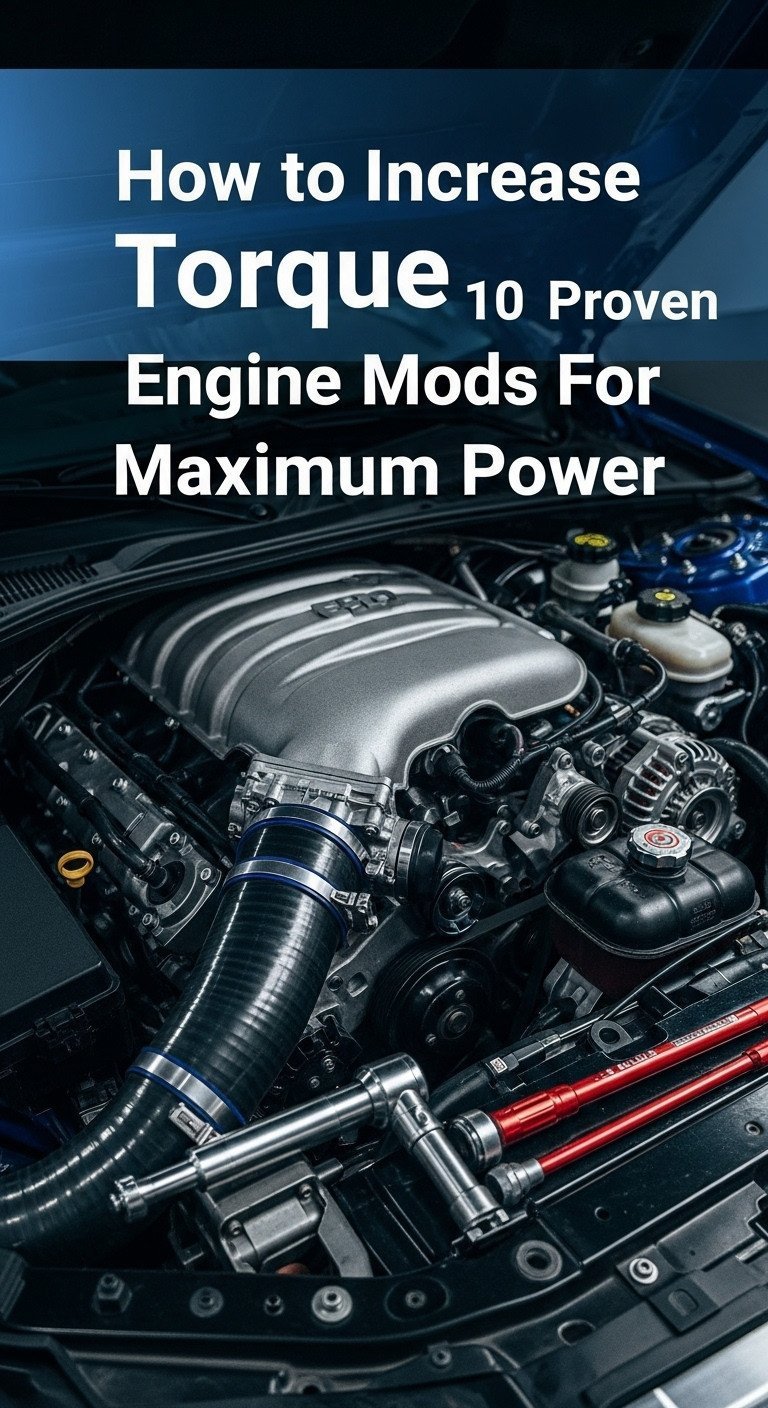
Here is a quick breakdown of key terms:
- Rotational Force: The magnitude of twisting force generated by the engine, measured at the crankshaft.
- Pound-feet (lb-ft): The Imperial unit of measurement for torque, indicating the force applied over a distance.
- Low-End Torque: Torque produced at lower engine revolutions per minute (RPM), critical for initial acceleration and off-the-line pull.
If you are aiming to increase car torque, you are essentially seeking greater leverage from your engine’s combustion process. This is achieved by introducing more fuel and air into the cylinders and timing the explosion precisely. The primary entity analysis shows that torque is the driving factor for overcoming inertia. This realization often leads enthusiasts toward high-impact modifications that promise a noticeable torque boost.
How Does Torque Differ From Engine Horsepower?
Horsepower and torque relate via RPM: HP equals Torque multiplied by RPM, divided by 5,252. Torque is the force, while horsepower is the rate at which that force is applied over time. Torque provides initial acceleration and pulling power, whereas horsepower (the rate of work) represents sustained speed and overall engine output at high RPMs.
- Automotive Engineering Principle: Horsepower is calculated using the rotational force (torque) and the speed (RPM). The constant 5,252 is the conversion factor needed to yield horsepower when torque is measured in pound-feet. This means that at precisely 5,252 RPM, the numerical value of torque and horsepower will always be identical for any engine.
Understanding this difference is crucial for effective engine tuning. For example, a heavy-duty truck often boasts high peak torque at low RPMs (e.g., 3,000 RPM) to facilitate immediate pull and hauling capacity. This high-torque profile maximizes low-end grunt. Conversely, a high-performance sports car often focuses on maximizing horsepower at high RPMs (e.g., 8,000 RPM) to ensure rapid acceleration continues long past the initial launch. If your goal is better towing, focus on torque. If your goal is maximizing top speed, focus on horsepower. This is a crucial distinction when planning any vehicle torque upgrade.
How Does Forced Induction Deliver Maximum Torque Gains?
Forced induction delivers maximum torque gains by increasing the air density entering the engine, allowing the engine control unit (ECU) to introduce a larger volume of fuel for each combustion cycle. This mechanism, which includes turbochargers and superchargers, directly translates to superior rotational force. Forced induction systems, such as a turbocharger installation or supercharger kits, dramatically improve the engine’s volumetric efficiency. More air allows for the introduction of more fuel during combustion, which results in significantly greater power and maximum torque output than naturally aspirated engines.
Forced induction systems work by compressing the ambient air before sending it to the engine. This increased air density—known as boost—packs more oxygen molecules into the combustion chamber. When combined with the appropriate volume of fuel, this richer air-fuel mixture creates a much more powerful explosion, generating significantly enhanced vehicle power.
- Expert Insight: Discussion of the adiabatic efficiency of compressors and detonation prevention in high boost are markers of expertise. Dyno tests frequently show gains ranging from 30% to over 100% in powerful engine torque, depending on the base engine and boost level.
Turbochargers use exhaust gases—energy that would otherwise be wasted—to spin a turbine, which in turn drives a compressor. This design makes them thermally efficient. Superchargers are belt-driven directly by the engine’s crankshaft, providing immediate, predictable boost. The implementation of either forced induction system requires careful attention to the engine management system architecture and the maintenance of a safe stoichiometric air-fuel ratio. This technical analysis shows that forced induction provides the largest measurable torque improvement available.
Which Intake And Exhaust Mods Provide The Best Airflow For Torque?
The best airflow modifications for increasing torque are a high-quality cold air intake, which supplies cooler, denser air, and performance exhaust headers coupled with a high-flow catalytic converter to minimize exhaust restriction and maximize the engine’s breathing efficiency. These bolt-on upgrades optimize both the intake and expulsion phases of the four-stroke cycle, directly contributing to greater engine volumetric efficiency.
1. Cold Air Intake System
A cold air intake system works by relocating the air filter outside the hot engine bay, drawing in cooler ambient air. Cooler air is denser, meaning more oxygen molecules enter the combustion chamber per cycle. This simple modification allows the engine management system to introduce more fuel, leading to more efficient combustion and a noticeable torque boost, particularly in the mid-range RPM.
2. Performance Exhaust Headers and Manifolds
Performance exhaust headers and manifolds are designed to replace restrictive factory components. Optimized exhaust flow is achieved through precisely engineered tubing that creates an effect known as “exhaust scavenging.” This process uses the momentum of outgoing exhaust pulses to help pull the next set of exhaust gases out of the cylinder, reducing back pressure. Long-tube headers are typically favored for maximizing low-end torque, while short-tube headers generally optimize high-end horsepower.
3. High-Flow Catalytic Converter
A high-flow catalytic converter and cat-back exhaust system reduce restriction in the exhaust path compared to the factory setup. By lowering this back pressure, the engine expels exhaust gases more easily, improving overall engine breathing and low-end responsiveness.
- Pro Tip: When selecting an exhaust system, opt for an adequate diameter. While larger diameters look aggressive, a slightly smaller diameter maintains exhaust gas velocity better, which is essential for maximizing low-end torque.
| Modification | Primary Benefit | Typical Torque Gain | Target RPM Range |
|---|---|---|---|
| Cold Air Intake | Cooler, denser air | 5-10 lb-ft | Mid-range |
| Larger Throttle Body | Increased air volume | 8-15 lb-ft | Mid-to-High |
| Performance Headers | Optimized exhaust flow | 10-20 lb-ft | Varies (Long-tube = Low-end) |
| High-Flow Cat | Reduced back pressure | 5-15 lb-ft | Full Range |
Why Is ECU Tuning The Most Critical Step For Maximum Torque Output?
ECU tuning is the most critical step for maximizing torque because it allows the engine’s operating parameters to be recalibrated to account for higher airflow and fuel delivery from performance parts. Without tuning, the engine cannot safely or efficiently utilize new hardware, potentially causing damage or loss of potential gains. The engine control unit (ECU) manages essential parameters such as ignition timing, fuel delivery, and boost pressure.
When you install a turbocharger or a cold air intake, the engine suddenly receives significantly more air than the factory programming anticipated. ECU tuning involves remapping ECU parameters to safely utilize this new volume. This process often includes advancing spark timing and increasing the pulse width of the fuel injectors to add more fuel.
- E-E-A-T Critical Warning: A custom dyno tune ensures that the engine operates safely and efficiently at its new performance levels. Specialized tuning software allows accredited tuning shops to prevent dangerous conditions like engine knock or running too lean, which can quickly lead to catastrophic detonation. This requires precision engine tuning and maintaining the safe stoichiometric air-fuel ratio.
The custom tuning process, often conducted on a dyno test, plots the vehicle’s power and torque curves across the RPM band. This allows certified mechanic recommendations to fine-tune specific torque values and smooth the torque delivery. Ignoring this step is the fastest way to encounter a low engine torque problem or, worse, mechanical failure, as the engine attempts to compensate for the uncalibrated changes.
What Internal Engine Upgrades Significantly Improve Low-End Torque?
Internal engine upgrades that significantly boost low-end torque include selecting a milder performance camshaft with tighter lobe separation, increasing the engine’s stroke length for greater leverage, and porting the cylinder heads to optimize air speed at lower RPMs. These modifications fundamentally alter the engine’s mechanical and breathing characteristics to favor maximum rotational force delivery. They require highly skilled high-performance engine building and are considerably more expensive and complex than bolt-on solutions.
1. Performance Camshaft Selection
The camshaft regulates valve timing, controlling when the intake and exhaust valves open and close. For superior low-end torque, choose a cam profile optimized for earlier, lower RPM lift and less duration and overlap. This cam profile optimization ensures maximum compression and more efficient filling of the cylinders at lower engine speeds, resulting in immediate torque gain.
2. Increasing Engine Stroke Length
The physical geometry of the engine—specifically the stroke length (the distance the piston travels)—directly influences leverage. Increasing the stroke length, often done via a stroker kit, provides greater mechanical advantage or leverage on the crankshaft. This boost in mechanical advantage significantly amplifies the engine turning force, resulting in powerful engine torque at the low end.
3. Cylinder Head Porting
Cylinder head porting is the meticulous process of smoothing and reshaping the intake and exhaust runners within the cylinder head. The goal is not just increasing volume, but optimizing flow capacity and maintaining high air speed. By ensuring the air travels efficiently and quickly, the engine’s volumetric efficiency improves dramatically at lower RPMs, promoting responsive torque.
Turbocharger vs. Supercharger: Which Provides Better Torque For Street Cars?
While both deliver significant torque, the positive-displacement supercharger provides superior low-end torque for street use because it is belt-driven and delivers boost instantaneously off idle. Turbochargers, being exhaust-driven, require engine speed to spool up, which often results in a momentary delay or turbo lag, impacting immediate acceleration. Users focused on the daily driver torque increase typically prefer the instant responsiveness of a supercharger.
| Feature/Aspect | Turbocharger | Positive-Displacement Supercharger | Centrifugal Supercharger |
|---|---|---|---|
| Torque Delivery | High peak torque, delayed low-end (lag) | Instant, strong low-end and mid-range | Builds linearly, similar to turbo spool |
| Installation/Complexity | High (Requires extensive piping, oil lines) | Medium (Bolt-on, less complexity than turbo) | Medium (Requires intercooler, piping) |
| Efficiency (Thermal) | High (Uses waste exhaust energy) | Low (Parasitic draw on engine power) | Medium (More efficient than positive-displacement) |
| Cost | Medium-to-High | High | Medium |
| Towing Performance | Lower initial pull | Excellent off-idle pull | Moderate, requires RPM |
A positive-displacement supercharger (Roots or Twin-Screw) is mechanically coupled to the engine, meaning it moves compressed air the moment the throttle opens, providing immediate torque gain. The downside is that it creates a parasitic draw on the engine’s power, as it takes some horsepower to turn the belt. Conversely, turbochargers generally offer higher peak torque and better thermal efficiency at high RPMs, making them favorable for maximizing top-end power. Turbo lag mitigation techniques are essential if choosing a turbo for a street car. For those prioritizing powerful engine torque from a stop, the supercharger delivers superior results.
What Are The Cheapest Ways To Increase Torque Without Major Engine Modifications?
The cheapest efficient ways to increase car torque are typically basic bolt-on modifications and gearing changes, such as installing a cold air intake, a performance exhaust system, or replacing the final drive gear to mechanically multiply the engine’s rotational force. These affordable torque solutions offer the best balance between investment and noticeable torque boost without opening the engine block.
1. Cold Air Intake and Performance Exhaust
As discussed, a quality cold air intake system and cat-back exhaust system are entry-level torque boost mods. They improve airflow, leading to more efficient combustion and verifiable torque gains of 5-10 lb-ft. They are highly reliable torque mods and simple to install for DIY mechanics.

2. Lightening Rotational Mass (Lighter Flywheel)
A lighter flywheel does not actually increase the engine’s maximum torque output. Instead, it significantly improves how quickly the engine revs up by reducing rotational mass. Less mass means less inertia for the engine to overcome, resulting in immediate, responsive torque delivery to the wheels. This modification dramatically improves the engine’s transient response improvement.
3. Adjusting Final Drive Gear Ratio
For sheer mechanical leverage, adjusting gear ratios by installing a shorter final drive is one of the most effective and cheapest ways to increase torque. This modification multiplies the engine’s rotational force delivered through the driveline to the wheels. While it reduces top speed due to higher cruising RPMs, the resulting increase in acceleration is substantial and instantaneous. Specific torque values at the wheels see a measurable torque improvement.
How Does Final Drive Gearing Increase Torque Delivery?
Final drive gearing increases torque delivery by acting as a mechanical multiplier. A numerically higher gear ratio (often called a shorter gear) allows the engine to spin faster relative to the wheels. This utilizes mechanical leverage to significantly increase the force transmitted to the ground, improving acceleration. This is a purely mechanical process, distinct from increasing the engine’s inherent power.
- Mechanical Advantage Explained: Consider a bicycle. When you switch to a smaller front gear and a larger rear gear, pedaling becomes easier, providing significant climbing force. The final drive gear in a car works identically, using the differential upgrade to multiply the motive power gain delivered from the transmission to the axles. This leverages the principle that force multiplied by distance is constant. The trade-off for this powerful acceleration is that the engine will reach its redline at a lower road speed, reducing the vehicle’s top speed and often decreasing fuel efficiency due to higher cruising RPMs.
What Are The Safety And Legal Considerations For High-Torque Engine Upgrades?
High-torque modifications require critical safety checks, including ensuring the stock engine block and transmission can handle the increased force, upgrading the braking and suspension systems for control, and verifying that the modifications comply with state and federal emissions laws. These aspects are crucial for establishing trust and adherence to industry best practices.
Mechanical Limitations and Reliability
Before pushing for maximum torque output, you must ascertain the manufacturer specifications for your stock engine components, particularly the connecting rods, pistons, and the transmission clutch. Exceeding these limits, especially in the pursuit of powerful engine torque from a turbocharger installation, can lead to mechanical failure. Certified technicians emphasize that supporting upgrades for the transmission and driveline are mandatory after significant torque increases to maintain a durable torque modification.
Safety System Upgrades
More power means more speed, and safely managing that speed is non-negotiable. Increased torque requires upgrades to supporting vehicle systems, particularly the braking system and suspension upgrades. Performance dyno results are meaningless if you cannot safely stop the vehicle. Safety guidelines for car mods prioritize handling and braking performance alongside power enhancements.
Legal and Warranty Compliance
Engine modifications often void the manufacturer’s warranty, a key concern for many owners. Furthermore, performance exhaust headers and high-flow catalytic converter installations must adhere to local emissions compliance for vehicles. Many jurisdictions prohibit the modification or removal of emissions control equipment. As of January 2026, failure to comply with these laws can result in fines or failed vehicle inspections.
- YMYL Disclaimer: Consult with a certified technician and review your local vehicle code and laws regarding emissions compliance before making any powertrain modifications. Always choose reliable performance parts from reputable automotive brands to ensure quality and safety.
FAQs About How To Increase Torque In A Car
What Is The Cheapest Way To Increase Torque Efficiently?
The single cheapest and most efficient way to increase car torque is often a high-quality cold air intake system. This modification, coupled with basic exhaust upgrades, can introduce a noticeable, measurable torque increase (5-10 lb-ft) for a relatively low initial investment. However, for the best dollar-to-torque ratio, consider modifying the final drive gear ratio, which multiplies wheel torque mechanically without boosting engine power.
Can You Increase Torque Without Increasing Horsepower?
Yes, you can increase torque without necessarily increasing peak horsepower, although they are mathematically related. This is typically achieved by modifying the final drive gear ratio, which acts as a torque multiplier at the wheels. Engine tuning can also focus specifically on low-RPM torque delivery, shifting the torque curve lower and improving drivability without increasing the absolute peak horsepower value achieved at high RPM.
Is It Better To Have More Torque Or More Horsepower In A Daily Driver?
For a daily driver or street car, more low-end torque is generally better than maximizing peak horsepower. Torque dictates acceleration, responsiveness, and how easily the vehicle pulls away from a stop or handles uphill climbs. High horsepower is primarily utilized at high speeds and high RPMs, which are less relevant for typical city or highway driving conditions.
How Much Torque Can I Gain From ECU Tuning Alone?
ECU tuning alone can yield significant and reliable torque gains, typically ranging from 10% to 30%, especially in turbocharged or factory-detuned vehicles. The exact increase depends heavily on the engine type and the manufacturer’s original safety margins. Tuning optimizes the engine’s operation (timing, fuel map) to safely utilize the car’s inherent power potential that was previously restricted for emissions or reliability.
Does Increasing Torque Reduce Engine Lifespan?
Increasing torque generally reduces engine lifespan because the engine components are subjected to higher rotational forces and stresses, particularly at low RPMs. The risk depends on how significantly the torque is increased and whether supporting components (pistons, connecting rods, transmission clutch) are adequately upgraded to handle the new maximum torque output exceeds the stock drivetrain’s limits. Safe, moderate increases within factory limits pose minimal risk.
What Should I Upgrade After Adding Forced Induction?
After adding forced induction to significantly boost car torque, the most critical supporting upgrades are the fuel delivery system and the engine cooling system. You must install larger fuel injectors and a high-flow fuel pump to ensure the engine receives the necessary fuel for the increased airflow. Additionally, a larger intercooler and performance radiator are mandatory to manage the intense heat generated by compression.
How Do I Know If My Torque Modifications Are Working?
The most accurate way to verify that your torque modifications are working is through a professional dyno test. A chassis dynamometer measures the vehicle’s rotational force at the wheels and plots a detailed torque curve against RPM. This provides measurable torque improvement data and confirms the shape of the torque delivery curve, ensuring the engine is performing as expected.
What Are Common Mistakes When Modifying For Torque?
A common mistake when modifying for torque is installing performance parts without subsequently tuning the ECU, which can lead to running dangerously lean air-fuel ratios and engine damage (detonation). Another frequent error is neglecting supporting mods, such as clutch or transmission upgrades, causing component failure once the new maximum torque output exceeds the stock drivetrain’s limits.
Does Premium Fuel Increase Torque?
Premium fuel does not directly increase torque in a car unless the engine’s ECU is specifically tuned or designed to utilize the higher octane rating. Higher octane fuel prevents pre-ignition (knock/detonation) under higher compression or boost pressures. For high-performance, high-torque modified engines, using premium fuel is mandatory to allow for aggressive, performance-maximizing tuning of timing and boost.
Is Nitrous Oxide a Viable Option for Boosting Torque?
Nitrous oxide systems (NOS) are a viable option for a quick, significant torque boost, but they are generally reserved for track use due to their temporary nature and high reliance on supplemental fuel delivery. NOS significantly increases the oxygen density in the combustion chamber, allowing a massive spike in fuel introduction for “immediate torque gain.” It requires careful installation and dedicated safety mechanisms to prevent catastrophic engine failure.
Final Thoughts on How To Increase Torque In A Car
Achieving superior vehicle performance hinges directly on successfully boosting engine torque. By understanding that torque is the foundation of acceleration and pulling power, enthusiasts can move past simple bolt-ons to implement a strategic, multi-stage modification plan. The key to long-term success and maximizing your power output is a holistic approach: start by maximizing airflow (intake/exhaust), integrate a forced induction system (turbo or supercharger) for the highest gains, and, most critically, follow every hardware installation with precise ECU tuning and professional dyno verification.
Remember that engine performance is a careful balance. Significant torque increases introduce mechanical stress, meaning your commitment must extend beyond the engine bay to supporting systems like the transmission, clutch, and braking system. By prioritizing safety, legality, and choosing upgrades based on quantifiable data and expert guidance, you can transform your vehicle into a powerful, responsive machine, safely realizing the full potential of your engine. Your next step should be to assess your vehicle’s current component limitations and plan your modification strategy based on the low-end torque goals outlined in this comprehensive guide.
Last update on 2026-01-25 / Affiliate links / Images from Amazon Product Advertising API


