
Wondering how thick your garage floor needs to be for a car lift? You’re right to be cautious; this is a critical safety question. Getting this wrong can lead to catastrophic equipment failure.
For most standard two-post car lifts (up to 10,000 lbs), the absolute minimum concrete thickness required is 4 inches of 3,000 PSI reinforced concrete; however, a thickness of 6 inches with 4,000 PSI concrete and rebar reinforcement is the widely recommended standard for optimal safety and long-term structural integrity. This stronger foundation provides a vital safety margin.
Based on industry standards and manufacturer specifications, this guide details everything you need to know. You will discover the precise requirements for your lift type. This ensures your installation is secure and protects your investment for years to come.
Key Facts
- Minimum vs. Recommended Thickness: The absolute minimum concrete thickness for a standard car lift is 4 inches, but the industry-recommended standard for safety and durability is 6 inches.
- Concrete Strength is Crucial: A minimum compressive strength of 3,000 PSI (Pounds per Square Inch) is required, while 4,000 PSI is strongly recommended for a more robust and failure-resistant foundation.
- Curing Time is Non-Negotiable: New concrete must cure for a minimum of 28 days before a car lift can be installed, as this allows it to reach nearly its full design strength.
- 2-Post vs. 4-Post Lifts Have Different Needs: 2-post lifts create high-stress point loads and have more demanding concrete requirements than 4-post lifts, which distribute weight more evenly.
- Reinforcement Adds Essential Strength: A rebar grid is considered the standard for providing the necessary tensile strength to prevent the concrete from cracking or pulling apart under the lift’s anchor forces.
How thick does concrete need to be for a car lift?
A standard two-post car lift generally requires a minimum concrete thickness of 4 inches with a strength of 3,000 PSI. For heavier lifts or added safety, a 6-inch thick slab with 4,000 PSI concrete is the recommended standard. However, you must always verify the specific requirements detailed in the lift manufacturer’s installation manual, as this is the ultimate source of truth.

The thickness of the concrete slab is the first thing people ask about, but it’s only one part of a three-part equation for a safe foundation. The structural integrity of your garage floor depends on the interplay between thickness, material strength, and reinforcement. Understanding all three is essential for a secure installation.
The key variables that determine the safety of your concrete slab include:
* Concrete Thickness: The depth of the slab, measured in inches.
* Concrete Strength (PSI): The material’s ability to resist compression.
* Reinforcement: Steel elements like rebar that provide tensile strength.
* Lift Type and Capacity: Different lifts exert different types of force.
But is thickness the only thing that matters? The answer is a definitive no. Let’s explore why the quality of the concrete is just as important as its depth.
Why Are Concrete PSI and Reinforcement Just as Important as Thickness?
Concrete’s PSI rating indicates its compressive strength, with 3,000 PSI being the minimum and 4,000 PSI recommended for car lifts. Reinforcement, like a rebar grid, provides crucial tensile strength to prevent the slab from cracking under the pulling forces exerted by the lift’s anchors. Thickness alone means nothing if the concrete itself is weak or brittle.
Think of it this way: PSI (Pounds per Square Inch) measures the concrete’s ability to resist being crushed by the downward force from the lift posts. A higher PSI number means the concrete mix is stronger. While 3,000 PSI is the minimum specified by most lift manufacturers, upgrading to a 4,000 PSI mix offers a significantly higher safety margin for a relatively small increase in cost. For a secure installation, the concrete must also be allowed to cure for at least 28 days to reach its specified strength.
Reinforcement, on the other hand, acts like a skeleton inside the concrete. It provides tensile strength, which is the ability to resist being pulled apart. The anchor bolts of a 2-post lift exert immense upward pulling forces on the slab. A grid of steel rebar holds the concrete together and prevents these anchors from ripping out a chunk of the floor. While some lighter-duty applications might use wire mesh, a rebar grid is the undisputed standard for the high-stress demands of a car lift.
Pro Tip: When ordering ready-mix concrete for a new slab, specifically request a 4,000 PSI mix with fibermesh reinforcement included. This combination creates an exceptionally strong and crack-resistant foundation perfect for any car lift.
What Are the Concrete Requirements for 2-Post vs. 4-Post Lifts?
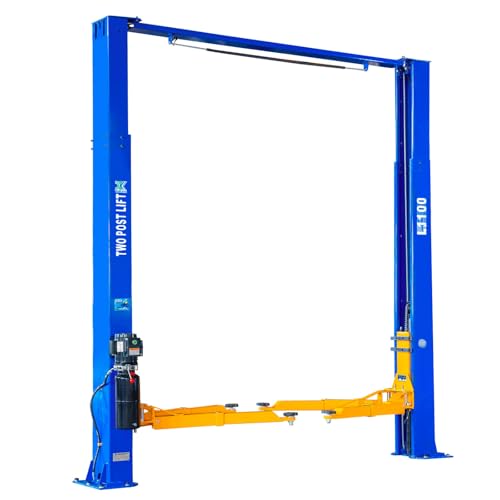
The primary difference is that 2-post lifts create concentrated point loading, requiring thicker, higher-strength concrete, while 4-post lifts have a distributed load profile, making their concrete requirements less demanding. The physics of how each lift transfers weight to the floor dictates the necessary foundation. A 2-post lift suspends the entire weight of a vehicle on two small anchor points, creating immense stress. A 4-post lift supports the vehicle on its wheels, spreading the load across four larger baseplates.
This fundamental difference in load distribution is why lift manufacturers specify different requirements and why a slab sufficient for a 4-post lift might fail catastrophically under a 2-post lift. Adhering to these specifications is critical for safety and for maintaining your equipment’s warranty. The following table breaks down the typical requirements.
| Feature/Aspect | 2-Post Car Lift (Symmetrical & Asymmetrical) | 4-Post Car Lift (Storage & Alignment) |
|---|---|---|
| Minimum Thickness | 4 inches (Absolute Minimum) | 4 inches |
| Recommended Thickness | 6 inches or more | 4.5 to 5 inches |
| Minimum PSI | 3,000 PSI | 3,000 PSI |
| Recommended PSI | 4,000 PSI or higher | 3,000 PSI |
| Reinforcement | Required. #4 Rebar grid is standard. | Recommended. Wire mesh or fibermesh is often sufficient. |
| Footings | Often recommended or required, especially for lifts over 12,000 lbs or on marginal slabs. Typically 3’x3’x12″ deep pads under each post. | Generally not required unless on very poor soil or thin slab. |
| Load Profile | High-stress point loading at anchor bolts. | Weight is distributed across four large baseplates. |
| Primary Risk | Anchor bolts pulling out, causing the lift to tip. | Slab cracking or sinking under the baseplates over time. |
How Do You Prepare and Pour a New Concrete Slab for a Car Lift?
Pouring a concrete slab for a car lift involves preparing a compacted soil and gravel base, installing a vapor barrier, placing a rebar grid on supports, pouring a 4,000 PSI concrete mix to a minimum of 6 inches, and allowing it to cure for at least 28 days before installation. Following a systematic, professional process is the only way to guarantee the foundation is built to last and can safely support the lift.
From our experience in professional garage builds, skipping any of these steps compromises the final structural integrity. Here is a step-by-step guide based on industry-standard practices.
- Excavate and Compact the Base. Start by excavating the area to the required depth, accounting for both the concrete and a gravel sub-base. A 4-inch layer of compacted gravel is standard. This gravel base provides drainage and a stable layer that supports the concrete slab, preventing it from sinking or cracking due to shifting soil.
-
Install Formwork and a Vapor Barrier. Build a wooden frame (formwork) around the perimeter to contain the wet concrete. Inside the formwork, lay down a 6-mil plastic vapor barrier. This barrier prevents ground moisture from wicking up through the concrete, which can cause damage over time and interfere with floor coatings.
-
Place the Rebar Grid. Lay out a grid of #3 or #4 rebar, tied together at the intersections. Crucially, the rebar must be elevated off the vapor barrier using small supports called “chairs.” This ensures the rebar ends up in the middle of the concrete slab where it provides the most tensile strength, not lying uselessly at the bottom.
-
Pour and Finish the Concrete. Order a 4,000 PSI concrete mix and pour it into the formwork, ensuring it reaches your target thickness of 6 inches. Use a screed to level the surface and a float to smooth it. Proper finishing is key to achieving a flat, level floor suitable for a lift installation.
-
Cure the Concrete. This is a waiting game you cannot rush. The slab must be left undisturbed to cure for a minimum of 28 days. During this time, the concrete undergoes a chemical reaction called hydration, which gives it its compressive strength. Drilling into it sooner can lead to anchor failure.
Can You Install a Car Lift on an Existing Concrete Slab?
Yes, you can install a car lift on an existing slab, but you must first verify its thickness, strength, and condition. Installing a lift, especially a 2-post model, on a slab of unknown quality is a dangerous gamble. The only way to know for sure is to perform a test.
From years of working with existing garage floors, we’ve seen everything from surprisingly robust old slabs to dangerously thin new ones. Never assume. The first step is always inspection. Check for any significant cracks, spalling, or signs of sinking. If the surface looks good, the next step is to find out what’s inside.
How to Test Your Slab
The most reliable method is to perform a core drill test. Rent a concrete core drill with a 2-inch diameter bit and drill a hole through the slab in the approximate location where a lift post will sit. Once the core is removed, you can directly measure the slab’s thickness and visually inspect it for the presence of rebar or wire mesh.
How to Fix a Thin or Weak Slab
If the core drill test reveals your slab is under 4 inches thick or lacks reinforcement, you cannot safely install a lift. The standard and most effective solution is to cut out a section of the existing floor and pour a new footing.
- Mark and Cut: For a 2-post lift, you would mark a square around each post location, typically 3′ x 3′ or 4′ x 4′. Use a concrete saw to cut through the existing slab.
- Excavate and Prepare: Remove the cut-out section and excavate the soil below to a depth of at least 12 inches (or more, depending on lift requirements and local code).
- Pour a New Footing: Prepare the new area with a compacted gravel base and a rebar grid, then pour a new 12-inch-deep footing with 4,000 PSI concrete.
- Cure: Allow the new footings to cure for 28 days before installing the lift.
This process ensures that even if the rest of your floor is thin, the lift posts are anchored into solid, deep, and reinforced concrete pads designed to handle the load. For any major remediation work, we always recommend consulting a structural engineer to validate the plan.
FAQs About how thick does concrete need to be for car lift
Is 3000 PSI concrete enough for a car lift?
For many lighter-duty 4-post lifts and some 2-post lifts under 9,000 lbs, 3,000 PSI concrete is often the stated minimum requirement by the manufacturer. However, for a minimal extra cost, upgrading to 4,000 PSI concrete provides a significant safety margin and is highly recommended, especially for 2-post lifts that exert higher stress on anchor points.
How long does concrete need to cure before installing a lift?
You must wait a minimum of 28 days for new concrete to cure before installing a car lift. This allows the concrete to reach approximately 99% of its final compressive strength (PSI). Installing a lift sooner can cause the anchor bolts to pull out or the concrete to crack, leading to catastrophic failure.
Do I need footings for a 2-post lift?
Footings are not always required but are strongly recommended, especially for lifts over 10,000 lbs capacity or if your slab is only the minimum 4-inch thickness. A footing is a thicker, deeper concrete pad poured directly under each post (e.g., 3′ x 3′ x 12″ deep) that helps distribute the concentrated load over a wider area of the underlying soil.
What happens if the concrete is too thin for a lift?
If the concrete is too thin, the anchor bolts on a 2-post lift can pull out of the slab under load, causing the lift and vehicle to fall. For a 4-post lift, a thin slab can crack, spall, or sink under the weight of the baseplates over time, leading to an unstable and unsafe lifting condition.
Can a small crack in the concrete hold a car lift?
No, you should never install a lift anchor bolt near a crack. Cracks represent a significant weakness in the concrete’s tensile strength. The force from the anchor can easily widen the crack and cause a chunk of the concrete to break away, resulting in anchor failure. Cracks must be professionally repaired or the lift base moved.
Can I install a car lift on asphalt?
Absolutely not. You must never install a surface-mounted car lift on asphalt. Asphalt is a flexible petroleum-based material that lacks the compressive and tensile strength to hold the lift’s anchors. The anchors would pull out immediately under load. A lift requires a solid, rigid concrete foundation.
Should I use wire mesh or rebar for a garage slab for a lift?
Rebar is significantly superior to wire mesh for a car lift slab. While wire mesh helps with shrinkage cracking during curing, a grid of #3 or #4 rebar provides the structural tensile strength needed to resist the bending and pulling forces exerted by a lift. For a lift application, always choose rebar.
How much weight can a 4-inch concrete slab hold?
This depends entirely on the PSI, reinforcement, and underlying soil, but a standard 4-inch, 3000 PSI slab might support 2,000-3,000 lbs per square foot (PSF) of distributed load. However, a 2-post lift creates concentrated point loads that far exceed this, which is why thickness, PSI, and reinforcement together are critical, not just the slab’s general capacity.
How deep should footings be for a car lift?
A common recommendation for a 2-post lift footing is a 3-foot by 3-foot square that is 12 inches deep. However, the exact depth depends on the lift’s capacity, the slab thickness, and your local soil conditions and frost line. Always consult the lift manufacturer’s manual or a structural engineer for precise footing dimensions.
Does a portable car lift need special concrete?
Portable lifts generally do not require special concrete because they are designed to be used on any standard, level, and solid concrete surface. Because they are not anchored to the floor, they don’t exert the same pulling forces. However, you should still ensure your slab is at least 4 inches thick and free of major cracks or spalling.
Key Takeaways: Car Lift Concrete Requirements Summary
Installing a car lift is a major upgrade for any garage, but safety starts from the ground up. Here are the most critical takeaways to ensure your foundation is solid, secure, and ready for the job.
- Thickness is Just the Start: While 4 inches is the absolute minimum, a 6-inch thick slab is the recommended standard for most car lifts, providing a crucial safety margin.
-
Strength and Reinforcement are Non-Negotiable: Always use concrete with a minimum of 3,000 PSI, with 4,000 PSI strongly preferred, and reinforce the slab with a rebar grid to provide necessary tensile strength.
-
2-Post Lifts Are More Demanding: Due to concentrated point loading, 2-post lifts require thicker, stronger concrete and often need separate footings, while 4-post lifts distribute the load more evenly.
-
Curing Time is Critical: A new concrete slab must cure for a minimum of 28 days before you can safely drill into it and install a lift. There are no shortcuts to this rule.
-
Test, Don’t Guess, with Existing Slabs: If you have an existing floor, you must perform a core drill test to verify its thickness and reinforcement before proceeding with any installation.
-
Manufacturer Specs are the Ultimate Authority: The information in this guide provides industry standards, but you must always read and follow the specific concrete requirements in your lift’s installation manual to ensure safety and preserve your warranty.
Final Thoughts on Ensuring a Safe Car Lift Foundation
Ultimately, ensuring your concrete is ready for a car lift is about prioritizing safety over convenience or cost-cutting. The foundation is the single most critical component of a safe lifting system. By understanding the relationship between concrete thickness, compressive strength (PSI), and reinforcement, you empower yourself to make an informed and secure decision. Whether you are pouring a new slab or assessing an existing one, taking the time to verify these specifications is an investment in your safety and the longevity of your equipment. When in doubt, always consult the manufacturer’s guidelines and a professional structural engineer.
Last update on 2026-02-23 / Affiliate links / Images from Amazon Product Advertising API


