
Wondering how tall of a ceiling you need for a car lift? You’re not alone. Many enthusiasts struggle to figure out if their garage can actually accommodate a lift without costly surprises. Getting this measurement wrong is a major concern.
As a general rule, a 12-foot ceiling is recommended for a standard 2-post or 4-post car lift, which allows you to walk comfortably underneath most raised vehicles. However, specific low-profile lifts can be installed in garages with ceilings as low as 9 to 10 feet, though this will limit lifting height and under-car access.
Based on an analysis of current manufacturer specifications and real-world installations, the exact height depends entirely on your specific lift and vehicle. This guide will walk you through everything, from measuring your space to a simple formula that gives you the precise number you need. You’ll discover exactly how to choose the right lift for your garage.
Key Facts
- The 12-Foot Standard: A 12-foot ceiling is the ideal height for most residential garages, allowing a standard 2-post or 4-post lift to raise a vehicle high enough for you to walk underneath.
- Measure to the Lowest Point: Your actual available height is not the distance to the ceiling slab but to the lowest hanging obstruction, such as an open garage door or a light fixture.
- Floor Integrity is Crucial: Most car lift manufacturers require a minimum of 4 inches of 3,000 PSI reinforced concrete, demonstrating that the foundation is just as critical as the overhead clearance.
- Low Ceiling Solutions Exist: For garages with ceilings under 10 feet, baseplate 2-post lifts and scissor lifts are specifically designed to provide lifting capability in height-restricted spaces.
- The Definitive Formula: The precise height you need is calculated by adding your tallest vehicle’s height, the lift’s maximum rise, and a non-negotiable 6-inch safety buffer.
How Much Ceiling Height Do You Need For A Car Lift?
The minimum ceiling height for a car lift typically ranges from 10 to 12 feet, but the exact dimension depends on three key factors: the type of lift, the height of the vehicle you plan to service, and how you intend to use the lift. For example, a lift used simply for storing one car over another has different requirements than one used for professional-style repairs where you need to stand upright underneath the vehicle.

A 12-foot ceiling is the widely accepted industry standard for installing a typical 2-post or 4-post lift in a residential garage, as this provides enough clearance to lift most cars and light trucks to a full working height. However, it’s a mistake to assume this number applies to every situation. For garages with low ceilings, specialized “baseplate” 2-post lifts or scissor lifts can often be installed in spaces with as little as 9 feet of clearance.
Understanding these variables is the first step toward making an informed decision. While a general rule is a great starting point, your specific car and garage dimensions will determine the final answer. Before you can choose a lift, you must first get a precise measurement of your workspace.
How Do You Accurately Measure Your Garage for a Car Lift?
To accurately measure your garage, you must identify the lowest point on your ceiling. This is rarely the ceiling slab itself but rather any object hanging below it, such as an open garage door, its track, or a light fixture. Measure from the concrete floor directly up to this lowest point to find your true minimum ceiling height. This single measurement is the most critical piece of data you will collect.
From years of working with lift installations, we’ve seen that the most common error is measuring from the floor to the highest point of the ceiling. This gives a false sense of security and can lead to a disastrous surprise when the lift is installed and the vehicle hits an obstruction.
Follow these steps for a foolproof measurement:
- Clear a space in the bay where you plan to install the lift.
- Open your garage door completely. This is essential, as the open door and its track are often the lowest point in the garage.
- Use a reliable tape measure or laser measure to find the vertical distance from the garage floor to the lowest hanging object in that bay.
- Check multiple spots within the bay, as the floor or ceiling may not be perfectly level. Record the shortest measurement you find.
This number is your absolute maximum clearance. Any lift and vehicle combination must fit underneath this height.
Step 1: How Do You Find Your True Ceiling Height by Identifying Obstructions?
When measuring for a car lift, your true ceiling height is the distance from the floor to the lowest hanging object, which is commonly the garage door opener motor or the open garage door itself. Before taking any measurements, you must perform a thorough visual inspection to identify all potential overhead obstructions. Even a 2-inch difference can be critical.
Use this checklist to find your lowest point. Check for any overhead obstructions, such as:
- The open garage door panel
- The garage door opener motor and its track
- Overhead lighting fixtures
- Structural support beams or trusses
- Exposed plumbing pipes or HVAC ductwork
- Ceiling-mounted storage racks
Pro Tip: Use a piece of blue painter’s tape to mark the lowest point you find. This gives you a clear visual reference for your final measurement and helps avoid any confusion later in the process.
What Is the Minimum Ceiling Height for a 2-Post vs. 4-Post Lift?
For a 2-post lift, you typically need a 12-foot ceiling for a clear floor model or a 10-foot ceiling for a baseplate model. A 4-post lift usually requires 10-12 feet, a figure calculated by adding the heights of both vehicles plus about 8 inches for the runways. Scissor lifts are the best option for low clearance, often fitting comfortably under 9-foot ceilings. Each lift type has a different design that directly impacts its height requirements.
2-Post Lifts
A 2-post lift is the choice for serious repair work due to its excellent access to the vehicle’s underbody. They come in two main designs. Clear Floor Lifts have a structural beam overhead that connects the two posts and houses the hydraulic lines. This design requires more height, typically 12 feet or more. In contrast, Baseplate Lifts run the lines across the floor under a protective steel plate, eliminating the overhead beam and making them suitable for ceilings as low as 9′ 6″.
4-Post Lifts
A 4-post lift is primarily used for vehicle storage (stacking cars) and simpler maintenance tasks like oil changes. Their height requirement is more variable because it depends on the two vehicles you plan to stack. You must add the height of the bottom car, the height of the top car, and the thickness of the lift’s runways (usually 6-8 inches) to find your total.
Scissor Lifts
Scissor lifts are a fantastic solution for garages with low ceilings. These lifts are compact and many models collapse to just a few inches off the floor. Mid-rise scissor lifts, which are perfect for wheel, brake, and body work, can often operate with a ceiling height of just 9 feet.
| Feature / Lift Type | 2-Post Lift (Clear Floor) | 2-Post Lift (Baseplate) | 4-Post Lift (Storage) | Scissor Lift |
|---|---|---|---|---|
| Typical Min. Ceiling | 12′ to 13′ | 9′ 6″ to 10′ | 10′ to 12′ (Vehicle Dependent) | 8′ 6″ to 9′ |
| Primary Use Case | Service & Repair | Service & Repair (Low Ceiling) | Vehicle Storage & Light Service | Quick Service, Wheels, Brakes |
| Key Height Factor | Overhead Equalization Beam | No Overhead Obstruction | Height of Both Vehicles + Runways | Collapsed Height & Max Rise |
| Walk-Under Access | Excellent (Asymmetrical) | Good | Limited by Runways | Varies (Mid-rise vs. Full) |
| Best For | Professional-level repairs | Garages under 10 feet | Stacking cars, long-term storage | Tire shops, home garages |
Ultimately, choosing between these depends on your primary goal. If you need to perform complex repairs and have the height, a 2-post lift is ideal. If you are primarily focused on adding a parking space, a 4-post lift is the answer. If your ceiling is low, a baseplate or scissor lift is your best bet.
How Does Concrete Thickness and Strength Affect Your Car Lift Choice?
Most car lift manufacturers require a minimum of 4 inches of 3,000 PSI reinforced concrete for a safe installation. For heavier capacity lifts (12,000 lbs or more), this requirement often increases to 6 inches. Ceiling height is irrelevant if your floor cannot safely support the lift’s anchors, making this a non-negotiable safety requirement. The lift exerts immense pressure, known as point load, on the spots where it is anchored.
Think of the concrete slab as the foundation of your lift. If that foundation is weak, cracked, or too thin, the expansion anchors used to secure the lift’s columns can pull out under load. This can lead to a catastrophic failure.
Before you even consider purchasing a lift, you must verify your floor meets these standards:
- Minimum Thickness: 4 inches is the standard, but always check the specific lift’s manual.
- Minimum Strength: 3,000 PSI (Pounds per Square Inch) is the typical requirement.
- Curing Time: The concrete must be fully cured for at least 28 days before you can drill into it and install anchors.
⚠️ Safety Warning: Never install a car lift on asphalt, freshly poured “green” concrete, or on any slab with significant cracks, flaking, or signs of structural weakness. If you have any doubt about your concrete’s integrity, it is essential to consult a structural engineer before proceeding.
What Are the Best Car Lifts for Garages With Low Ceilings?
For garages with low ceilings (under 10 feet), the best options are baseplate 2-post lifts, mid-rise scissor lifts, and portable column lifts. These designs are specifically engineered to function in spaces where a traditional clear-floor lift would not fit. They offer a trade-off, sacrificing some under-car access for the ability to operate safely in a height-restricted environment.
Here are the top solutions for low-clearance garages:
Baseplate 2-Post Lifts
These are the most popular solution for home garages with 10-foot ceilings. By running the hydraulic lines and equalization cables across the floor under a steel plate, they eliminate the need for an overhead beam. You gain the height clearance but have to drive over a small ramp (the baseplate) between the posts. Models like the Weaver W-9KFP are well-regarded examples of this design.
Low-Profile Scissor Lifts
Scissor lifts are champions of compact spaces. A mid-rise scissor lift is perfect for tire, brake, and suspension work, lifting the vehicle about 3 to 4 feet off the ground. They take up very little floor space and many can operate with ceilings as low as 8 feet 6 inches, making them ideal for standard builder-grade garages.
Portable Car Lifts
Portable options, such as single-post or mobile column lifts, offer maximum flexibility. Because they are not bolted down, they can be moved and stored when not in use. They typically have a lower lifting height and capacity but are an excellent choice for garages where even a baseplate lift is too tall or where a permanent installation is not desired.
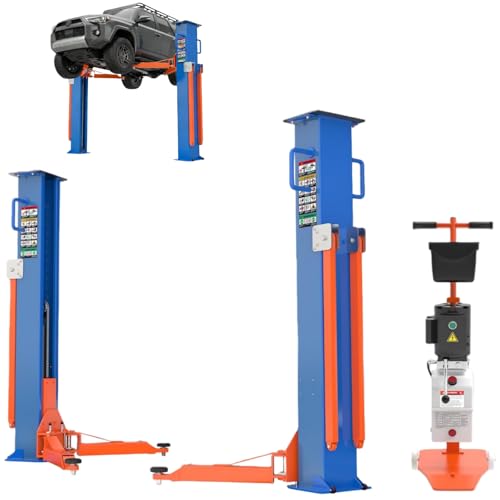
Choosing the right model is about balancing your service needs with your spatial reality. A baseplate lift offers the most access, while a scissor lift is the most space-efficient. A portable lift provides unmatched flexibility for the ultimate space-saving solution.
How Do You Calculate the Exact Ceiling Height Required?
To calculate the minimum ceiling height for a car lift, add the height of your tallest vehicle, the maximum lifting height of the lift, and a safety buffer of at least 6 inches. This simple formula removes all guesswork and provides the precise, custom measurement you need for your specific situation. This calculation is the final check before you commit to a purchase.
Here is the industry-standard formula that turns this complex question into simple addition:
(A) Your Vehicle’s Height + (B) The Lift’s Maximum Rise + (C) 6-Inch Safety Buffer = Your Minimum Required Ceiling Height
Follow this step-by-step worksheet to get your number:
- Measure Your Vehicle (A): Use a tape measure to find the height of the tallest vehicle you plan to put on the lift, measured in inches.
- Check Lift Specs (B): Look at the manufacturer’s specifications for the lift you are considering and find the “max lifting height” or “rise.” This is how high the lift will raise your vehicle.
- Add a Safety Buffer (C): Always add a minimum of 6 inches. This is a non-negotiable safety margin to prevent the vehicle from ever hitting an overhead obstruction.
- Calculate the Total: Add your three numbers (A + B + C) together. This sum is the absolute minimum ceiling height your garage must have to safely operate that specific lift with that specific vehicle.
Example for an SUV: A 75-inch tall SUV on a lift with a 72-inch rise requires 75″ (Vehicle) + 72″ (Lift Rise) + 6″ (Buffer) = 153 inches. This translates to a minimum ceiling height of 12 feet, 9 inches.
FAQs About how tall of ceiling for car lift
Can I install a car lift in a garage with a 10-foot ceiling?
Yes, you can absolutely install a car lift in a garage with a 10-foot ceiling. Your best options are a baseplate-style 2-post lift, which has no overhead beam, or a mid-rise scissor lift. You will not have full walk-under clearance, but you will have plenty of room for wheel, brake, and suspension work.
Do I need to modify my garage trusses for a car lift?
In almost all cases, you should never cut or modify your garage roof trusses to fit a car lift. Trusses are engineered structural components; altering them can compromise the integrity of your entire roof. Instead, choose a lift model (like a baseplate or scissor lift) that fits within your existing structural constraints.
How much space do I need on the sides of the car lift?
You should plan for at least 2 to 3 feet of clearance on each side of the lift. This provides enough room to open car doors without hitting the posts or walls and allows you to move tool carts, oil drains, and other equipment around the workspace safely and efficiently.
What is the difference between a symmetrical and an asymmetrical 2-post lift?
A symmetrical lift has columns that face each other directly, centering the vehicle’s load. An asymmetrical lift has rotated columns and arms of different lengths, allowing the vehicle to be positioned further back. This provides better clearance for opening the driver and passenger doors, making it a popular choice for residential garages.
Can a 4-post lift be used for storing two SUVs?
It depends on the specific SUVs and the lift’s capacity and rise. You must add the height of both SUVs plus about 8 inches for the lift’s runways and safety buffer. This total often exceeds 12 feet, making it difficult in many standard garages. Always use the calculation formula before assuming it will fit.
Do portable car lifts have different ceiling height requirements?
Yes, portable lifts like single-post or mobile column lifts are excellent for low ceilings. Because they are not permanently bolted and often have a lower maximum lift height, they can frequently be used in garages with ceilings as low as 8 or 9 feet. However, they may offer less stability and lower weight capacities.
How high does a car need to be lifted to work underneath it?
To comfortably walk underneath a car, the bottom of the vehicle should be at least 6 feet (72 inches) off the ground. To achieve this, you need a full-rise lift. For work done on a creeper or stool, a mid-rise lift that raises the car 3-4 feet is often sufficient.
Is it safe to install a car lift on a sloped garage floor?
No, you should never install a post lift on a sloped floor. The lift must be installed on a perfectly level surface to ensure stability and prevent the vehicle from rolling. If your floor is sloped, it must be leveled with new concrete in the lift’s footprint before installation.
Does the lift’s hydraulic power unit require extra space?
Yes, the hydraulic power unit typically mounts to one of the posts and requires about 1-2 feet of space beside it. It also needs access for maintenance and electrical connections. Factor this into your garage layout when deciding on the lift’s position.
What happens if I don’t have enough concrete thickness?
If your concrete is too thin, the anchors can pull out of the floor under load, causing the lift to collapse. This is extremely dangerous. If your slab is less than the required 4 inches thick, you must cut out a section of the floor and pour a new, reinforced concrete footing that meets the manufacturer’s specifications.
Key Takeaways: Car Lift Ceiling Height Requirements
- The 12-Foot Rule: For general-purpose 2-post or 4-post lifts with full walk-under access, a 12-foot ceiling is the gold standard.
- Measure the Lowest Point: Your true ceiling height is the distance from the floor to the lowest obstruction, which is often your open garage door or its opener, not the ceiling itself.
- The Formula is Key: Your minimum required height is (Vehicle Height) + (Lift’s Max Rise) + (6″ Safety Buffer). Always use this calculation for your specific car and potential lift.
- Low Ceilings Have Solutions: For ceilings under 10 feet, your best options are baseplate 2-post lifts, mid-rise scissor lifts, or portable lifts. You will trade some under-car access for the ability to fit the lift.
- The Floor is as Important as the Ceiling: Never install a lift without confirming you have a level slab with a minimum of 4 inches of 3,000 PSI concrete that has cured for at least 28 days.
- Lift Type Dictates Height: A clear floor 2-post lift requires the most height (12’+) due to its overhead beam. A 4-post lift’s height depends on the two vehicles you plan to stack.
- Safety is Non-Negotiable: Always add a 6-inch safety buffer in your calculations and never cut structural trusses. When in doubt about your concrete, consult a structural engineer.
Final Thoughts on Choosing the Right Lift for Your Ceiling Height
Choosing a car lift is a balance between your service needs and your garage’s physical limitations. There is no single “right” answer, only the right answer for you. By taking the time to carefully measure your space, understand your floor’s capacity, and use the correct calculation formula, you can move forward with confidence. The principle is simple: measure twice, buy once. You now have the tools and knowledge to select a car lift that is not only effective for your projects but, most importantly, is fundamentally safe for you and your vehicles for years to come.
Last update on 2026-02-23 / Affiliate links / Images from Amazon Product Advertising API


