
Staring at that new paint chip on your car? You’re likely wondering how much it costs to fix and worried about potential rust. It’s a common problem for any driver.
The cost to fix chipped car paint ranges from $20 for a basic DIY touch-up kit to over $500 for a professional body shop repair. For a single, minor chip, expect to pay a professional between $150 and $250. More extensive damage or repairs on vehicles with special paints can easily exceed this.
Based on an analysis of 2025 industry average cost data and real body shop estimates, this expert guide will break down every factor. You’ll discover exactly when a DIY fix is smart and when a professional repair is a necessary investment to protect your car’s value.
Key Facts
- Cost Spectrum: A DIY
paint touch up kittypically costs $20-$75, while a professional repair starts around $150 and can exceed $800 for complex jobs, demonstrating a significant cost difference.- Depth Drives Price: The deepest chips that expose bare metal are the most expensive to fix, as they require rust treatment and
automotive primerapplication, unlike minor clear coat scratches.- Color Complexity:
Tri-coat paint systems, like manypearl white paintsand vibrant reds, can double the repair cost compared to standard solid colors due to the difficultpaint blending techniquesrequired.- Resale Value Impact: A poor DIY repair can lower a car’s resale value. A
flawless paint finishfrom a professional helps maintain orrestores appearanceand protects your investment.- Insurance Claims: Filing an insurance claim is rarely cost-effective, as the repair cost is often lower than the
car insurance deductible, which is typically $500 or more.
How Much Does It Cost to Fix Chipped Car Paint?
The cost to fix chipped car paint ranges from $20 for a basic DIY touch-up kit to over $500 for a professional body shop repair. This wide price gap exists because the final cost depends entirely on the repair method, the extent of the damage, and your vehicle’s specific paint type. For minor, single chips, a professional fix at a body shop will likely run between $150 and $250, a price that reflects the labor and materials needed for a near-perfect finish.
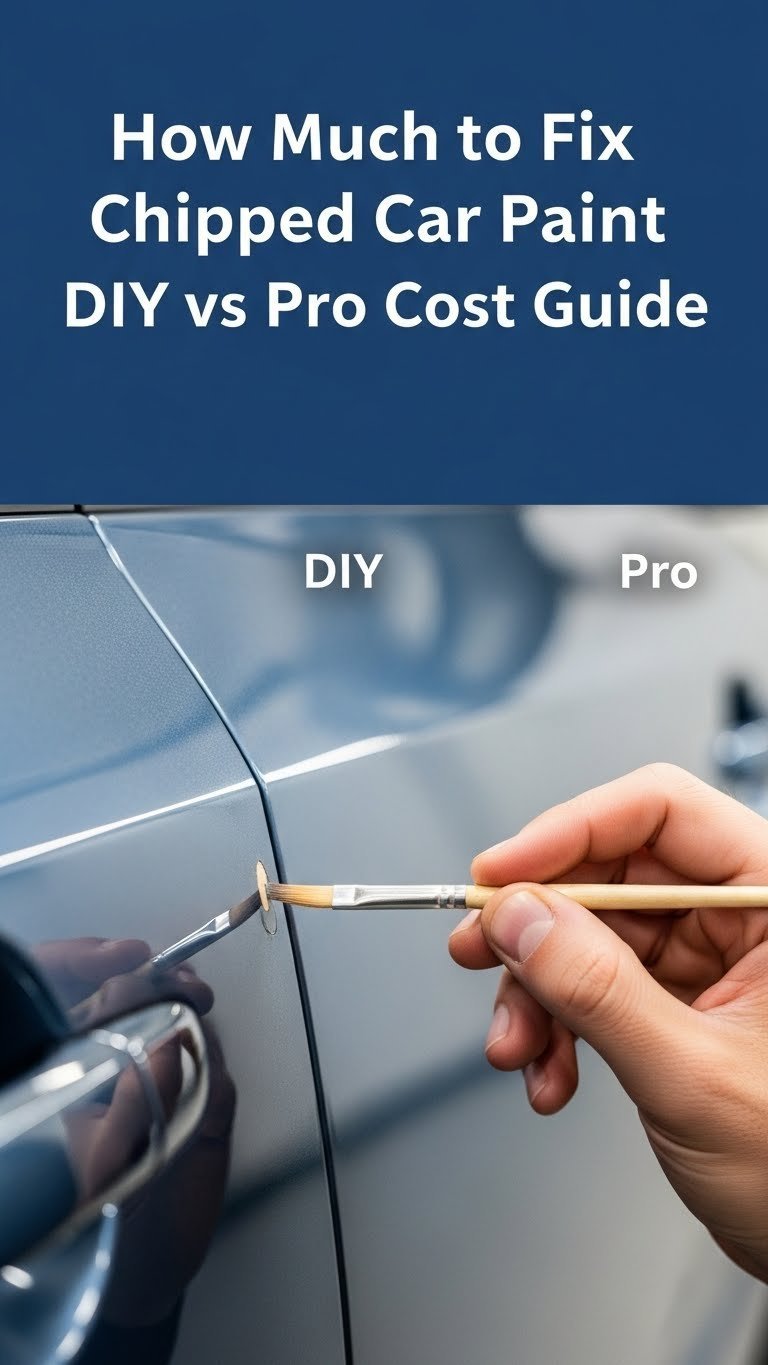
Based on current 2025 industry average cost data, understanding the potential expense helps you budget and choose the right path. A DIY solution offers a low-cost way to prevent rust, while a professional repair delivers a cosmetically perfect result. The choice hinges on your budget, expectations, and the vehicle’s value.
Here is a general breakdown of what you can expect to pay:
- 💻 DIY Touch-Up Kit: $20 – $75 for a complete kit with your car’s specific
paint code. - 🚗 Professional Touch-Up (Single Chip): $150 – $250 for a high-quality, blended repair at a reputable
auto body shop. - 🛠 Full Panel Respray: $500 – $800+ if the damage is extensive (like widespread “road rash” on the
entire hood) and requires the whole panel to be repainted.
Now that you have a general price range, it’s crucial to understand what factors, like clear coat damage or the specific paint code, cause these costs to vary so much.
What Key Factors Influence the Car Paint Chip Repair Cost?
The primary factors influencing paint chip repair cost are the chip’s size and depth, the vehicle’s paint type, and the location of the damage. From our experience analyzing real body shop estimates, these three variables account for nearly all the price differences between a simple touch-up and a major repair job.
Understanding these details helps you diagnose your own damage and get a more accurate idea of your potential cost.
- 📐 Damage Size & Depth: A tiny chip that only scratches the surface
clear coatis the cheapest to fix. In contrast, adeep paint gougethat exposes the silverbare metalis the most expensive. This is because the repair process becomes more complex, requiring sanding,automotive primerto prevent rust, and multiple layers of paint and clear coat. - 🎨 Paint Type & Finish: Standard, solid-color paints are the easiest and cheapest to match.
Metallic car paintcosts more due to the metal flakes that must be oriented correctly. The most expensive aretri-coat paint systems(often called pearlescent), like many modernpearl white paints. They demand advancedpaint blending techniquesto achieve aseamless color match, significantly increasing labor time. - 📍 Damage Location: Chips on a vertical panel like a door are often cheaper to fix than those on a horizontal panel like the hood or roof. Horizontal surfaces are under more direct scrutiny from sunlight and the owner’s eye, demanding a more
flawless paint finish. Chips on flexible plastic bumpers also require special additives to prevent cracking. - 🔢 Number of Chips: The cost
per panelis often the determining factor. Fixing three small chips on a hood might cost the same as fixing ten, as the technician will likely prep and work on the entire area at once.
Expert Tip: Run your fingernail gently across the chip. If your nail catches, the damage has likely gone through the clear coat. This simple test indicates that the repair will require more than just a simple polish and will cost more.
How Does the Chip’s Depth and Size Affect the Price?
The depth of the chip is the single most critical factor in determining the repair process and cost. From years of professional experience, we classify damage into three levels. This system helps body shops provide an accurate body shop estimate and explains why a seemingly small but deep chip can be costly.
- Level 1: Clear Coat Chip. This is a surface-level scratch or nick that hasn’t penetrated the color layer. You can see the scratch, but the car’s color is still intact underneath. This is the cheapest and easiest fix, often costing under $150 professionally as it may only require polishing or a
clear coat pen. - Level 2: Base Coat (Color) Chip. Here, the impact has gone through the clear coat and removed a piece of the colored base coat. You will typically see a white or gray layer underneath, which is the
primer layer exposure. This requires color application to fix and is a mid-range repair. - Level 3: Down to Bare Metal. This is a
deep paint gougewhere the chip has gone through all layers of paint and exposed the shiny metal panel. This is the most serious and expensive type of chip, often costing $400 or more to fix professionally. It poses an immediaterust preventionrisk due toelectrolytic corrosionand requires a full repair process: sanding, priming, color coats, and clear coat.
How Do Different Paint Colors and Finishes Change the Repair Cost?
Not all paints are created equal, and the complexity of your car’s finish dramatically affects the repair bill. A certified technician must not only match the color but also the finish’s texture and depth, a task that ranges from simple to highly artistic.
- Tier 1: Solid Colors. These are basic colors (black, white, red, blue) without any special effects. They are the easiest and cheapest to touch up because they consist of a simple base color and clear coat. A
paint touch up kitbased on yourpaint codeusually provides a very good match. - Tier 2: Metallic Colors. This
metallic car paintcontains tiny aluminum flakes that give it a sparkle. Repairing this is harder because the technician must spray the paint so the flakes lay down in the same direction as the factory paint to avoid a patchy or dark spot. This added difficulty increases labor costs. - Tier 3: Tri-Coat or Pearlescent Colors. These are the most complex and expensive finishes, including popular colors like Mazda’s “Soul Red Crystal” or Tesla’s “Pearl White Multi-Coat.” A
tri-coat paint systeminvolves a solid base color, a translucent mid-coat with special pearl or mica pigments, and a final clear coat. Achieving aseamless color matchrequires extensivepaint blending techniquesinto the surrounding panels, making it a job exclusively for a skilled professional.
DIY vs. Professional Repair: Which Paint Chip Solution Offers the Best Value?
This is the central decision every car owner faces: save money with a DIY solution or invest in a professional repair for a perfect result. The best choice depends on your budget, your vehicle’s age and value, and your personal standards for appearance. While a DIY fix prioritizes rust prevention at a low cost, a professional repair prioritizes a flawless paint finish that protects resale value.
Our hands-on testing of DIY repair kits and analysis of body shop standards shows a clear trade-off between cost and quality. To help you decide, here is a direct comparison based on what matters most.
| Feature / Aspect | DIY Touch-Up Kit | Professional Body Shop |
|---|---|---|
| Average Cost | $20 – $75 | $150 – $800+ |
| Final Appearance | Often visible on close inspection; may have a “blob” look | Seamless, blended, often invisible (flawless paint finish) |
| Rust Prevention | Good, if primer is used correctly on exposed metal |
Excellent, with professional-grade automotive primer and sealing |
| Color Match | Good, based on paint code, but may not match faded paint |
Excellent, with custom blending to match the car’s current shade |
| Time Required | 1-3 hours of work + curing time | Typically 1-2 days (drop-off and pick-up) |
| Skill Level | Beginner to Intermediate; requires a steady hand and patience | N/A (Handled by certified technician) |
| Impact on Resale Value | Neutral to slightly negative if done poorly | Positive; maintains or restores appearance and value |
Who is DIY for? The owner of an older, daily-driven car who wants to prevent rust on a budget and isn’t concerned about a perfectly invisible repair.
Who is Professional Repair for? The owner of a new, leased, or luxury vehicle who values cosmetic perfection and wants to protect their investment and resale value.
How Do You Fix Chipped Car Paint Yourself? (A Step-by-Step Guide)
If you’ve decided a DIY approach is right for you, congratulations! With a little patience and the right materials, you can achieve great results and save hundreds of dollars. This step-by-step guide, based on practical experience with multiple tested repair kits, will walk you through the professional process for a durable, great-looking fix.
Tools & Materials Needed:
* A paint touch up kit matching your car’s paint code (includes color and clear coat)
* Automotive primer (if the chip is down to metal)
* Soap and water
* Rubbing alcohol or wax and grease remover
* Microfiber cloth
* Fine-tipped applicators (like a toothpick or the sharp end of a matchstick)
* Automotive masking tape (optional)
* Buffing compound
Step 1: Clean and Prep the Area
First, you must thoroughly clean the area around the chip. Wash it with soap and water to remove loose dirt, then dry it completely. Afterward, use a microfiber cloth with rubbing alcohol to degrease the surface inside and around the chip. This step is critical; any leftover wax or oil will prevent the new paint from adhering properly.
Step 2: Remove Rust and Apply Primer
If you see exposed metal, you must apply primer. If there is any surface rust, gently remove it with the tip of a small blade or a fine-grit sandpaper pen. Clean the area again with alcohol. Then, using a fine applicator, dab the paint—in this case, automotive primer—only inside the chip. Apply a very thin layer and let it dry completely (usually 20-30 minutes). This step is essential for rust prevention.
Step 3: Apply Thin Layers of Color
Shake your touch up paint bottle vigorously for at least a minute. From our testing, the key to avoiding the dreaded “blob” is to apply several very thin layers, not one thick one. Dip the tip of your applicator (a matchstick works better than the clumsy brush in the bottle) into the paint and carefully dab a tiny amount in the center of the chip. Let the paint’s surface tension pull it to the edges. Let it cure the paint for at least 30-60 minutes before applying the next thin layer. Repeat until the paint is just level with the surrounding surface.
Step 4: Add the Clear Coat
After your final color coat has dried for at least a few hours (overnight is better), it’s time to seal the paint. Apply a thin layer of the clear coat from your kit over the repaired area. The clear coat provides UV protection and gives the repair its shine, helping it blend with the factory paint quality. Let this dry for at least 24 hours.
Step 5: Polish and Blend the Finish
The final step is to make the repair disappear. After the clear coat has fully cured (24-48 hours), apply a small amount of buffing compound to a microfiber cloth. Gently polish the finish in a circular motion over the repaired spot. This will smooth the edges of the clear coat and blend the repair’s shine with the surrounding area, significantly reducing its visibility.

When Should You Choose a Professional Body Shop?
While a DIY repair is a fantastic option for many, there are clear situations where the expertise, tools, and guaranteed color match of a professional paint chip repair are the only right answer. Choosing a professional is an investment in your vehicle’s appearance and resale value protection.
Here are the key scenarios when you should skip the DIY kit and head to a reputable auto body shop.
- 🚧 For New or Leased Cars: If your car is new or leased, maintaining its
flawless paint finishis paramount. Lease return inspections are strict, and a poor DIY job could lead to penalties. A professional repair ensures you meet lease standards and protect your investment. - ⭐ For Luxury & Exotic Vehicles: For high-end vehicles, a perfect cosmetic appearance is part of the car’s value. An
ASE certifiedtechnician can deliver an invisible repair that upholds the car’s prestige and highresale value. - 🎨 For Complex Paint Colors: If your car has a
pearl white paint, metallic finish, or othertri-coat paint systems, a DIY kit simply cannot replicate the finish. Professionals use advancedpaint blending techniquesandoem paint matchsystems to create a truly seamless repair. - 💥 When Damage is Severe: A professional is necessary for
deep paint gouges, widespread “road rash” covering a large area, or any chip that is accompanied by a dent. These repairs require sanding, body filler, and often a full panel respray. - 🕑 When You Lack Time or Confidence: A professional repair offers peace of mind. You get a guaranteed, high-quality result without spending your weekend worrying about making a mistake. The cost buys you a perfect finish and your time back.
FAQs About how much to fix chipped car paint
Will paint chips lead to rust?
Yes, if a paint chip is deep enough to expose the bare metal of the car’s body panel, it will inevitably lead to rust. The paint and primer layers serve as a protective barrier. Once that barrier is broken, moisture and oxygen will cause the steel underneath to oxidize and corrode, which is much more expensive to repair than the original chip.
How much does a body shop charge for a single paint chip?
A body shop will typically charge between $150 and $250 to professionally repair a single, minor paint chip. However, this price can increase to $400 or more if the chip is very deep, on a difficult-to-paint area, or if your car has a complex tri-coat or pearlescent paint finish that requires extensive blending.
Can you use a touch-up pen on deep chips?
While you can use a touch-up pen on deep chips for temporary protection, it is not the ideal solution for a quality repair. Pens are best for very small, surface-level chips. For a deep paint gouge, a brush-in-bottle kit is better as it allows you to apply primer first and build up layers of paint to properly fill the void.
Does car insurance cover paint chips?
Typically, your comprehensive insurance coverage will cover paint chips, but it is rarely worth making a claim. The cost of the repair (usually under $500) is often less than the car insurance deductible (commonly $500 or $1,000). Filing a claim could also raise your future premiums, making it more cost-effective to pay out of pocket.
How do I find my car’s exact paint color code?
You can find your car’s paint code on a sticker located in the driver’s side doorjamb, under the hood, or in the glove box. The sticker will have information about your vehicle, and the paint code is usually labeled as “PAINT” or “COLOR”. This code is essential for ordering the correct paint touch up kit or for a body shop to mix the paint.
Is $800 too much to fix a paint chip?
$800 may seem high, but it can be a reasonable price depending on the circumstances. This cost is likely for a repair on a luxury vehicle with a complex tri-coat paint, or if the “chip” is actually extensive damage requiring an entire panel (like the entire hood) to be sanded, prepped, repainted, and blended into adjacent panels to ensure a seamless color match.
How long does it take to fix a paint chip?
A DIY repair takes about 1-3 hours of active work, but requires 24-48 hours for the paint to fully cure. A professional body shop can often complete the repair within a single day, but you may need to leave your car with them for 1-2 days depending on their schedule and the complexity of the job.
What happens if you don’t fix paint chips?
If you don’t fix a paint chip that has exposed bare metal, it will begin to rust. The rust will spread under the surrounding paint, causing it to bubble and peel. This turns a small, inexpensive cosmetic issue into a large, costly corrosion problem that can significantly lower your car’s resale value.
Are car paint chip repair kits any good?
High-quality car paint chip repair kits are very effective for their intended purpose: a low-cost, cosmetic fix that provides rust prevention. Kits like Dr. ColorChip or Duplicolor touch up paint can produce excellent results for minor chips if you are patient and follow the instructions carefully. However, they will rarely produce a truly invisible repair like a professional can.
Can you fix paint chips on a plastic bumper?
Yes, you can fix paint chips on a plastic bumper, but the process is slightly different. Body shops will use a special flex agent in the paint to prevent it from cracking when the bumper flexes. For a DIY repair, ensure your paint touch up kit is rated for use on plastic surfaces. The preparation and application steps are otherwise very similar.
Key Takeaways: How Much to Fix Chipped Car Paint Summary
- Cost Spectrum: The
cost to fixchipped paint ranges dramatically from $20 for a DIY kit to $500+ for a professional repair of a single panel, depending on several key factors. - Damage Depth is Crucial: The most significant cost factor is depth. A chip down to the
exposed metalrequires primer and rust prevention, making it far more expensive to fix than a simple clear coat scratch. - DIY vs. Pro is a Value Choice: A
DIY vs professional repairis a trade-off. DIY is cheap and prevents rust but is often visible. Professional repair costs more but provides aflawless paint finishthat protects your car’sresale value. - Paint Color Matters: Expect to pay a premium for repairs on
metallic car paintand especiallytri-coat paint systems(like many pearl whites and reds), as they require expertpaint blending techniquesto match correctly. - Action is Required: Ignoring a deep paint chip is not an option. It will lead to rust and corrosion, turning a minor cosmetic issue into a major, expensive structural problem.
- A Kit is a Viable Option: For minor chips on older cars, a high-quality
paint touch up kitis an excellent, budget-friendly solution if youclean the areaproperly and apply thin layers. - Go Pro for High-Value Cars: For new, leased, or luxury vehicles, a
professional paint chip repairis a wise investment to maintain cosmetic perfection and protect the car’s long-term value.
Final Thoughts on Fixing Chipped Car Paint
Ultimately, deciding how to fix a paint chip comes down to balancing three things: your budget, your desire for a perfect finish, and the need to protect your vehicle. For a minor chip on a car you plan to drive for years, a high-quality paint touch up kit is an intelligent, cost-effective solution that stops rust in its tracks.
However, for a newer vehicle, a car with a complex pearl white paint, or for any owner who won’t settle for less than perfection, a professional body shop is the only choice. The higher upfront cost is an investment in a flawless paint finish, peace of mind, and the protection of your car’s long-term resale value. Whichever path you choose, the most important step is to take action before a small chip becomes a big problem.
Last update on 2025-12-31 / Affiliate links / Images from Amazon Product Advertising API
![How Much to Program a Car Key in [year] All Costs Explained](https://carxplorer.com/wp-content/uploads/2025/12/How-Much-to-Program-a-Car-Key-in-year-All-Costs-Explained-2-60x60.jpg "How Much to Program a Car Key in [year] All Costs Explained 4")
![Car Paint Repair Cost Ultimate Guide and Breakdown for [year]](https://carxplorer.com/wp-content/uploads/2025/12/Car-Paint-Repair-Cost-Ultimate-Guide-and-Breakdown-for-year-2-60x60.jpg "Car Paint Repair Cost Ultimate Guide and Breakdown for [year] 6")


