Wondering why your car’s AC is blowing warm air? You’re likely dealing with low refrigerant, a common issue for many drivers. This situation often leads to the question of how much R134a your car actually needs to get back to blowing ice-cold air.
The correct amount of R134a refrigerant your car needs is a precise weight specified by the vehicle’s manufacturer. This vehicle-specific value, typically measured in ounces or grams, is critical for performance. It is not a one-size-fits-all number and using the wrong amount can cause damage.
Based on an analysis of current OEM specifications and factory service manuals, this guide shows you exactly how to find the correct R134a capacity. You will discover the professional methods for recharging your system. This ensures you do the job right the first time, protecting your AC components.
Key Facts
- Vehicle-Specific Capacity is Crucial: Industry analysis reveals that using the manufacturer-specified refrigerant weight is the single most important factor for AC cooling performance and longevity.
- Overcharging Causes Damage: Adding too much refrigerant can spike system pressures to dangerous levels, potentially destroying the AC compressor, which is a costly repair.
- A Low System Indicates a Leak: A car’s AC is a sealed system; if it needs refrigerant, it has a leak. Research indicates that even small leaks should be repaired for a long-term solution.
- Pressure is Dependent on Temperature: The correct pressure reading on an AC gauge changes with the ambient outside temperature, demonstrating why charging by weight is more accurate than charging by pressure alone.
- Evacuation is Not Optional for Repairs: Professional standards require evacuating the system with a vacuum pump before charging to remove moisture, which can form corrosive acids and blockages.
How Much R134a Does My Car AC System Need?
The amount of R134a your car needs depends entirely on its make, model, and year, typically ranging from 18 to 32 ounces (510 to 907 grams). There is no universal amount. Think of it as a precise recipe for your vehicle’s air conditioning system. Using the exact R134a charge quantity specified by the manufacturer is the only way to ensure optimal cooling performance and prevent expensive damage to the AC compressor.

Both undercharging and overcharging the system can lead to problems. An undercharged system results in poor cooling. An overcharged system is even more dangerous, as it can cause excessively high pressures that can damage the compressor and other components. This is why you must find the correct car AC refrigerant capacity before adding any refrigerant. Finding this information is straightforward, and this guide will walk you through the most reliable methods.
You can find your car’s exact refrigerant charge level by:
* Checking the sticker under your hood
* Consulting the owner’s manual
* Looking up the information in an online database
* Referring to a professional auto repair manual
What Are The 4 Ways To Find Your Car’s AC Refrigerant Capacity?
The four primary ways to find your car’s R134a capacity are checking the under-hood service sticker, consulting the owner’s manual, using an online refrigerant capacity database, or referring to a professional auto repair manual. From our experience, the most reliable method is always the sticker located in the engine bay, as it is specific to your vehicle as it left the factory.
Here are the four methods, ranked from most to least reliable, for finding your vehicle-specific refrigerant amount.
How Do You Read the Under-Hood AC Sticker?
The under-hood AC sticker will clearly list the Refrigerant Type (e.g., R-134a) and the Charge Capacity or Filling Quantity. This is the most accurate source of information. It is usually a silver or white label located in a prominent spot in the engine bay, such as on the radiator support, firewall, or one of the strut towers.
When you find the sticker, look for the following information:
* Refrigerant Type: It must say HFC-134a or R-134a. If it says R1234yf or R12, your system uses a different refrigerant.
* Charge Capacity: This will be listed as a weight. For example, you might see “0.65 kg” or “22.9 oz.”. This is the number you need. Note that you may need to convert kilograms to ounces (1 kg = 35.274 oz).
* Oil Type: The sticker also specifies the required AC compressor oil, such as PAG 46 or PAG 100. This is crucial if you are replacing parts.
Method 2: Consult Your Owner’s Manual
Your vehicle’s owner’s manual often contains a section dedicated to fluid capacities and specifications. Look in the index for “Air Conditioning,” “Specifications,” or “Capacities.” This section should list the correct refrigerant type (R134a) and the system’s charge weight. While generally reliable, always cross-reference with the under-hood sticker if possible, as the manual may cover multiple sub-models.
Method 3: Use an Online AC Capacity Database
Many websites and forums offer free R134a filling chart resources where you can look up your car’s AC refrigerant capacity. You can find these by searching online for terms like “R134a capacity chart PDF” or “[Your Car’s Make Model Year] AC capacity.” While these are convenient, be aware that their data can sometimes be inaccurate or generalized. It’s best to use them as a secondary source to confirm the information you found elsewhere.
Method 4: Refer to a Digital Service Manual
For the most detailed and accurate information, professional-grade digital service manuals are the gold standard. Services like AllData or Mitchell provide dealership-level information, including the exact refrigerant and oil capacities for your specific vehicle. While these are often subscription-based, some local libraries offer free access. This is the best option if the sticker under your hood is missing or unreadable.
How Do You Recharge Your Car AC System by Weight?
Recharging a car AC system by weight involves evacuating the system with a vacuum pump to remove air and moisture, then using a digital scale to add the exact manufacturer-specified weight of R134a refrigerant through the low-side service port. This is the most accurate method and the one used by professionals. It ensures the system has the perfect charge for optimal cooling and longevity.
Safety First: Always wear safety glasses and gloves when working with refrigerants. R134a can cause frostbite on contact with skin and serious eye injury. Work in a well-ventilated area.
What Tools and Equipment Do You Need for an AC Recharge?
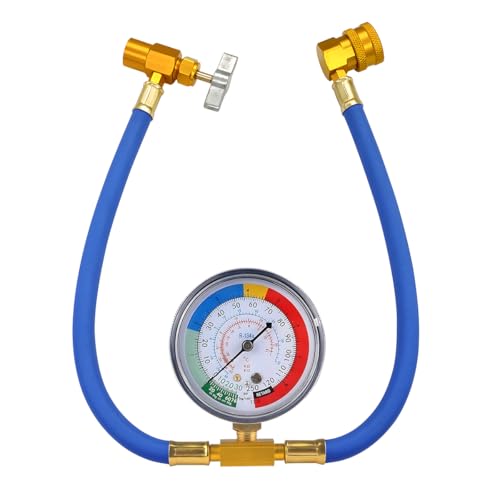
To properly recharge a car’s AC by weight, you need a manifold gauge set, a vacuum pump, a digital refrigerant scale, safety glasses, gloves, and the correct amount of R134a refrigerant. For this procedure, you will need a manifold gauge set, not just a single-hose gauge from a basic DIY can.
Essential Tools:
* Manifold Gauge Set: This allows you to monitor both low-side and high-side pressures and is necessary for pulling a vacuum.
* Vacuum Pump: Essential for removing air and moisture from the system before charging.
* Digital Refrigerant Scale: This is used to precisely measure the amount of refrigerant you add to the system.
* R134a Refrigerant: Purchase enough to meet your system’s capacity.
Safety Equipment:
* Safety Glasses: Protects your eyes from refrigerant spray.
* Gloves: Protects your hands from frostbite.

Step 1: Connect Tools and Evacuate the System
The first step in a proper recharge is to connect your manifold gauge set and vacuum pump to evacuate all air and moisture. Moisture is the enemy of an AC system, as it can freeze or mix with refrigerant to form corrosive acids.
1. Connect Gauges: With the engine off, connect the blue hose from the manifold gauge set to the low-side service port (usually marked with an “L”) and the red hose to the high-side service port (marked with an “H”).
2. Connect Vacuum Pump: Attach the yellow service hose to the intake on your vacuum pump.
3. Evacuate System: Open both the low-side and high-side valves on the gauge set. Turn on the vacuum pump and let it run for at least 30-60 minutes. Real-world experience shows a longer vacuum is always better. The goal is to achieve a deep vacuum, ideally around 29.9 inches of mercury (inHg) or 500 microns, to boil off any moisture.
4. Check for Leaks: After 30-60 minutes, close the gauge valves and turn off the pump. The low-side gauge should hold its vacuum. If the needle rises, you have a leak that must be repaired before proceeding.
Step 2: Charge the System by Weight
Once the system is fully evacuated and holds vacuum, you can charge it with the precise amount of R134a.
1. Prepare Refrigerant: Close the gauge valves. Disconnect the yellow hose from the vacuum pump and connect it to your can of R134a. Briefly purge the air from the yellow hose.
2. Use the Scale: Place the R134a can on the digital scale and zero it out.
3. Start Charging: With the engine off, open the valve on the refrigerant can and the low-side valve (blue) on your manifold gauge set. Refrigerant will begin to flow into the system. You may need to start the car and turn the AC on MAX to draw in the rest of the refrigerant.
4. Monitor the Scale: Keep a close eye on the scale. When the scale shows that the correct weight of refrigerant has been dispensed (e.g., if you need 20 oz, the scale should read -20.0 oz), close the low-side valve on your gauge set and the valve on the can.
5. Final Checks: Let the system run for a few minutes and check your pressure readings against a pressure-temperature chart to ensure everything is operating correctly. Disconnect your gauges, and you’re done.
What Pressure Should Your Car AC Be?
A car’s AC pressure is not a single number; it varies with the outside (ambient) temperature. A common misconception is looking for a single “correct” pressure. In reality, the pressure inside the system changes based on the laws of physics. Think of it like a tire—pressure goes up on a hot day. Your AC system is similar but much more sensitive. At 80°F (27°C), a typical R134a system should have a low-side pressure of 40-50 PSI and a high-side pressure of 180-210 PSI.
The best way to verify your AC charge is with a pressure-temperature chart. After charging by weight, you can use your manifold gauges to confirm the system is functioning as expected. With the engine running, AC on MAX, and doors open, compare your gauge readings to this chart.
| Ambient Temperature (°F) | Low Side Pressure (PSI) | High Side Pressure (PSI) |
|---|---|---|
| 70° F (21° C) | 35 – 40 PSI | 150 – 170 PSI |
| 80° F (27° C) | 40 – 50 PSI | 180 – 210 PSI |
| 90° F (32° C) | 45 – 55 PSI | 220 – 250 PSI |
| 100° F (38° C) | 50 – 60 PSI | 275 – 315 PSI |
If your readings are far outside these ranges, it could indicate a problem. For example, if both low and high side pressures are too high, your condenser fan might not be working correctly. If they are both too low, you are likely still undercharged.
What Happens if You Put Too Much or Too Little Freon in Your Car?
Putting too much R134a in your car (overcharging) can cause extremely high pressures, leading to poor cooling and compressor failure, while putting too little (undercharging) results in weak cooling and can starve the compressor of lubricating oil. Both scenarios are harmful and underscore the importance of charging the system to the exact specification. Understanding the symptoms can help you diagnose a problem after a recharge.
Symptoms of an Undercharged System
An undercharged system lacks enough refrigerant to properly transfer heat out of the cabin. This is the most common issue DIY mechanics face.
* Weak or No Cooling: The air from the vents will be only slightly cool or warm.
* Compressor Cycles Rapidly: The compressor clutch will click on and off frequently. This is the low-pressure switch protecting the compressor because there isn’t enough refrigerant to maintain pressure.
* Ice on AC Lines: You may see frost or ice forming on the evaporator or the AC lines in the engine bay.
* Low Pressure Readings: Both the low-side and high-side gauge readings will be below the normal range for the ambient temperature.
Symptoms of an Overcharged System
An overcharged system has too much refrigerant, causing dangerously high pressure on the high side. This prevents the refrigerant from changing state correctly and is very damaging.
* Poor Cooling: Ironically, too much refrigerant also causes poor cooling. The air from the vents may be warm or fluctuate between cool and warm.
* Compressor Strains or Won’t Engage: The compressor may make groaning noises or the high-pressure sensor may prevent it from turning on at all to avoid damage.
* High Pressure Readings: The high-side pressure reading will be excessively high, while the low-side reading may also be higher than normal.
* Loud Noises: You may hear loud noises from the engine bay as the compressor strains under the extreme pressure.
| Symptom | Undercharged System | Overcharged System |
|---|---|---|
| Cooling Performance | Weak or no cooling, air is only slightly cool | Poor cooling, air may be warm or fluctuate |
| Compressor Behavior | Compressor cycles on and off rapidly | Compressor may not engage, or strains and groans |
| Pressure Readings | Low-side and High-side pressures are too low | Low-side and High-side pressures are too high |
| AC Lines | Ice may form on the evaporator or lines | No icing, components may be excessively hot |
FAQs About how much r134a does my car need
How many 12 oz cans of R134a do I need?
Most cars require between 1.5 to 2.5 cans of 12 oz R134a refrigerant for a full recharge from empty. Since you cannot buy partial cans, you will likely need to purchase 2 or 3 cans. For example, a system with a 24 oz capacity requires exactly two 12 oz cans. Always buy more than you think you need and use a scale for an accurate charge.
Do I need to add oil when adding R134a refrigerant?
You only need to add AC oil if you have repaired a major leak or replaced a component like the compressor. For a simple “top-off,” you typically do not need to add oil. If a full recharge is performed after a leak, the general rule is to add 1-2 ounces of the correct PAG oil to replenish what was lost.
What is the difference between R134a and R1234yf?
R134a and R1234yf are different refrigerants and are not interchangeable. R134a was the standard for vehicles from the mid-1990s to the mid-2010s. R1234yf is the newer, more environmentally friendly standard for most modern cars, with a much lower Global Warming Potential (GWP). Using the wrong one will damage your system.
Can I mix different brands of R134a?
Yes, you can safely mix different brands of pure R134a refrigerant. The chemical compound (Tetrafluoroethane) is the same regardless of the brand. However, you should NEVER mix different types of refrigerants (like R134a and R12) or use R134a products that contain leak sealants, as they can clog professional recovery machines.
How often does a car AC system need to be recharged?
A car’s AC system is a sealed loop and should theoretically never need recharging. If your system is low on refrigerant, it means you have a leak. While a very slow leak might only require a top-off every few years, the proper solution is to find and repair the leak using UV dye or an electronic leak detector.
Is it legal to vent R134a into the atmosphere?
No, it is illegal to intentionally vent R134a refrigerant into the atmosphere in the United States and many other countries. Under Section 609 of the Clean Air Act, refrigerant must be recovered using a certified recovery machine. This is why evacuating a charged system is a job best left to professionals.
Why does my AC compressor not turn on?
The most common reason a compressor won’t turn on is low refrigerant pressure. A low-pressure safety switch prevents the compressor from engaging to protect it from damage. Other causes can include a blown fuse, a bad relay, or a faulty pressure switch. Always check your system pressure first.
Can I recharge my car AC without a vacuum pump?
While you can “top off” a partially charged system without a vacuum pump, it is not the correct procedure for a full recharge. A vacuum pump is essential to remove air and moisture, which can cause corrosion and drastically reduce cooling performance. For a lasting, effective repair, always evacuate the system first.
What are the symptoms of moisture in an AC system?
Moisture in an AC system can cause intermittent cooling, an oily residue from vents, or a complete blockage. When water combines with refrigerant, it forms corrosive acids that eat away at components. It can also freeze at the expansion valve or orifice tube, creating a blockage that stops the cooling process.
Should I use an R134a product with a leak sealant?
Most professionals advise against using R134a with “stop leak” additives. While it may offer a temporary fix for very small leaks, these sealants can clog the expansion valve, receiver/drier, and condenser. They can also damage expensive professional AC service and recovery equipment, and many shops will refuse to work on a system containing sealant.
Key Takeaways: How Much R134a Your Car Needs
- Capacity is Vehicle-Specific: The single most important factor is using the exact weight of R134a specified by your car’s manufacturer, usually found on an under-hood sticker.
- Charge by Weight for Accuracy: The most professional and accurate DIY method is to use a digital scale to weigh the refrigerant into an evacuated system, not by using pressure gauges alone.
- Evacuation is Not Optional: For a proper and long-lasting recharge, you must use a vacuum pump to remove air and moisture from the system before adding new refrigerant.
- Pressure Depends on Temperature: AC system pressures are not static; they change with the ambient outside temperature. Always use a pressure chart as a diagnostic guide, not an absolute charging tool.
- Overcharging is Destructive: Adding too much R134a is just as bad as having too little. It causes poor cooling and can quickly destroy your expensive AC compressor.
- Low Refrigerant Means a Leak: Your AC is a sealed system. If it’s low on charge, there is a leak that should be found and repaired for a permanent solution.
- Avoid Leak Sealants: R134a products containing “stop leak” additives can clog critical AC components and damage professional service equipment, leading to more expensive repairs down the road.
Final Thoughts on Your Car’s AC Recharge
Getting your car’s AC back to peak performance is a satisfying DIY project. The key to success is not speed, but precision. By taking the time to find your car’s specific R134a capacity and using the right tools—like a vacuum pump and a digital scale—you are performing the job to a professional standard. This commitment to accuracy protects your vehicle’s components, ensures the coldest air possible, and saves you from costly repairs down the road. Correctly charging your car’s AC with the right amount of R134a is a manageable task that rewards careful work with ice-cold results.
Last update on 2026-02-20 / Affiliate links / Images from Amazon Product Advertising API