
Struggling to figure out how much a car seat weighs? You’re likely asking for one of two reasons: portability for travel or safety compliance for your growing child. This is a common point of confusion for many parents.
A typical car seat’s physical weight ranges from 8 pounds for a lightweight infant carrier to over 35 pounds for a feature-rich all-in-one model. It’s crucial to distinguish this from the child’s weight limit, which dictates safety transitions and can range from 22 to 120 pounds depending on the seat type and official regulations.
Based on an analysis of manufacturer data and federal safety standards, this guide clarifies everything. You will discover the exact physical weights of popular models for carrying and the official child weight limits for safety. This will help you choose the right seat with confidence.
Key Facts
- Two Critical Weights: A car seat’s physical weight (for carrying) ranges from 8 to 35 pounds, while its child weight limit (for safety) can be as high as 120 pounds. These are not the same.
- Weight Does Not Equal Safety: All car seats sold in the U.S. must pass the same federal crash tests (FMVSS 213). A heavier seat is not inherently safer than a lighter one.
- Infant Seats Prioritize Portability: The lightest infant car seat carriers can weigh as little as 5 to 7 pounds, making them ideal for parents who need to move the seat frequently.
- Heavier Seats Offer Longevity: Convertible and all-in-one seats weigh more (18-35 lbs) because they often feature steel-reinforced frames and are designed to adapt through multiple growth stages.
- Follow Expert Age Guidelines: The American Academy of Pediatrics (AAP) and NHTSA recommend all children under age 13 ride in the back seat, regardless of their weight or height.
How Much Does a Car Seat Weigh? [2024] A Complete Guide
The central point of confusion for parents is the difference between a car seat’s physical weight and its child weight limit. The physical weight is how much the seat itself weighs when you lift and carry it. The child weight limit is a safety specification that tells you the maximum weight of the child the seat is designed to protect. Are you asking because you’ll be carrying it through an airport, or because your child is getting bigger? This guide covers both scenarios.
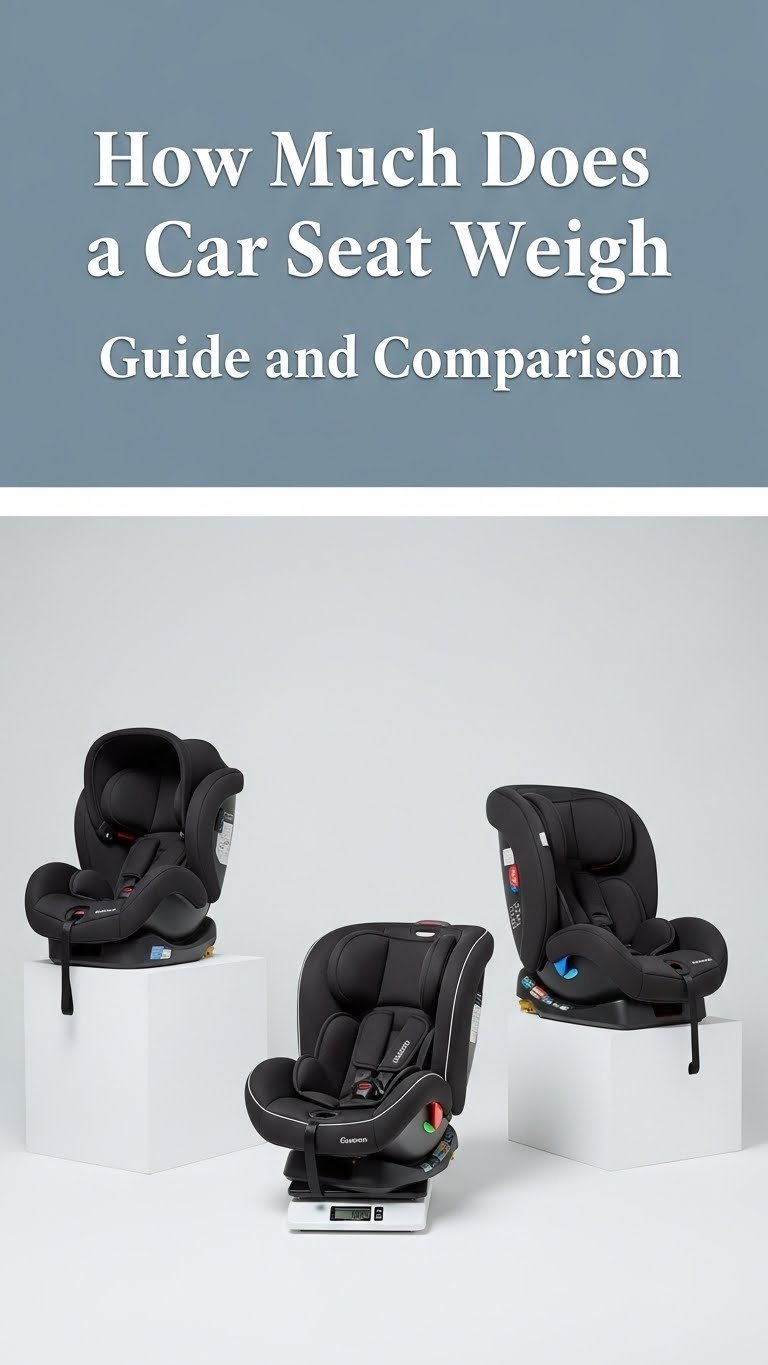
Think of it like a backpack: there is the weight of the bag itself, and then there is the total weight it’s designed to carry. Understanding this distinction is the first step to making an informed decision.
- Physical Seat Weight: This is the actual weight of the car seat product, ranging from 8 to 35+ pounds. This number matters most for portability, travel, and ease of installation.
- Child Weight Limit: This is the manufacturer’s specified maximum weight for the child using the seat, ranging from 22 to 120 pounds. This number is a critical safety standard that determines when you must transition to the next seat.
What Are the Average Weights of Different Car Seat Types?
On average, car seat weights are: Infant Seats (8-12 lbs), Convertible Seats (18-30 lbs), All-in-One Seats (20-35 lbs), and Booster Seats (5-10 lbs). The physical weight of a car seat varies significantly depending on its type and intended use. Each category is engineered with different priorities, which directly impacts how much it weighs. Let’s break down the typical weights you can expect.
How Much Does an Infant Car Seat Weigh?
The weight of an infant car seat carrier, the part you actually carry, is typically between 8 and 12 pounds (3.6 to 5.4 kg). These seats are designed for portability, allowing you to move a sleeping baby from the car to a stroller without disruption. Ultra-light models, built specifically for parents who prioritize ease of carrying, can weigh as little as 5-7 pounds.
The carrier is what you lift; the separate car seat base is what usually stays in the car. This base can add another 5 to 10 pounds to the total system weight, but you rarely carry it. The carrier-only weight is the most important number for new parents concerned about a product being too heavy or difficult to carry.

Things to consider for infant carrier weight:
* Stroller Compatibility: Ensure the lightweight carrier you choose is compatible with your stroller to create a travel system.
* Ergonomic Handle: A well-designed carry handle can make a 9-pound seat feel more manageable than a poorly designed 8-pound one.
* Features vs. Weight: The lightest models may sacrifice features like extra padding or a large canopy to reduce weight.
How Much Does a Convertible or All-in-One Car Seat Weigh?
Convertible and all-in-one car seats are the heaviest, weighing between 18 and 35 pounds (8.2 to 15.9 kg). These seats are not designed for portability. Instead, they are built to remain installed in your vehicle for long periods, often for years. Their substantial weight comes from features that provide longevity and enhanced safety. Think of it as buying one sturdy piece of furniture that adapts as your child grows.
These seats convert from rear-facing to forward-facing and sometimes even to a booster seat. This multi-stage functionality requires a robust structure.
Features that add weight include:
* Steel-Reinforced Frame: Provides extra strength and durability in a crash.
* Advanced Safety Features: Components like an anti-rebound bar or extra energy-absorbing foam add both safety and mass.
* Multi-Stage Components: The mechanisms required to adjust and convert the seat through different modes add to its overall weight.
How Much Does a Booster Seat Weigh?
Booster seats are the lightest type of child safety seat, with high-back models weighing 8 to 12 pounds (3.6 to 5.4 kg) and backless boosters weighing as little as 2 to 5 pounds (0.9 to 2.3 kg). Their simple design is the key to their low weight. Unlike infant and convertible seats with a built-in 5-point harness, a booster seat requires the vehicle’s own seat belt to restrain the child.
Their primary function is to “boost” the child up so that the car’s shoulder and lap belts fit them correctly.
* High-back boosters offer the added benefit of side-impact protection for the head and torso.
* Backless boosters are extremely portable and are an excellent option for carpooling or travel once your child meets the age, height, and weight requirements.
What Is the Car Seat Weight Comparison for Top [2024] Models?
Seeing the data side-by-side makes choosing easier. Popular infant car seats like the Nuna Pipa lite rx weigh 6.9 lbs, while convertible seats like the Britax Boulevard weigh 29.4 lbs. This table compares some of the top models on the market, showing both the physical seat weight (for carrying) and the child weight limits (for safety).
Data in this chart is sourced directly from manufacturer data and official owner’s manual documents as of December 2025. Always confirm specifications on the product label before use.
| Car Seat Model & Type | Seat Weight (lbs / kg) | Child Rear-Facing Limit (lbs) | Child Forward-Facing Limit (lbs) |
|---|---|---|---|
| Nuna Pipa lite rx (Infant) | 6.9 lbs / 3.1 kg | 4-32 lbs | N/A |
| UPPAbaby Mesa V2 (Infant) | 9.9 lbs / 4.5 kg | 4-35 lbs | N/A |
| Chicco KeyFit 30 (Infant) | 9.6 lbs / 4.3 kg | 4-30 lbs | N/A |
| Graco Extend2Fit (Convertible) | 19 lbs / 8.6 kg | 4-50 lbs | 22-65 lbs |
| Britax Boulevard (Convertible) | 29.4 lbs / 13.3 kg | 5-40 lbs | 20-65 lbs |
| Diono Radian 3QXT (All-in-One) | 32 lbs / 14.5 kg | 4-50 lbs | 22-65 lbs |
| Graco 4Ever DLX (All-in-One) | 22.8 lbs / 10.3 kg | 4-40 lbs | 22-65 lbs |
| Graco TurboBooster (High-Back Booster) | 8.2 lbs / 3.7 kg | N/A | N/A (Booster: 40-100 lbs) |
Is a Heavier Car Seat Safer?
No, a heavier car seat is not automatically safer. All car seats legally sold in the United States must pass identical, rigorous federal crash-test standards. Safety is determined by proper installation and correct use, not by the sheer weight of the product. This is a critical point that causes anxiety for many parents.
All car seats must meet the standards defined by the Federal Motor Vehicle Safety Standard 213 (FMVSS 213). This ensures a baseline of safety for every seat on the market, regardless of its weight or price. Think of helmets: a modern, lightweight carbon fiber helmet can be far safer than an old, heavy steel one because of better technology and materials.
Expert Insight: What Really Matters for Safety
According to certified Child Passenger Safety Technicians (CPSTs), the single most important factor for a child’s safety in a vehicle is the correct installation and use of their car seat. A lightweight seat installed correctly is infinitely safer than a heavy, expensive seat installed improperly.
What actually makes a car seat safe:
* Proper Installation: The seat must be installed tightly in your vehicle, moving no more than one inch side-to-side at the belt path.
* Correct Use: The harness must be snug on the child, and the chest clip positioned at armpit level.
* Appropriate for Your Child: The child must be within the height and weight limits for that specific seat and usage mode (e.g., rear-facing).
* Advanced Features: Modern safety comes from features like energy-absorbing foam, side-impact protection, and anti-rebound bars, not from weight alone.
What Are the Child Weight and Height Limits for Each Car Seat Stage?
Children should remain in a rear-facing car seat until they reach the maximum height or weight limit, typically 40-50 pounds. After that, they move through a sequence of seats based on their size. Understanding these transitions is a vital part of car seat safety. According to the AAP and NHTSA, you should always keep your child in their current seat until they max out either the height or weight limit.
Here is the recommended car seat journey for your child:
- Stage 1: Rear-Facing (Birth to 2-4 years)
Children should ride rear-facing for as long as possible, until they reach the top height or weight limit allowed by their car seat’s manufacturer. This is the safest way for them to ride, as it protects the developing head, neck, and spine in a crash. This can be in an infant carrier or a convertible seat. Limits typically go up to 40-50 pounds. -
Stage 2: Forward-Facing with Harness (2-7 years)
Once your child outgrows their rear-facing seat, they can travel in a forward-facing car seat with a harness and tether. They should stay in this type of seat until they reach the top height or weight limit, which is often around 65 pounds. -
Stage 3: Booster Seat (4-12 years)
After outgrowing the forward-facing harness, a child should use a belt-positioning booster seat until the vehicle’s seat belt fits properly. This typically happens when they are 4 feet 9 inches tall and are between 8 and 12 years of age. The booster lifts them up so the car’s lap and shoulder belts cross their body at the strong points (hips and chest). -
Stage 4: Vehicle Seat Belt (8-13+ years)
A child is ready for the adult seat belt when they can pass the “5-Step Test”:- Their back is flat against the vehicle seat back.
- Their knees bend comfortably at the edge of the seat.
- The lap belt sits snugly across the upper thighs, not the stomach.
- The shoulder belt sits on the shoulder and chest, not crossing the neck or face.
- They can stay seated properly for the entire trip.
FAQs About how much does a car seat weigh
How much does a Graco car seat weigh?
A Graco car seat’s weight varies significantly by type, from around 9 pounds for an infant seat to 25 pounds for an all-in-one model. For example, the popular Graco SnugRide infant carrier weighs about 7.2 lbs (without the base), while the Graco 4Ever DLX All-in-One seat weighs approximately 23 lbs. Always check the specific model’s specifications.
How much does the Nuna Pipa weigh?
The Nuna Pipa series is known for being lightweight, with the carrier typically weighing between 5.3 and 8 pounds. The Nuna Pipa lite rx model weighs 6.9 lbs, while the original Nuna Pipa weighs about 8 lbs. This weight does not include the base, which adds extra pounds but usually stays in the car.
Is it okay to use a car seat without the base?
Some infant car seats can be installed safely without the base, but you must follow the manufacturer’s specific instructions for a “baseless” or “European belt path” installation. This feature is designed for convenience in taxis or travel. However, convertible and all-in-one seats are designed to be installed as a single unit and cannot be used without their integrated base.
Do car seats go by weight or height?
Car seats go by both weight and height, and you must follow whichever limit your child reaches first. Every car seat has both a minimum and maximum for height and weight. Outgrowing a seat by either of these measurements means it’s time to transition to the next stage for your child’s safety.
How much weight can a car seat hold?
This refers to the child’s weight limit, which ranges from 22-35 lbs for infant seats, up to 65 lbs for forward-facing seats with a harness, and up to 120 lbs for booster seats. This is different from the physical weight of the seat itself. Always check the labels on your specific car seat for its maximum child weight capacity.
What is the lightest car seat available?
The lightest infant car seats on the market typically weigh between 5 and 7 pounds for the carrier alone. Models like the Nuna Pipa Lite series are specifically engineered for portability and are popular choices for parents who prioritize a lightweight design for travel or carrying.
Why do car seats have weight limits?
Car seats have strict weight limits because they are crash-tested and engineered to protect a child of a specific size and mass. The materials, harness, and shell are designed to absorb and distribute impact forces for that weight range. Exceeding the limit means the seat may not perform as expected in a crash, creating a significant safety risk.
Can a 40 lb child be in a booster seat?
Yes, most booster seats have a minimum weight requirement of 40 pounds, but weight is not the only factor. According to the AAP, children should also be mature enough to sit properly for the entire ride without slouching or playing with the seat belt. Many experts recommend keeping a child in a 5-point harness until they reach the maximum limit of their forward-facing seat.
How much does a Doona car seat weigh?
The Doona Infant Car Seat & Stroller weighs approximately 16.5 pounds. This weight is higher than a typical infant carrier because it includes the integrated stroller wheels and frame. The trade-off for the higher weight is the convenience of an all-in-one travel system without needing a separate stroller frame.
How much does a child have to weigh to sit in the front seat?
The American Academy of Pediatrics (AAP) and NHTSA recommend that all children under the age of 13 ride in the back seat. This is due to the significant risk of injury from active front-passenger airbags. There is no specific weight where it becomes safe; the age-based guideline is the most important rule to follow.
Key Takeaways: Understanding Car Seat Weight
- Two Types of “Weight”: Always distinguish between the physical weight of the seat (for carrying, typically 8-35 lbs) and the child’s weight limit (for safety, up to 120 lbs).
- Weight Doesn’t Equal Safety: A heavier car seat is not inherently safer. All seats must pass the same federal crash tests (FMVSS 213). Proper installation is the most critical safety factor.
- Infant Seats Are for Portability: Infant carriers are the lightest (often 8-12 lbs) because they are designed to be carried. Lightweight models can be as low as 5-7 lbs, making them ideal for travel.
- Convertible Seats Are Heavy for a Reason: Convertible and all-in-one seats are heavy (18-35 lbs) because they have steel-reinforced frames and are built to last for many years, converting through multiple stages.
- Follow Both Height and Weight Limits: To ensure safety, you must transition your child to the next car seat stage as soon as they reach either the height or weight limit of their current seat.
- Trust the Experts on Transitions: Always follow the guidelines from the NHTSA and AAP for transitioning between rear-facing, forward-facing, and booster seats. Keep children rear-facing for as long as possible.
- Check Manufacturer Specs: The best source of truth for any car seat’s physical weight or child weight capacity is the official manufacturer data found on the product’s labels and in the owner’s manual.
Final Thoughts on Choosing the Right Car Seat
Choosing a car seat involves balancing your family’s need for portability with the long-term safety features that protect your child as they grow. The most important step is understanding the critical difference between the physical weight you have to carry and the child weight limits you must follow for safety. By using this guide to clarify your needs, you can move forward and select the perfect seat for your child with total confidence.
Last update on 2025-12-31 / Affiliate links / Images from Amazon Product Advertising API

![Car Scratch Repair Cost Guide Minor Deep DIY Professional [year]](https://carxplorer.com/wp-content/uploads/2025/12/Car-Scratch-Repair-Cost-Guide-Minor-Deep-DIY-Professional-year-2-60x60.jpg "Car Scratch Repair Cost Guide Minor Deep DIY Professional [year] 6")


