
Struggling to figure out how many watts your car battery has? You’re not alone. Many people get lost in a sea of technical terms like volts, amps, and amp-hours, making it hard to get a straight answer. This confusion can be frustrating when you just want to know if you can power your devices.
A standard 12-volt car battery does not have a single, fixed wattage; instead, its total energy capacity is measured in Watt-hours (Wh), typically ranging from 400 to 1,000 Wh. For instantaneous power, like starting an engine, it can deliver several thousand watts for just a few seconds. The continuous wattage it can supply depends on its Amp-hour rating and the power draw of the connected device.
Based on an analysis of current manufacturer specifications and technical data, this guide clears up the confusion. We’ll break down the critical difference between power (Watts) and energy (Watt-hours). You will learn exactly how to calculate your battery’s real-world capacity and use it safely for more than just starting your car.
Key Facts
- Power vs. Energy: Watts (W) measure instantaneous power, like the speed of a car. Watt-hours (Wh) measure total stored energy, like the amount of fuel in the tank, which is a more useful metric for running accessories.
- Starting Power is Immense: A car battery delivers a massive but brief burst of 3,000 to 6,000 watts to the starter motor for a few seconds, demonstrating its high-power, low-energy design.
- Capacity Calculation: The total energy of a battery in Watt-hours (Wh) is calculated by multiplying its Amp-hour (Ah) rating by its nominal voltage (e.g., 60 Ah x 12V = 720 Wh).
- Real-World Limits: A battery’s advertised capacity is rarely what you get in practice. Factors like cold temperature, high power draw (Peukert’s Law), and age significantly reduce its effective wattage output.
- Discharge Damage is Real: Routinely draining a standard car battery below 50% of its charge (about 12.0 volts) causes permanent damage called plate sulfation, which drastically reduces its lifespan and capacity.
How Many Watts Is a Standard Car Battery?
A standard 12-volt car battery doesn’t have a single “wattage” rating; instead, it’s defined by its total energy storage, typically 480 to 960 Watt-hours (Wh), and its ability to deliver a massive power burst of 3,000 to 6,000 watts for starting the engine. This distinction between stored energy and instantaneous power is the most common point of confusion. A Lead-Acid Automotive Battery [a rechargeable battery designed for starting, lighting, and ignition] is built for two very different jobs.

Think of it this way: Watts (W) are like the speed of your car, measuring instantaneous power delivery. Watt-hours (Wh) are like the total fuel in your tank, measuring the total energy you can use over time. A car battery is like a drag racer’s engine—it can generate incredible power for a very short sprint (starting the car) but doesn’t have the fuel tank for a long road trip (powering appliances for extended periods).
The two key numbers to understand are starting power and total capacity. The 3,000-6,000 watts figure is only relevant for the few seconds it takes to crank the engine. For everything else—like running a power inverter or charging your phone—the Watt-hour capacity is the number that truly matters. But which number matters more for running your camping fridge? Understanding this difference is the first step to using your battery’s power effectively.
What Is The Critical Difference Between Watts (Power) and Watt-Hours (Energy)?
The essential difference is that Watts (W) measure the rate of power at a single moment, while Watt-hours (Wh) measure the total amount of energy stored. Understanding this is crucial for knowing both what you can power and for how long. One tells you if you can run a device, and the other tells you how long you can run it.
Using our car analogy:
* Watts (W) are like your speedometer reading. It shows how fast you’re going right now (e.g., 60 MPH). An appliance with a 60W rating needs that much power at any given moment to operate.
* Watt-hours (Wh) are like the total gallons of fuel in your gas tank. It tells you the total distance you can travel. A battery with a 600Wh capacity holds a finite amount of energy to be used over time.
This distinction is vital for practical use. A high-wattage device might run on your battery, but it will drain the total Watt-hours very quickly. A low-wattage device will run for much longer. Let’s explore this with a table.
| Feature | Watts (W) | Watt-hours (Wh) |
|---|---|---|
| What It Measures | Instantaneous Power (Rate of energy flow) | Total Energy (Stored capacity) |
| Real-World Analogy | The speed you are driving (e.g., 60 MPH) | The total fuel in your tank (e.g., 15 gallons) |
| Practical Question | “How much power does my device need right now?” | “How long can my battery run this device?” |
| Formula Role | W = Volts × Amps | Wh = Volts × Amp-hours |
Here’s a practical test of this concept. If your laptop charger is 65W and your car battery has 600Wh, can you calculate the theoretical run time? You would divide the total energy (600Wh) by the power demand (65W), which gives you just over 9 hours. This simple calculation is the key to planning your power usage.
How Do You Calculate a Car Battery’s Wattage and Watt-Hour Capacity?
To find your battery’s total energy capacity in Watt-hours (Wh), you multiply its Amp-hour (Ah) rating by its nominal voltage. For instantaneous wattage, you multiply the current draw of a device in Amps (A) by the battery’s voltage. These two simple formulas, based on Ohm’s Law [a fundamental principle of electricity], unlock all the practical information you need.
Let’s walk through the steps to calculate the most important number: total energy capacity.
- Find the Amp-hour (Ah) Rating: First, locate the Amp-hour rating on your battery’s label. It’s often abbreviated as “Ah”. Most standard car batteries fall in the range of 40-80 Ah. If you can’t find it, look for the BCI group size and check a chart online, as this often corresponds to a specific capacity.
- Confirm the Voltage (V): Standard car batteries operate on a 12-volt DC system. While a fully charged battery reads around 12.6V, the industry standard for calculation is to use the nominal voltage of 12V.
- Calculate Watt-hours (Wh): Now, simply multiply the two numbers together.
Formula: Watt-hours (Wh) = Amp-hours (Ah) × Volts (V)
For example, a common 60 Ah battery provides: 60 Ah × 12V = 720 Wh of total energy.
For calculating the instantaneous power a specific device uses:
Formula: Watts (W) = Amps (A) × Volts (V)
If you have a 12V accessory that draws 5 Amps, it is using: 5 A × 12V = 60 W of power at that moment.
Pro Tip: Some batteries only list Reserve Capacity (RC) in minutes. You can get a rough estimate of the Amp-hour rating by dividing the RC by 2.4. For example, an RC of 120 minutes is approximately 120 / 2.4 = 50 Ah.
What Factors Reduce a Car Battery’s Real-World Wattage Output?
Your battery’s real-world power output is always less than its theoretical maximum due to four key factors: temperature, discharge rate, age, and depth of discharge. What most guides miss is that a battery’s label capacity is a best-case scenario measured under perfect lab conditions. In reality, these factors can significantly reduce the usable wattage you get.
Here’s a breakdown of what really happens:
- 🌢 Temperature: Extreme cold is a battery’s worst enemy. The chemical reaction that generates electricity slows down dramatically in cold weather, reducing both starting power and overall capacity. Conversely, extreme heat can accelerate battery degradation and increase the self-discharge rate. A battery performs best around 77°F (25°C).
🖊 Discharge Rate (Peukert’s Law): This is a critical but often-overlooked concept. Peukert’s Law explains that the faster you drain a battery, the less total energy you get from it. Drawing a high-wattage load is like trying to sprint a marathon; you’ll exhaust your energy far more quickly than if you jogged. A 100Ah battery might provide 100 amp-hours if drained over 20 hours, but only 70-80 amp-hours if drained in one hour.
📅 Age and Health: As a battery ages, a process called plate sulfation occurs. Lead sulfate crystals build up on the battery plates, increasing internal resistance. This resistance makes it harder for the battery to deliver power, effectively lowering its available wattage and capacity. A 5-year-old battery simply can’t perform like a new one.
🔋 Depth of Discharge (DoD): This refers to how much of the battery’s “fuel” you have used. As a battery’s State of Charge (SoC) drops, so does its voltage. Since Watts = Volts × Amps, a lower voltage directly results in lower wattage output. More importantly, discharging a standard car battery below 50% DoD (around 12.0V) causes irreversible damage and dramatically shortens its lifespan.
Can a Car Battery Power an Inverter and Other Appliances?
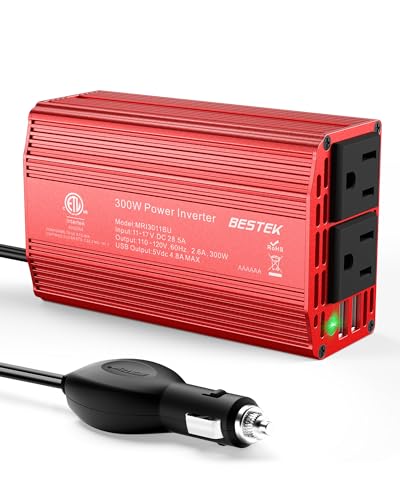
Yes, a standard car battery can absolutely power a power inverter to run AC appliances, but it is crucial to manage expectations and respect the battery’s limitations. You must account for the inverter’s inefficiency and avoid draining the battery too deeply. A power inverter [a device that converts 12V DC power to 120V AC power] is the key to unlocking this capability for camping, emergencies, or work.
However, there are three critical considerations:
1. Inverter Inefficiency: Inverters are not 100% efficient. They consume some power just to operate, typically losing 10-15% of the energy they draw. This means to power a 100W device, the inverter will actually pull around 115W from your battery.
2. The 50% Rule: To avoid damaging your starter battery, you should never discharge it more than 50%. This means a 720Wh battery only has about 360Wh of usable energy.
3. Appliance Wattage: You need to know the power consumption of the appliance you want to run. This is usually listed on its power brick or label.
Let’s put this into a practical table. Below are estimated run times for common devices powered by a typical 720Wh car battery, used safely down to 50% capacity (360Wh usable).
Estimated Run-Time on a Typical Car Battery (720Wh Capacity, 50% DoD)
| Appliance | Power Draw (Watts) | Inverter Loss (~15%) | Total Draw (Watts) | Estimated Run Time |
|---|---|---|---|---|
| Smartphone Charger | 10W | ~1.5W | 11.5W | ~31 hours |
| Laptop | 65W | ~10W | 75W | ~4.8 hours |
| 32″ LED TV | 50W | ~7.5W | 57.5W | ~6.2 hours |
| Small Camping Fridge | 45W (cycling) | ~7W | 52W | ~6.9 hours (of run time) |
Warning: If you plan to frequently power appliances, investing in a true deep cycle battery is highly recommended. Unlike a starter battery, a deep cycle battery is designed to be deeply and repeatedly discharged without significant damage.
FAQs About how many watts is car battery
How many watts does it take to start a car?
Starting a car requires a massive but brief burst of power, typically between 3,000 and 6,000 watts. This is why batteries are rated with Cold Cranking Amps (CCA), which measures their ability to deliver this high current in cold conditions. This high wattage is only needed for a few seconds to turn the engine over.
How many watts is a car battery charger?
A typical car battery charger uses between 100 to 250 watts, depending on its amperage setting. A trickle charger or battery maintainer might only use 15-30 watts to keep the battery topped off. A high-speed charger on a “boost” setting could temporarily draw over 500 watts.
What’s the difference between a car battery and a deep cycle battery?
A car battery (starter battery) is designed to deliver a high burst of watts for a short time to start an engine. A deep cycle battery is designed to provide a lower, steady amount of watts for a long period and can be safely discharged more deeply. Car batteries are for starting; deep cycle batteries are for running appliances.
How many watts can a 12V 100Ah battery produce?
Theoretically, a 12V 100Ah battery stores 1200 Watt-hours (12V x 100Ah) of energy. This means it could produce 1200 watts for one hour, or 120 watts for ten hours. However, real-world output will be less due to factors like temperature, discharge rate, and battery health.
How many kWh is a standard car battery?
A standard car battery holds a very small amount of energy in kilowatt-hours (kWh), typically between 0.5 to 1.0 kWh. For example, a 720 Watt-hour (Wh) battery is equivalent to 0.72 kWh. This is much less than an electric vehicle (EV) battery, which can range from 40 to over 100 kWh.
How many watts does an alternator produce?
A car’s alternator typically produces between 500 and 1,500 watts. This power is used to run the car’s electrical systems (lights, radio, ECU) and to recharge the battery while the engine is running. The wattage output depends on the vehicle model and engine RPM.
Why did my power inverter shut down?
An inverter usually shuts down due to low input voltage from the battery or an overload. As the battery discharges, its voltage drops. Most inverters have a low-voltage cutoff to protect both the battery from damage and the appliance from undervoltage. It can also shut down if the appliance you connected tries to draw more peak wattage than the inverter is rated for.
Is it bad to fully drain a car battery?
Yes, it is very damaging to fully drain a standard car battery. These starter batteries are not designed for deep discharging. Draining them below 50% capacity (about 12.0V) can lead to plate sulfation, which permanently reduces the battery’s capacity and lifespan.
Can a car battery power a TV?
Yes, a car battery can power a modern LED TV for several hours using a power inverter. A typical 32″ LED TV uses about 50 watts. A healthy car battery with 720Wh, discharged to a safe 50% level (360Wh available), could theoretically power the TV for over 6 hours (360Wh / 57.5W total draw with inverter).
How many watts do I need to charge a car battery with solar?
To effectively charge a car battery, a solar panel setup of at least 100 watts is recommended. This provides enough power to overcome system losses and deliver a meaningful charge, especially on less-than-sunny days. A smaller 10-20 watt panel can act as a trickle charger to maintain a charged battery but will struggle to recharge a depleted one.
Key Takeaways: Car Battery Wattage Summary
- Power vs. Energy is Key: Watts (W) measure instantaneous power (how fast), while Watt-hours (Wh) measure total energy capacity (how long). A car battery’s Wh rating is more important for running accessories.
- Simple Calculation for Capacity: You can find your battery’s total energy by multiplying its Amp-hour (Ah) rating by its voltage (V). For a standard 12V, 60Ah battery, this is 720 Watt-hours (Wh).
- Starting Requires Massive Power: A car requires a very high burst of power, 3,000-6,000 watts, for a few seconds to start the engine, which is why Cold Cranking Amps (CCA) are a critical rating.
- Real-World Output is Always Lower: The theoretical wattage is reduced by factors like cold temperature, high power draw (Peukert’s Law), battery age, and inverter inefficiency (typically 10-15% loss).
- Don’t Drain Your Starter Battery: Standard car batteries are not deep cycle batteries. Discharging them below 50% capacity (around 12.0V) will cause permanent damage (sulfation) and drastically shorten their life.
- Inverters Make Batteries Practical: A power inverter is required to convert the battery’s 12V DC power to 120V AC for household appliances, but you must account for its power consumption and efficiency loss in your calculations.
Final Thoughts on Understanding Your Car Battery’s Power
Understanding your car battery’s wattage isn’t about finding a single magic number. It’s about confidently navigating the relationship between instantaneous power (Watts) and total energy capacity (Watt-hours). By learning the simple formulas and, more importantly, respecting the real-world factors that affect performance, you move from confusion to capability.
You now have the framework to calculate your battery’s capacity, estimate run times for your devices, and make informed decisions. By honoring the 50% depth of discharge rule and accounting for inverter inefficiency, you can safely and reliably use your battery for much more than just starting your car. This knowledge empowers you to be prepared for a power outage, equipped for a camping trip, or ready for any project on the go.
Last update on 2026-03-13 / Affiliate links / Images from Amazon Product Advertising API


