Wondering just how loud your car horn is? You’re not alone. Many drivers question the true power of this critical safety device, especially when trying to be heard in dense traffic.
A typical car horn has a sound level of approximately 100-110 decibels (dB), with most factory-installed horns specifically rated between 107-109 dB. This measurement is taken from a standardized distance of one meter (about 3.3 feet) to ensure accuracy.
Based on an analysis of manufacturer specifications and automotive engineering standards, this guide breaks down exactly what those decibel numbers mean. You will discover the laws governing horn loudness, the real risks to your hearing, and how stock horns compare to popular aftermarket options.
Key Facts
- Standard Loudness: A factory-installed car horn typically produces a sound pressure level between 100 and 110 decibels, with a common rating of 107-109 dB at one meter.
- Logarithmic Power: The decibel scale is logarithmic, meaning a 110 dB sound is perceived by the human ear as twice as loud as a 100 dB sound, representing a tenfold increase in sound power.
- Legal Variances: There is no single federal decibel limit for car horns in the U.S. Regulations are set at the state and local levels, making it crucial to check local noise ordinances before installing loud aftermarket horns.
- Hearing Damage Risk: According to OSHA, exposure to noise levels above 85 dB can cause permanent hearing loss. A 110 dB car horn far exceeds this and can be damaging in under two minutes of exposure.
- Extreme Differences: An aftermarket train horn can exceed 150 dB, a level that is painfully loud and can sound over 16 times louder to the human ear than a standard 110 dB car horn.
How Many Decibels (dB) Is a Standard Car Horn?
A typical car horn has a sound level of approximately 100-110 decibels (dB), with most factory-installed horns specifically rated between 107-109 dB. This measurement is standardized and taken from a distance of one meter (about 3.3 feet) to ensure consistent and comparable ratings across different vehicles.

This specific range isn’t arbitrary. Automotive manufacturers design these warning signal devices to be loud enough to cut through ambient road noise, which can be around 80-85 dB, and effectively alert other drivers and pedestrians. The loudness is determined according to established industry regulations, like the SAE J377 standard, which provides a testing procedure for vehicle horns. This ensures the sound pressure level is effective for safety without being excessively harmful in typical use.
Understanding this baseline is the first step. However, the number “110 dB” doesn’t tell the whole story without understanding the science behind the decibel scale itself. The way our ears perceive this sound is far from linear.
Why Is Understanding the Decibel (dB) Scale So Important?
The decibel scale is logarithmic, not linear, which means a small increase in decibels equals a large jump in sound intensity and perceived loudness. This is the single most important concept for understanding why a 120 dB horn is dramatically louder than a 110 dB one. It’s not just a small percentage louder; it’s a massive leap in power.
Much like the Richter scale for earthquakes, the decibel scale represents exponential growth. Here are the key rules to remember:
* A 3 dB increase is roughly a doubling of sound power, but is only a clearly noticeable difference to the human ear.
* A 10 dB increase represents a tenfold increase in sound power and is perceived by our ears as being twice as loud.
* A 20 dB increase means a 100-fold increase in power and is perceived as four times as loud.
This is why a 130 dB air horn sounds so much more intense than a 110 dB stock horn—it’s not just a little louder, it’s perceived as being four times as loud. When discussing sound, experts sometimes use A-weighted decibels (dBA), a measurement that adjusts for how the human ear perceives different sound frequencies. For the purposes of loudness and safety, the core concept of the logarithmic scale remains critical.
How Do Car Horn Decibels Compare to Other Common Sounds?
To truly grasp what 110 decibels feels like, it helps to place it in context with other sounds you encounter. A standard car horn is designed to be a sharp, urgent warning, and its loudness level reflects that purpose. It sits in a range that is intentionally uncomfortable to ensure it grabs attention.
Field test results and data from safety organizations like NIOSH provide a clear picture of where a car horn falls on the auditory spectrum. The following chart compares the sound pressure level of a stock horn to other familiar noises.
| Sound Source | Typical Decibel Level (dB) | Perceived Loudness Comparison |
|---|---|---|
| Normal Conversation | 60-70 dB | Standard background noise |
| City Traffic | 80-85 dB | Annoying, but not painful |
| Stock Car Horn | 100-110 dB | Uncomfortable; like a power tool |
| Ambulance/Fire Siren | 120-130 dB | Painful to ears; short exposure only |
| Live Rock Concert | 110-125 dB | High risk of hearing damage |
| Aftermarket Train Horn | 140-150+ dB | Immediate ear pain; dangerous |
| Jet Engine at Takeoff | 140 dB | Intolerable; causes physical pain |
As the data shows, a car horn is significantly louder than normal traffic, which is why it works as a safety device. However, it’s easily overshadowed by emergency vehicle sirens and aftermarket train horns. The jump from a 110 dB car horn to a 150 dB train horn is immense and crosses the threshold from a warning signal into a dangerously powerful acoustic weapon.
What Are the Legal Decibel Limits for Car Horns?
While there isn’t one universal U.S. federal law, most states and cities regulate car horn loudness. Factory horns around 110 dB are universally legal, but aftermarket horns exceeding 120 dB, like train horns, are often illegal for road use.
Legal compliance is a primary concern for anyone considering a horn upgrade. Here are the key points to understand about vehicle noise regulations:
* No Federal Standard: The federal government does not set a maximum decibel limit for passenger cars. Instead, this is left to state and local governments.
* Implicit Acceptance: Because all new cars must meet federal motor vehicle safety standards, their stock horns (around 100-110 dB) are considered legal everywhere.
* State and Local Ordinances: Most laws focus on preventing “unreasonably loud or harsh” sounds. Some jurisdictions set specific maximum permissible noise levels, often around 110-120 dB.
* Train Horns are a Red Flag: Horns designed for trains, which can exceed 150 dB, are almost universally illegal on passenger vehicles for road use. They are considered a public nuisance and can cause panic or hearing damage.
⚠ Pro Tip: Before installing any aftermarket horn, always check your local “municipal noise ordinance data.” A quick search for “[Your City] vehicle noise ordinance” will often provide the specific legal decibel limit you must follow. Laws are subject to change, and this information is for educational purposes as of 2026.
Can a Car Horn Cause Hearing Damage?
Yes, a car horn can absolutely cause hearing damage, especially with close-range or prolonged exposure. According to hearing safety guidelines from organizations like the Occupational Safety and Health Administration (OSHA), any sound above 85 dB can lead to permanent, noise-induced hearing loss (NIHL) over time.
A 110 dB car horn is far above this safe threshold. The critical factors are loudness and exposure time. The louder the sound, the less time you can be exposed to it before damage occurs.
- At 85 dB (heavy city traffic), the maximum permissible exposure is 8 hours per day.
- At 100 dB (like a power drill), that time drops to just 15 minutes.
- At 110 dB (a stock car horn), the recommended exposure limit from NIOSH is less than two minutes per day.
For a pedestrian on a sidewalk, a passing car’s honk is brief and unlikely to cause harm. However, for a mechanic testing a horn in a garage or someone standing directly in front of the vehicle, the risk is very real.
🛡 Safety First: Always wear hearing protection, such as earplugs or earmuffs, when testing or working on a vehicle’s horn system in an enclosed space. Your hearing is irreplaceable.
What Is the Difference Between Stock Horns and Aftermarket Air Horns?
For many enthusiasts, the stock horn’s high-pitched beep feels inadequate. This leads to exploring aftermarket options, which primarily fall into two categories: louder electric horns and powerful air horns. The core difference lies in their technology, which dictates their loudness, sound profile, and installation complexity.
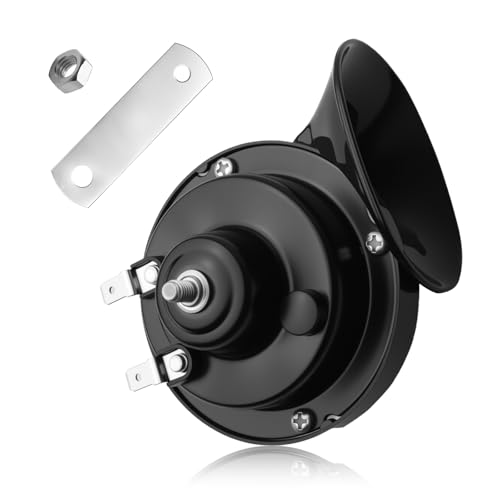
Stock car horns are typically electric disc horns. They use a 12v signal to power an electromagnet that vibrates a metal diaphragm, creating a sound around 100-110 dB. Aftermarket air horns, in contrast, use a separate compressor system to generate pneumatic pressure, forcing a massive blast of air through a trumpet to produce a much louder, deeper sound, often between 120 dB and 150+ dB.
This table breaks down the key differences:
| Feature | Stock Electric Horn | Aftermarket Air Horn |
|---|---|---|
| Technology | Vibrating metal diaphragm | Air from a compressor |
| Avg. Decibels | 100-110 dB | 120-150+ dB |
| Sound Profile | Single or dual-tone, high pitch | Deep, loud, train-like blast |
| Installation | Simple; direct replacement | Complex; requires compressor, tubing, and relay |
| Legality | Universally legal for road use | Often illegal for road use; check local laws |
While an aftermarket electric horn like a Hella Supertone offers a noticeable volume boost and a more aggressive tone with simple installation, a true air horn or train horn is a major project. It requires mounting a compressor, running air lines, and wiring a dedicated horn relay to handle the higher electrical current, making it a choice for serious hobbyists who understand the legal limitations.
FAQs About how many db is a car horn
How loud is a 150 dB horn?
A 150 dB horn is dangerously loud and comparable to a jet engine at takeoff or a live firearm discharge. This level is far beyond a standard car horn (110 dB) and can cause immediate, irreversible hearing damage. Perceived by the human ear, a 150 dB horn would sound over 16 times louder than a 110 dB car horn.
Are air horns legal on cars?
In most places, air horns are not legal for use on public roads in standard passenger vehicles. While owning them may be legal, their extreme volume (often 120-150+ dB) typically violates local noise ordinances and vehicle codes. They are generally reserved for emergency vehicles, trains, and marine applications.
How do you measure car horn decibels?
Car horn decibels are officially measured using a calibrated Sound Level Meter (SLM). The standard procedure, such as SAE J377, specifies placing the meter one meter (about 3.3 feet) away from the horn. For casual testing, a smartphone decibel meter app can provide a rough estimate, but it will not have the accuracy of a dedicated SLM.
Why does my car horn sound weak?
A weak or muffled car horn is usually caused by electrical issues or physical problems with the horn itself. Common causes include a failing horn relay, corroded wiring or ground connections, low battery voltage, or a damaged internal diaphragm in the horn unit. Start by checking the fuse and relay before inspecting the horn’s wiring.
Can you adjust car horn volume?
No, you cannot typically adjust the volume of a standard car horn. The loudness is determined by its design and the voltage it receives from the car’s electrical system. If your horn seems too quiet, it’s likely due to a fault. The only way to change the volume is to replace the horn with a different model.
How far away can you hear a car horn?
A standard 110 dB car horn can be audible from over a mile away in ideal, quiet conditions. However, in a city with ambient traffic noise (around 80 dB), its effective warning distance is significantly reduced to a few hundred feet. The sound level decreases by about 6 dB for every doubling of distance from the source.
What is the loudest car horn I can legally install?
There is no single answer, as the legal limit varies by state and city, but it’s generally around 110-120 dB. The safest approach is to use a loud, DOT-approved aftermarket horn that is not an air or train horn. Horns like the Hella Supertone are noticeably louder than stock but are designed to be compliant in most areas.
How many decibels is a train horn compared to a car horn?
A train horn is significantly louder, typically operating between 130 and 150 decibels. This is substantially more powerful than a car horn’s 100-110 dB. Due to the logarithmic scale, a 150 dB train horn can be perceived as 16 times louder than a 110 dB car horn and is designed to be heard from miles away.
What makes a car horn loud?
A car horn’s loudness is determined by the efficiency and power of its sound-producing mechanism. In electric horns, this is the size of the diaphragm and the power of the electromagnet making it vibrate. In air horns, loudness is determined by the air pressure from the compressor and the acoustic design of the trumpet bell.
How many db is a motorcycle horn?
A standard motorcycle horn is often quieter than a car horn, typically in the 90-105 dB range. This is a common complaint among riders, as the horn can struggle to be heard in heavy traffic. Many motorcyclists upgrade to louder aftermarket horns (around 110-120 dB) for increased safety and visibility.
Final Thoughts
Understanding your car horn’s decibel level is about more than just a number; it’s about grasping the balance between safety, legality, and auditory science. Now you know not just the “how many,” but the “why” behind it all.
Here are the most critical points to remember:
* The Standard is 100-110 dB: Your factory car horn is engineered to be in this range, providing an effective warning that is legal everywhere.
* Decibels are Deceptive: Remember the logarithmic scale. A 10 dB jump means twice the perceived loudness and ten times the power—a massive increase.
* Laws are Local: Before you upgrade to a louder horn, always check your state and city noise ordinances to avoid fines and failed inspections.
* Protect Your Hearing: A 110 dB horn is loud enough to cause hearing damage in under two minutes. Always use hearing protection when working near one.
* Upgrades Have Trade-offs: Aftermarket horns can be much louder, but options like train horns are often illegal and require complex installation.
Your car horn is a vital piece of safety equipment. Whether you’re troubleshooting a weak horn or considering an upgrade for better visibility, making an informed choice is key to staying safe and legal on the road.
Last update on 2026-03-04 / Affiliate links / Images from Amazon Product Advertising API