
Struggling with how do you get water spots off of a car? You are not alone; these unsightly blemishes are a common frustration, especially on dark-colored paint where they stand out. Those chalky rings can make a freshly washed car look dirty and neglected.
To get water spots off a car, you must first identify their severity, as they are mineral deposits left after water evaporates. For light mineral deposits sitting on the surface (Type 1), a simple 1:1 solution of white vinegar and distilled water is effective. For more stubborn spots that feel rough, a clay bar treatment is needed. For etched spots that have damaged the clear coat and feel smooth (Type 2), polishing with an abrasive compound is required to restore the finish.
This guide is based on tested methods used by professional detailers to diagnose and remove every type of water spot. It provides a complete framework for tackling the problem safely. You will discover exactly how to identify your specific type of water spot and apply the correct removal technique, from simple DIY fixes to full paint restoration.
Key Facts
- Two Main Types Exist: Water spots are either mineral deposits on top of the paint (Type 1) or etched craters in the clear coat (Type 2), requiring different removal methods.
- Vinegar is a Go-To Solution: A 1:1 mix of white vinegar and distilled water effectively dissolves the alkaline mineral deposits of most common water spots, as confirmed by industry analysis.
- Drying is 90% of Prevention: The single most effective way to prevent water spots is to thoroughly dry your vehicle after any exposure to water, which stops mineral precipitation on the surface.
- Ceramic Coatings Aren’t Immune: While a ceramic coating’s hydrophobic properties help water slide off, they can still get water spots; however, these spots are on the coating itself and are much easier to remove.
- Polishing is the Only Fix for Etching: Once minerals have etched into the clear coat, chemical cleaners will not work; the only solution is to mechanically abrade the surface with a polish or compound to level the paint.
How Do You Get Water Spots Off of a Car?
The key to removing water spots is to follow a tiered approach, starting with the least aggressive method first. Before you grab any product, you must diagnose the severity of the spotting. This ensures you use the right technique for the job, preventing you from wasting time on a method that won’t work or, worse, causing unnecessary wear on your car’s paint. This expert guide outlines the proven techniques for removing everything from light mineral stains to severe paint etching.

Based on years of real-world detailing experience, the process always follows a logical progression. You will learn to work through the solutions systematically, ensuring a safe and effective outcome. This approach saves you time, money, and protects the integrity of your vehicle’s finish. We will cover the three primary methods for car water spot removal:
- Chemical Cleaning: Using a DIY vinegar solution or a commercial water spot remover to dissolve mineral deposits.
- Mechanical Decontamination: Employing a clay bar to physically shear off stubborn, bonded contaminants.
- Paint Correction: Polishing the clear coat with an abrasive to level the surface and remove permanent etch marks.
What Causes Water Spots and How Do You Identify the Damage?
There are two types of car water spots: Type 1 spots are mineral deposits on the paint’s surface, feeling slightly rough. Type 2 spots are etched, meaning they have eaten into the clear coat and feel smooth or indented. Understanding the difference is critical because it dictates the removal method. Using a chemical cleaner on an etched spot will do nothing, and trying to polish a simple mineral deposit is overkill.
The primary cause of car water stains is hard water [water containing minerals like calcium and magnesium] that evaporates on the surface. As the water disappears, the mineral deposits are left behind, creating the visible spot. This is common from sprinklers, washing a car in direct sunlight, or not drying it properly. Acid rain can also cause spots that etch the paint more quickly when baked by the sun.
A simple “fingernail test” can help you diagnose the issue. Gently glide your fingernail over a spot. If you can feel a rough, raised edge, it’s a Type 1 mineral deposit. If the surface feels completely smooth, as if the spot is inside the paint, you have a Type 2 etch.
| Feature | Type 1: Mineral Deposits | Type 2: Etched Spots |
|---|---|---|
| Appearance | White, hazy rings or spots on the surface. | Faint, translucent spots that seem “in” the paint. |
| Feel | Slightly rough, can be felt with a fingernail. | Smooth or slightly indented, can’t be felt. |
| Cause | Evaporated hard water (sprinklers, improper drying). | Minerals or acid rain baking in the sun, eating into clear coat. |
| Removal Method | Chemical (Vinegar, Water Spot Remover). | Mechanical (Polishing, Compounding). |
How Do You Remove Mild Water Spots with a DIY Vinegar Solution?
The safest and most common DIY method for removing light water spots is a simple vinegar and water solution. White vinegar [an acetic acid] is mildly acidic, making it perfect for dissolving the alkaline mineral deposits (calcium and magnesium) that form most Type 1 spots. This is the first method you should always try. For this, you need distilled water [mineral-free water] to avoid adding more minerals back onto the surface.
Here is the step-by-step process based on proven detailing techniques:
- Create the Solution: Mix a 1:1 ratio of plain white vinegar and distilled water in a clean spray bottle.
- Apply to a Towel: Spray the solution liberally onto a clean, plush microfiber towel, not directly onto the car’s paint. This prevents the solution from running into panel gaps or drying too quickly.
- Gently Wipe: Gently wipe the affected area with the damp towel for 30-60 seconds. You are not scrubbing; you are giving the acid time to dissolve the minerals.
- Rinse Thoroughly: Immediately rinse the area with plenty of plain water to neutralize the acid and wash away the dissolved minerals.
- Dry Completely: Dry the area with a separate, clean microfiber towel to prevent new water spots from forming.
Pro Tip: For extra safety, always work in a shaded area on a surface that is cool to the touch. This prevents the vinegar solution from evaporating too quickly and potentially causing its own etching.
What If Vinegar Doesn’t Work? Exploring Commercial Water Spot Removers
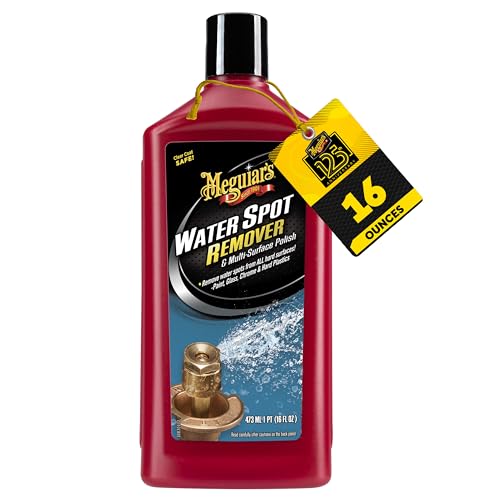
If vinegar fails to remove the water spots, a dedicated commercial water spot remover is the next logical step. While vinegar is effective, some mineral deposits can be too resilient for such a mild acid. Commercial removers are specifically formulated to tackle these tougher jobs safely and efficiently.
These products are often better for stubborn Type 1 spots for a few key reasons:
- Balanced Chemistry: They use a blend of mild acids that are pH balanced, making them strong enough to dissolve heavy mineral deposits without being overly harsh on your clear coat.
- Added Lubricants: Trusted brands formulate their removers with special lubricants. This is a critical feature that helps prevent scratching as you wipe the dissolved minerals and the product off the surface.
- Faster Action: Their concentrated formulas often work more quickly than a DIY vinegar solution, saving you time and effort.
When our testing shows that a simple vinegar solution isn’t cutting it, we turn to a reliable commercial product. These are designed to be the bridge between a simple chemical cleaning and needing to perform more intensive mechanical decontamination.

How Do You Use a Clay Bar to Remove Stubborn Water Spots?
To use a clay bar for water spots, you spray a lubricant on the paint and glide the clay across the surface to shear off bonded mineral deposits. A detailing clay bar [an abrasive polymer clay] is used for mechanical decontamination, a process that physically removes contaminants that have bonded to the top of your paint and won’t come off with a normal wash or chemical cleaner. It is highly effective for severe Type 1 spots that feel very rough to the touch.
Before you begin, you will need a clay bar kit, which typically includes the clay and a clay lubricant spray.
Here is how to perform a clay bar treatment safely:
- Wash and Dry: Start with a clean car. A clay bar must only be used on a surface free of loose dirt and debris.
- Lubricate a Small Area: Working in a small, 2×2 foot section, spray a generous amount of clay lubricant onto the paint. There is no such thing as too much lubricant; it’s essential for preventing scratches.
- Glide the Clay: Take a small piece of the clay bar and flatten it into a pancake in your palm. Gently glide it back and forth over the lubricated area using light pressure. You should feel the clay grabbing at first and then moving smoothly as it removes the contaminants.
- Wipe and Inspect: Wipe the residue away with a clean microfiber towel. The surface should feel perfectly smooth.
- Knead the Clay: After each section, inspect the clay. You will see the contaminants it has picked up. Fold the clay over on itself and knead it until you have a clean surface again.
- Protect the Paint: Clay barring will remove any existing wax or sealant. It is critical to apply a new layer of car paint protection after you are finished.
Warning: If you drop the clay bar on the ground, throw it away immediately. It will pick up grit and sand that will severely scratch your paint.
How Do You Polish Out Etched Water Spots for a Full Restoration?
To remove etched water spots, you must perform paint correction by polishing the clear coat. This process uses a polishing compound [a paste containing micro-abrasives] to remove a microscopic layer of the clear coat. This levels the surface, effectively erasing the “valley” or crater of the etch mark and restoring a perfectly smooth, reflective finish. This is the only way to fix Type 2 damage.
The terms “compound” and “polish” are often used together. A compound is more abrasive and is used to remove heavier defects, while a polish is finer and used to refine the finish and maximize gloss. For most water spot etching, a one-step polish is sufficient.
| Product | Abrasiveness | Primary Use |
|---|---|---|
| Compound | High | Removing deep scratches, heavy oxidation, and severe etching. |
| Polish | Low to Medium | Removing light swirls, minor etching, and restoring gloss. |
Method 1: Polishing By Hand
For minor, isolated etched spots, you can often achieve great results by polishing by hand. This method offers more control and is less intimidating for beginners.
- Apply a few pea-sized drops of car polish to a foam or microfiber applicator pad.
- Press the pad onto the affected area and rub in overlapping circular or straight-line motions with firm, consistent pressure.
- Continue until the polish starts to turn clear or dry out.
- Wipe the residue off with a clean microfiber towel and inspect the area under good lighting.
- Repeat the process if the etching is still visible.
- Always follow up by applying a layer of wax or sealant to protect the freshly polished paint.
Method 2: Polishing With a Machine
For widespread etching, using a machine polisher, such as a dual-action (DA) buffer polisher, is far more efficient and provides more uniform results. Real-world experience shows this is the go-to method for professional detailers.
- Apply 3-4 small drops of polish to a clean foam polishing pad on your machine.
- Set the machine to a low speed and spread the polish over a 2×2 foot section.
- Increase the speed and work the polish into the paint using slow, overlapping passes in a cross-hatch pattern (up-and-down, then side-to-side).
- Once the polish becomes a thin, clear film, turn off the machine and lift it from the paint.
- Wipe away the residue and inspect your work.
- After completing the paint correction, protect the entire vehicle with a high-quality sealant or ceramic coating.
Safety First: When machine polishing, always keep the polisher moving to avoid “buffer burn,” which is damage caused by generating too much heat in one spot. Never start or stop the machine while it is held firmly against the paint.
How Can You Prevent Water Spots from Forming in the First Place?
To prevent water spots, focus on two key areas: proper drying techniques and applying a layer of car paint protection. After going through the effort of removing spots, being proactive is the best way to keep your car looking great. It’s much easier to prevent spots than it is to remove them.
The most critical step is to remove water from the surface before it can evaporate. Always dry your vehicle completely after washing or exposure to rain. Use a plush, dedicated microfiber drying towel or a car air blower to get water out of all the crevices. Washing in the shade or on a cool day also helps by slowing the evaporation rate, giving you more time to dry.
The second part of prevention is creating a hydrophobic surface. A hydrophobic coating makes water bead up into tight, tall drops that are more likely to roll off the surface rather than sit flat and evaporate.
| Protection Type | Durability | Cost | Hydrophobicity |
|---|---|---|---|
| Car Wax | Low (Weeks-Months) | Low | Good |
| Paint Sealant | Medium (Months) | Medium | Very Good |
| Ceramic Coating | High (Years) | High | Excellent |
Applying one of these protective layers is a fundamental part of car detailing. A car wax is a great, easy-to-apply starting point. A paint sealant offers longer-lasting protection. For the ultimate in durability and water-beading performance, a ceramic coating is the superior choice for 2026 and beyond, making weekly maintenance washes faster and easier.
FAQs About how do you get water spots off of a car
How do you remove water spots from car windows and glass?
For car glass, you can use the same methods as paint, but often more aggressively. Start with a 1:1 vinegar solution. If that fails, use a dedicated glass polish or even #0000 steel wool (use with extreme caution and plenty of lubricant) which can safely abrade the spots from the hard glass surface without scratching. Never use coarse steel wool.
Will a car wash remove water spots?
Typically, a standard automatic car wash will not remove existing water spots. The brushes are not abrasive enough to remove mineral deposits or etching. In fact, if the car wash uses hard water and an inefficient drying system, it can actually cause more water spots. True removal requires the targeted chemical or mechanical methods described in this guide.
Why are water spots more visible on a black car?
Water spots are more visible on black or dark-colored cars due to the high contrast. The light-colored mineral deposits, which are primarily calcium and magnesium, stand out starkly against the dark background. The smooth, highly reflective surface of dark paint also makes any surface imperfection, including the subtle craters of paint etching, much more noticeable to the eye.
Can waxing a car remove water spots?
Applying wax will not remove existing water spots, but it can hide very minor ones. The oils and fillers in some car waxes can temporarily fill in the microscopic texture of very light mineral deposits, making them less visible. However, for true removal of the deposits or any level of etching, you must use a chemical cleaner or abrasive polish before you apply wax.
How do you remove water spots from chrome?
Chrome is very durable, so you can be slightly more aggressive than with paint. Start with a vinegar solution, as it is often sufficient. If that doesn’t work, a quality metal polish applied with a microfiber towel is very effective. The polish contains fine abrasives that will remove the mineral deposits and restore a brilliant shine without scratching the chrome plating.
What is the difference between a compound and a polish?
A compound is more abrasive than a polish and is used for removing heavier defects. Think of it like sandpaper: a compound is like coarse-grit paper for removing deep scratches or heavy etching, while a polish is like fine-grit paper for refining the finish and restoring gloss. You often use a compound first, then follow with a polish to create a flawless surface.
Does clay barring remove scratches?
No, a clay bar does not remove scratches, swirls, or etched water spots. A clay bar’s function is to remove contaminants that are bonded to the top of your paint’s surface, such as industrial fallout, tree sap, and stubborn mineral deposits. It creates a perfectly smooth surface for polishing, but it does not perform any paint correction itself.
How long can you leave vinegar on car paint?
You should not let a vinegar solution sit on car paint for more than 60-90 seconds. While it is a mild acid, it can begin to etch the clear coat if left to dwell for too long, especially in direct sunlight or on a hot panel. The correct technique is to wipe it on, let it work for a moment, and then immediately rinse it off thoroughly with water.
Can you use lemon juice to remove water spots?
While lemon juice is acidic and can dissolve minerals, it is not recommended for car paint. Unlike white vinegar, it contains natural sugars and other organic compounds that can leave a sticky residue and attract more contaminants. Furthermore, its acidity is less controlled, posing a higher risk to your clear coat. Stick with white vinegar for a safe and effective DIY remedy.
Does ceramic coating make a car immune to water spots?
No, a ceramic coating does not make a car immune to water spots, but it provides significant resistance. The hydrophobic nature of the coating helps most water slide off. However, if water does evaporate, it will leave mineral deposits on top of the coating. The crucial benefit is that these spots are far less likely to etch the durable coating and can usually be removed easily with a pH-neutral maintenance wash.
Key Takeaways: Removing Water Spots from a Car
- Diagnose First, Act Second – Always determine if you have Type 1 (surface deposits) or Type 2 (etched spots) before starting. Use the mildest method that works.
- Vinegar is Your First Line of Defense – A 1:1 solution of white vinegar and distilled water is the safest, cheapest, and most effective method for light mineral deposits (Type 1).
- Clay Bars Remove What Washing Leaves Behind – For stubborn, bonded mineral spots that vinegar can’t handle, a clay bar treatment will physically lift them from the paint surface.
- Etching Requires Polishing – If the spots are etched into the paint (Type 2), the only way to permanently remove them is to level the clear coat using a polish or compound.
- Protection is the Best Solution – The best way to fight water spots is to prevent them. Always dry your car thoroughly and use a quality wax, sealant, or ceramic coating to create a hydrophobic surface.
- Glass and Paint Are Different – While methods are similar, you can often use more aggressive techniques on glass, like a dedicated glass polish or #0000 steel wool, that would be unsafe on paint.
- Safety is Paramount – Never work on a hot surface, test products in an inconspicuous area, use plenty of lubricant with clay, and follow a “less is more” approach when polishing.
Final Thoughts on Achieving a Spot-Free Finish
Successfully removing water spots from your car is not about finding one magic product, but about understanding the problem and applying a methodical solution. By diagnosing whether you have simple mineral deposits or true paint etching, you can choose the right tool for the job. Start with the gentlest approach—a simple vinegar solution—and only escalate to more aggressive methods like claying or polishing if necessary.
This tiered strategy, used by professionals, ensures you get a perfect finish without causing unnecessary wear to your paint. Now that you are armed with this knowledge, you can confidently tackle any water spot issue and, more importantly, take the proactive steps to prevent them from coming back. A little preventative maintenance goes a long way in keeping your car looking its best.
Last update on 2026-02-14 / Affiliate links / Images from Amazon Product Advertising API



![EUHOMY 37QT Dual Zone Review: Best 12V Car Fridge? [year]](https://i0.wp.com/carxplorer.com/wp-content/uploads/2026/02/EUHOMY-37QT-Dual-Zone-Review-Best-12V-Car-Fridge-year-1.jpg?resize=60%2C60&ssl=1 "EUHOMY 37QT Dual Zone Review: Best 12V Car Fridge? [year] 12")