Wondering how to get that aggressive, thumping engine sound? You’ve heard the term “camming a car” but are likely facing a wall of confusing technical jargon. Many guides assume you already know what lobe separation and duration mean.
Camming a car is the process of replacing the engine’s stock camshaft with an aftermarket performance version to alter valve timing, lift, and duration. This modification is one of the most effective ways to increase horsepower, improve high-RPM performance, and achieve the characteristic aggressive “lopey” idle sound popular with muscle cars and tuners.
This guide, based on analysis of current expert methodologies, will walk you through the entire process. You will discover exactly how to choose the right parts for your goals, understand the installation steps, and learn the critical tuning procedures required for success.
Key Facts
- Significant Power Gains: A camshaft swap can add anywhere from 30 to over 100 horsepower, depending on the engine and supporting modifications, as shown by aggregated dyno testing data.
- Wide Cost Range: The total cost can range from $1,500 for a DIY installation with basic parts to over $7,000 for a professional, high-performance build including a dyno tune, based on 2026 market analysis.
- Tuning Is Mandatory: Driving a newly cammed car without a proper ECU tune is not recommended by industry experts, as it can lead to poor performance and potential engine damage.
- Reliability Depends on Quality: When installed correctly with quality supporting parts and a professional tune, a cammed engine can be very reliable; however, mismatched components can reduce engine lifespan.
- The “Lope” Is from Overlap: The desirable “thumpy” or lopey idle sound is a direct result of increased valve overlap, where the intake and exhaust valves are momentarily open at the same time.
How Do You Cam a Car? An Overview of the Process and Its Meaning
Camming a car means replacing the engine’s factory-installed camshaft with a performance-oriented aftermarket part. The camshaft [a rotating rod with lobes] is the brain of the engine’s valvetrain, controlling exactly when, how far, and for how long the intake and exhaust valves open. By changing this component, you fundamentally alter the engine’s breathing characteristics, which directly impacts its power, sound, and personality.

Think of the camshaft as the conductor of an orchestra, telling the engine’s valves when to open and close during the four-stroke cycle. A stock cam is designed for a quiet, smooth, and efficient performance. A performance camshaft, however, prioritizes peak power. It typically features higher valve lift (how far the valve opens) and longer valve duration (how long the valve stays open), allowing more air and fuel to enter the cylinders at higher RPMs. This results in a significant horsepower increase and the aggressive, choppy lopey idle sound many enthusiasts crave.
However, this modification involves trade-offs. The focus on high-RPM power often comes at the expense of low-RPM torque, which can make the car feel less responsive in city traffic. It also almost always leads to a decrease in fuel economy. Understanding these compromises is key to deciding if this popular and exciting upgrade is right for you.
Here’s a quick summary of the pros and cons:
- Pros:
- ✅ Significant horsepower and torque gains
- ✅ Aggressive, lopey idle sound
- ✅ Improved high-RPM performance
- Cons:
- ❌ Reduced fuel economy (MPG)
- ❌ Can decrease low-speed drivability
- ❌ Requires a complete kit of supporting parts and a mandatory engine tune
How Much Does It Cost to Cam a Car?
The total cost to cam a car can range from $1,500 for a bare-bones DIY installation to over $7,400 for a professional, high-performance build. This price variation depends heavily on the quality of parts, labor rates, and the thoroughness of the tune. The table below provides an estimated cost breakdown for 2026.
| Expense Category | DIY Budget | Professional Install (Mid-Range) | High-Performance Build |
|---|---|---|---|
| Camshaft & Lifters | $400 – $600 | $700 – $1,200 | $1,000 – $1,800 |
| Valve Springs & Retainers | $200 – $350 | $350 – $600 | $500 – $900 |
| Timing Chain & Gaskets | $100 – $200 | $200 – $400 | $300 – $500 |
| Professional Labor | $0 | $1,000 – $2,000 | $1,500 – $3,000 |
| ECU Tuning | $300 – $500 (Mail-order) | $600 – $900 (Dyno Tune) | $800 – $1,200+ (Extensive Dyno) |
| Total Estimated Cost | $1,000 – $1,650 | $2,850 – $5,100 | $4,100 – $7,400+ |
Pro Tip: Don’t forget to budget an extra 10-15% for miscellaneous items like replacement fluids, specialty assembly lubricants, and the inevitable broken bolt or stripped thread. These small costs add up quickly.
How Do You Choose the Right Camshaft For Your Car?
Choosing the right camshaft depends entirely on your car’s primary use, your engine’s current specifications like compression ratio, and your desired power band. A cam that is perfect for a drag strip car will be miserable to drive on the street. The key is to decode the technical specs to find a cam profile that matches your goals.
The three most important specifications to understand are:
- Valve Lift: This is the maximum distance the valve opens. More lift generally allows more air and fuel to enter, increasing power potential.
- Valve Duration: This is the amount of time, measured in crankshaft degrees, that the valve remains open. Longer duration pushes the engine’s power band higher in the RPM range.
- Lobe Separation Angle (LSA): Measured in degrees, the LSA is the angle between the centerlines of the intake and exhaust lobes. A “tighter” or lower LSA (e.g., 110°) creates more overlap and a more aggressive, thumpy idle, but it reduces engine vacuum and low-speed drivability. A “wider” LSA (e.g., 115°) provides a smoother idle, better vacuum for accessories like power brakes, and a broader power band.
To simplify selection, manufacturers often categorize cams into “Stages.”
| Cam Stage | Powerband Focus | Idle Quality | Required Supporting Parts | Best For |
|---|---|---|---|---|
| Stage 1 (Mild) | Low-Mid RPM (1,500-5,500) | Near stock, slight chop | Stock or upgraded valve springs | Daily drivers, improved towing |
| Stage 2 (Street/Strip) | Mid-High RPM (2,000-6,500) | Noticeable lope/thump | Upgraded valve springs, pushrods, maybe stall converter | Aggressive street cars, occasional track use |
| Stage 3+ (Wild/Race) | High RPM (3,000-7,000+) | Rough, aggressive lope | New springs, pushrods, lifters, high-stall converter, gear change | Primarily track/race cars, maximum effort builds |
Real-world experience shows that factors like your engine’s compression ratio, intake manifold, and exhaust headers must work in harmony with the cam. A big cam in a low-compression engine will feel sluggish. Always consult the cam manufacturer’s recommendations.
What Parts and Tools Are Needed for a Cam Swap?
A successful cam swap requires a complete camshaft kit along with several specialty tools that are non-negotiable for doing the job correctly and safely. Simply buying a camshaft by itself is a recipe for failure. Based on countless real-world implementations, creating a comprehensive checklist before you begin is the most critical step to prevent delays.
Required Replacement Parts (“The Cam Kit”)
- Performance Camshaft: The core of the upgrade.
- New Lifters: Always replace lifters with the cam. For
flat tappetcams, this is mandatory. Forhydraulic rollercams, it is highly recommended. - Matching Valve Springs: Stock springs cannot handle the higher lift of a performance cam and will lead to
valve float. - Valve Spring Retainers and Seals: These complete the valve spring assembly.
- New Timing Chain and Gears: This is a critical “while you’re in there” replacement. A new cam puts more stress on the old chain.
- Gasket Kit: Includes timing cover, water pump, and crank seal gaskets.
- Assembly Lubricant: A specific high-pressure lube for the cam lobes and lifter bottoms.
- Break-In Oil: An oil with high zinc (
ZDDP) content is mandatory for flat tappet cam break-in.
“While You’re In There” Recommended Upgrades
- New Oil Pump: The oil pump is accessible once the timing cover is off, making this the perfect time for a replacement or upgrade.
- Upgraded Pushrods: Stronger pushrods prevent flex with higher spring pressures.
- Upgraded Rocker Arms: A roller trunnion upgrade or full roller rockers reduce friction.
- New Water Pump: If it has high mileage, now is the time to replace it.
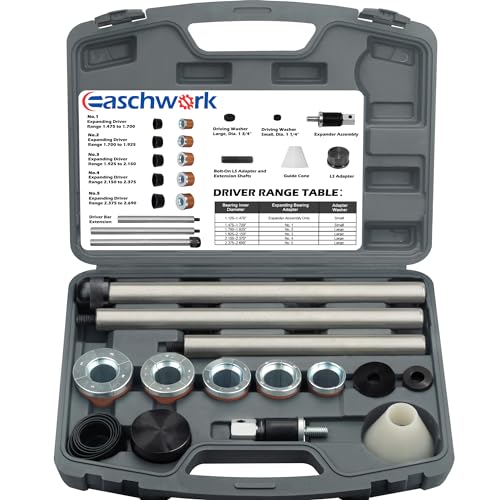
Required Tools Checklist
- Basic Hand Tools: A comprehensive socket and wrench set, screwdrivers, pliers, etc.
- Torque Wrench: Absolutely essential for correctly tightening critical bolts to manufacturer-recommended
torque specs. - Harmonic Balancer Puller: You cannot safely remove the
harmonic balancer(crank pulley) without this tool. - Valve Spring Compressor: A tool specifically designed for compressing valve springs, especially with the cylinder heads on the engine.
- Gasket Scraper: A good, sharp scraper is invaluable for cleaning old gasket material.
- Engine Fluids: Fresh coolant and engine oil.
How Do You Install a Camshaft? (Step-by-Step Guide)
Installing a camshaft is an advanced mechanical job that involves draining fluids, removing the front of the engine, swapping the cam, installing a new timing set, and reassembling everything to precise torque specifications. While the exact steps vary by engine (e.g., LS engine vs. small block Chevy), the overall process is similar for most pushrod V8s.
⚠ SAFETY WARNING: This procedure involves working with fuel, heavy parts, and critical engine components. Always disconnect the battery, use jack stands on level ground, wear safety glasses, and consult a professional
service manualfor your specific vehicle. If you are not confident in your mechanical ability, entrust this job to a certified professional.
Step 1: How Do You Prepare the Vehicle and Engine Bay?
Proper preparation is crucial for a safe and efficient installation. Before a single bolt is turned, you must create a clean and safe working environment. From years of working on these projects, we’ve found that taking ‘before’ pictures of hose and wire routing can be a lifesaver during reassembly.
- Disconnect the Negative Battery Terminal. This is the first and most important safety step.
- Drain the Engine Coolant. Place a large drain pan under the radiator and open the petcock.
- Drain the Engine Oil.
- Relieve Fuel System Pressure. Consult your service manual for the proper procedure.
- Remove the Air Intake and MAF Sensor. Label all electrical connectors as you disconnect them.
Step 2: How Do You Disassemble the Front of the Engine?
This phase involves gaining access to the timing cover, which hides the camshaft and timing set. The most challenging part for most DIY mechanics is removing the stubborn harmonic balancer.
- Remove Accessory Belts by releasing tension on the belt tensioner.
- Remove the Radiator and Cooling Fans to create working space.
- Remove the Water Pump. Be prepared for some residual coolant to spill.
- Remove the Harmonic Balancer. This requires a specific
harmonic balancer puller. Do not try to pry it off.
> Pro Tip: Thread the long crankshaft bolt back in a few turns before using the puller. This gives the puller’s center screw a safe place to push against without damaging the crank snout threads. - Remove the Timing Cover. With the balancer off, you can now remove the bolts holding the front cover to expose the camshaft gear.
What Is the Correct Camshaft Break-In and Tuning Procedure?
The break-in and tuning procedures are the most critical final steps; skipping or rushing them will destroy your new parts and all your hard work. A new camshaft requires a mechanical break-in to harden its surfaces, and the engine’s computer requires an electronic tune to learn how to operate with its new “lungs.”
The Mechanical Break-In
The procedure for breaking in a cam differs significantly based on its type. A flat tappet cam has lifters that slide on the lobes, while a hydraulic roller cam has lifters with wheels that roll. This distinction is critical.
❗ CRITICAL WARNING for Flat Tappet Cams: Failure to follow this procedure exactly will wipe out your cam lobes in minutes.
1. Prime the oil system before the first start.
2. Use special high-zinc (ZDDP) break-in oil.
3. Upon first start, immediately bring the engine RPM to 2,000 and vary it between 2,000-2,500 RPM.
4. Continue for 20-30 minutes. Do not let the engine idle or drop below 1,500 RPM during this time.
5. After the break-in, change the oil and filter to remove contaminants.
For hydraulic roller cams, the break-in is less severe. It’s generally sufficient to prime the oil system, ensure oil pressure is good, and run the engine for a few minutes while checking for leaks before proceeding to the tuning phase.
The Electronic Tune (ECU Tuning)
After a cam install, the engine’s computer (ECU) must be reprogrammed. This process, known as tuning, is not optional. Your engine’s computer has learned to deliver fuel and spark based on the airflow characteristics of the stock cam. The new performance cam allows dramatically different airflow, and the ECU has no idea how to manage it.
Driving a car with a new performance cam without a proper tune can result in:
- Poor performance and stalling
- A persistent
check engine light - Dangerously lean or rich air-fuel ratios
- Potential engine damage
A professional dyno tune is the gold standard. A tuner will put your car on a dynamometer (a “treadmill” for cars) and use software like HP Tuners to recalibrate the ECU for optimal power, drivability, and safety with the new camshaft.
How Do You Troubleshoot Common Problems After a Cam Swap?
It can be incredibly frustrating when the car doesn’t run right after all that work. However, most post-install issues are common and can be diagnosed systematically. Here’s a framework for tackling the most frequent problems.
Problem: Car Won’t Start After Cam Swap
- Possible Causes:
- No fuel or no spark
- Incorrect camshaft or crankshaft sensor connection
- Incorrect timing gear alignment
- Dead battery
- Diagnostic Steps:
- Check the easy stuff first: Is the battery connected and charged? Are the cam and crank position sensor plugs fully seated?
- Verify fuel and spark. Use a fuel pressure gauge to check for pressure at the rail. Pull a spark plug, connect it to its wire, ground it on the engine block, and have a helper crank the engine to check for spark.
- If both are present, the issue is likely mechanical timing. You may need to remove the timing cover to re-verify that the timing marks on the cam and crank gears are correctly aligned.
Problem: Loud Ticking or “Lifter Noise”
- Possible Causes:
- Lifters haven’t pumped up with oil yet
- Incorrect pushrod length
- A collapsed or faulty lifter
- Low oil pressure
- Diagnostic Steps:
- Let the engine run for several minutes to see if the lifters quiet down as they fill with oil.
- If the noise persists on one side, you may have an issue with pushrod length or a bad lifter. This requires removing the valve cover to investigate further.
- Check the oil pressure with a mechanical gauge to rule out a failing
oil pump.
Problem: Check Engine Light and/or Rough Idle
- Possible Causes:
- The ECU needs a tune (most common cause)
- A vacuum leak from a misplaced hose or bad gasket
- A faulty or disconnected sensor (O2, MAF, etc.)
- Diagnostic Steps:
- Do not drive the car extensively. The first step is to get the ECU tuned. In 90% of cases, a professional
dyno tunewill resolve these issues. - If the problem persists after a tune, check for
vacuum leaks. With the engine running, carefully spray brake cleaner or starting fluid around the intake manifold gaskets and vacuum hose connections. If the engine RPM changes, you’ve found your leak. - Use an OBD2 scanner to read the specific diagnostic trouble codes.
- Do not drive the car extensively. The first step is to get the ECU tuned. In 90% of cases, a professional
FAQs About how do you cam a car
Does Camming a Car Affect Reliability?
Yes, camming a car can affect reliability if not done correctly. A properly installed cam with all the necessary supporting modifications (like upgraded valve springs) and a professional tune can be very reliable. However, using mismatched parts, an overly aggressive cam for a stock engine, or skipping the tune can lead to premature engine wear and reduced reliability.
Can You Cam a Car with an Automatic Transmission?
Absolutely, but you may need a higher-stall torque converter. Aggressive camshafts lower engine power at idle, which can cause a stock torque converter to feel sluggish or “push” through the brakes at a stop. A higher-stall converter allows the engine to rev slightly higher before engaging the transmission, matching the cam’s new powerband and improving drivability.
Does Camming a Car Affect Gas Mileage (MPG)?
Yes, in almost all cases, installing a performance camshaft will decrease your car’s gas mileage. The new cam profile is optimized for performance, which means it generally uses more fuel and air. The effect can be minor with a “Stage 1” cam (1-2 MPG loss) or significant with a “Stage 3” race cam (5+ MPG loss).
Is Camming a Car Legal?
It depends entirely on your location and the specific camshaft. In areas with strict emissions testing, like California, most aggressive aftermarket camshafts are not legal for street use. Some manufacturers offer “50-state legal” cams designed to pass smog tests, but these are typically very mild. Always check your local laws.
How Much Horsepower Does a Cam Add?
A camshaft swap can add anywhere from 30 to over 100 horsepower. The exact amount depends heavily on the engine, the aggressiveness of the cam (Stage 1, 2, 3), and the quality of the supporting modifications and tune. For a typical V8 LS engine, a well-chosen “Stage 2” cam with a good tune often yields 50-70 horsepower.
What Is the Difference Between a Flat Tappet and a Roller Cam?
The primary difference is how the lifter contacts the camshaft lobe. A flat tappet lifter has a flat bottom that slides along the lobe, requiring a careful break-in procedure. A roller lifter has a small wheel that rolls along the lobe, reducing friction and allowing for more aggressive cam profiles.
Can You Install a Cam Without Removing the Engine?
Yes, on most pushrod engines (like a Chevy Small Block or LS), the camshaft can be installed without removing the engine. The process involves removing the radiator and front of the engine to slide the cam out. However, on many overhead cam (OHC/DOHC) engines, the job is much more complex.
Why Do You Need New Valve Springs with a New Cam?
You need new valve springs to match the camshaft’s higher lift and more aggressive opening rates. Stock springs are too weak and will cause “valve float” at high RPM, leading to a loss of power and potential catastrophic engine damage.
What Causes the “Lopey” Idle Sound?
The characteristic “lopey” or “thumpy” idle is caused by valve overlap. This is the brief period when both the intake and exhaust valves are slightly open. Aggressive cams have more overlap, which causes the choppy, rough idle sound.
Can You Cam a Stock Engine?
Yes, you can install a mild camshaft in an otherwise stock engine, but there are limits. A “Stage 1” or mild “Stage 2” cam can often work well. However, installing a very aggressive cam into a stock engine is a waste, as the stock components will become a bottleneck, preventing the cam from making power.
Key Takeaways: Camming a Car Summary
- Choose the Right Profile: The most critical step is selecting a camshaft (
cam profile) that matches your goals and engine. A “Stage 2” cam is often the best balance of power and drivability for a street car. - It’s a Full System Upgrade: A cam swap is not just one part. It
requires valve springs, lifters, and other components. Budget for a completecamshaft install kitto avoid issues. - Tuning is Not Optional: The engine’s computer (ECU)
requires a tune. Skipping thedyno tunewill result in poor performance and potential engine damage. - The Process is Intensive: A cam swap is a major job that
requiresdisassembly of the entire front of the engine. Allocate a full weekend and have all tools ready. - Break-In is Critical: The
cam break-in procedure, especially for a flat tappet cam, is vital. Failure to follow it can destroy the new camshaft in minutes. - Expect Trade-Offs: A performance cam trades low-RPM torque and fuel economy for high-RPM horsepower. Be prepared for a decrease in MPG and a more
aggressive idle. - Troubleshooting is Part of the Game: Don’t be discouraged by a
check engine lightorrough idlepost-install. These are oftentuning issuesthat can be resolved systematically.
Final Thoughts on How to Cam a Car
Camming your car is one of the most significant and rewarding performance modifications an enthusiast can undertake. It goes beyond a simple bolt-on part; it fundamentally changes the heart and soul of your vehicle, delivering substantial gains in both power and sound. Success in a cam swap comes from meticulous planning, choosing the right combination of parts, and a firm commitment to following procedures for installation, break-in, and tuning.
While the process is technically demanding, the feeling of turning the key for the first time and hearing that aggressive new idle is a rite of passage. By following the steps outlined in this guide, you are equipped with the knowledge to transform your vehicle’s performance. The journey from a quiet stock engine to a cammed, roaring machine is challenging, but the result is an engine with a character that is uniquely yours.
Last update on 2026-02-14 / Affiliate links / Images from Amazon Product Advertising API