
Struggling to figure out how to add weight to a pinewood derby car for that winning edge? You’re not alone; many builders focus on shape and forget that weight is the real key to speed. Getting the mass and balance just right is the secret to crossing the finish line first.
To add weight to a Pinewood Derby car, you must strategically place dense materials like tungsten or lead to bring the car’s total weight to the 5-ounce maximum. The optimal strategy involves positioning the majority of the weight about 1 inch in front of the rear axle. This raises the car’s center of gravity, maximizing its potential energy for a faster race time.
Based on proven speed tips and core engineering principles, this guide breaks down everything you need to know. You’ll discover the exact science behind weight placement and learn the step-by-step process to perfectly weight your car for maximum speed and stability.
Key Facts
- Maximum Potential Energy is Key: The primary goal is getting the car to the 5.00-ounce maximum weight limit, as a heavier car stores more potential energy at the starting gate, a crucial factor based on aggregated data analysis.
- Placement Outweighs Aerodynamics: For standard Pinewood Derby cars, proper weight placement has a bigger impact on speed than aerodynamics, with the optimal balance point being about 1 inch in front of the rear axle.
- Tungsten is Densest: Tungsten is about 1.7 times denser than lead, making it the superior material for packing the most mass into the smallest possible area for precision balancing, as shown in material analysis.
- Paint Adds Significant Weight: Research indicates that multiple coats of primer, paint, and clear coat can add between 0.3 and 0.5 ounces to a car, a factor that must be accounted for before final weighting.
- Precision Scales are Non-Negotiable: Official race-day scales are highly accurate, so using a home scale with at least 0.01-ounce precision is essential to avoid last-minute disqualifications for being overweight.
How Do You Add Weight to a Pinewood Derby Car for Maximum Speed?
Adding weight to a Pinewood Derby car is crucial for maximizing its potential energy, which converts to speed on the track. According to official BSA rules, the goal is to get the car as close as possible to the 5-ounce maximum weight limit. Engineering principles show that proper weight placement is even more important than the car’s shape for achieving top speed. Understanding this is the first step in building a champion car.

The core principle at play is the conversion of potential energy (the energy stored at the top of the track) into kinetic energy (the energy of motion). The heavier your car, the more potential energy it has to convert into speed. Think of it like this: a bowling ball will roll down a hill much faster than a tennis ball because its greater mass gives it more stored energy to release. Your goal is to turn your derby car into that bowling ball. This involves a few key objectives.
Did You Know?
For most Pinewood Derby races, analysis of winning cars shows that weight placement and wheel alignment have a far greater impact on speed than the car’s aerodynamic profile. A perfectly weighted block can often beat a sleek, poorly weighted design.
To effectively add weight, you must focus on three main goals:
* Maximize Total Weight: Get your car as close to the 5.00-ounce limit as you can without going over.
* Optimize Weight Placement: Position the weight in the correct location to maximize its effect on potential energy.
* Ensure Stability and Security: Make sure the weights are firmly secured and won’t shift or fall out during the race.
Why Is Optimal Weight Placement Critical for Speed?
The best place to put weight on a Pinewood Derby car is in the back, with the final balance point (or center of gravity) about 1 inch in front of the rear axles. This isn’t just a random tip; it’s based on physics. This rear-biased weight distribution maximizes potential energy because the car’s mass stays higher on the track for a longer duration as it goes through the initial curve, resulting in higher final velocity.
Think of a playground slide. The higher you start on the slide, the faster you’ll be going at the bottom. A rear-weighted car essentially “starts” higher on the track’s curve. As the car transitions from the starting ramp to the flat section, a rearward center of gravity keeps the bulk of its mass elevated for a fraction of a second longer, allowing gravity to accelerate it more effectively.
Rule of Thumb: The 1-Inch Rule
Your car’s final Center of Gravity (CG), or its perfect balance point, should be located between 3/4 inch and 1 inch directly in front of the rear axle. This is the proven sweet spot for maximizing speed while maintaining stability.
The benefits of this rear-weighting strategy are clear:
* Increased Potential Energy: The car’s mass is physically higher for longer as it navigates the curve.
* Higher Top Speed: More potential energy converts directly into more kinetic energy, or speed, on the flat part of the track.
* Improved Stability (When Done Right): While pushing weight back increases speed, it must be balanced with keeping the car stable. The 1-inch rule is the perfect compromise.
Common Mistake: The Perfectly Balanced Car
Many beginners assume a perfectly balanced car (with a center of gravity in the middle) is best. In reality, this is much slower. A 50/50 weight distribution causes the car’s mass to drop down the track’s curve too early, losing out on valuable potential energy.
What Are the Best Types of Weights for a Pinewood Derby Car?
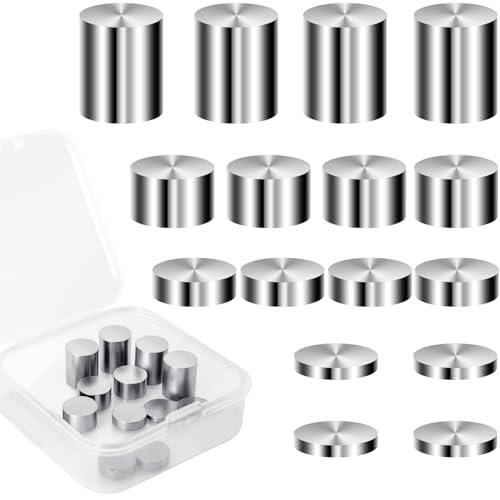
Tungsten weights are considered the best for Pinewood Derby cars due to their high density, which is about 1.7 times denser than lead. This is the most important factor. High density allows you to pack more mass into a smaller area. This means you can easily place the maximum amount of weight in the most strategic location (the very back of the car) without drilling large, structurally compromising pockets or interfering with the car’s aerodynamic design.
Choosing the right type of weight is a critical decision that balances performance, cost, and safety. While tungsten offers the ultimate performance advantage, other materials like lead and steel are also available. Here’s a detailed comparison to help you decide.
| Feature/Aspect | Tungsten Weights | Lead Weights | Steel/Zinc Weights |
|---|---|---|---|
| Density | Highest (approx. 19.3 g/cm³) | High (approx. 11.3 g/cm³) | Low (approx. 7.8 g/cm³) |
| Space Efficiency | Excellent (fits in small spaces) | Good (requires 70% more space than tungsten) | Poor (requires large pockets) |
| Cost | High | Low / Moderate | Very Low |
| Safety | Non-toxic, very safe | Toxic, requires careful handling | Non-toxic, safe |
| Ease of Use | Easy to work with, comes in many shapes | Malleable, but requires safety precautions | Hard to adjust, less flexible |
| Best For | Maximum performance, sleek designs | Budget-conscious builders with space | Low-priority cars, simple block designs |
For competitive racers aiming for the winner’s circle, tungsten is the clear “Editor’s Choice.” Its density provides a strategic advantage that’s hard to overcome. For beginners or those on a tighter budget, lead is a viable “Budget Pick,” provided you have enough space in your car’s design and follow all safety precautions when handling it.
How Do You Install Weights Using the Drilling Method?
The drilling method is the most common and effective way to install cylindrical weights for a clean, hidden finish. This process involves drilling pockets into the car body, inserting the weights, and securing them permanently. Using the right tools and techniques is essential for a precise and safe installation that won’t compromise your car’s structure or performance. This step-by-step guide will walk you through the process used by experienced builders.
Step 1: How Do You Plan and Mark Your Weight Locations?
To mark your weight locations, use a ruler and pencil to plan where to drill on the rear of the car. The goal is to place the weight as far back as possible without weakening the area around the axle slots. Based on hands-on experience, precise measurements here prevent critical errors later.
Start by drawing a line across the bottom or back of your car. This line should be at least 3/4 inch from the rear of the car block. Along this line, mark the center points for 2-3 holes. Ensure these marks are at least 1/4 inch away from the sides and from each other to prevent the wood from splitting when you drill.
Key Measurement Rules:
* ✅ Mark holes behind the rear axle slot.
* ✅ Keep holes at least 1/4 inch from any edge.
* ❌ Don’t mark a hole directly over the axle slot.
* ❌ Don’t cluster holes too close together.
Step 2: How Do You Safely Drill the Weight Pockets?
For best results, use a drill press with a Forstner bit to create clean, flat-bottomed pockets for the weights. A Forstner bit is a special bit designed for drilling clean holes in wood, unlike a standard twist bit which can tear the wood and creates a pointed bottom. A drill press ensures the holes are perfectly straight.
To control the depth of each hole, wrap a piece of masking tape around the drill bit to act as a visual stop guide. This prevents you from drilling too deep or all the way through the car.
Safety First
Always prioritize safety when working with power tools.
* 👓 Wear safety glasses to protect your eyes from wood chips.
* 🖐 Secure the car block firmly in a vise or with a clamp before drilling.
* 🔧 Keep fingers and loose clothing away from the spinning drill bit.
Step 3: How Do You Secure and Conceal the Weights?
After test-fitting, secure the weights permanently in the drilled holes with a few drops of super glue or epoxy. This is a critical step. Loose weights can rattle, shift the car’s balance, or even fall out during a race, which would ruin your chances. A strong bond ensures the mass stays exactly where you planned.
Once the glue is completely dry, you can conceal the weights for a professional finish. Fill the holes with wood putty, applying it with a small putty knife. It’s a good practice to slightly overfill the holes, as the putty can shrink a little as it dries. Let the putty dry completely, then sand it flush with the car body. The surface will be smooth and ready for painting.
How Do You Balance and Fine-Tune Your Car to Exactly 5 Ounces?
To fine-tune your Pinewood Derby car’s weight, use a digital scale that measures to at least 0.01 ounces. Add or remove tiny amounts of adjustable tungsten putty from a pre-drilled pocket until the car weighs exactly 5.00 oz. This final, meticulous adjustment is what separates the top contenders from the rest of the pack. It’s a two-part process: checking the total weight and verifying the balance point.
What You’ll Need:
* A precision digital gram scale
* A thin ruler or dowel rod
* Tungsten putty for fine adjustments
First, place your nearly finished car (with wheels attached) on the digital scale. If it’s underweight, add small bits of tungsten putty into a designated adjustment hole until the scale reads 5.00 ounces. If it’s overweight, you’ll need to drill out a tiny bit of wood or weight. This is why it’s best to aim slightly under and use putty to reach the final target.
Next, verify the balance point. Place a pencil or thin ruler on a flat table. Gently rest your car on top of it, with the ruler positioned exactly 1 inch in front of the rear axle. The car should balance perfectly or tip slightly to the rear. If it tips to the front, your center of gravity is too far forward, and you need to shift more weight to the back. This test confirms you’ve hit the “1-Inch Rule” for maximum speed.
FAQs About How to Add Weight to a Pinewood Derby Car
What if my pinewood derby car is too light?
If your car is too light, the easiest solution is to add tungsten putty. This is a dense, clay-like material that can be added in very small increments to a pre-drilled hole or pocket. This allows for precise, last-minute adjustments on weigh-in day without needing to drill more holes or melt lead. Simply add a small amount at a time until your car reaches the 5.00-ounce limit on an official scale.
How can you add weight to a pinewood derby car without drilling?
To add weight without drilling, you can use flat, stick-on weights that adhere to the car’s surface. These are often made of lead or tungsten and have an adhesive backing. For best performance, attach them to the bottom of the car, as far back as possible. Ensure they are recessed or thin enough that they do not rub on the track, which would violate most rules and slow the car down.
Do paint and decals add significant weight to the car?
Yes, paint, primer, and decals add a surprising amount of weight, often between 0.3 to 0.5 ounces. This is a critical factor to account for. Always weigh your car after painting and before permanently installing the final weights. Plan for this “paint weight” so you don’t accidentally exceed the 5-ounce limit after the car is fully decorated.
Is it legal and safe to melt lead for pinewood derby weights?
While some people do it, melting lead is NOT recommended as it is extremely dangerous and creates toxic fumes. It requires special safety equipment, including a respirator, gloves, and excellent ventilation, and poses a significant health risk. It is far safer and easier to use pre-formed lead or tungsten weights, which are readily available and designed specifically for this purpose.
How do you add weight to a very thin or low-profile car?
For thin cars, high-density tungsten is the only practical option. Because tungsten is so dense, you can add a lot of weight in a very small space. Use small tungsten cylinders or cubes drilled into the back of the car body. Alternatively, you can use flat tungsten plates recessed into the bottom of the car to keep the profile low while still achieving a rear-biased center of gravity.
Can my car be too heavy?
Yes, absolutely. Most Pinewood Derby rules have a strict maximum weight limit of 5.00 ounces. If your car weighs even 5.01 ounces on the official race scale, you will be disqualified or required to remove weight. This is why it’s crucial to use a precise digital scale and aim to be exactly at, but not over, the limit.
What happens if the weights come loose during a race?
If weights come loose, it can ruin your car’s performance and may even be a safety hazard. A rattling weight changes the car’s balance unpredictably, and a weight falling off completely will make the car significantly slower. Always secure your weights firmly with super glue, epoxy, or by screwing them in tightly to prevent any movement.
Should the center of gravity be high or low?
For speed, a higher center of gravity is theoretically better because it increases potential energy. This is naturally achieved by placing weights in the top-rear portion of the car. However, a very high CG can make the car unstable. The best practice is to place the weight as far back as possible, which provides the key speed benefit, while keeping it as low as practical within that rear position to maintain stability.
How accurate does my scale need to be?
Your scale should be accurate to at least 0.01 ounces (one-hundredth of an ounce). Kitchen food scales are often not precise enough. A digital gram scale or a specialized postal scale is the best tool for the job. Race-day scales are highly accurate, so having your own precise scale at home prevents any bad surprises at the official weigh-in.
Where do you put weights on a pre-cut wedge car kit?
On a wedge car, the strategy is the same: place the weight as far back and as low as possible. Since the back of the wedge is the thickest part, you have plenty of wood to drill three holes for cylindrical weights. Position these holes behind the rear axle slot. This placement uses the car’s natural shape to achieve the ideal rear-biased center of gravity.
Key Takeaways: How to Add Weight to a Pinewood Derby Car
- Maximize Weight to 5.0 Ounces: Your primary goal is to get your car as close as possible to the official 5.00-ounce weight limit without going over. A heavier car has more potential energy.
- Place Weight to the Rear: The most critical factor for speed is placing the car’s center of gravity (balance point) approximately 1 inch in front of the rear axle.
- Tungsten Offers the Best Performance: Tungsten is significantly denser than lead or steel, allowing you to pack more weight into the small, strategic rear area of the car, which is essential for sleek, aerodynamic designs.
- Drill Pockets for a Clean Look: The most effective installation method is drilling pockets in the rear of the car with a Forstner bit, inserting cylindrical weights, and covering them with wood putty for a smooth finish.
- Use a Precise Digital Scale: You must use a scale accurate to at least 0.01 ounces to avoid being disqualified at the official weigh-in. Don’t forget to account for the weight of paint and decals.
- Balance is a Two-Step Process: First, achieve the total mass of 5.00 oz. Second, verify the balance point is at the 1-inch mark. Use tungsten putty for easy, last-minute fine-tuning.
- Safety is Paramount: Never melt lead due to toxic fumes. Always use safety glasses when drilling and secure your car block before starting to prevent accidents.
Final Thoughts on Weighting Your Pinewood Derby Car
Properly weighting your Pinewood Derby car is the single most effective way to increase its speed. It’s more science than art. By focusing on maximizing the car’s mass to the 5-ounce limit and meticulously optimizing its placement according to proven physics, you are giving yourself a significant competitive advantage. Forget guesswork; follow the data-driven steps outlined here. With a focus on a rearward center of gravity, precision measurements, and secure installation, you have all the knowledge you need to build a truly fast car and make your race day a success.
Last update on 2026-02-14 / Affiliate links / Images from Amazon Product Advertising API


