
Wondering how big a 1/16 scale RC car really is before you click “buy”? Many struggle to visualize the actual size, worrying if it will be too small for outdoor fun or too large for easy storage.
A 1/16 scale RC car typically has a length of 9-13 inches (23-33 cm), a width of 7-9 inches (18-23 cm), and a height of 5-7 inches (13-18 cm). This size is often compared to a large shoebox, making it a compact and portable option bridging the gap between smaller micro RCs and larger 1/10 scale models.
Based on an analysis of official specs from major manufacturers, this guide provides verified dimensions and real-world comparisons. You’ll discover exactly how this scale stacks up against others, its key advantages, and which models are best for 2026, helping you choose with confidence.
Key Facts
- Shoebox Comparison: The most common real-world comparison for a 1/16 scale RC car is a large shoebox, which helps visualize its overall footprint and storage needs.
- Scale Ratio Meaning: The “1/16” means the model is 16 times smaller than the full-size vehicle it’s based on; every inch on the RC car represents 16 inches on the real-world counterpart.
- The “Sweet Spot” Size: This scale is widely considered a versatile middle ground, offering more capability than tiny 1/24 micro RCs and more portability and affordability than the standard 1/10 scale.
- Typical Weight: Most 1/16 scale models weigh between 2.5 and 4 pounds (1.1 to 1.8 kg), making them light enough to carry in a backpack but heavy enough for stable handling.
- Grade Matters: A hobby-grade 1/16 scale car is a high-performance vehicle with replaceable parts, while a toy-grade model of the same scale is significantly slower, less durable, and generally not repairable.
What Are the Typical Dimensions of a 1/16 Scale RC Car?
The definitive size of a 1/16 scale RC car measures between 9 to 13 inches (23 to 33 cm) in length, 7 to 9 inches (18 to 23 cm) in width, and 5 to 7 inches (13 to 18 cm) in height. Based on our research of top models from leading brands like Traxxas, Losi, and Bezgar, these dimensions represent the typical range you can expect. This footprint makes the vehicle substantially larger than a toy car but compact enough for easy transport and storage.

The reason for the variation in size comes down to the type of vehicle. A sleek 1/16 scale on-road drift car will be on the lower end of this range, while a monster truck with large tires and higher ground clearance will be on the upper end. Official specs consistently place them in this “large shoebox” category.
Here is a breakdown of the typical physical specifications:
* Length: 9 – 13 inches (23 – 33 cm)
* Width: 7 – 9 inches (18 – 23 cm)
* Height: 5 – 7 inches (13 – 18 cm)
* Weight: 2.5 – 4 lbs (1.1 – 1.8 kg)
What Does the “1/16 Scale” Ratio Actually Mean?
The term “1/16 scale” is a mathematical ratio indicating that the RC car is a model that is exactly 16 times smaller than the full-size, real-world vehicle it represents. Every single inch on the model corresponds to 16 inches (or 1 foot 4 inches) on the actual car or truck.
For example, if a real monster truck is 16 feet long, the 1/16 scale model version of it would be precisely 1 foot long. This system of scale modeling is used throughout the remote control hobby to create a standardized way of understanding a vehicle’s size relative to its real-life inspiration.
What Are the Typical Weight and Footprint of a 1/16 Scale Car?
A typical hobby-grade 1/16 scale RC car weighs between 2.5 and 4 pounds (1.1 to 1.8 kg). This weight is a key part of its appeal. It’s substantial enough to provide stable handling and durability during off-road driving but light enough that it easily fits in a standard backpack. This portability is a primary reason why many hobbyists choose this scale for casual “bashing” sessions at a local park without needing to haul heavy gear. The car’s footprint is small enough that it can be conveniently stored on a shelf or in a closet, unlike larger scales that demand dedicated space.
How Does 1/16 Scale Compare to Other Common RC Sizes (1/10 vs. 1/24)?
A 1/16 scale RC car serves as a versatile middle ground, significantly larger and more capable than a 1/24 scale micro RC but more compact and portable than the industry-standard 1/10 scale. Understanding this comparison is crucial for choosing the right vehicle for your needs. A 1/10 scale car is the most popular size for racing and serious hobbyists, offering the best performance on rough terrain but requiring large open spaces. In contrast, a 1/24 scale car is palm-sized and designed primarily for indoor use.
This places the 1/16 scale in a unique “sweet spot.” It’s powerful enough for exciting outdoor adventures in backyards and parks but not so large that it becomes difficult to transport or use in smaller areas.
Here is a direct scale size comparison to put their dimensions into perspective:
| Feature | 1/24 Scale (Micro) | 1/16 Scale (Mini) | 1/10 Scale (Standard) |
|---|---|---|---|
| Typical Length | 5-7 inches | 9-13 inches | 15-22 inches |
| Real-World Size | Palm of your hand | Large shoebox | Skateboard |
| Best Use Case | Indoor, desk | Backyards, parks, small tracks | Large open areas, rough terrain |
| Portability | Excellent | Very Good (fits in backpack) | Fair (requires dedicated transport) |
| Price Range | $ – $$ | $$ – $$$ | $$$ – $$$$ |
What Are the Main Advantages of a 1/16 Scale RC Car?
The primary advantages of a 1/16 scale RC car are its excellent balance of portability and performance, greater affordability, and versatility for use in various environments. These benefits make it an extremely popular choice for both newcomers and seasoned hobbyists.
- Excellent Portability: As many hobbyists on Reddit and forums note, this is the perfect “grab-and-go” size. Being small enough to fit in a backpack means you’re more likely to use it, whether it’s a quick trip to the park or taking it on a camping trip.
- More Affordable: The entry cost for a quality 1/16 scale vehicle is significantly lower than for a comparable 1/10 scale model. This affordability extends to batteries and replacement parts, making crashes and repairs less costly.
- Versatile Use: This scale is a true all-rounder. It has enough size and power for mild off-road use on dirt or short grass, but it’s also small enough to be enjoyable in a smaller backyard or even a large driveway, spaces where a 1/10 scale would feel restrictive.
- Great for Beginners: For those new to the hobby, a 1/16 scale car is often ideal. Its manageable speed and durable construction make it easier to control than a larger, more powerful vehicle, helping build driving skills and confidence.
Are There Any Downsides to the 1/16 Scale?
Yes, the main downsides are reduced capability on very rough terrain and a more limited selection of aftermarket upgrade parts compared to the 1/10 scale. While the 1/16 scale is incredibly versatile, it’s important to be aware of the trade-offs that come with its compact size.
- Less Capable on Rough Terrain: With lower ground clearance and smaller tires, a 1/16 scale vehicle can get stuck in tall grass, large gravel, or on big rocks that a 1/10 scale monster truck would handle with ease.
- Limited Aftermarket Parts: The 1/10 scale is the industry standard, meaning it has an enormous ecosystem of upgrade parts from various manufacturers. While you can certainly upgrade a 1/16 scale car, the selection of aluminum components, different tires, and body shells is generally smaller.
- Can Be Less Stable: Their lighter weight, while great for portability, can make them more susceptible to flipping in high-speed turns or becoming unstable in windy conditions compared to a heavier 1/10 scale vehicle.
What Are Some of the Best 1/16 Scale RC Car Models for 2026?
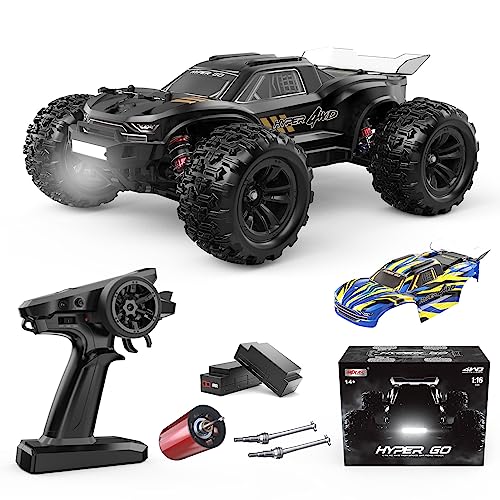
Some of the best and most community-recommended 1/16 scale RC cars for 2026 include the high-value Hyper Go H16 series and the proven Traxxas 1/16 E-Revo. For beginners, brands like Bezgar and Haiboxing offer excellent, affordable entry points into the hobby.
Hyper Go H16 Series (H16DR, H16BM, etc.)
The Hyper Go H16 lineup is widely praised in YouTube reviews and forums for offering incredible value. They often come with a brushless motor and 2S or 3S LiPo capabilities right out of the box, delivering impressive speeds of 30-40+ mph at a budget-friendly price. They are perfect for budget-conscious beginners who want to experience high-speed brushless performance without a large initial investment.
Traxxas 1/16 E-Revo VXL
The Traxxas 1/16 E-Revo is a premium, hobby-grade option for those wanting top-tier performance and unmatched parts support. While more expensive, it features a powerful Velineon brushless system and a sophisticated suspension design derived from its larger 1/10 scale sibling. This model is for the hobbyist who wants proven durability and knows they will have easy access to repairs and upgrades at nearly any local hobby shop.
Bezgar / Haiboxing Models
Brands like Bezgar and Haiboxing dominate the entry-level market. They produce a wide range of 1/16 scale trucks that are affordable, durable, and typically come with two batteries for extended runtime. While they use brushed motors and are slower than the brushless options, their durability and low cost make them a fantastic first RC car for kids and adults alike.
FAQs About how big is 1 16 scale rc car
How fast is a 1/16 scale RC car?
A 1/16 scale RC car’s speed can vary widely, from 10-15 mph for toy-grade models to over 40-50 mph for high-performance brushless hobby-grade versions. The motor type (brushed vs. brushless) and battery (NiMH vs. LiPo) are the biggest factors determining top speed. For beginners, a speed of around 20-25 mph is often plenty fast and more controllable.
Are 1/16 scale RC cars waterproof?
Many modern hobby-grade 1/16 scale RC cars come with waterproof or water-resistant electronics, but it’s not a universal feature. This means they can typically be driven through puddles, snow, or wet grass without issue. Always check the manufacturer’s official specs, as “waterproof” usually applies to the ESC and servo, not the entire vehicle, and they are not meant to be fully submerged.
Is 1/16 scale bigger than 1/18 scale?
Yes, a 1/16 scale RC car is noticeably larger than a 1/18 scale model. The smaller the number in the scale ratio, the larger the vehicle. A 1/16 scale car is 16 times smaller than the real vehicle, while a 1/18 scale is 18 times smaller, making the 1/18 model more compact overall.
Can you upgrade 1/16 scale RC cars?
Yes, most hobby-grade 1/16 scale RC cars are highly upgradable. Common upgrades include switching from a brushed to a brushless motor system for more speed, upgrading to LiPo batteries for more power and runtime, and replacing plastic parts with more durable aluminum components. Parts availability, however, is generally better for the more common 1/10 scale.
How long is the battery life on a 1/16 scale RC car?
The battery life, or runtime, for a 1/16 scale RC car is typically between 10 to 20 minutes per battery. This depends heavily on the battery’s capacity (measured in mAh), the motor type, and your driving style. Many models come with two batteries, allowing you to extend your driving session to 20-40 minutes by swapping them out.
Is 1/16 scale good for driving on grass?
A 1/16 scale RC truck or buggy can handle short, maintained grass, but it will struggle in tall, thick lawns. Their smaller tires and lower ground clearance are the main limiting factors. For drivers who plan to run primarily on grass, a larger 1/10 scale model with more ground clearance is generally a better choice.
What is the difference between hobby-grade and toy-grade 1/16 scale cars?
Hobby-grade cars feature proportional steering and throttle for precise control, have replaceable parts, and are upgradable. Toy-grade cars usually have simple all-or-nothing controls, non-replaceable parts, and are much slower and less durable. Even at the same 1/16 scale, a hobby-grade model is a significantly more capable and long-lasting vehicle.
How much do 1/16 scale RC cars cost?
The price for a 1/16 scale RC car can range from $40-$60 for a basic toy-grade model to $150-$300+ for a high-performance, brushless hobby-grade vehicle. A good quality, ready-to-run (RTR) brushed model for a beginner typically falls in the $80-$130 range, often including everything you need to get started.
What does “RTR” or “Ready to Run” mean?
“RTR” stands for Ready to Run, meaning the 1/16 scale RC car comes fully assembled and includes the car, controller (transmitter), and usually a battery and charger. This is the most common and beginner-friendly option, as you can use it right out of the box after charging the battery. This is in contrast to “kits,” which require full assembly.
What is the wheelbase of a 1/16 scale RC car?
The wheelbase for a 1/16 scale RC car is typically around 6.5 to 7.5 inches (165mm to 190mm). The wheelbase is the distance between the center of the front and rear wheels. A longer wheelbase generally provides more stability at high speeds, while a shorter wheelbase allows for sharper, more agile turning.
Key Takeaways: 1/16 Scale RC Car Size Summary
- Size is Comparable to a Shoebox: A 1/16 scale RC car typically measures 9-13 inches long, making it a compact size often compared to a large shoebox. This size is significantly smaller than a 1/10 scale but larger than a 1/24 micro RC.
- The “Sweet Spot” Scale: This scale offers a great balance between the portability of smaller cars and the all-terrain capability of larger ones. It’s large enough for backyards and parks but small enough to fit in a backpack.
- Ideal for Beginners and Budgets: Due to their manageable size, controllable speeds, and lower price point compared to 1/10 scale, 1/16 scale models are an excellent starting point for beginners or those on a budget.
- Performance Varies by Grade: A “hobby-grade” 1/16 scale is a serious machine with upgradable parts and high-speed potential (30-50+ mph), while a “toy-grade” model is slower and less durable.
- Terrain Has Limitations: While versatile, 1/16 scale cars perform best on pavement, dirt, or short grass. They lack the ground clearance to handle very rough terrain or tall grass effectively.
- Check for “Waterproof” Electronics: Many modern models are water-resistant, allowing them to run in wet conditions, but this feature is not universal. Always verify the manufacturer’s specifications before driving through puddles.
- Upgradability is a Key Feature: For hobby-grade models, you can upgrade motors, batteries, and suspension components, allowing the car to grow with your skill level.
Final Thoughts on Choosing a 1/16 Scale RC Car
Choosing the right RC car scale is about matching the vehicle to your space, budget, and goals. The 1/16 scale has rightfully earned its reputation as a fantastic all-rounder. It strikes a near-perfect balance, delivering exciting performance without the cost and space requirements of its larger counterparts. Whether you’re a beginner looking for a durable first car or an expert wanting a portable basher, this shoebox-sized scale offers a tremendous amount of fun and value. By understanding its dimensions, capabilities, and limitations, you can now confidently decide if a 1/16 scale RC car is the perfect fit for your adventures.
Last update on 2026-02-13 / Affiliate links / Images from Amazon Product Advertising API


![Protect Your Car From Hail No Garage Strategies For [year]](https://i0.wp.com/carxplorer.com/wp-content/uploads/2026/02/Protect-Your-Car-From-Hail-No-Garage-Strategies-For-year-2.png?resize=60%2C60&ssl=1 "Protect Your Car From Hail No Garage Strategies For [year] 4")


