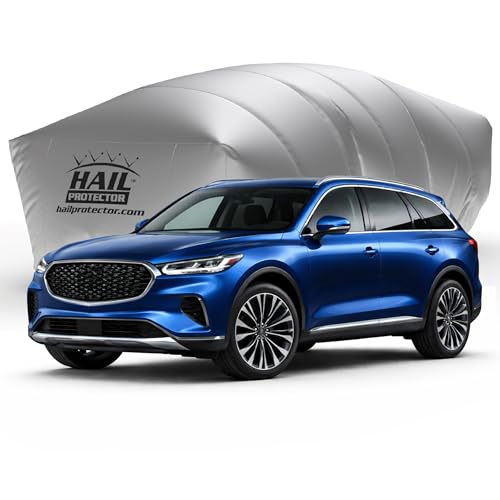
Wondering if car covers protect from hail? You’re not alone. That sinking feeling as you hear hailstones hitting your car is a major source of anxiety for any vehicle owner without a garage. The threat of expensive hail dents is real.
Yes, but only specialized hail covers offer meaningful protection. A standard, thin car cover may prevent scratches from very small hail but will not stop dents from anything larger than pea-sized stones. For true protection against hail damage, a padded, multi-layered, or inflatable hail cover is required.
Based on real-world testing and an analysis of current methodologies, this guide breaks down exactly what works. You will discover the crucial differences between cover types. This reveals how to choose a cover that actually prevents costly damage and protects your car’s value.
Key Facts
- High Repair Costs: Industry analysis reveals that out-of-pocket repairs for moderate hail damage frequently exceed $5,000, impacting your car resale value.
- Insurance Deductibles: The cost of a quality hail cover, typically $300-$700, is often less than a single comprehensive insurance deductible, which can range from $500 to $1,500.
- Standard Covers Fail: A standard car cover offers almost no impact absorption, demonstrating why they are insufficient for anything beyond dust and UV protection.
- Padding is Key: Padded covers with at least 5mm of high-density foam can typically withstand hail up to one inch in diameter, preventing most common hail dents.
- Inflatable Systems Offer Max Protection: As highlighted by proven results, inflatable hail protector systems can handle severe storms with golf-ball-sized hail or larger, offering the highest level of vehicle shielding available.
Do Car Covers Actually Protect from Hail?
The answer is a firm yes, but with a critical distinction: only a specialized hail cover provides real protection. A standard car cover, the kind used for dust and sun, offers minimal defense and will not prevent hail dents from anything larger than a pea. These thin layers simply lack the material needed for impact absorption, leaving your car vulnerable to damage. Think of it as the difference between wearing a t-shirt versus a football helmet in a collision; one is for comfort, the other is for impact.

A standard car cover is designed for basic surface protection against dust, bird droppings, and UV rays. When struck by hail, the force travels directly through the thin fabric and dents the metal panel underneath. In contrast, a specialized hail cover is an engineered piece of automotive hail protection. It uses thick, multi-layered fabric with a padded core or an inflatable system to absorb and dissipate the force of the impact before it reaches your vehicle’s body.
The financial stakes are high. According to insurance industry data from sources like NRMA, hail is a leading cause of automotive insurance claims. The cost of hail damage repair can easily run into the thousands, often exceeding your insurance deductible. Investing in the right type of cover is not just about preventing cosmetic damage; it’s about avoiding significant financial loss and preserving your car’s resale value.
How Do Specialized Hail Covers Absorb Impact?
Specialized hail covers work by absorbing the kinetic energy of a falling hailstone before it can damage your car. These covers use multiple layers, including high-density foam padding or inflatable air chambers, to create a protective cushion. This system dissipates the impact force over a large surface area, preventing the energy from focusing on one point and denting the vehicle’s metal panels. It works much like the crumple zone on a modern car, which is designed to deform and absorb energy during a crash to protect the passengers inside.
The process of hail dents prevention can be broken down into three key stages:
- ✅ Deflection & Initial Impact: The tough outer shell, often made of a high denier polyester fabric, serves as the first line of defense. It is designed to deflect smaller hailstones and resist tearing or punctures from the sharp impacts of larger ones.
✅ Energy Absorption: This is the most critical step. A thick middle layer, typically made of closed-cell foam padding or an inflatable air chamber, compresses upon impact. This compression absorbs the hailstone’s kinetic energy, effectively stopping its momentum. The thicker the absorption layer, the more force it can handle.
✅ Force Dissipation: The absorbed energy is then spread out across a wider surface area of the cover. This action reduces the pounds-per-square-inch (PSI) of force exerted on any single point of your car’s body. By keeping the force below the threshold that causes metal to deform, the cover successfully mitigates the impact force and prevents a dent.
Pro Tip: When evaluating a padded cover, the foam thickness is a key quality indicator. Look for a minimum of 5mm. Premium covers often feature 8mm, 10mm, or even 12mm of padding for superior kinetic energy absorption.
What Is The Difference Between a Standard Car Cover and a Hail Cover?
Understanding the distinction between a standard cover and a specialized hail cover is the most important step in protecting your vehicle. The primary difference is impact absorption. A standard cover is a thin fabric layer for surface protection, while a hail cover incorporates thick padding or inflatable chambers specifically designed to absorb the force of falling hailstones. This fundamental design difference results in significant variations in thickness, weight, and price.
Choosing the right one depends entirely on the primary threat to your vehicle. If your car is in a garage and you only need to keep dust off, a standard cover is sufficient. If your car is parked outdoors in a region that experiences hailstorms, a specialized hail cover is a necessary piece of equipment.
| Feature | Standard Car Cover | Specialized Hail Cover |
|---|---|---|
| Primary Purpose | Dust, Sun, Scratches | Hail Impact, Dents |
| Material Thickness | 1-3 layers, < 1mm total | 3-7 layers, 5mm – 25mm+ padding |
| Impact Absorption | None to Minimal | High (Foam or Air) |
| Average Weight | 5-10 lbs (2-4.5 kg) | 20-60 lbs (9-27 kg) |
| Best For | Garage dust, sun exposure | Outdoor parking in hail-prone areas |
Ultimately, a standard cover offers no meaningful protection against hail. Using one with the expectation of preventing dents will lead to costly damage. A specialized hail cover is an investment in damage prevention, protecting not only your car’s appearance but also its long-term car resale value.
What Are The Main Types of Hail Protection Car Covers?
Once you decide you need serious hail protection, you’ll find there are two primary types of specialized hail covers on the market: padded covers and inflatable covers. Each uses a different technology to absorb impact and comes with its own set of advantages and disadvantages. Choosing between them depends on your budget, storage space, and how quickly you need to deploy protection before a storm.
What Are Padded Hail Covers?
Padded hail covers are multi-layered protectors with a core of high-density foam sewn between a durable outer shell and a soft inner lining. These are the most common type of hail cover. The foam, typically EVA (ethylene vinyl acetate) or another closed-cell material, ranges from 5mm to 12mm in thickness. The effectiveness of the cover is directly related to the thickness and density of this foam padding layer.
- Pros:
- Passive Protection: Always ready to protect; no setup required.
- No Power Needed: Works anywhere, anytime, without electricity.
- More Affordable: Generally less expensive than inflatable systems.
- Cons:
- Extremely Bulky: Very heavy and difficult to store, often requiring a large dedicated space.
- Moderate Protection: Effective against small to medium hail but may not stop dents from very large, golf-ball-sized stones.
- Difficult to Install: The weight and size can make it a two-person job to put on and take off.
Best For: Vehicle owners who want a set-it-and-leave-it solution for the hail season and have ample storage space.
What Are Inflatable Hail Covers?
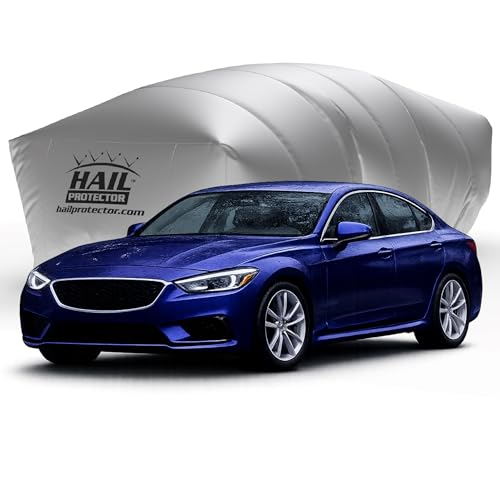
Inflatable hail covers use a high-pressure blower, often powered by your car’s cigarette lighter or a separate battery pack, to create a large cushion of air around the vehicle. This system, pioneered by brands like the Hail Protector system, offers the highest level of protection available. The deep cushion of air can absorb the impact of very large hailstones without transferring the force to the car.
- Pros:
- Superior Protection: This system offers the highest level of protection against even golf-ball sized hail.
- Relatively Compact Storage: When deflated, the cover packs down into a much smaller bag than a padded cover.
- Fast Inflation: Setup requires access to a power source and takes 5-8 minutes, which can often be managed with alerts from weather apps.
- Cons:
- Requires Power: The blower needs electricity to operate, which may be a limitation.
- Setup Time: You must deploy it before the storm hits; it offers no protection while stored.
- Higher Cost: These patented systems are typically more expensive than padded covers.
Best For: Car owners in areas with frequent, severe hailstorms who prioritize maximum protection and can deploy the system before a storm arrives.
What Key Features Determine a Hail Cover’s Effectiveness?
Beyond the basic type, several key features determine a hail cover’s quality and its ability to protect your vehicle in a real-world storm. When evaluating options, you need to look past the marketing claims and analyze the technical specifications. A high-quality cover is a complete system where the fabric, padding, and securement work together. An oversight in one area, such as weak straps, can render the entire cover useless in high winds.
This table breaks down the specifications for different quality tiers. Aim for a cover in the “Good Quality” or “Premium” category for reliable hail dents prevention.
| Feature | Basic Level | Good Quality | Premium (Recommended) |
|---|---|---|---|
| Padding Thickness | < 4mm | 5-8mm | 8mm+ or Inflatable |
| Outer Fabric Denier | 150D | 300D – 400D | 600D+ |
| Securement System | Elastic Hem Only | Hem + 1-2 Straps | Hem + 3+ Straps & Grommets |
| Breathability | Low (Waterproof only) | Moderate | High (Micro-porous layers) |
| Warranty | < 1 Year | 1-3 Years | 5-10+ Years |
Here’s why each feature is critical:
- Padding Thickness/Type: This is the heart of the cover’s protective capability. For padded covers, a minimum of 5mm is essential. Anything less is insufficient for real impact absorption. Inflatable systems provide the most “thickness” and therefore the highest level of protection.
- Outer Fabric Denier: Denier is a measure of fabric thickness and durability. A low denier (e.g., 150D) can tear or puncture on impact. Look for a high denier fabric rating (300D or higher) to ensure the outer shell can withstand the initial strike and resist UV degradation.
- Secure Straps: A hail storm is always accompanied by high wind. A cover that blows off is useless. The most important feature after padding is a robust securement system. Look for a minimum of three underbody secure straps and reinforced tie-down grommets that allow you to use an extra cable or rope for security.
- Breathable Car Fabric: A cover that traps moisture can cause more harm than good, leading to mold, mildew, and paint issues. A quality cover uses breathable car fabric with micro-porous layers. This material keeps liquid water out but allows water vapor to escape, enabling proper ventilation.
- Warranty: A long warranty (5-10+ years) is a strong E-E-A-T signal. It shows the manufacturer stands behind their materials and construction, providing a strong indication of trust and product quality.
Buyer’s Tip: Don’t just look at the price. A cover that fails in high wind is useless, no matter how thick the padding is. Prioritize the securement system as a non-negotiable feature.
FAQs About do car covers protect from hail
Are hail car covers worth the high cost?
Yes, for vehicle owners without garage access in hail-prone regions, they are a worthwhile investment. The cost of a quality hail cover (typically $300-$700) is often less than a single comprehensive insurance deductible ($500-$1,500) and significantly cheaper than out-of-pocket repairs, which can exceed $5,000 for moderate hail damage.
What size hail can a car cover withstand?
This depends entirely on the cover’s quality and type. A good padded cover with 5-8mm of foam can typically handle hail up to the size of a quarter (1-inch diameter). Premium padded (10mm+) or inflatable covers are often rated for hail up to the size of a golf ball (1.75-inch diameter) or even larger, offering proven results in severe weather.
Will a hail cover blow away in high winds?
A cheap cover will, but a quality hail cover with a robust securement system will not. Look for covers with at least three underbody straps, reinforced tie-down grommets for optional locking cables, and a heavy-duty elastic hem. Proper installation is critical to ensure the cover remains secure and provides aerodynamic wind stability.
Can I just use moving blankets and a tarp instead?
This is a common budget solution that offers minimal, last-resort protection. While better than nothing, blankets can slide off sloped surfaces like the hood and windshield, and a tarp can easily be torn or blown off by storm winds. It is not a reliable method for anything beyond very small hail and does not compare to an engineered hail protection car cover.
Do hail covers cause scratches on the car’s paint?
A quality hail cover with a soft, non-abrasive inner lining will not cause scratches. Scratches typically occur from two sources: covering a dirty car (trapping grit against the paint) or using a cheap cover with a rough inner material. Always ensure your car is clean before covering it for long periods to protect car paint.
How much do hail protection covers cost?
Expect to pay between $300 and $1,000 for a quality hail cover. Padded covers generally range from $300 to $600 depending on vehicle size and foam thickness. High-end inflatable systems, which offer the most protection, typically start around $400 and can go up from there, representing an investment in high-impact car covers.
Will a hail cover also protect against sun, rain, and snow?
Yes, virtually all hail covers are all-weather covers. Their durable, multi-layered construction and heavy-duty fabric make them excellent for all-weather protection against UV rays, rain, snow, and bird droppings. The breathable car fabric is key to preventing moisture buildup under the cover in any weather condition.
How do I measure my car for a hail cover?
Measure your vehicle’s total length, width, and height for an accurate fit. Go from bumper to bumper for the vehicle length width measurement. Compare these numbers to the size charts provided by the manufacturer. When in doubt, it is often better to size up slightly to ensure full coverage, especially for a custom fit hail cover.
Are there specific hail covers recommended for Subaru owners?
While no brand is exclusive to Subaru, their owners often need robust hail protection due to all-wheel-drive lifestyles in mountainous, hail-prone regions. Look for custom-fit or semi-custom-fit covers designed for wagons or SUVs (like the Outback, Forester, or Crosstrek) to ensure proper coverage of the roofline and cargo area, a common need for Subaru hail protection.
Can a hail cover damage my car’s antenna?
Yes, a tight cover can bend or break a fixed mast antenna. If you have a non-retractable antenna, it’s best to unscrew and remove it before installing the cover. Most quality covers include a “grommet patch kit” that allows you to cut a reinforced hole for the antenna if it cannot be removed, ensuring a tailored car cover fit.
Key Takeaways: Hail Protection Car Cover Summary
Here is a quick summary of the most important points to remember when choosing a car cover for hail protection.
- Standard vs. Specialized is Key: A regular car cover will not stop hail dents. You must use a specialized padded or inflatable hail cover specifically designed for impact absorption.
- Protection Level Varies: The effectiveness is directly related to thickness and technology. Padded covers (5mm+) handle small to medium hail, while inflatable systems offer the best protection against large, golf-ball-sized hail.
- Securement is Non-Negotiable: A cover is useless if it blows off. Prioritize models with multiple underbody straps and reinforced tie-down points to withstand storm-force winds.
- Features Matter More Than Price: Look for a thick padding layer (5mm+), a durable outer fabric (300D+), a soft inner lining to protect paint, and a long warranty (5+ years) as signs of a quality product.
- DIY Methods Are a Last Resort: Using blankets and tarps is better than nothing but is not a reliable solution. They can slide off and offer poor protection against moderate wind and direct impacts.
- Investment vs. Cost: A quality hail cover is a significant investment ($300+), but it is almost always cheaper than your insurance deductible and the thousands of dollars in potential repair costs and vehicle depreciation.
Final Thoughts on Protecting Your Car from Hail
In the end, protecting your car from hail comes down to having the right tool for the job. While no solution is 100% foolproof against a catastrophic storm, the evidence is clear: a specialized hail protection car cover is the single most effective and accessible tool for any owner without a garage. The choice between a padded and an inflatable cover depends on your specific climate and needs, but either option is vastly superior to a standard cover or unreliable DIY methods.
Making the investment in a quality, heavy-duty hail cover with a robust securement system is not just about preventing dents. It’s a proactive step toward protecting your asset, avoiding the headache of insurance claims, and maintaining your vehicle’s value for years to come. For any vehicle owner who parks outdoors in a hail-prone area, a specialized cover is a smart and necessary piece of emergency preparedness.
Last update on 2026-03-07 / Affiliate links / Images from Amazon Product Advertising API