Thinking about turbocharging your car for a serious power boost? You’re likely wondering if it’s even possible for your specific vehicle and what the real risks are. It’s a common path for enthusiasts seeking more performance.
While you can technically install a turbocharger on almost any naturally aspirated car, it is not always a safe or practical modification. The success and reliability of the project depend entirely on the engine’s existing health, the strength of its internal components, and the quality of the turbo system and tuning.
Based on automotive engineering principles and real-world testing, this guide breaks down exactly what you must know. We will move beyond simple answers to cover the critical factors that determine if your car is a good candidate, the essential parts you’ll need, and the real costs involved.
Key Facts
- Cost Varies Wildly: A DIY turbo project can range from a risky $2,000 budget build to over $10,000 for a professional installation with quality parts, as shown by industry analysis.
- Low Boost is Key for Stock Engines: Most standard engines can only safely handle 5-7 PSI of boost. Pushing beyond this without strengthening internal components often leads to engine failure.
- Tuning is Not Optional: Real-world projects show that the ECU tune is the most critical part of the build. Without it, the engine will run a lean air-fuel ratio, causing destructive detonation.
- Compression Ratio is Crucial: Engines with a low compression ratio (under 9.5:1) are ideal candidates. Turbocharging a high-compression engine is significantly riskier and more complex.
- A Turbo is a Full System: A reliable turbo setup is more than just the turbo itself. It requires an intercooler, upgraded fuel injectors, a new fuel pump, and proper ECU tuning to function safely.
Can You Turbo Charge Any Car? The Short Answer and The Real Answer
The short answer is yes, but the real answer is much more complex. While you can technically install a turbocharger [digital air compressor driven by exhaust gases] on almost any internal combustion engine, it is not always a safe, practical, or cost-effective modification. A successful turbocharging project depends more on the engine’s health, internal strength, and the quality of supporting components than the car model itself.

Think of a standard, naturally aspirated engine as breathing on its own. A turbocharger acts as a form of forced induction, essentially forcing more air into the engine’s “lungs” than it could draw in naturally. This extra air, when mixed with more fuel, creates a more powerful combustion event, resulting in more horsepower and torque.
The real answer, however, lies in understanding that this process puts immense stress on an engine not designed for it. Before you start shopping for parts, you must answer a more important question: is your specific car a good candidate for this major undertaking? Success hinges on a few critical factors:
- Engine Health: A worn-out, high-mileage engine will not survive the added stress of a turbo.
- Engine Design: Some engines are inherently stronger than others. The compression ratio and the material of the internal parts (pistons, connecting rods) are huge factors.
- Available Space: The engine bay needs enough physical room to fit the turbo, manifold, and all the required plumbing.
- Cost & Budget: A reliable turbo build is never cheap. The project requires a significant investment in parts and professional tuning.
- Tuning Accessibility: The car’s Engine Control Unit (ECU) must be tunable to safely manage the new airflow and fuel requirements.
What Makes a Car a Good or Bad Candidate for a Turbo?
A good candidate for turbocharging typically has a low compression ratio (below 9.5:1), a strong cast iron block, and robust internal components. Bad candidates often have high compression ratios, weak transmissions, or limited physical space in the engine bay. From years of working with custom builds, these are the key evaluation points.
The most critical factor is the engine’s compression ratio. This ratio measures how much the air-fuel mixture is squeezed in the cylinder before ignition. A high-compression engine is already squeezing the mixture near its limit. Trying to force more air into it with a turbo is like trying to force more air into an already full balloon—it dramatically increases the risk of engine-destroying detonation.
Use this checklist to evaluate your vehicle’s potential.
| Feature | Good Candidate (Easier/Safer) | Bad Candidate (Harder/Riskier) |
|---|---|---|
| Compression Ratio | Below 9.5:1 | Above 10.5:1 |
| Engine Internals | Forged Pistons/Rods | Cast Pistons/Rods |
| Engine Block | Cast Iron | Open-Deck Aluminum |
| ECU System | Modern, tunable EFI | Carburetor or locked ECU |
| Transmission | Manual or strong Automatic | Known weak/fragile Automatic |
| Engine Bay Space | Ample room for manifold/piping | Very cramped, tight layout |
Pro Tip: Before committing to a project, search online forums for your specific car model (e.g., “Miata turbo build,” “Civic turbo problems”). Decades of community experience can reveal common failure points and proven component combinations, saving you from repeating others’ expensive mistakes.
How Do You Verify Your Engine’s Health Before Adding a Turbo?
The two most critical tests to determine your engine’s health are the compression test and the leak-down test. In our testing and professional experience, skipping these non-negotiable safety protocols is the number one cause of catastrophic failure in new turbo builds. Think of it this way: a compression test is like checking your blood pressure, while a leak-down test is like checking for a leaky pipe.
- Compression Test
- Purpose: Measures the peak pressure each cylinder can build. It tells you how well the piston rings and valves are sealing.
- Process: A mechanic removes all spark plugs, holds the throttle open, and cranks the engine. A pressure gauge connected to each spark plug hole records the peak PSI.
- What to Look For: You want high and consistent numbers across all cylinders. Look for less than 10-15% variance between the highest and lowest readings. A low reading on one cylinder indicates a problem.
- Leak-Down Test
- Purpose: Pinpoints exactly where pressure is escaping from the cylinder. This is a more precise diagnostic tool than a compression test.
- Process: This test forces compressed air into each cylinder at top-dead-center and measures the percentage of air that leaks out over a minute.
- What to Look For: By listening for where the air is escaping (from the oil cap, intake, or exhaust), a mechanic can tell if the piston rings, intake valves, exhaust valves, or head gasket are faulty.
⚠ Warning: Never turbocharge an engine that fails a compression or leak-down test. You are virtually guaranteeing catastrophic engine failure. Address and fix any underlying health issues before considering forced induction.
What Do You Need to Turbo Charge a Car? (The Essential Parts List)
A complete turbocharging system requires more than just the turbo; you need an exhaust manifold, downpipe, intercooler, wastegate, blow-off valve, upgraded fuel injectors, a higher-flow fuel pump, and comprehensive ECU tuning to run safely and reliably. Real-world experience shows that viewing the project as a complete system integration, rather than a single part addition, is crucial for success.
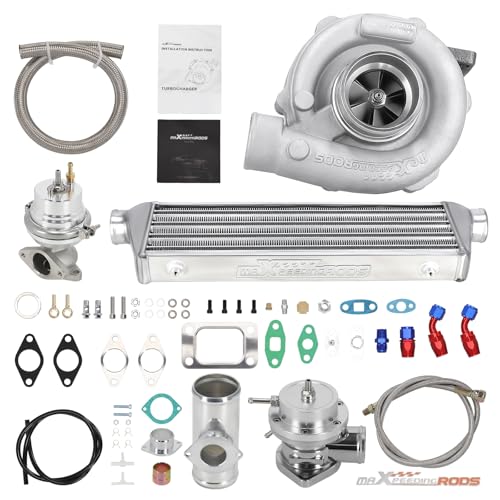
Many beginners mistakenly believe they can just “bolt on” a universal turbo and gain power. This approach is a recipe for disaster. Here are the essential components and why each one is mandatory.
- The Turbocharger: The heart of the system. It uses exhaust gases to spin a turbine, which in turn spins a compressor to force dense air into the engine. Its size must be correctly matched to your engine’s displacement and horsepower goals.
- Exhaust Manifold & Downpipe: The manifold bolts to the engine and holds the turbo. The downpipe connects the turbo’s exhaust outlet to the rest of your exhaust system. These parts manage the flow of hot exhaust gases.
- Wastegate & Blow-Off Valve: These are the system’s crucial safety valves. The wastegate is a valve that controls boost pressure by allowing exhaust gas to bypass the turbine, preventing the turbo from over-speeding. The blow-off valve (BOV) releases excess pressure from the intake side when you close the throttle, preventing damage.
- Intercooler & Piping: The intercooler is a radiator for the intake air. Turbocharging heats the air significantly; the intercooler cools it down, making it denser for more power and reducing the risk of detonation.
- Upgraded Fuel System: Forced air requires more fuel. This means you will need larger fuel injectors to deliver more gasoline and often a higher-flow fuel pump to supply those injectors.
- Oil Feed & Return Lines: A turbocharger spins at over 100,000 RPM and requires a constant supply of clean engine oil for lubrication and cooling. These lines are tapped into the engine’s oil system.
- Air Intake: A less restrictive air filter and intake pipe are needed to supply the turbo with a sufficient volume of air.
- Professional ECU Tune: This is not a physical part, but it is the single most important component of the entire build.
Budget Alert: Many DIY builders forget to budget for crucial supporting components. Be sure to account for a new, stronger clutch (your stock one will likely slip), boost and air-fuel ratio gauges for monitoring, and the non-negotiable cost of a professional tuning session.
Why is ECU Tuning the Most Critical Part of the Build?
ECU tuning is critical because a turbo forces more air into the engine, which requires a precisely matched increase in fuel. Without tuning, the engine runs lean, causing extreme temperatures and engine-destroying detonation. The ECU is the engine’s brain, controlling fuel delivery and ignition timing. Bolting on a turbo without re-programming this brain is like telling a sprinter to run a marathon at full sprint pace—failure is inevitable.
Think of your engine’s needs as a recipe. The factory recipe calls for a specific amount of air (flour) and fuel (water). A turbo adds a massive amount of extra flour. If you don’t tell the ECU to add a corresponding amount of extra water, your mixture becomes dangerously “lean” (too much air, not enough fuel). A lean mixture burns extremely hot, which leads to detonation—violent, uncontrolled explosions in the cylinder that can break pistons in seconds.
A professional tune, often performed on a dynamometer (dyno), adjusts several key parameters:
- Fuel Maps: Re-calibrates the fuel injectors to deliver significantly more fuel under boost.
- Ignition Timing: Adjusts when the spark plug fires to optimize power and prevent knock under the higher cylinder pressures.
- Boost Limits: Sets a maximum safe boost level through the wastegate.
- Rev Limiter: Adjusts the engine’s maximum RPM if necessary.
A turbo kit without a proper tune is not a performance upgrade; it is an expensive grenade with the pin already pulled. It is the single most important investment for the safety and reliability of your engine.
What Are the Biggest Risks of Turbocharging a Stock Engine?
The biggest risk of turbocharging a stock engine is detonation, where the air-fuel mixture explodes violently instead of burning smoothly, which can break pistons and bend connecting rods. Other major risks include snapping weak connecting rods from the increased torque and overwhelming the factory cooling system with the immense heat generated by the turbo.
Understanding these risks is the first step toward building a reliable boosted car. Here are the most common failure points we’ve observed in real-world testing.
- 💥 Engine Detonation (Knock): As explained, this is the #1 killer of turbocharged stock engines. It’s caused by a lean air-fuel ratio, excessive boost, or improper ignition timing. The effect on the piston is like hitting it with a sledgehammer instead of giving it a firm push, leading to catastrophic failure.
- 🧹 Mechanical Failure of Internals: Most stock engines use cast pistons and connecting rods designed for a specific power level. The massive, instant increase in cylinder pressure from a turbo can physically break these components. A bent connecting rod or shattered piston is a common result of pushing boost too high on a stock motor.
- 🌡 Overheating: A turbocharger is lubricated by engine oil and spun by 1,000°+ F exhaust gases. This adds a tremendous amount of heat to both the engine oil and the engine coolant. The stock radiator and oil cooling system can easily be overwhelmed, leading to overheating, oil breakdown, and premature engine wear.
How to Minimize Risks:
* Start with Low Boost: Stick to a conservative 5-7 PSI.
* Invest in a Quality Tune: Do not cheap out on tuning. It is your engine’s life insurance.
* Install an Intercooler: This is essential for cooling the intake air and reducing detonation risk.
* Monitor Everything: Install boost and air-fuel ratio (AFR) gauges and watch them closely.
* Upgrade Supporting Systems: Consider a larger radiator or an external oil cooler for better thermal management.
Is It Better to Turbo or Supercharge Your Car?
Turbochargers are generally more efficient and can produce more peak power, but they suffer from “turbo lag.” Superchargers offer instant throttle response and a linear powerband with no lag, but they are less efficient as they are driven by a belt connected to the engine. The choice between these two main types of forced induction, or “power adders,” depends entirely on your budget, power goals, and desired driving experience.
A turbocharger is exhaust-driven, meaning it uses “wasted” energy from the exhaust stream to create power, making it highly efficient. A supercharger is belt-driven, meaning it takes power from the engine’s crankshaft to make power, a phenomenon known as parasitic loss.
Here is a breakdown of the key differences:
| Feature | Turbocharger | Supercharger |
|---|---|---|
| Power Source | Exhaust Gases (Efficient) | Engine Belt (Parasitic Loss) |
| Power Delivery | Delayed (“Turbo Lag”), then a rush of power | Instant, Linear power increase |
| Efficiency | High (uses waste energy) | Lower (takes engine power to make power) |
| Complexity | High (hot-side/cold-side plumbing, oil lines) | Moderate (usually simpler, self-contained) |
| Cost | Generally lower for universal kits | Generally higher for vehicle-specific kits |
| Sound | Whistle/spooling sounds, “whoosh” from BOV | Distinctive whine or whistle |
| Best For | Peak horsepower, efficiency, “exciting” powerband | Instant response, towing, V8-like feel |
The driving “feel” is the biggest differentiator. With a supercharger, the power increase is immediate and builds predictably with engine RPM, much like a larger engine. With a turbo, there is a slight delay (turbo lag) as you wait for the exhaust to spin the turbine, followed by a dramatic “kick” as the boost comes on strong.
Which is for you? Choose a turbo if you want the highest potential horsepower, better fuel efficiency, and enjoy an exciting, non-linear power delivery. Choose a supercharger if you want instant throttle response, predictable power for daily driving or towing, and the classic supercharger whine.
How Much Does It Cost to Turbo a Car?
The cost to turbocharge a car ranges widely from $2,000 for a risky DIY budget build to over $10,000 for a professional, reliable installation with quality components. Based on current 2026 market data, a realistic budget for a safe, DIY project using decent parts is typically between $4,000 and $7,000, including the critical cost of a professional tune.
It’s crucial to be realistic about the financial commitment. Cutting corners on a turbo build almost always leads to a much more expensive engine replacement down the road. Here is a typical cost breakdown:
- Budget DIY Build: $2,000 – $4,000. This usually involves a cheap universal eBay kit, your own labor, and often cuts corners on fueling and tuning. This path carries a very high risk of engine failure.
- Quality DIY Build: $4,000 – $7,000. This is the sweet spot for many enthusiasts. It involves buying quality components from reputable brands, doing the installation yourself, and paying for a professional dyno tune.
- Professional Installation: $8,000 – $15,000+. This involves dropping your car off at a reputable performance shop and having them handle everything from parts selection to fabrication and final tuning. This is the most expensive but also the most reliable and hassle-free option.
Here is a sample budget for a mid-range DIY project to illustrate where the money goes:
| Component / Service | Estimated Cost | Notes |
|---|---|---|
| Turbo Kit (Quality) | $1,500 – $2,500 | Includes turbo, manifold, wastegate |
| Intercooler Kit | $300 – $600 | Essential for reliability |
| Fuel Injectors | $300 – $500 | Must match power goals |
| Fuel Pump | $150 – $300 | Often overlooked |
| ECU Tuning Session | $500 – $1,000 | Non-negotiable safety cost |
| Upgraded Clutch | $400 – $800 | If stock clutch will slip |
| Gauges (Boost, AFR) | $200 – $400 | Critical for monitoring |
| Total Estimated Parts | $3,350 – $6,100 | Excludes your labor time |
Don’t Forget! Miscellaneous costs can add up quickly. Remember to budget for new fluids (oil, coolant), gaskets, high-performance spark plugs, and various shop supplies like hoses and clamps, which can easily add another few hundred dollars to the total.
FAQs About can you turbo charge any car
How many PSI can a stock engine handle?
Most stock, non-turbo engines can only safely handle a very low amount of boost, typically between 5-7 PSI. Pushing beyond this level on an engine with cast pistons and a high compression ratio dramatically increases the risk of catastrophic engine failure. The exact limit depends on the specific engine’s design, condition, and the quality of the tune.
Can you turbocharge an automatic car?
Yes, you can absolutely turbocharge a car with an automatic transmission, but the transmission’s strength is a critical factor. Many factory automatic transmissions are not designed for a significant increase in torque and may fail prematurely. Upgrading the transmission’s torque converter and internal clutch packs is often a necessary and expensive part of a reliable build.
Does turbocharging void your car’s warranty?
Yes, in almost all cases, adding an aftermarket turbocharger to a car still under warranty will void the powertrain warranty. Manufacturers will not cover failures of the engine, transmission, or drivetrain if they can be attributed to the stress of the non-factory forced induction system. Always assume the warranty for related components is gone.
Can you turbocharge a diesel engine?
Yes, and it is very common as almost all modern diesel engines are already turbocharged from the factory. Upgrading the existing turbo on a diesel for more power is a popular modification. Adding a turbo to a very old, naturally aspirated diesel engine is also possible and follows the same principles, often with even greater reliability due to diesel’s inherent strength and low compression.
What is the difference between a single turbo and a twin-turbo setup?
A single turbo uses one turbocharger, while a twin-turbo setup uses two. Single turbos are simpler and more cost-effective. Twin-turbo systems, often found on V6 or V8 engines, typically use two smaller turbos to reduce turbo lag and provide a broader powerband. However, they are significantly more complex and expensive to install and tune.
Do you always need an intercooler for a turbo?
While not technically required for the engine to run, an intercooler is considered essential for any reliable and safe street-driven turbo build. A turbo heats the air as it compresses it; an intercooler cools this charge air back down. Cool, dense air makes more power and drastically reduces the risk of engine-destroying detonation, making it cheap insurance.
Can you turbocharge a carbureted engine?
Yes, it is possible but significantly more complex than with a modern fuel-injected (EFI) engine. It requires a specialized “blow-through” or “draw-through” carburetor setup, a boost-referenced fuel pressure regulator, and expert-level tuning knowledge to avoid dangerous lean conditions. It is not recommended for beginners.
How long does it take to install a turbo?
For an experienced DIY mechanic, a turbo kit installation can take 40-60 hours of work, often spread over several weekends. For a professional shop, the process typically takes one to two full weeks, which includes time for any custom fabrication, installation, and the final dyno tuning session. This timeline can extend if unexpected issues arise.
Is turbocharging legal?
This depends entirely on your local and state emissions laws. In many areas, particularly states with strict emissions testing like California (CARB), any modification that alters the factory emissions equipment is illegal for street use. Always check your local regulations, as you may be required to use a specific CARB-approved kit to remain street legal.
Can you DIY a turbo kit installation?
Yes, if you have significant mechanical experience, a comprehensive set of tools, and a great deal of patience. This is not a beginner project. It involves working with critical engine systems like oil and fuel lines, exhaust fabrication, and electrical wiring. A mistake can easily lead to leaks or catastrophic engine failure.
Final Thoughts
Deciding to turbocharge your car is a major undertaking that transforms it from a simple vehicle into a complex performance project. As we’ve covered, while the technical answer to “can you turbocharge any car?” is a qualified yes, the practical reality is a matter of careful planning, realistic budgeting, and a deep respect for the mechanical stresses involved.
Your project’s success will not be defined by the brand of turbo you buy, but by the health of your engine before you start, the quality of your supporting components, and the precision of your ECU tune. By focusing on building a balanced and reliable system, you can achieve the exhilarating power gains you’re looking for without the heartbreak of a blown engine. Start with low boost, prioritize safety, and enjoy the rewarding process of adding a new level of performance to your car.
Last update on 2026-03-04 / Affiliate links / Images from Amazon Product Advertising API