
Wondering if you can trade a motorcycle in for a car? You’re not alone. Many riders find themselves needing the practicality of a car but dread the hassle of selling their bike privately.
Yes, you can trade in a motorcycle for a car, and the process is similar to a standard car trade-in. A car dealership will appraise your motorcycle’s value and apply that amount toward the purchase of a new or used car. However, acceptance varies by dealer, and the offered value is often based on wholesale prices.
Based on current industry standards and financial regulations, this guide breaks down the entire vehicle trade-in process. You will discover exactly how dealers calculate your bike’s value, the pros and cons versus a private sale, and how to handle a trade-in even if you still owe money on your motorcycle.
Key Facts
- Wholesale, Not Retail: Car dealers value motorcycle trades based on their wholesale or auction price, which is what they can sell it for quickly, not its retail value. This is the primary reason trade-in offers are lower than private sale prices.
- Sales Tax Advantage: In many states, trading in a vehicle provides a significant tax credit. You only pay sales tax on the difference between the car’s price and your trade-in’s value, which can save hundreds of dollars.
- Negative Equity is a Major Hurdle: If you owe more on your motorcycle loan than its trade-in value, this “negative equity” must be addressed. It is typically rolled into the new car loan, increasing your total debt.
- Dealer Acceptance Varies Widely: Not all car dealers accept motorcycle trades. Large auto groups, dealers with attached powersports stores, and national retailers like CarMax are the most likely to accept them.
- Preparation is Key: A clean bike with complete service records and a clear title signals to an appraiser that the vehicle was well-maintained, which can positively influence the final offer.
Can you trade a motorcycle in for a car
The definitive answer is yes, you can absolutely trade a motorcycle in for a car. Many car dealerships are equipped to handle this type of cross-category vehicle trade-in process. The core transaction involves the car dealership appraising your motorcycle, determining its trade-in value, and applying that equity as a form of payment or down payment toward the car you wish to purchase.
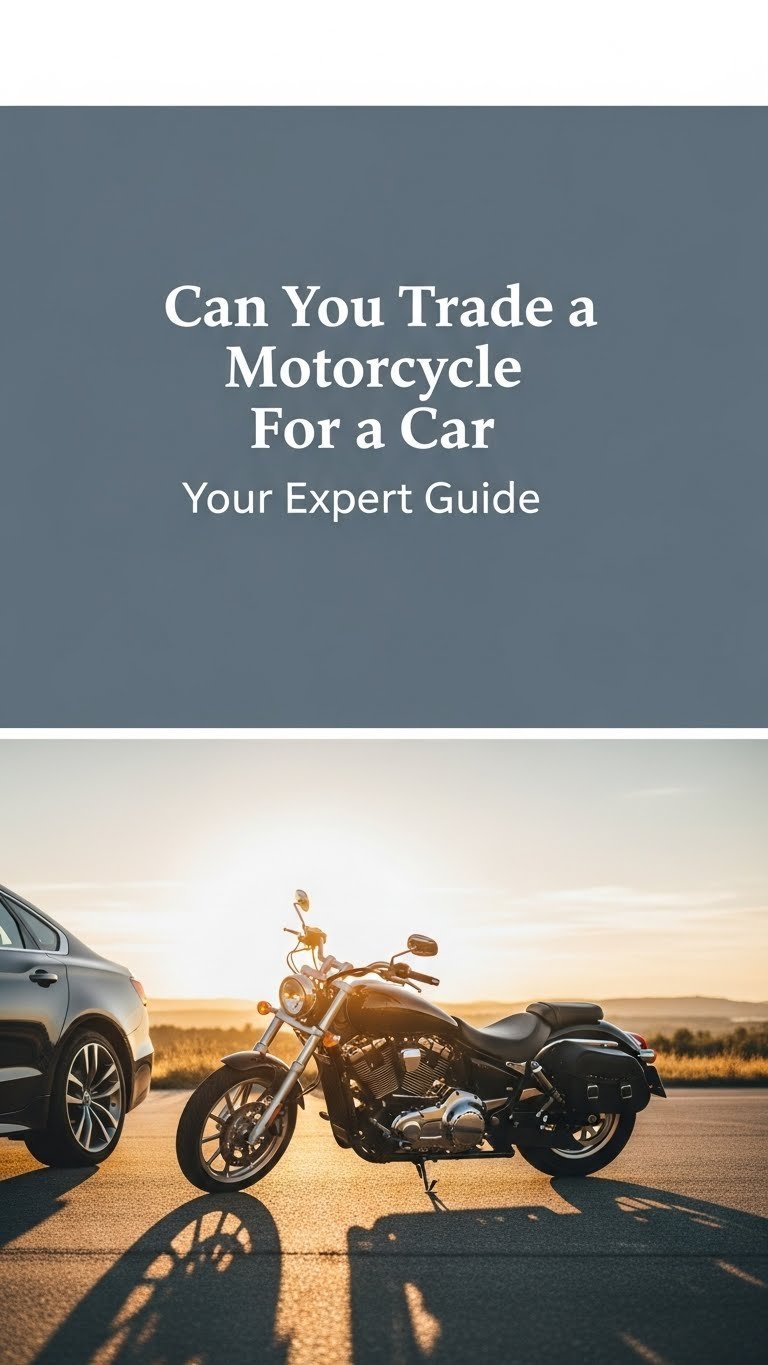
However, it’s not as common as a car-for-car swap, and success hinges on a few key factors. The primary consideration is the individual dealership’s policy. Some dealers are not set up to value or resell motorcycles and will decline the trade. Those who do accept bikes will base their offer on the motorcycle’s wholesale value, not what you might get from a private sale. This guide will walk you through every step to ensure you understand the process and can secure the best possible deal.
But how does this process actually unfold at the dealership? And will you get a fair price for your beloved bike? Let’s explore the step-by-step mechanics of making the trade happen.
How Does a Motorcycle-for-Car Trade-In Actually Work?
The process for trading a motorcycle for a car involves five main steps: preparation, appraisal, negotiation, finalizing the deal, and completing the paperwork. While it mirrors a car-for-car trade, understanding the nuances of a motorcycle appraisal is crucial. From the dealer’s perspective, they are acquiring an asset they likely need to sell at a wholesale auction, which heavily influences their offer.
Based on years of experience in automotive financing, the process can be broken down into a clear sequence. Following these steps will demystify the experience and put you in a stronger position.
Step 1: How Do You Prepare Your Motorcycle for Trade-In?
Before heading to the dealership, you must prepare your motorcycle and its associated documents to maximize its value and ensure a smooth transaction. A well-presented bike signals to the appraiser that it has been cared for, which can positively influence their valuation. While major repairs are rarely cost-effective, a few key actions can make a significant difference.
Your goal is to make the bike as appealing as possible and to prove you are a responsible owner. Follow this checklist:
- 🔧 Deep Clean: Give your motorcycle a thorough wash and wax. Clean the chain, polish the chrome, and treat the leather. A clean bike looks better and makes it easier for the appraiser to inspect its true condition.
- 📄 Gather Documents: Collect all essential paperwork. This is non-negotiable.
- Title: You must have the clean title in hand. If there is a lien on it, you need the loan account information and lender’s name.
- Registration: Ensure your bike’s registration is current.
- Loan Information: If financed, have your 10-day payoff statement from the lender.
- Service Records: Gather any receipts for maintenance, new tires, or aftermarket parts. This demonstrates a history of care.
- 🔎 Minor Fixes: Address small, inexpensive issues. Replace a burnt-out bulb, tighten a loose mirror, or fix a dead battery. This prevents the appraiser from immediately docking the value for easily fixable problems.
Step 2: How Does the Dealership Appraisal Work?
During the appraisal, the car dealership inspects your motorcycle to determine its wholesale value—the price they can expect to get by selling it quickly at a dealer-only auction. This process is less about the bike’s retail price and more about its condition, market demand, and the costs the dealer will incur to resell it. The appraiser is trying to calculate a number that minimizes the dealership’s risk.
Here is what happens behind the scenes:
- VIN Check and History Report: The appraiser will first run the Vehicle Identification Number (VIN) to check for a salvage title, accident history, or outstanding liens. A clean title is critical.
- Physical Inspection: They will walk around the bike, assessing its overall condition. They check for cosmetic damage like scratches and dings, tire and brake wear, and any signs of being dropped. They will also test electronics like lights and signals.
- Market Data Comparison: This is the most important step. The appraiser will consult industry resources like the NADA Black Book or check recent Manheim auction results for similar models. This data provides a baseline wholesale value for a bike of your year, make, model, and mileage.
- Reconditioning Cost Estimate: The dealer estimates how much it will cost them to get the bike “auction-ready.” This includes any necessary repairs, a professional detail, and transportation costs. This amount is deducted from the baseline value.
- The Offer: The final trade-in offer is the calculated wholesale value minus reconditioning costs and a small profit margin for the dealer’s risk and effort.
How Do Car Dealers Calculate a Motorcycle’s Trade-In Value?
Car dealers calculate a motorcycle’s trade-in value by starting with its wholesale auction price, then deducting estimated costs for reconditioning and profit. This number is almost always lower than the Kelley Blue Book (KBB) private party value because the dealership assumes all the risk, time, and effort of reselling the vehicle. Understanding this difference is the key to managing your expectations.
Think of it this way: the dealer is a reseller, not an end-user. They need to acquire your motorcycle at a low enough price to make a profit when they liquidate it. According to industry data, the trade-in offer typically falls between the “Wholesale” and “Trade-In” values you see on guides like KBB.
To make this clear, let’s compare the different types of value for a hypothetical motorcycle:
| Value Type | What It Represents | Who It’s For | Example Price |
|---|---|---|---|
| Private Party Value | The highest price an owner can get selling to another individual. | You, the seller. | $8,000 |
| Dealer Retail Value | The price a motorcycle dealer would list the bike for on their lot. | A future buyer. | $7,500 |
| Trade-In Value | The value a dealer gives you as credit towards another vehicle. | You, the trader. | $5,500 – $6,000 |
| Wholesale/Auction Value | The price the car dealer expects to get selling your bike at a dealer-only auction. | The car dealership. | $5,000 |
Pro Tip: Before you go to the dealership, use the Kelley Blue Book (KBB) online tool to get an estimate for your motorcycle’s “Trade-In Value” and “Private Party Value.” This gives you a realistic baseline for negotiation.
Is It Better to Sell a Motorcycle Privately or Trade It In?
Deciding whether to sell your motorcycle privately or trade it in comes down to a simple trade-off: time and convenience versus money. A private sale will almost always net you a higher price, but a trade-in offers unmatched speed and simplicity. There is no single “right” answer; the best choice depends on your personal priorities.
Pros and Cons of Trading In Your Motorcycle
Trading your bike to a car dealership is the path of least resistance. It’s fast, easy, and consolidates two major transactions into one.
- ✅ Pros:
- Speed and Convenience: You can complete the sale of your bike and the purchase of your car in a single afternoon at one location.
- No Hassle: You avoid the time-consuming process of listing the bike, responding to inquiries, scheduling test rides, and dealing with potential scammers.
- Sales Tax Credit: In most states, you only pay sales tax on the price of the car minus your trade-in value. This can result in significant savings.
- ❌ Cons:
- Lower Value: You will receive a lower price than you would in a private sale, as the dealer’s offer is based on wholesale value.
Pros and Cons of Selling Your Motorcycle Privately
Selling privately requires more effort but puts the most money back in your pocket.
- ✅ Pros:
- Highest Sale Price: You can sell the motorcycle for its fair market value, which could be thousands of dollars more than a trade-in offer.
- Full Control: You control the price, the negotiation, and the timing of the sale.
- ❌ Cons:
- Time-Consuming: The process can take weeks or even months. You have to advertise, field calls and emails, and meet with potential buyers.
- Safety Risks: You must deal with strangers coming to your home and the potential for scams or joyriders.
- Paperwork Responsibility: You are responsible for ensuring the title transfer and bill of sale are handled correctly.
How Do You Trade In a Financed Motorcycle for a Car?
When you trade in a financed motorcycle, the dealership handles paying off your existing auto loan lender as part of the transaction. The critical factor is your equity position: whether your bike’s trade-in value is more or less than your loan balance. This determines if you have money to put toward your new car or if you have debt to carry over.
What Happens if You Have Positive Equity?
Positive equity means your motorcycle’s agreed-upon trade-in value is greater than what you still owe on the loan. This is the ideal scenario, as the surplus cash becomes your down payment on the new car.
For example:
* You owe your lender: $5,000
* The dealer offers you a trade-in value of: $7,000
* You have $2,000 in positive equity. The dealer pays off your $5,000 loan, and the remaining $2,000 is applied as a down payment on your new car, reducing the amount you need to finance.
What if You Have Negative Equity (Are “Upside Down”)?
Negative equity, or being “upside down,” means you owe more on your motorcycle loan than its trade-in value. This is a common and stressful situation, but you have options. The difference between your loan balance and the trade-in value must be paid.
For example:
* You owe your lender: $8,000
* The dealer offers you a trade-in value of: $6,000
* You have $2,000 in negative equity.
Here are the three primary ways to resolve negative equity:
- Pay the Difference in Cash: You can pay the $2,000 difference out of pocket. This is the most financially sound option, as it prevents you from financing more debt.
- Roll the Negative Equity into the New Loan: The most common solution is to add the $2,000 you’re upside down to the new car loan. If the car costs $20,000, you would finance $22,000.
- Wait to Trade: If possible, you can delay the trade-in and continue making payments on your motorcycle loan until you have positive equity or at least break even.
Expert Warning: Be very cautious about rolling negative equity into a new loan. It increases your new loan’s Loan-to-Value (LTV) ratio. Lenders often have a maximum LTV they will approve (e.g., 125% of the car’s value). Exceeding this limit can lead to a loan denial or require you to purchase expensive GAP insurance.
How Can You Find Car Dealerships That Take Motorcycle Trade-Ins?
To find car dealerships that take motorcycle trade-ins, focus your search on large auto groups, dealers with an attached powersports division, and national retailers like CarMax. The key is to find a business with an established process for handling non-standard inventory. The most important step is to always call ahead to save yourself a wasted trip.
Use this checklist to identify willing dealers:
- 📞 Call the Used Car Manager: This is the most effective strategy. Call the dealership and ask to speak directly to the used car manager. Ask them a simple question: “Do you take motorcycles on trade for car purchases?” You’ll get a direct answer in minutes.
- 🏢 Target Large Auto Groups: Large dealership groups that own multiple brand stores (Ford, Toyota, Honda, etc.) in one area often have a centralized appraisal process and more channels to resell a motorcycle, making them more likely to accept one.
- 🏍 Look for Attached Powersports Dealers: Some car dealerships are co-located with or owned by the same company as a powersports or motorcycle dealer. This is your best-case scenario, as they have an expert appraisal team and a direct retail outlet for your bike.
- 🚗 Check with National Retailers: Chains like CarMax have a well-known policy of buying almost any vehicle, including motorcycles. While Carvana‘s policy has varied, it’s worth checking their website for the most current information. Their online appraisal tools can give you a quick estimate.
- 🌲 Consider Rural Dealerships: Dealers in more rural areas sometimes have a more flexible trade-in policy and may be more open to taking a motorcycle, especially if it’s a model popular in their region (like a cruiser or dual-sport).
FAQs About can you trade a motorcycle in for a car
What documents do I need to trade in a motorcycle?
You will need the motorcycle’s title, your driver’s license, the current registration, and if financed, your loan account information. Having recent service records on hand can also be helpful to demonstrate the bike’s maintenance history to the appraiser and potentially increase its value.
Does trading in a motorcycle for a car save on sales tax?
In many states, yes. You are typically only required to pay sales tax on the difference between the car’s price and your trade-in’s value. For example, if the car is $25,000 and your trade-in is valued at $5,000, you would only pay sales tax on $20,000, which could save you hundreds of dollars.
Can I trade in a motorcycle with a salvage title?
It is extremely difficult to trade a motorcycle with a salvage or rebuilt title to a car dealership. Most mainstream dealers will not accept them due to liability concerns and difficulty in reselling. Your best option for a salvage title bike is almost always a private sale to a buyer who understands the history.
Can I trade two motorcycles for one car?
Yes, this is possible if you find the right dealer. The process is the same, but the dealer will appraise both motorcycles separately and combine their trade-in values into a single credit toward the car purchase. This is most likely to be accepted by a large auto group or a dealer with a powersports division.
Should I fix my motorcycle before trading it in?
You should only fix minor, cosmetic issues and ensure the bike is in safe, running condition. Do not invest in major mechanical repairs or expensive new tires, as you will not recoup that cost in the trade-in value. The dealer can perform major repairs for much cheaper than you can.
Can I trade in a motorcycle for a lease?
Yes, you can use the equity from your motorcycle trade-in as a down payment on a car lease. This is called a “cap cost reduction” and it will lower your monthly lease payments. The process works the same way as a trade-in for a purchase, with the equity reducing the total amount you finance.
Can a car dealer buy my motorcycle if I don’t buy a car from them?
Some car dealers will buy your motorcycle outright, but many will not. Dealers who offer this service, like CarMax, are essentially just buying your used vehicle. Traditional dealers prefer trades because the primary goal is to facilitate the sale of a car from their own inventory.
How to negotiate motorcycle trade-in value?
The best way to negotiate is to be prepared with your own research. Get a trade-in value estimate from KBB and NADA Guides beforehand. For the clearest deal, negotiate the price of the car you’re buying first, then negotiate the value of your trade-in as a separate transaction.
Does CarMax or Carvana buy motorcycles?
CarMax does buy motorcycles, offering a straightforward way to get a cash offer, whether you buy a car from them or not. Carvana’s policy on motorcycles has varied over time, so it is essential to check their website directly for their current policy on motorcycle purchases or trades.
Can I trade a motorcycle for a car straight across?
A “straight across” trade is possible but very rare in a dealership setting. This would only happen if the agreed-upon trade-in value of your motorcycle perfectly matches the final sale price of the car you are buying. This is much more common in a private-party transaction between two individuals.
Key Takeaways: Trading a Motorcycle for a Car Summary
- It’s Possible, But Be Prepared: While you can trade a motorcycle for a car, car dealers will offer you wholesale/auction value, which is significantly lower than a private sale price.
- Value vs. Convenience: A private sale gets you more money. A trade-in offers speed, convenience, and a potential sales tax credit, saving you hassle and time.
- Know Your Equity: The most critical factor is your equity. Positive equity acts as a down payment. Negative equity (“being upside down”) complicates the deal and will be added to your new car loan.
- Do Your Homework: Before visiting a dealer, get your own value estimate from KBB or NADA, and call the dealership’s used car manager to confirm they even accept motorcycle trades.
- Focus on Large or Specialized Dealers: Your best bet is with large auto groups, dealers with an attached powersports division, or national chains like CarMax who have systems in place for non-standard trades.
- Separate the Negotiations: For the clearest deal, negotiate the price of the car you are buying first, then negotiate the value of your motorcycle trade-in as a separate transaction.
- Prepare Your Bike and Paperwork: A clean bike and organized documents (title, loan info, service records) make the process smoother and signal to the appraiser that the motorcycle was well-maintained.
Final Thoughts on Trading Your Motorcycle for a Car
Ultimately, trading your motorcycle for a car is a strategic decision that pits financial return against convenience. It is a completely viable option, provided you walk into the dealership with realistic expectations about your bike’s value and a clear understanding of your financial position.
By preparing your bike, researching its wholesale value, and knowing your equity status, you move from a position of uncertainty to one of control. With the knowledge from this guide, you are now equipped to navigate the process, find a willing dealership, and make the best choice for your unique situation.


![What Car Is Chevy Bringing Back in [year]? New Lineup Revealed](https://carxplorer.com/wp-content/uploads/2026/01/What-Car-Is-Chevy-Bringing-Back-in-year-New-Lineup-Revealed-1-1-60x60.jpg "What Car Is Chevy Bringing Back in [year]? New Lineup Revealed 11")