
Wondering if you can have a gun in your car in Texas? You’re not alone, as the laws can seem complex. Many drivers struggle to understand the specific rules for handguns, long guns, and restricted locations.
In Texas, you can legally have a gun in your car under the Motorist Protection Act (Texas Penal Code §46.02). This applies to law-abiding individuals in a vehicle they own or control. However, specific rules regarding concealment, holsters, and your eligibility apply and must be followed to remain compliant.
Based on an analysis of current Texas statutes, this guide explains exactly what you need to know to stay legal. You will discover the different rules for handguns versus rifles, the critical exceptions for school zones and federal property, and how a License to Carry (LTC) changes everything.
Key Facts
- The Motorist Protection Act is the Foundation: This act, part of Texas Penal Code §46.02, is the primary law that permits legally eligible individuals to carry a handgun in their vehicle.
- Concealment is Default: For those without a License to Carry (LTC), a handgun must be kept out of plain view, such as in a glove compartment or center console.
- Holsters Provide an Exception: An LTC holder can carry a handgun in plain view within their vehicle, provided it is secured in a shoulder or belt holster.
- Long Guns are Treated Differently: Texas state law does not impose the same restrictions on rifles and shotguns, which can be transported loaded and in plain view.
- Prohibited Places Still Exist: Even with vehicle carry rights, you cannot bring a firearm onto certain properties, with federal post offices and school zones having the most stringent rules.
Can I Have a Gun in My Car in Texas?
Yes, under Texas law, it is generally legal for a qualified person to have a gun inside a private vehicle they own or control.. The foundational law that grants this right is the Texas Motorist Protection Act, codified in Texas Penal Code §46.02. This law establishes the legal framework for both handgun and long gun transport within a motor vehicle, ensuring that law-abiding citizens can exercise their right to self-protection while traveling.
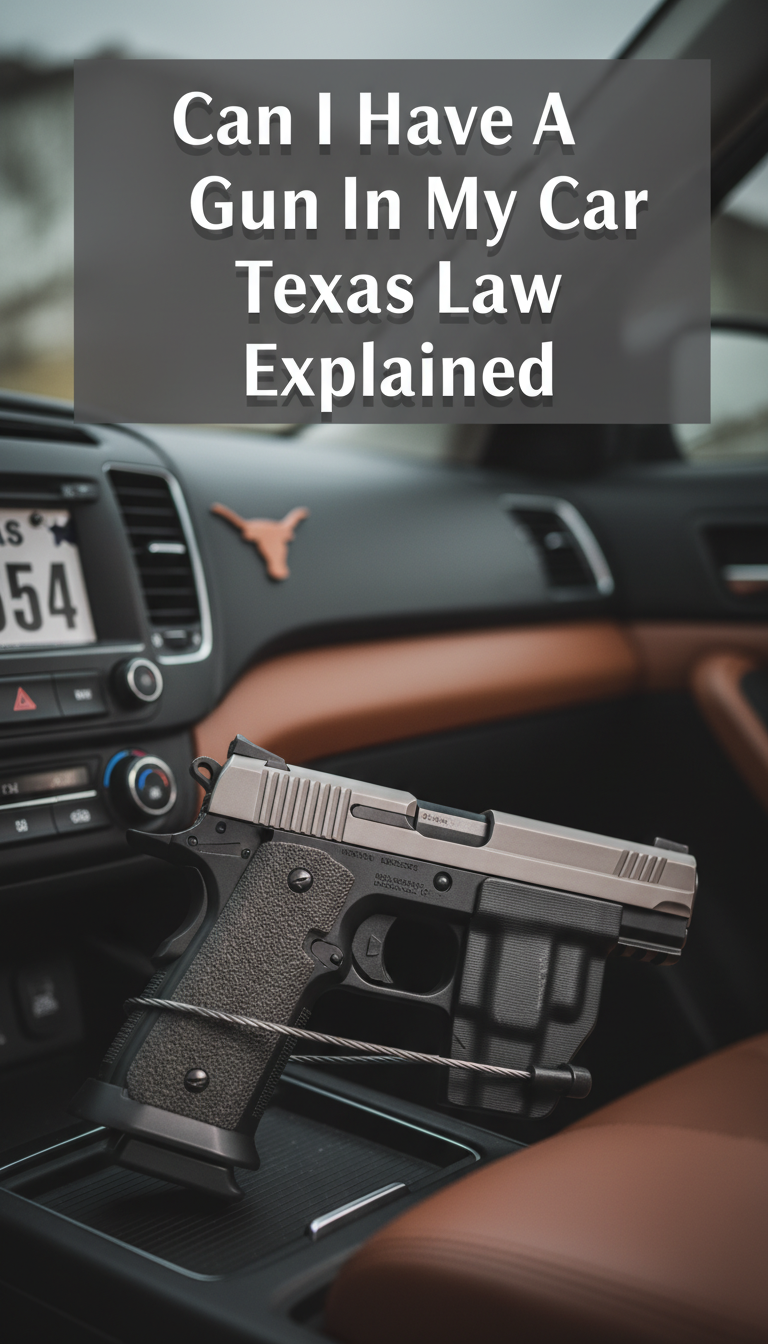
This legal protection applies to a handgun [a firearm designed to be fired with one hand] or a long gun [a rifle or shotgun]. However, the specific rules for how you must carry them differ significantly. Understanding these distinctions is crucial for legal compliance. For instance, the regulations surrounding concealment and holsters for handguns are much more specific than the rules for transporting a rifle or shotgun.
Furthermore, your eligibility is a key factor. The right to carry a firearm in your vehicle is reserved for individuals who are not prohibited by state or federal law from possessing a firearm. As we will explore, these laws create a system where responsible gun owners can legally transport firearms, but within a clear set of rules designed to ensure public safety. This guide breaks down the specific requirements for handguns, the separate rules for long guns, the benefits of a License to Carry (LTC), and the critical locations where firearms are always prohibited.
What Are the Core Rules for Carrying a Handgun in a Car?
To carry a handgun in your car in Texas without a license, the handgun must not be in plain view, and you must be legally eligible to possess a firearm. These foundational rules are established under Texas Penal Code §46.02 and apply to anyone carrying a handgun in a vehicle they own or control. Staying compliant requires meeting several key conditions.
According to the statute, you can legally carry a handgun inside your vehicle if you meet the following requirements:
- The Handgun Is Not in Plain View: This is the most critical rule for a non-LTC holder. The firearm must be concealed. We will discuss what “plain view” means in more detail shortly.
- You Are Not Engaged in Criminal Activity: This protection does not apply if you are committing a crime. However, there is an important exception for minor traffic violations; being stopped for a Class C misdemeanor like speeding does not negate your right to carry.
- You Are Not Prohibited by Law From Possessing a Firearm: Federal or state law prohibits certain individuals, such as convicted felons or those subject to a protective order, from ever possessing a firearm.
- You Are Not a Member of a Criminal Street Gang: The law explicitly excludes members of criminal gangs from this protection.
- You Are at Least 21 Years Old: The legal age to carry a handgun in Texas is 21, with some exceptions for active-duty military members.
For instance, if you’re stopped for a simple traffic ticket, you are generally still compliant with the law. But if you have an outstanding warrant for a more serious offense, your right to carry in the vehicle may be void. The distinction between being concealed and in “plain view” is the most common point of confusion and legal trouble, which makes understanding the next section on holsters essential.
What Does “Plain View” Mean and Why Is a Holster Crucial?
In Texas, “plain view” means a firearm is visible from outside the vehicle or to a person in a normal position inside the car, and it is illegal for a non-LTC holder. A common mistake is leaving a handgun on a passenger seat, dashboard, or even partially covered by a piece of clothing. If an officer can identify it as a firearm by glancing into your car, it is considered in plain view, which is a Class A misdemeanor.
However, the law provides a critical exception that hinges on two things: having a License to Carry (LTC) and using a holster. If you have a Texas LTC, you can legally have a handgun in plain view inside your car, but only if it is secured in a shoulder or belt holster. This holster acts as a legal tool that changes the status of the firearm, acknowledging it is being carried with intent and responsibility.
Here is a simple breakdown of legal versus illegal scenarios:
- ❌ Illegal (for anyone): A handgun sitting loose on the passenger seat.
- ✅ Legal (for Non-LTC Holder): A handgun fully concealed inside the glove compartment or center console.
- ✅ Legal (for LTC Holder Only): A handgun in a holster mounted to the center console or worn on the driver’s hip, even if visible.
Common Mistake: A widespread error is assuming that partially covering a handgun with a jacket or papers is sufficient concealment. If any recognizable part of the firearm is visible, law enforcement can still consider it to be “in plain view,” leading to a potential arrest. True concealment means it cannot be seen or identified as a gun.

How Do the Rules Differ for Long Guns (Rifles and Shotguns)?
Texas state law does not have specific restrictions on how you can carry a long gun, such as a rifle or shotgun, in your vehicle. This is a major difference from the highly regulated rules for handguns. For long guns, the concepts of “plain view” and “concealment” do not legally apply at the state level. You can transport them loaded or unloaded, visible or covered, without a permit.
While state law is permissive, it is crucial to remember that federal laws still apply everywhere. The most significant of these is the Gun-Free School Zones Act, which federally prohibits firearms within 1,000 feet of a school. This federal overlay is a critical piece of information many people miss, as it can turn a legal act under Texas law into a federal offense.
For a clear visual comparison, here is how the rules for handguns and long guns stack up for vehicle carry in Texas:
| Feature | Handgun (Without LTC) | Long Gun (Rifle/Shotgun) |
|---|---|---|
| Plain View | Illegal | Legal |
| Holster Required | N/A (must be concealed) | No |
| Concealment | Required | Optional |
| Loaded Carry | Legal | Legal (subject to safety) |
While it is legal to carry a long gun openly in your vehicle, practical experience shows it is a best practice to transport them cased and unloaded. This enhances safety, reduces the risk of accidental discharge, and helps avoid causing unnecessary public alarm, which could lead to a law enforcement encounter you would rather avoid.
Are There Places I Can’t Have a Gun in My Car?
Yes, you absolutely cannot have a gun in your car on certain properties in Texas, regardless of the general vehicle carry laws. The most common and high-risk restricted areas include school premises, federal properties like post office parking lots, and the secure areas of airports. Both state law under Texas Penal Code §46.03 (“Places Weapons Prohibited”) and overriding federal laws define these gun-free zones. Misunderstanding these rules can lead to serious state or federal felony charges.
The two most common areas of confusion for drivers are school zones and federal property. Each is governed by a different set of laws and has very different exceptions, making it essential to understand them separately.
How Do Gun-Free School Zone Laws Affect Vehicle Carry?
Federal law strictly prohibits firearms within 1,000 feet of a school’s premises, but Texas law provides a narrow and vital exception for LTC holders. The federal Gun-Free School Zones Act (18 U.S.C. § 922(q)) creates a broad, restrictive bubble around K-12 schools. Driving into this zone with a firearm is a federal crime by default.
Federal Rule: It is illegal to knowingly possess a firearm within 1,000 feet of the property line of a public, parochial, or private school.
However, Texas law carves out a specific safe harbor for those with a License to Carry. IF you have a Texas LTC, THEN you are legally permitted to keep your handgun concealed in your locked vehicle while on a school’s driveway, street, or in a parking lot. This state-level exception allows a licensed parent to, for example, park in the school pickup line with their firearm legally and safely stored in their car. If you do not have an LTC, the federal ban applies without this exception.
💡 Pro Tip: This critical exception is specific to handguns. The federal act’s rules for long guns are much stricter and generally do not include this kind of vehicle exception. When traveling near a school, it is always the safest course of action to leave rifles and shotguns secured at home.
What Are the Rules for Federal Property like Post Offices?
It is a federal crime to have a firearm on federal property, and this prohibition includes the entire premises, including parking lots. This is an absolute rule where state laws, including a Texas License to Carry, provide no protection. Federal law is supreme on federal property, and the penalties for violations are severe. The most common example is a United States Post Office.
Warning: Federal law under 39 CFR 232.1 and 18 U.S.C. § 930 strictly forbids the possession of firearms in federal facilities and on their property. This includes the building, sidewalks, and the parking lot. Your Texas LTC is irrelevant here.
A common and dangerous myth is that you are compliant as long as the firearm remains locked in your vehicle. This is false. Federal regulations cover the entire property, from the street entrance to the front door. If you need to visit a post office, a federal courthouse, or a Social Security office, you must leave your firearm stored legally elsewhere before entering their property.
Does Having a Texas License to Carry (LTC) Change the Rules?
Yes, having a Texas License to Carry (LTC) provides significant legal advantages and expanded rights for carrying a handgun in your car. While Texas is a “Constitutional Carry” state, the LTC is far from obsolete. It acts as a legal upgrade that resolves many of the restrictions placed on non-licensed individuals, particularly regarding vehicle carry.
The most significant benefits an LTC provides are the ability to carry in plain view with a holster and special permissions in sensitive locations. For many, these advantages make the process of getting licensed a worthwhile investment in legal protection and peace of mind. Here’s a direct comparison of the rules for an LTC holder versus a non-licensed carrier in common vehicle scenarios:
| Scenario | Non-LTC Carrier (Permitless Carry) | Texas LTC Holder |
|---|---|---|
| Handgun on Console | Illegal (Plain View) | Legal, if in a holster |
| In School Parking Lot | Illegal (Federal Law) | Legal, if concealed in locked vehicle |
| Carry in Another State | Depends entirely on that state’s laws | Legal in 37+ states with reciprocity |
| Police Interaction | Must answer if asked | No legal duty to inform in Texas |
As the table shows, an LTC directly addresses the two most common legal pitfalls: the “plain view” doctrine and the school zone prohibition. It also provides the powerful benefit of reciprocity, which is an agreement where dozens of other states recognize and honor a Texas LTC, allowing you to carry legally when you travel. Considering these advantages, obtaining an LTC remains a highly valuable step for Texas gun owners in 2026.
FAQs About can i have a gun in my car
Can I have a gun in my car in Texas if I am 18, 19, or 20 years old?
Generally, no, you cannot legally carry a handgun if you are under 21 years old. Texas law aligns with federal regulations, which restrict the possession and carrying of a handgun to individuals aged 21 or older. This age requirement applies even under the Motorist Protection Act for vehicle carry. A narrow exception may exist for certain active-duty military members.
Can I carry a gun in a car that is not mine, like a friend’s car or a rental?
Yes, the law applies as long as the vehicle is under your control. If you are driving a friend’s car with their permission, it is considered to be under your control. For rental cars, it is crucial to check the rental company’s corporate policy first. Many rental agreements contractually prohibit firearms in their vehicles, which could create a civil issue even if you comply with state law.
Do I have to tell a police officer that I have a gun in my car in Texas?
No, Texas has no “duty to inform” law for vehicle carry. During a routine traffic stop, you are not legally obligated to volunteer the information that you have a firearm in your car. However, if an officer asks you directly whether there are any weapons in the vehicle, you must answer truthfully.
What are the penalties for illegally having a gun in plain view?
Having a handgun in plain view in a vehicle without an LTC and a proper holster is a Class A misdemeanor. This is a serious criminal offense in Texas, punishable by up to one year in jail and a fine of up to $4,000. This is why fully understanding and following the concealment and holster rules is absolutely critical for legal compliance.
Can I keep my gun loaded in my car?
Yes, Texas law permits you to keep both handguns and long guns loaded while they are in your vehicle. There are no state statutes requiring firearms to be transported unloaded in a motor vehicle. Despite this, exercising responsible gun safety by handling any loaded firearm with extreme care is paramount.
What if I am a visitor from another state? Can I have a gun in my car in Texas?
Yes, as a visitor, you can typically carry a handgun in your car under the same rules that apply to Texas residents. As long as you are legally allowed to possess a firearm in your home state and are not otherwise prohibited by law, you can transport a handgun in your vehicle. The key requirement is that it must be kept concealed from plain view.
Can my employer prevent me from having a gun in my car in the company parking lot?
No, your employer cannot legally stop you from keeping a firearm in your vehicle in their parking lot. Texas has a “parking lot law,” codified in Labor Code §52.061, that protects an employee’s right to transport and store a lawfully possessed firearm in their locked, privately-owned vehicle on company parking premises.
Does “Constitutional Carry” mean I can carry a gun anywhere in my car?
No, “Constitutional Carry” does not eliminate all restrictions. Also known as permitless carry, this law allows eligible Texans 21 and over to carry a handgun in many public places without an LTC. However, for vehicle carry, all the rules regarding concealment (for non-LTC holders), legal eligibility, and prohibited places like school zones and federal properties still apply.
What is the best way to store a gun in a car for legal compliance?
For a non-LTC holder, the safest legal method is storing the handgun in a location completely hidden from sight. This includes a glove compartment, center console, or a secure case placed under a seat. For an LTC holder who wishes to carry openly in a vehicle, a quality belt or shoulder holster is the legally specified method that must be used.
Is it legal to have a gun in my vehicle on a college campus?
This is a complex area, but generally, yes, when confined to your vehicle in a parking area. Texas law allows licensed individuals to carry concealed on many parts of public university campuses. The same “parking lot law” that protects employees typically extends to college campuses, allowing for the legal storage of a firearm inside a locked, private vehicle in a campus parking lot, garage, or driveway. Always check the specific university’s rules.
Key Takeaways: Texas Gun in Car Law Summary
- Handguns Must Be Concealed (Usually): For anyone without a License to Carry (LTC), a handgun in a vehicle must be kept out of plain view. Failure to do so is a Class A misdemeanor.
- An LTC Provides a Holster Exception: The single biggest benefit of an LTC for vehicle carry is the ability to have a handgun in plain view, provided it is in a shoulder or belt holster.
- Long Guns Have Fewer Rules: Texas state law does not impose specific restrictions on carrying rifles or shotguns in your vehicle; they can be loaded and in plain view.
- School Zones are High-Risk Areas: Federal law prohibits firearms within 1,000 feet of a school. Texas provides a critical exception for LTC holders to keep a handgun secured in their locked vehicle in the parking lot.
- Federal Property is Off-Limits: State laws do not apply on federal property. You cannot have a firearm in your car in a post office parking lot or on other federal grounds, even with an LTC.
- Eligibility is Key: You must be legally eligible to possess a firearm (e.g., not a felon, not subject to a protective order, and 21+ for handguns) to carry one in your vehicle under any circumstance.
- Your Employer’s Parking Lot is Protected: Texas law protects your right to store a firearm in your locked, private vehicle in your employer’s parking area, regardless of their company policy.
Final Thoughts on Carrying a Gun in Your Car in Texas
Navigating the laws for carrying a firearm in your vehicle in Texas requires careful attention to detail. While the Motorist Protection Act provides a clear right for law-abiding citizens, compliance hinges on understanding the nuances of concealment, the specific rules for different types of firearms, and the absolute prohibitions in sensitive locations. The law rewards knowledge and preparation. By understanding the specific advantages of a License to Carry and respecting the boundaries of federal properties and school zones, you can confidently and legally exercise your rights while ensuring your safety and the safety of those around you.
Last update on 2026-02-01 / Affiliate links / Images from Amazon Product Advertising API


