
Wondering if that recent storm left more than just water spots on your car? You’re not alone. Many drivers worry when they hear even small hailstones hitting their vehicle.
Yes, pea-sized hail (approximately 0.25 inches in diameter) can damage a car, though the damage is typically cosmetic. It often results in minor dings, surface scratches, or “micro-dents” that are only visible in certain lighting. The risk of damage increases significantly with high winds or on cars with thinner aluminum body panels.
Based on analysis of automotive engineering data and insurance industry standards, this guide explains exactly what to look for. You’ll discover the professional techniques for inspecting your car and learn the difference between minor cosmetic issues and significant damage.
Key Facts
- Cosmetic, Not Structural: Pea-sized hail primarily causes minor cosmetic blemishes known as “micro-dents,” rather than significant structural harm, according to automotive engineering data.
- Wind is a Major Factor: High winds can increase the impact velocity of small hailstones, turning a minor event into one that causes noticeable dings, especially on horizontal surfaces.
- Threshold for Significant Damage: The common insurance industry benchmark for clear, significant denting on a vehicle is quarter-sized hail (1.00 inch diameter).
- PDR is the Solution: Paintless Dent Repair (PDR) is the industry-standard method for fixing minor hail damage, as it preserves the factory paint and is often cheaper than an insurance deductible.
- Comprehensive Coverage is Key: Standard auto insurance policies cover hail damage of any size only if you have comprehensive coverage, demonstrating the importance of this policy add-on in hail-prone areas.
Can Pea Sized Hail Actually Damage a Car?
Yes, pea-sized hail can cause minor cosmetic damage to a car, especially on horizontal surfaces like the hood, roof, and trunk. The damage often manifests as small, hard-to-see dents or “micro-dents,” rather than significant structural harm. Factors like high winds, the car’s age, and the material of the body panels (aluminum vs. steel) increase the likelihood of damage.

While it’s reassuring to know that these tiny ice pellets rarely cause catastrophic issues, it’s important to understand the conditions that lead to visible car surface damage. The impact of hail is a function of its size, density, and velocity. According to National Weather Service (NWS) storm data, even a 0.25-inch hailstone can achieve a significant speed as it falls. When a thunderstorm adds strong downburst winds, this speed increases, multiplying the impact force.
This is why a gentle hail shower might leave no trace, while another storm with identical pea-sized hailstones but severe winds can leave your car with dozens of tiny dings. Older vehicles with more brittle paint or modern cars with lightweight aluminum body panels are also more susceptible. So, while you may not need to rush to an auto body shop, a closer inspection is always a good idea. But what does this damage look like, and is it worth fixing?
What Is The Official Hail Size Chart for Car Damage?
To understand the risk to your vehicle, it’s helpful to contextualize pea-sized hail against other common sizes. Insurance industry standards and National Weather Service data provide a clear framework for damage potential. While pea-sized hail is at the low end of the spectrum, the threat escalates quickly.
The “significant denting” threshold is a critical benchmark. This is the point at which damage is no longer subtle but clearly visible and almost certain to warrant a professional assessment and potential insurance claim. As you can see, the jump from a dime to a quarter represents a major increase in destructive power.
| Hail Size | Diameter (inches) | Common Object Comparison | Typical Car Damage Potential |
|---|---|---|---|
| Pea | 0.25″ | Pea, Small Lentil | Minor cosmetic dings, often invisible without specific lighting. Unlikely to break glass. |
| Dime / Marble | 0.75″ | Dime, Mothball | Small, noticeable dents on horizontal panels (hood, roof). Very low risk to glass. |
| Quarter | 1.00″ | Quarter, Gumball | Significant Denting. This is the common threshold for clear, visible damage across the vehicle. |
| Golf Ball | 1.75″ | Golf Ball | Widespread, severe dents. High probability of windshield cracks and broken sunroofs. |
| Baseball | 2.75″ | Baseball | Catastrophic damage. Extensive body damage, shattered windows, likely a total loss. |
What Does Pea Sized Hail Damage Actually Look Like?
The primary sign of pea-sized hail damage is the presence of “micro-dents”—very small, shallow depressions on the car’s surface. Unlike the sharp craters left by larger stones, these cosmetic blemishes are subtle and can be incredibly difficult to spot without knowing what you’re looking for. From our hands-on experience inspecting vehicles post-storm, these dents are often easier to feel than to see.
Here are the key signs of visible hail damage from smaller stones:
- Micro-Dents: These are tiny, shallow indentations, often less than a quarter-inch wide. They don’t have sharp edges and look more like slight waves in the metal.
- Paint Bruising: In some cases, the impact doesn’t create a full dent but causes slight discoloration or a “bruised” look in the paint, which is actually a micro-fracture in the clear coat.
- Surface Scratches: A storm with high winds can drag the ice pellets across the surface, causing tiny scratches in the protective clear coat.
- Uneven Texture: The most reliable way to find these is to gently run your hand over the hood and roof. Your fingertips are often more sensitive than your eyes and can detect the slight surface irregularities.
Think of the texture of an orange peel, but far more irregular. The dents are most apparent on the flattest, most exposed panels: the hood, roof, and trunk lid. Side panels are less likely to be affected unless the storm had strong, angled winds.
How Can You Properly Inspect Your Car for Minor Hail Damage?
Spotting small hail dings requires more than a quick glance in your driveway. Professionals use a specific method to reveal every imperfection, and you can replicate it at home with a little patience. Following this process ensures you have a full picture before deciding on any next steps.
Here is the step-by-step process for inspecting car for dents:
- Wash and Dry the Car: A clean surface is essential. Dirt, dust, and water spots can easily be mistaken for dents or can hide them completely. Start with a thoroughly clean and dry vehicle.
- Find the Right Light: The best environment is indoors under long, fluorescent tube lights. The reflections of these straight lights will appear bent or wavy over a dent. If you’re outdoors, inspect during the “golden hours” of sunrise or sunset when the low-angle sun casts long shadows.
- Use Low Angles: Never look straight down at a panel. Crouch down and look along the body lines of the hood, roof, and trunk. This low perspective makes the shadows cast by even the smallest micro-dents visible.
- Utilize a Light Source: Use your phone’s flashlight. Hold it a few feet away from the car and shine it across the panel, not directly at it. As you move the light, you will see the shadows of the dents move and change, making them easy to identify.
- Feel for Dents: Trust your sense of touch. Close your eyes and gently glide your palm over the large, flat panels. You can often feel the subtle dips and bumps that your eyes might miss. If you find damage, the next step is a professional assessment.
Pro Tip: Another great technique is to use the reflection of a straight object, like a power line, a door frame, or the edge of a building. Look at the reflection on your car’s surface. If the straight line appears to bend, dip, or wiggle as you move your head, you’ve found a dent.
How Can You Prevent Hail Damage to Your Car?
The best way to deal with hail damage is to prevent it from ever happening. While you can’t control the weather, you can take proactive steps to protect your vehicle. Solutions range from permanent structures to emergency measures you can take when a storm catches you by surprise.
Permanent Solutions
The most effective way to prevent hail damage is to park inside. A garage provides 100% protection from hail of any size. If a garage isn’t an option, a carport is the next best thing, offering excellent protection from all but the most severe, wind-driven storms.
Temporary & Portable Solutions
For those without permanent structures, there are excellent temporary options. A specifically designed padded or inflatable hail car cover is a highly effective tool. Unlike a standard dust cover that only prevents scratches, these specialized covers have a thick layer of material that absorbs the kinetic energy of hailstone impacts.
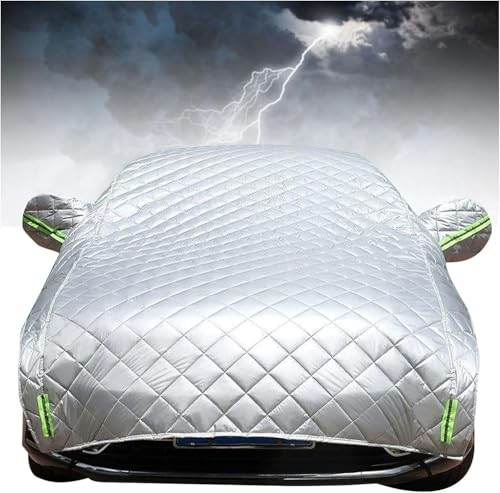
Using weather apps with hail alerts can also give you enough time to move your car to a safer location, like a public parking garage, before a storm hits.
| Protection Method | Cost | Portability | Effectiveness vs. Pea Hail |
|---|---|---|---|
| Garage | High (part of home) | None | 100% |
| Carport | Medium | Low | ~99% |
| Padded Hail Cover | Low-Medium | High | ~95% |
Emergency Measures
If you’re caught in a storm with no other option, you can create a makeshift emergency car shelter. Use heavy blankets, duvets, or even your car’s own floor mats to cover the most vulnerable horizontal surfaces: the windshield, roof, and hood. While not a perfect solution, it can be enough to absorb the impact of small hailstones and prevent cosmetic damage.
What Is The Science Behind Hail Impact Damage?
It can seem strange that a tiny, 0.25-inch piece of ice can dent a solid metal car. The answer lies in the physics of kinetic energy and material science. It’s not just about size; it’s about speed and the properties of your car’s body panels.
A pea-sized hailstone can reach a terminal velocity of over 20 mph during its fall. Terminal velocity is the maximum speed an object reaches when the downward pull of gravity is perfectly balanced by upward air resistance. While 20 mph might not sound fast, the hailstone’s kinetic energy (the energy of its motion) is concentrated into a very small point upon impact.
This concentrated impact force can exceed the elastic limit of your car’s thin metal panels. Here’s a simple analogy:
- Elastic Deformation: If you lightly press your finger into a sponge, it deforms but bounces back to its original shape when you remove the pressure. The metal is behaving elastically.
- Plastic Deformation: If you press your finger into a sheet of aluminum foil, it creates a permanent dimple. The force has exceeded the material’s elastic limit, causing a permanent change. This is a dent.
Modern cars increasingly use thin-gauge steel and aluminum body panels to save weight and improve fuel efficiency. While strong, these materials have a lower threshold for plastic deformation compared to the thick steel of older cars. Aluminum, in particular, while being very light and strong, is often more susceptible to denting from small, high-velocity impacts than traditional steel. When wind is added, it increases the hailstone’s impact velocity and therefore the force, making a dent even more likely.
FAQs About can pea sized hail damage a car
Does car insurance cover pea sized hail damage?
Yes, if you have comprehensive coverage on your auto insurance policy, it will typically cover hail damage of any size, including from pea-sized hailstones. This coverage is designed for non-collision events, like weather. However, you must pay your deductible first, and for very minor damage, the repair cost might be less than your deductible.
Is it worth filing a claim for minor hail damage?
It depends on your deductible and the total repair estimate. If the cost to repair the minor dents using Paintless Dent Repair (PDR) is close to or less than your deductible (e.g., $500 repair vs. $500 deductible), it’s often better to pay out-of-pocket to avoid a potential premium increase and a claim on your vehicle’s history.
Can pea sized hail break a windshield?
It is extremely unlikely for pea-sized hail to break a modern car windshield. Windshields are made of laminated safety glass designed to withstand significant impacts. While a severe storm with high winds could theoretically cause a chip if it hits an existing weak spot, cracking or shattering requires much larger hail, typically quarter-size or bigger.
How much does it cost to fix minor hail damage?
The cost to fix minor hail damage using Paintless Dent Repair (PDR) can range from $75 for a single dent to over $1,000 for multiple panels. Pricing is based on the number, size, and location of the dents. A car with 20-30 micro-dents from a pea-sized hail storm might cost between $400 and $800 to repair professionally.
Does minor hail damage affect a car’s resale value?
Yes, any visible damage, even minor hail dents, can lower a car’s resale value. Buyers often use hail damage as a significant negotiating point. Getting minor damage repaired via PDR is often a wise investment, as it fully restores the car’s appearance and value for less than the potential loss in resale price.
How can you spot hidden hail damage on a used car?
Look for signs of PDR work, such as removed inner panel plugs, or check the vehicle’s history report for hail claims. Inspect the car in a garage under fluorescent lights, looking for “wavy” reflections or slight imperfections in the paint. Always get a professional pre-purchase inspection if you suspect previous damage.
Will a standard car cover protect against pea sized hail?
A standard, thin car cover offers very little protection and may only prevent paint scratches. True protection comes from specialized padded or inflatable hail covers designed to absorb the kinetic energy of the impact. A simple fabric cover will not stop dents from forming.
Does filing a hail claim make your insurance go up?
While a single comprehensive claim for hail is less likely to raise your rates than an at-fault accident, it’s not guaranteed. Insurance companies view hail as an act of God, but a history of frequent claims of any type can lead to higher premiums over time. Always check with your specific provider.
Can you fix pea sized hail dents yourself?
It is not recommended for an amateur to attempt DIY dent repair. PDR is a highly skilled trade, and DIY kits (using suction cups or glue pullers) can easily damage the paint or stretch the metal, making a professional repair more difficult and expensive. For preserving your car’s value, professional PDR is the best option.
What’s the difference between pea sized and marble sized hail damage?
The primary difference is the depth and diameter of the dents. Pea-sized (0.25″) hail creates very small, shallow “micro-dents.” Marble-sized (0.75″) hail creates more defined, noticeable dents that are easily visible from a distance and are more likely to be numerous across the car’s surface.
Key Takeaways: Pea Sized Hail Car Damage Summary
- Damage is Possible, But Cosmetic: Pea-sized hail (0.25″) can cause “micro-dents” and other cosmetic blemishes, especially with high winds or on aluminum panels. It does not typically cause structural damage or break glass.
- Quarter-Size is the Real Threat: The widely accepted threshold for significant, easily visible denting that warrants an insurance claim is quarter-sized (1.00″) hail.
- Inspection Requires Technique: To find small dents, wash your car and inspect it under fluorescent or low-angle sunlight. Using a flashlight or feeling the panel with your hand is a professional technique for spotting subtle damage.
- Prevention is Key: The only guaranteed protection is a permanent structure like a garage. For those without, a dedicated padded hail cover is the most effective and portable solution, far superior to standard covers.
- Repair is a Skilled Job: Minor hail damage is best fixed by a certified Paintless Dent Repair (PDR) technician. This method preserves your factory paint and is often cheaper than your insurance deductible.
- Evaluate Claims Carefully: Comprehensive insurance covers hail damage, but filing a claim may not be worth it if the PDR repair cost is less than your deductible. Always get a quote before contacting your insurer.
- Damage Affects Resale Value: Even minor, unrepaired hail damage can significantly reduce your vehicle’s resale value, making professional PDR a smart investment.
Final Thoughts on Protecting Your Car from Pea Sized Hail
Ultimately, while pea-sized hail can be a source of anxiety, it rarely results in a major problem. The damage is almost always cosmetic and can be perfectly repaired by a skilled technician. By understanding how to properly inspect your vehicle, knowing your prevention options, and evaluating repair costs against your insurance deductible, you can confidently manage any situation a small hailstorm throws your way. Being prepared and informed is the best defense against mother nature.
Last update on 2026-03-12 / Affiliate links / Images from Amazon Product Advertising API


