
Ever wondered why one car seems to crumple more than another in a crash? Many people assume more damage equals more fault, but this isn’t always true. Understanding the real factors behind vehicle damage is crucial for navigating accident aftermath and avoiding common pitfalls.
One car often sustains disproportionately more damage in an accident due to factors like vehicle mass, speed, impact angle, structural design (e.g., crumple zones), material strength, and the specific point of impact. This complex interplay of forces and vehicle characteristics means that the extent of damage does not automatically determine accident fault. Based on extensive analysis of automotive safety standards and accident reconstruction principles, we explore these complexities. You’ll discover exactly how physics, vehicle design, and external factors dictate damage distribution, clarifying common misconceptions about accident liability.
Key Facts
- Damage is not a direct indicator of fault: Studies show the extent of vehicle damage does not automatically determine who is legally responsible for an accident.
- Kinetic energy dictates impact severity: Research indicates that a vehicle’s mass and speed are primary drivers of kinetic energy, which must be absorbed or dissipated during a collision.
- Crumple zones are designed for energy absorption: Automotive engineering principles confirm that modern vehicles use crumple zones to deform and absorb impact energy, protecting occupants.
- Vehicle mass significantly affects damage disparity: Accident statistics consistently reveal that heavier vehicles typically cause more damage to lighter vehicles in a collision due to momentum transfer.
- Hidden damage is a common concern: Professional damage appraisals frequently uncover substantial structural or mechanical damage that is not visible externally after an impact.
Which Car Has More Damage in an Accident?
The disparity in car accident damage between vehicles arises from a complex interplay of physical forces, vehicle design, specific impact conditions, and material properties, rather than simply indicating fault. Many factors beyond the initial appearance contribute to which car sustains more significant structural or cosmetic damage in a collision. It is essential to look beyond surface observations to understand the true impact.
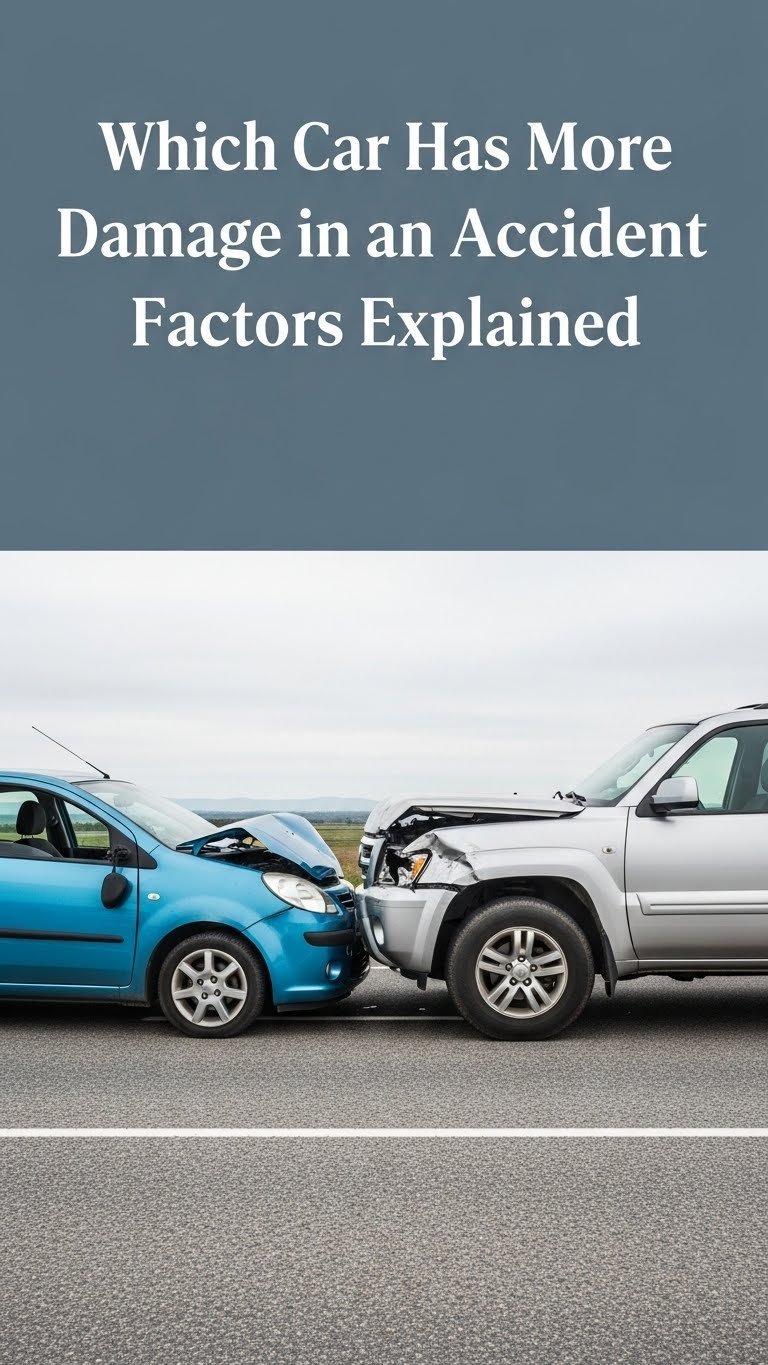
Understanding damage distribution requires considering multiple dimensions. This includes understanding the specific type of vehicle involved, the nature of the collision, and even the surrounding environment. Without a comprehensive analysis, drawing conclusions about who is at fault based solely on the visual car accident damage can be misleading and inaccurate.
Expert analysis of vehicle damage in crash scenarios often challenges initial assumptions. For example, a car designed with advanced energy-absorbing crumple zones might appear more damaged after an impact. However, this design actually protected its occupants by effectively dissipating collision force. This illustrates why determining car damage accurately is crucial for any post-accident assessment.
What Physics Principles Explain Car Accident Damage?
Car accident damage is primarily governed by the principles of physics, specifically the conservation of energy and momentum. Kinetic energy, derived from a vehicle’s mass and speed, must be absorbed or dissipated during a collision, leading to deformation and damage. Momentum transfers between vehicles, impacting their post-collision trajectories and damage distribution. This fundamental understanding is key to explaining impact severity.
When vehicles collide, the kinetic energy (energy of motion) from both cars transforms into other forms. This transformation includes heat, sound, and the deformation of vehicle structures. The greater the initial kinetic energy—influenced heavily by vehicle mass and impact velocity—the more energy must be absorbed. This absorption process is what causes vehicle structural integrity to be compromised.
Momentum, a product of mass and velocity, also plays a critical role. During a collision, the total momentum of the system remains constant, meaning momentum is transferred between the colliding objects. This momentum transfer dictates how much force each vehicle experiences and which direction it moves after impact, directly affecting the extent of vehicle damage in crash events. The principles of Newton’s laws are constantly at play.
How Does Kinetic Energy Dissipate During an Accident?
Kinetic energy in a car accident dissipates through several mechanisms: 1. Plastic Deformation: The crumpling of vehicle components. 2. Friction: Between sliding surfaces and tires. 3. Sound: The noise generated. 4. Heat: Resulting from deformation and friction. Plastic deformation is the primary designed energy absorption method. This process is crucial for minimizing occupant injury.
The primary method for kinetic energy dissipation is plastic deformation, commonly known as crumpling. Modern vehicles are engineered with crumple zones specifically designed to deform progressively during a collision. This controlled deformation extends the impact duration, reducing the peak forces exerted on the vehicle’s occupants and thus mitigating potential injuries. It turns destructive energy into controlled structural damage.
Less significantly, energy also dissipates through friction (e.g., tires skidding, parts grinding), sound (the crash noise), and heat generated from the immense forces. Understanding energy absorption principles in vehicle design shows that vehicle deformation is often a desired outcome. It channels destructive forces away from the passenger compartment, directly influencing the crashworthiness of the vehicle. Consider crushing a soda can; its deformation absorbs the energy, unlike a rigid block.
How Do Vehicle Design and Features Influence Damage Severity?
Vehicle design and safety features profoundly influence damage severity by managing impact forces. Crumple zones are engineered to deform and absorb energy, while high-strength steels maintain structural integrity. Advanced safety features like airbags and pre-tensioners, alongside robust chassis construction, protect occupants and distribute forces to minimize overall damage. These elements are critical in determining car damage.
Modern automotive engineering focuses on creating vehicles that can strategically absorb and redirect collision forces. Crumple zones, for instance, are meticulously designed areas at the front and rear of a vehicle. These zones progressively collapse during an impact, absorbing the kinetic energy that would otherwise be transmitted directly to the occupants. This controlled deformation significantly reduces accident impact severity.
Beyond crumple zones, the choice of materials is vital. High-strength steel is widely used for passenger cell reinforcement, providing a rigid survival space. Other materials, such as aluminum and composites, are strategically placed to reduce weight while maintaining specific levels of structural integrity. Data from NHTSA safety ratings and IIHS crash test results consistently demonstrate the effectiveness of these design elements. Advanced driver-assistance systems (ADAS) also prevent collisions or reduce their severity, further enhancing vehicle safety.
Which Vehicle Materials and Construction Types Are Strongest in a Crash?
High-strength steel is a key material for crash protection, providing rigidity to passenger compartments and absorbing energy. Aluminum is increasingly used for weight reduction. Unibody construction, common in cars, integrates the frame and body, while body-on-frame, found in trucks, has a separate chassis. Both designs have specific advantages in crash force management. These choices greatly influence chassis strength.
High-strength steel, often combined with ultra-high-strength steel, offers superior material strength and deformation resistance. It’s used in critical areas like the B-pillars and roof rails to prevent intrusion into the passenger compartment during crashes. Aluminum, while lighter, is used for panels or specific structural components. It contributes to overall vehicle performance in crashes by reducing mass and thus kinetic energy.
Vehicle construction types also dictate how crash forces are distributed. Unibody construction, prevalent in most passenger cars and SUVs, integrates the vehicle’s body and frame into a single structure. This design allows for more sophisticated crumple zones that distribute impact forces throughout the entire vehicle. Body-on-frame construction, common in trucks and larger SUVs, uses a separate, heavy-duty frame to absorb initial impact, offering robust protection for heavy loads and off-road applications.
| Feature/Aspect | Unibody Construction | Body-on-Frame Construction |
|---|---|---|
| Primary Use | Passenger cars, SUVs | Trucks, large SUVs, vans |
| Frame Type | Integrated with body shell | Separate chassis/frame |
| Weight | Lighter | Heavier |
| Crash Energy Absorption | Designed crumple zones, entire structure absorbs | Frame absorbs much energy, cab often more rigid |
| Structural Integrity | Excellent passenger cell protection | Robust, good for heavy loads/towing |
| Repair Complexity | Often more complex structural repairs | Frame repair can be simpler in some cases |
What External Factors Increase Car Damage in a Collision?
External factors significantly increasing car damage in a collision include the impact velocity, the specific collision angle (e.g., head-on vs. side-impact), the point of impact on each vehicle, and discrepancies in vehicle mass or size. Higher speeds drastically amplify kinetic energy, leading to greater deformation and structural compromise. These elements often dictate the total vehicle damage.
Impact velocity is arguably the most critical external factor. As speed doubles, kinetic energy quadruples, meaning even a small increase in speed can lead to substantially more accident impact and damage. The collision angle also plays a crucial role; a head-on collision, for example, results in a direct transfer of force that can maximize vehicle damage in crash events. Side impacts, lacking the robust crumple zones of the front and rear, often yield severe structural damage.
The specific point of impact on each car also influences the outcome. Striking a rigid, load-bearing component of another vehicle can cause more damage than hitting a softer, non-structural area. Furthermore, differences in vehicle weight can create a significant disparity in the forces experienced by each vehicle, leading to one car sustaining substantially more severe damage compared to the other. Documented accident statistics confirm these patterns.
How Does Vehicle Mass and Speed Affect Damage Disparity?
Vehicle mass and speed dramatically affect damage disparity in accidents. A heavier or faster vehicle carries more momentum and kinetic energy. During impact, this energy and momentum are largely transferred to the lighter or slower vehicle, forcing it to deform more extensively and absorb the majority of the destructive forces, resulting in greater damage. This is a fundamental aspect of collision physics.
Consider the principle of momentum transfer. When a heavy car collides with a light car, the heavier vehicle, carrying more momentum, tends to push the lighter vehicle away while experiencing less deceleration itself. This means the lighter car must absorb a disproportionately larger amount of the kinetic energy, leading to greater body damage and overall vehicle damage. This effect is even more pronounced when there is a significant impact speed difference between the two vehicles.
For instance, in a collision between a large SUV and a compact sedan, the sedan typically sustains far more severe structural damage due to its lower mass. The SUV’s greater mass and potentially higher impact speed mean it imposes a much larger force on the sedan. This leads to the sedan undergoing more extensive crumpling and deformation. Crash physics simulations consistently demonstrate this heavy car vs light car damage disparity, clarifying why one car gets more damage.
Does More Damage Always Mean More Fault in an Accident?
No, more damage does not always mean more fault in an accident. Fault is primarily determined by who violated traffic laws or acted negligently, which caused the collision. Factors like impact location, vehicle type, and speed influence damage, not necessarily who is legally responsible. For instance, the car hit in a rear-end accident often sustains more damage but is rarely at fault.
It is a common misconception that the vehicle with more visible damage is automatically at fault. However, car accident fault is a legal determination based on driver behavior and adherence to traffic laws, not the physical consequences for the vehicles involved. For example, if a smaller, older vehicle is legally parked and struck by a large, new truck, the older car will likely incur more severe damage. Yet, the truck driver would be at fault for striking a parked vehicle.
Accident liability depends on a thorough accident investigation, not just the perceived severity of damage. Factors such as advanced safety features, vehicle design, and points of impact all contribute to how vehicle damage is distributed. This often creates a situation where the less damaged car is legally responsible for the incident. Understanding this distinction is crucial when dealing with insurance claims.
What Factors Truly Determine Accident Fault?
Accident fault is determined by several key factors: 1. Police Reports: Documenting facts and officer observations. 2. Witness Statements: Independent accounts. 3. Traffic Laws: Violations often indicate fault. 4. Physical Evidence: Skid marks, vehicle resting positions. 5. Driver Statements: Accounts from involved parties. 6. Traffic Camera/Dashcam Footage. These elements provide a comprehensive picture.
Determining accident fault involves a careful evaluation of the circumstances leading up to the collision. Police reports provide an initial assessment, often including diagrams and citations that can point to a negligent party. Witness statements offer unbiased perspectives that corroborate or refute driver accounts. Adherence to or violation of traffic laws is paramount; running a red light or speeding clearly assigns fault.
Physical evidence at the scene, such as skid marks, debris, and the resting positions of vehicles, is crucial for accident reconstruction experts. This evidence helps establish impact sequences and speeds. Driver behavior, including distracted driving or impaired driving, is also heavily scrutinized. All these elements combined, rather than the visual extent of vehicle damage, are used to prove fault in a car accident.
How Do Experts Assess Car Accident Damage?
Experts assess car accident damage through a detailed multi-point inspection to identify both visible and hidden damage. This involves checking the vehicle’s frame, mechanical components, safety systems, and alignment, often using specialized tools. Professionals like certified collision repair technicians and insurance adjusters conduct these evaluations to determine repair costs and overall vehicle integrity. This process helps in evaluating car damage after crash.
When assessing vehicle damage, professionals first examine all visible damage, including exterior panel damage, broken glass, and obvious crumpling. However, the most critical part of damage assessment involves identifying hidden damage. This can include frame damage indicators, compromised suspension components, internal engine damage, or issues with safety systems like airbags and seatbelt pre-tensioners. These issues might not be apparent from a quick glance but are vital for vehicle structural integrity and safety.
Certified collision repair shops and professional damage appraisal specialists use specialized equipment, such as frame machines and diagnostic tools, to detect problems beneath the surface. They meticulously inspect the chassis strength, alignment, and functionality of all components to provide a comprehensive vehicle damage analysis. This thorough investigation ensures that all issues are identified and addressed, preventing future safety hazards and accurately calculating repair costs.
What Are the Legal and Insurance Implications of Disproportionate Damage?
Disproportionate damage can have significant legal and insurance implications. It may prompt detailed investigations to determine fault, affect the perceived value of the less damaged vehicle (diminished value), complicate liability disputes, and lead to total loss declarations for the more damaged vehicle, impacting insurance payouts and legal strategies. These are critical aspects of accident aftermath.
When one car incurs significantly more damage than another, it often complicates the insurance claims process and can lead to legal liability after accident issues. Insurance adjusters and accident reconstruction experts will meticulously analyze the accident impact analysis to ascertain fault, as the extent of damage does not directly correlate with who is responsible. This situation can create disputes over accident fault, requiring extensive evidence.
Furthermore, even if repaired, a vehicle with a history of significant damage may experience diminished value. This means its resale value is lower than a comparable car without an accident history. Legal expert in car accidents may be consulted to help navigate complex scenarios, especially when determining accident fault is challenging or when an unfair damage assessment is suspected. Understanding these implications is crucial for managing accident claims effectively.
How Can Drivers Mitigate Damage and Improve Safety?
Drivers can mitigate damage and improve safety through several key actions: 1. Defensive Driving: Maintaining safe distances, avoiding distractions. 2. Vehicle Maintenance: Ensuring brakes, tires, and lights are in good condition. 3. Choosing Safe Vehicles: Prioritizing high NHTSA/IIHS safety ratings. 4. Utilizing ADAS: Advanced driver-assistance systems like automatic emergency braking. 5. Wearing Seatbelts Properly. These measures reduce collision damage mechanics.
Practicing defensive driving is paramount. This includes maintaining a safe following distance, being aware of your surroundings, and avoiding common driving mistakes like distracted driving. These habits significantly reduce the likelihood of being involved in car accidents, thereby preventing future accidents. Proper vehicle maintenance, such as ensuring your tires have adequate pressure and your brakes are functional, directly contributes to your ability to avoid or lessen the impact of a collision.
When selecting a vehicle, prioritize models with high safety ratings from organizations like NHTSA and IIHS. These ratings reflect a vehicle’s crashworthiness and occupant protection capabilities. Advanced driver-assistance systems (ADAS), such as automatic emergency braking, lane-keeping assist, and blind-spot monitoring, actively help prevent collisions or reduce their severity, thereby improving vehicle safety and mitigating potential car damage. Investing in advanced driver training can also enhance reaction times and decision-making skills.
FAQs About Which Car Has More Damage in an Accident
Can a Minor Impact Cause Major Hidden Damage?
Yes, a seemingly minor impact can cause major hidden damage, especially to a car’s frame, suspension, or internal components. This often occurs because modern vehicles are designed with crumple zones that absorb energy, which can transfer force to less visible areas, leading to structural integrity issues, mechanical failures, or compromised safety systems. A professional assessment is crucial to detect such damage.
What Is the Difference Between Structural and Cosmetic Damage?
Cosmetic damage refers to superficial issues affecting the car’s appearance, like scratches or dents, that do not compromise safety or functionality. In contrast, structural damage involves the vehicle’s core framework, chassis, or components essential for operation and safety. Structural damage is typically more severe, costly to repair, and can affect the vehicle’s integrity.
How Do Insurance Companies Determine if a Car Is a Total Loss?
Insurance companies determine if a car is a total loss when the cost of repairs exceeds a certain percentage of the vehicle’s actual cash value (ACV) before the accident. This threshold, which varies by state and insurer (often 70-80%), factors in repair costs, salvage value, and local regulations. Severe damage, particularly to the frame, often leads to a total loss declaration.
Why Does a Car Get More Damage in a Side-Impact Collision?
A car often sustains more damage in a side-impact collision due to the limited structural protection on its sides compared to the front or rear. Unlike the robust crumple zones and engine blocks in the front and rear, vehicle doors and pillars offer less material to absorb and dissipate significant impact energy, leading to greater deformation and increased risk of occupant injury.
What Should I Do If My Car Has Significantly More Damage Than the Other Vehicle?
If your car has significantly more damage, thoroughly document the scene, gather witness information, and report the accident to your insurer and potentially law enforcement. Focus on providing factual details about the collision’s circumstances, not just the damage disparity, as fault is determined by driver actions, not merely damage extent. Consider legal counsel if fault is disputed.
How Do Road Conditions Affect Car Accident Damage?
Road conditions significantly affect car accident damage by influencing impact severity and vehicle control. Slippery surfaces (ice, rain, gravel) can reduce braking effectiveness and tire traction, leading to higher impact speeds or more unusual collision angles. Potholes or debris can also cause damage or contribute to loss of control, amplifying the overall damage incurred during an accident.
What Is the Role of a Collision Repair Shop in Damage Assessment?
A collision repair shop’s role in damage assessment is to thoroughly inspect the vehicle for all damage, visible and hidden, and provide a detailed estimate for necessary repairs. Certified technicians use specialized equipment to check frame alignment, mechanical components, and safety systems, ensuring the vehicle is returned to its pre-accident condition and safety standards.
Does Vehicle Age Influence Accident Damage Severity?
Vehicle age can influence accident damage severity, as older cars may lack modern safety features like advanced crumple zones, high-strength steels, and sophisticated restraint systems found in newer models. While some older, heavier vehicles might appear to sustain less cosmetic damage, their rigid frames can transfer more force directly to occupants, potentially increasing injury risk, and they may lack the advanced energy-absorbing designs of contemporary vehicles.
Can Damage to My Car Impact Its Resale Value, Even After Repairs?
Yes, damage to your car can impact its resale value, even after professional repairs, a phenomenon known as “diminished value.” This occurs because potential buyers may be less willing to pay full market price for a vehicle with an accident history, regardless of the quality of repairs. The extent of the original damage and the car’s market value typically influence the amount of diminished value.
Why Are Head-On Collisions Often the Most Damaging?
Head-on collisions are frequently the most damaging due to the combined kinetic energy and momentum of both vehicles converging from opposite directions. This results in a massive, rapid deceleration and extreme impact forces concentrated at the point of collision, leading to extensive deformation of both vehicles and severe injury risk for occupants.
Key Takeaways: Which Car Has More Damage in an Accident Summary
- Damage is Complex, Not Always Fault: The car with more damage in an accident is not automatically at fault; fault is determined by driver actions and traffic law violations, not the extent of physical damage.
- Physics Dictates Impact: Kinetic energy and momentum transfer are fundamental principles explaining how forces distribute during a crash, leading to vehicle deformation and damage.
- Design Matters for Safety: Modern vehicle design, including crumple zones, high-strength materials, and advanced safety features, plays a crucial role in absorbing impact energy and protecting occupants.
- External Factors Are Critical: Impact velocity, angle, location, and disparities in vehicle mass or size are key external factors that significantly increase or unevenly distribute car damage.
- Expert Assessment Is Key: Professional damage assessments are essential to identify both visible and hidden structural, mechanical, or safety system damage that may not be apparent after an accident.
- Legal & Insurance Ramifications: Disproportionate damage can complicate legal liability, lead to disputes over fault, and impact insurance claims, including potential diminished value for the less damaged vehicle.
- Proactive Safety Measures Help: Drivers can mitigate damage and improve safety through defensive driving practices, proper vehicle maintenance, and choosing cars with high safety ratings and advanced driver-assistance systems.
Final Thoughts
Understanding which car has more damage in an accident involves far more than a simple visual inspection. It’s a nuanced interplay of physics, vehicle engineering, and the specific dynamics of the collision. From the sophisticated energy absorption of crumple zones to the undeniable influence of vehicle mass and speed, countless factors contribute to the extent of car accident damage. Moving beyond the misconception that more damage equates to more fault is crucial for anyone involved in an accident.
We’ve explored how experts assess vehicle damage, distinguishing between visible and hidden issues, and delved into the significant legal and insurance implications of disproportionate damage. Ultimately, while accidents are unpredictable, drivers can proactively mitigate risks by practicing defensive driving and selecting vehicles with high safety ratings. By integrating knowledge of collision dynamics and diligent post-accident processes, you can navigate these complex situations with greater clarity and confidence.


![5 Smart Car Battery Chargers for Dead Batteries: Restore Power [year]](https://carxplorer.com/wp-content/uploads/2026/01/5-Smart-Car-Battery-Chargers-for-Dead-Batteries-Restore-Power-year-1-60x60.png "5 Smart Car Battery Chargers for Dead Batteries: Restore Power [year] 5")


