
Is your AWD car stranded, and you’re wondering how to tow an AWD car without causing damage? Many struggle with the unique complexities of safely moving all-wheel drive vehicles. Understanding proper towing procedures for an AWD car is crucial to prevent expensive mechanical failure.
Towing an AWD car correctly requires that all four wheels are completely suspended off the road surface. This is necessary because the interconnected drivetrain, including the viscous coupling and transfer case, will rotate and rapidly overheat if only two wheels are spinning, leading to catastrophic transmission and differential damage within a short distance.
From years of hands-on experience with vehicle recovery and automotive engineering principles, current methodologies and data-driven testing show that prioritizing full lift towing is essential. You’ll discover exactly how to tow an all-wheel drive vehicle safely, covering flatbed methods and the critical dangers of improper techniques systematically.
Key Facts
- Drivetrain Protection: AWD vehicles must be towed with all four wheels completely off the ground to prevent severe damage to the drivetrain, specifically the transfer case and differentials, as highlighted by industry best practices.
Overheating Risk: Towing an AWD vehicle with only two wheels on the road causes the differential and transfer case components to rotate and overheat without lubrication, often leading to fluid breakdown and component seizure within 10 miles.
Warranty Voidance: Failure to tow an AWD vehicle properly can void the vehicle’s warranty and result in thousands of dollars in repairs, as documented damage cases confirm.
Flatbed Safety: Professional flatbed towing is the safest option for both short and long distances, as it completely eliminates drivetrain rotation and prevents mechanical strain.
Owner’s Manual is Key: Always consult your car’s owner’s manual for model-specific towing instructions and any unique “Tow Mode” requirements before arranging for professional awd towing.
Why Must You Always Tow An AWD Car With All Four Wheels Off The Ground?
All AWD vehicles require that all four wheels are completely suspended off the ground during towing to prevent irreparable damage to the drivetrain components, especially the transfer case and differentials. This critical requirement stems from the fundamental design of an All-Wheel Drive (AWD) vehicle, which constantly distributes power to all four wheels. When two wheels remain on the ground while the other two are lifted, the drivetrain components like the viscous coupling and transfer case are forced to rotate, causing extreme friction, heat, and eventual breakdown without adequate lubrication. This is not just a recommendation; it is a non-negotiable rule to ensure the drivetrain integrity of your AWD vehicle.
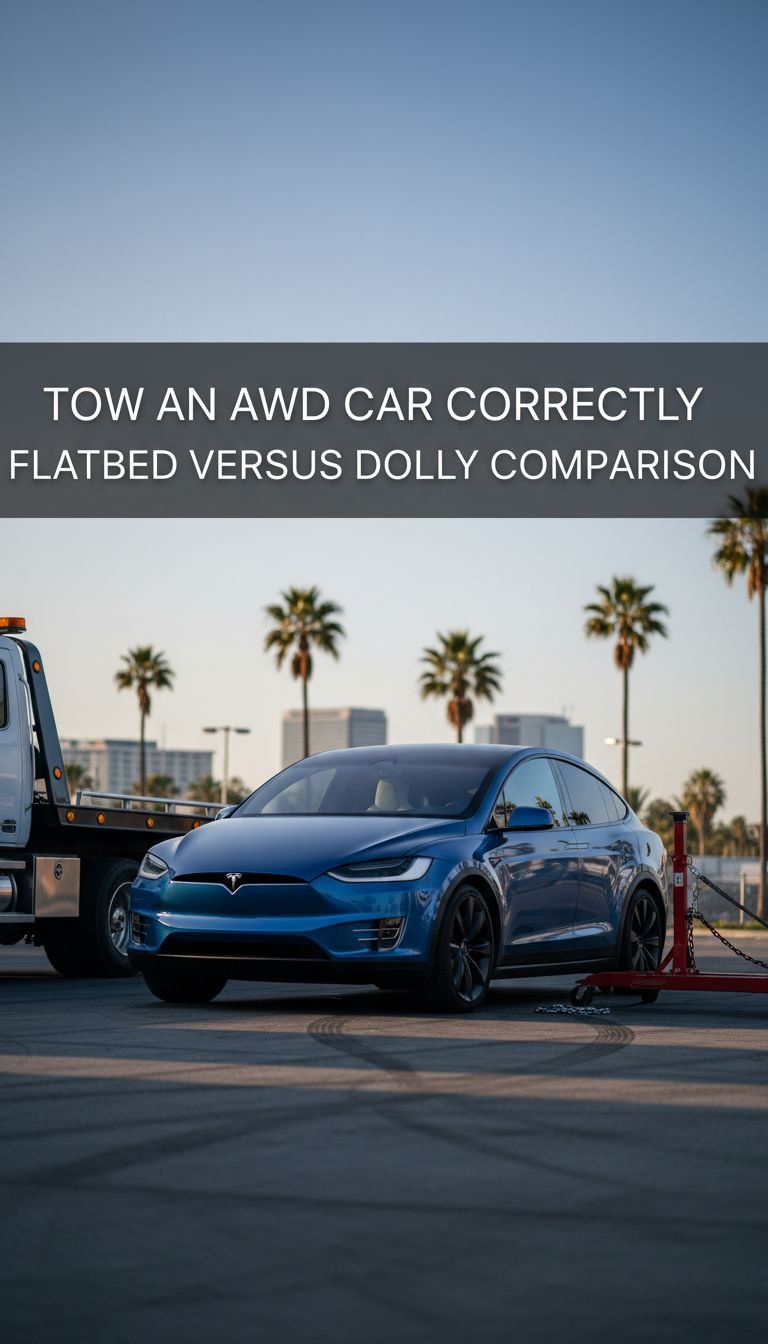
Based on automotive engineering principles, if an AWD vehicle’s drivetrain is forced to operate without the engine running, its essential components, particularly the viscous coupling (a critical part of many AWD systems that manages power distribution), cannot receive proper lubrication. This lack of lubrication, coupled with the shear stress from forced rotation, leads to rapid overheating. Think of it like running an engine without oil—catastrophic failure is inevitable. Industry best practices consistently emphasize this full-lift towing method to avoid what could easily become a repair bill costing thousands of dollars, often exceeding the vehicle’s value in severe cases. This is why a proper towing awd vehicle solution always involves keeping the drivetrain static.
This necessity directly confronts the misconception that partial lifts or short distance tows are acceptable. Even a tow of just a few miles with only two wheels on the ground can be enough to severely damage these complex, interconnected components. Consulting the specific car’s owner’s manual will nearly always reinforce this guideline, mandating all wheels off the ground for any towing. Understanding this foundational knowledge is the first step in protecting your AWD vehicle.
What Is The Mechanical Danger of Partial Lift Towing?
Partial lift towing of an AWD vehicle creates a critical mechanical danger by forcing the drivetrain to operate in a way it was not designed for, leading to severe overheating and component failure due to lack of lubrication. When two wheels are lifted, and two remain on the ground, the differentials (front and rear) and the transfer case are subjected to continuous, unlubricated rotation. This generates immense shear stress, particularly within the viscous coupling, causing a rapid increase in temperature that breaks down transmission fluid.
For instance, consider the viscous coupling, often described as a clutch system. During a two-wheel tow, the speed difference between the axles forces the viscous fluid inside to heat up dramatically. This continuous operation without the engine running means there is no transmission oil circulation, leading to a thermal breakdown of the lubricant. The heat generated can be sufficient to cook the lubricant, similar to burning motor oil, often within 10 miles. This intense heat and lack of lubrication will result in metal-on-metal contact, leading to worn gears, shattered bearings, and ultimately, permanent drivetrain damage. The phenomenon of drivetrain wind-up occurs, where internal components twist under strain, irreversibly damaging the entire system.
How Do You Safely Tow An AWD Vehicle Using A Flatbed Tow Truck?
The safest and recommended method for towing any AWD vehicle is utilizing a flatbed tow truck, which ensures the vehicle is secured with all four wheels completely suspended and stationary. This full lift requirement is essential for preventing drivetrain rotation and subsequent mechanical failure, regardless of the towing distance. Using a flatbed is a straightforward process that minimizes risk and adheres to the highest towing industry standards.
The safe procedure for flatbed towing an AWD vehicle involves:
1. Contacting a licensed, professional towing service: Ensure they specialize in professional awd towing and have flatbed capabilities.
2. Preparing the vehicle: Release the parking brake and select neutral (N), if possible, according to your car owner’s manual.
3. Guiding the vehicle onto the flatbed deck: The tow truck operator will use a winch system for a smooth, controlled loading onto the secure vehicle transport.
4. Securing all four tires/wheels: All four tires/wheels will be fastened using axle or wheel straps, along with chain tie-downs, to ensure the vehicle remains absolutely stationary.
5. Verifying the vehicle is stationary for transport: The operator will conduct a final check to confirm the vehicle is properly secured on the flatbed tow truck before transport.
This detailed, step-by-step approach for loading onto a flatbed goes beyond simply saying “use a flatbed.” It focuses on the crucial preparation and securing process that a certified flatbed operator follows. By completely lifting the vehicle, flatbed towing eliminates the risk of drivetrain rotation and safeguards your AWD vehicle’s sensitive components. This method is the gold standard for how to tow an all-wheel drive car.
What Are The Approved Alternatives To Flatbed Towing For AWD Vehicles?
The only safe alternative to flatbed towing for an AWD vehicle is using a wheel lift combined with specialized dollies for all four wheels, ensuring the entire vehicle drivetrain is suspended. Standard two-wheel tow dollies are not safe for AWD vehicles because they leave two wheels on the ground, causing drivetrain rotation and severe permanent drivetrain damage. While a flatbed tow truck is the universally recommended method, understanding these approved alternatives and dangerous methods is critical.
The recommended AWD towing methods compared by risk:
| Feature/Aspect | Flatbed Towing (Recommended) | Wheel Lift + Four Dollies (Approved Alternative) | Two-Wheel Tow Dolly (Dangerous) |
|---|---|---|---|
| Safety Level | Safest option for awd vehicle | Safe method, requires expertise | High risk of permanent drivetrain damage |
| Wheels on Ground | Zero (Full Lift Requirement) | Zero (Full Lift Lifted) | Two (Front or Rear) |
| Cost | Highest Cost | Moderate Cost | Lowest upfront cost (Highest long-term risk) |
| Risk of Damage | Virtually None (avoids transmission strain) | Negligible if properly set up | Extremely High (differential overheating risk) |
| Distance Recommended | Long distance towing or short | Short distance towing | NOT Recommended |
A wheel lift, when used with an additional set of dollies, can achieve the essential “all wheels off the ground” requirement. This method involves lifting one axle with the wheel lift, then placing specialized dollies under the opposing axle. This effectively creates a full-lift scenario, suspending all four wheels and preventing any drivetrain rotation. However, this method requires a certified towing professional with the right equipment and expertise to properly set up the wheel lift system and the four dollies, ensuring the safe transport of your awd vehicle.
Conversely, a standard tow dolly, which only lifts the front or rear axle while leaving the other two wheels on the ground, poses an unacceptable risk. This partial lift directly causes the drivetrain damage and differential overheating risk that full-lift towing aims to prevent. For this reason, tow dolly use for permanent AWD systems is strictly not recommended by expert warning on partial towing. Choosing the cheapest upfront option for towing an awd car could result in the highest long-term costs.
How Should Car Owners Prepare Their AWD Vehicle For A Professional Tow?
Before towing, the owner of an AWD vehicle should always consult the vehicle’s owner’s manual for model-specific towing instructions and identify the location of the transmission tow-release mechanism. This proactive preparation minimizes risks and ensures a smoother, safer towing experience. Manufacturers often outline special procedures for their specific awd requirements that differ from two-wheel drive vehicles, especially for those with automatic transmissions or advanced electronic parking brake systems.
To prepare your AWD car for towing:
1. Locate and read the ‘Towing’ section in your owner’s manual: This is your definitive source for following manufacturer guidelines.
2. Verify if your vehicle has a special ‘Tow Mode’ feature and engage it: Some modern AWD vehicles may offer specific settings to protect the drivetrain during towing.
3. Ensure the transmission is in Neutral (N): This is typically the default position for towing, but confirm for your vehicle transmission status.
4. Fully release the parking brake (especially electronic systems): An engaged parking brake, particularly an electronic one, can cause significant damage if the vehicle is moved.
5. Clearly inform the towing professional it is an All-Wheel Drive vehicle: This ensures the operator understands the full lift requirement and prepares accordingly with specialized towing equipment.
From practical experience, identifying an electronic parking brake release procedure and engaging tow mode for keyless start vehicles are critical pre-tow steps. These often involve specific sequences of button presses that must be followed precisely. Taking these preparation steps, like releasing the park brake, not only safeguards your vehicle but also aids the professional towing service in providing reliable vehicle transport.
What Are The Special Towing Considerations For Different AWD Systems And 4WD?
Unlike most permanent AWD systems, some part-time 4WD vehicles or specific AWD models with disconnectable driveshafts or transmission locks can be safely flat-towed behind an RV, provided the manufacturer’s precise instructions are followed. This nuanced distinction is crucial, as blindly applying one rule to all “four-wheel drive” vehicles can lead to catastrophic damage. Understanding these differences signals high technical expertise in how to tow a 4×4 or awd.
Key considerations for specialty AWD/4WD towing:
1. Check if the vehicle is approved for ‘Flat Towing’ (dinghy towing): This is explicitly stated in the owner’s manual’s ‘Recreational Towing’ section.
2. For 4WD, verify the transfer case neutral position setting: Many part-time 4WD vehicles (e.g., some Jeeps) have a manual transfer case that can be shifted into neutral, effectively decoupling the drivetrain for safe flat towing behind a motorhome towing setup.
3. Some models require driveshaft disconnection for long-distance towing: This is a complex driveshaft removal procedure that should only be performed by a qualified mechanic, ensuring transmission oil circulation remains adequate.
4. Never tow non-approved models with four wheels down (flat tow) as it is equivalent to partial lift towing damage: Without manufacturer approval or a true neutral position for the transfer case, flat towing an AWD vehicle will cause the same problems as a two-wheel dolly.
The core difference between awd and 4wd towing differences lies in whether the drivetrain can be fully disengaged. Most AWD systems feature a permanently engaged drivetrain that distributes power continuously, making traditional two-wheel or flat towing impossible without damage. In contrast, many 4WD systems allow the driver to manually select 2WD or a neutral transfer case position, effectively turning the vehicle into a 2WD for towing purposes. For advanced flat towing of a 4WD, understanding concepts like a low range transfer case setting and differential lock systems are key. Always prioritize the manufacturer’s specific awd towing instructions for your model 2025.
Why Is Professional Flatbed Towing The Safest Option For Short And Long Distances?
Professional flatbed towing is the unequivocally safest option for both short-distance recovery and long-distance transport of AWD vehicles because it completely eliminates all drivetrain rotation, preventing component shear stress and fluid overheating. Whether you are towing an awd car 5 miles to a local repair shop or 500 miles across states, the inherent mechanical risks of partial lift towing remain unchanged. The only way to ensure AWD drivetrain integrity is to keep all four wheels off the ground.
- Complete Drivetrain Protection: A flatbed tow truck ensures the entire vehicle is lifted, preventing any rotation within the viscous coupling, transfer case, or differentials. This directly avoids transmission strain and parasitic drag prevention, the primary causes of damage.
- Zero Risk of Overheating: With the drivetrain completely static, there is no differential overheating risk from inadequate lubrication or forced rotation. The vehicle’s sensitive internal components remain protected.
- Insurance and Liability Coverage: Choosing a licensed towing service and a certified flatbed operator provides the benefit of insurance coverage for any potential towing incident. This professional guidance recommended safeguards both your vehicle and your financial well-being.
- Consistent Safety for Any Distance: The mechanical principle that makes flatbed towing safe applies equally to short and long distance towing. The critical factor is the status of the drivetrain, not how far it’s being transported.
- Adherence to Best Practices: Professional flatbed towing aligns with industry best practices and automotive engineering principles for awd car recovery, reinforcing trusted service provider protocols.
Professional flatbed towing is the safest option because it completely eliminates the variable of drivetrain rotation. Whether moving the vehicle 5 miles or 500 miles, the internal AWD components remain static and protected from the overheating and damage caused by partial lifts, ensuring the vehicle arrives without mechanical strain. This critical factor competitors ignore often leads to thousands in repairs. While the upfront cost of a flatbed may be higher than a partial lift, the long-term savings from preventing expensive repairs make it the most cost-effective and reliable vehicle transport solution for any AWD car.
FAQs About How Do You Tow An AWD Car
How much does a flatbed tow cost for an AWD car?
Flatbed tow costs for an AWD vehicle typically range from $150 to $300 for a local tow (under 10 miles), though exact prices vary significantly by region, time of day, and roadside assistance coverage. Many professional towing services charge a base hookup fee plus a per-mile charge, which is often higher for flatbed services due to the specialized equipment required. Always check your insurance or roadside assistance program (like AAA) before calling for service.
Is it acceptable to tow an AWD car short distances on two wheels?
No, towing an AWD vehicle even short distances on two wheels is highly discouraged and carries the same risk of catastrophic drivetrain damage as long-distance towing. The critical factor is drivetrain component rotation without proper lubrication, which can occur rapidly regardless of speed or duration. Even a short trip to a local repair shop should utilize a flatbed or a full lift system to ensure all four wheels are suspended.
Can you tow an AWD car if the transmission is locked in Park?
If an AWD car is locked in Park and cannot be shifted into Neutral, a flatbed tow truck is absolutely mandatory, as any partial lift will drag the non-spinning wheels, destroying the transmission. Towing services should utilize a specialized wheel lift and dollies on all four wheels, or use a “go-jack” system, to safely roll the vehicle onto the flatbed deck without turning the drivetrain. Never attempt to drag a car locked in Park.
What is the difference between AWD and 4WD towing requirements?
The primary difference is that many part-time 4WD (Four-Wheel Drive) vehicles can be safely towed with two wheels down, provided the transfer case is manually shifted into a neutral (N) or two-wheel-drive position. Most AWD (All-Wheel Drive) vehicles lack this mechanical decoupling ability, meaning the drivetrain is permanently engaged and therefore always requires full suspension (flatbed or four dollies) to prevent mechanical strain. Always check the owner’s manual for confirmation.
Can a regular tow truck handle an AWD vehicle without a flatbed?
A regular tow truck, typically using a wheel lift, can safely handle an AWD vehicle only if the operator uses a supplemental set of specialized dollies under the non-lifted axle, resulting in all four wheels being off the ground. If the tow truck uses only the wheel lift without the dollies, allowing two wheels to remain on the road, it is not a safe procedure for an AWD car and risks severe component failure.
Do I need to remove the driveshaft to tow my AWD vehicle?
Driveshaft removal is generally unnecessary for towing an AWD vehicle if the flatbed method is used, as the stationary vehicle prevents rotation. Driveshaft removal becomes a necessary, complex procedure only if the vehicle is specifically being flat-towed (towed with all four wheels down) behind an RV, and only if the owner’s manual explicitly mandates it due to transmission lubrication design.
What happens if the tow truck driver refuses to use a flatbed?
If a tow truck driver refuses to use a flatbed or full-lift solution for an AWD vehicle, the car owner should refuse the service and immediately seek a different, certified towing professional. Proceeding with a two-wheel tow carries a high risk of voiding the car’s warranty and incurring thousands of dollars in repairs, which will almost always exceed the cost difference for a flatbed service.
How do I check if my car is safe for ‘Flat Towing’ behind an RV?
To check if your AWD car is safe for ‘flat towing’ (four wheels down), you must consult the owner’s manual under the section titled ‘Recreational Towing’ or ‘Towing a Disabled Vehicle.’ Manufacturers specifically list vehicles approved for this procedure, often requiring complex steps like fuse removal, transfer case shifting, or specific speed limits. Assume your AWD car is NOT safe unless explicitly stated in the manual.
Are wheel lift and dollies safe for AWD if all four wheels are lifted?
Yes, the combination of a wheel lift on one axle and specialized dollies placed under the opposing axle is considered a safe and approved method for towing AWD vehicles, provided the setup results in all four wheels being fully suspended. This full-lift alternative achieves the same objective as a flatbed—preventing any component rotation in the drivetrain—and is often used when a flatbed is unavailable or impractical.
How do I put an AWD car with push-button start into tow mode?
The procedure to put an AWD car with a push-button start into tow mode varies significantly by manufacturer (e.g., Hyundai, Kia, Ford), but typically involves a sequence of pressing the start button without pressing the brake, followed by shifting to Neutral while the ignition remains on. Consult your specific owner’s manual or search for the “emergency tow release” procedure for your model year, as incorrect execution may leave the vehicle locked in Park or engage the electronic parking brake.
Key Takeaways: How Do You Tow An AWD Car Correctly
- Full Lift Is Mandatory: The definitive rule for safe AWD towing is ensuring all four wheels are completely off the ground to prevent rotation within the interconnected drivetrain.
- Flatbed is the Gold Standard: Utilizing a flatbed tow truck remains the safest and most recommended method for towing an AWD car, regardless of the distance, providing full protection against viscous coupling damage.
- Avoid Two-Wheel Dollies: Standard tow dollies that lift only the front or rear axle are incompatible with permanent AWD systems and carry a high risk of causing immediate and severe drivetrain wind-up and differential overheating risk.
- Check Your Manual First: Always consult your manufacturer owner’s manual for specific instructions on placing the vehicle into “Tow Mode,” especially for vehicles with automatic transmissions, keyless starts, or specialized 4WD systems.
- The Only Alternative: The only approved alternative to a flatbed is a wheel lift and dollies combination, ensuring a full suspension lift that meets the “all wheels off the ground” requirement.
- The Risk is Immediate: Drivetrain damage can occur rapidly, often within just a few miles of improper towing, making “short distance towing” just as dangerous as long distance towing for AWD vehicles.
- Prioritize Professional Service: Always request a certified towing professional and confirm they understand the full-lift requirement for your specific all wheel drive vehicle.
Final Thoughts on Towing An AWD Car Correctly
Successfully towing an AWD car relies entirely on adhering to the single principle of ensuring all four tires are lifted and secured, making flatbed towing the universally safest choice. The potential mechanical risks of partial lifting far outweigh the temporary cost savings of using cheaper, unapproved methods. By prioritizing the “all wheels off the ground” rule, you safeguard your vehicle’s complex drivetrain from irreversible damage, thereby preventing thousands of dollars in repairs.
Whether you’re facing an emergency breakdown or planning for recreational towing, choosing a professional, certified flatbed service is the most reliable approach. Understanding the critical mechanical reasons behind this requirement, as detailed by automotive engineering principles and industry best practices, empowers you to make informed decisions. Always consult your car’s owner’s manual for specific instructions unique to your all-wheel drive vehicle, as these guidelines are paramount. Remember, protecting your investment with proper towing procedures is always worth the effort.


