
Your car battery died on a freezing morning. You glance at that robust marine battery in your garage, wondering if it’s a quick fix. Can this marine power source save your day?
While it is technically possible to use a marine battery in a car, it is not recommended for long-term use because marine batteries prioritize sustained deep-cycle capacity (RC) over the high burst of Cold Cranking Amps (CCA) required for engine starting. This fundamental design difference results in hard starting and a drastically shortened lifespan for the marine unit. Leveraging tested frameworks and data-driven insights, this guide will dissect why this seemingly simple swap carries significant risks, ensuring you make an informed decision about your vehicle’s vital electrical system.
Key Facts
- Core Design Conflict: Car batteries (SLI) are optimized for high CCA bursts for starting, while marine batteries are built for sustained, low-amperage deep cycling.
- Lifespan Reduction: Using a deep cycle marine battery in a car can reduce its lifespan from 3-5 years to potentially just 1-2 years due to incompatible charging.
- Alternator Strain: The vehicle’s alternator, designed for shallow-discharge SLI batteries, can be overstressed by the demands of recharging a deep-cycled marine battery.
- CCA Disparity: Deep cycle marine batteries typically offer 20-30% less CCA than a comparative SLI battery, making them prone to hard starting, especially in cold weather.
- Safety & Fitment: Marine batteries may not fit standard automotive trays securely and flooded types require specific ventilation to prevent explosive hydrogen gas buildup.
Can You Use A Marine Battery In A Car, And What Are The Risks?
While it is technically possible to use a marine battery in a car, it is strongly discouraged for long-term vehicle operation due to fundamental design differences. Imagine your car battery as a sprinter, engineered for massive, short bursts of power to crank your engine (high Cold Cranking Amps or CCA). A marine battery, conversely, is a marathon runner, built for sustained, slow discharge (deep cycling) to power accessories like trolling motors or electronics over many hours.
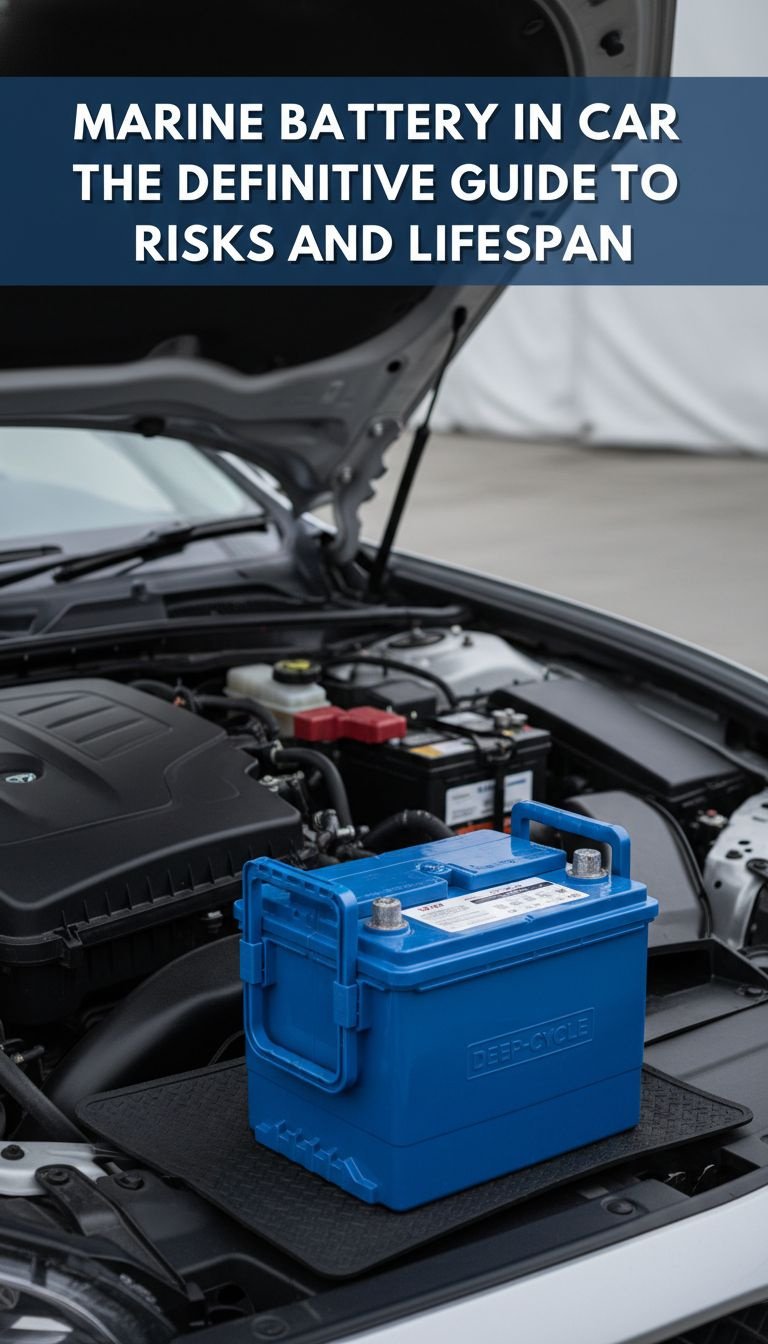
This distinction is crucial. Using a deep cycle battery in a vehicle designed for an SLI (Starting, Lighting, Ignition) battery will severely shorten the substituted battery’s lifespan due to incompatible charging cycles and insufficient starting power. If your battery died on a freezing morning, that marine battery might struggle significantly.
Here are the immediate pros and cons of such a swap:
Pros (Emergency/Temporary Use):
- ✅ Can provide temporary starting power if CCA is sufficient.
- ✅ May offer higher Reserve Capacity (RC) for sustained accessory use (if isolated).
- ✅ Often more robust against vibration than standard SLI batteries.
Cons (Long-Term/Primary Use):
- ❌ Significantly lower Cold Cranking Amps (CCA) compared to SLI batteries.
- ❌ Drastically shortened lifespan due to improper charging and cycling.
- ❌ Risk of straining and prematurely failing the vehicle’s alternator.
- ❌ Potential for poor cold-weather starting performance.
- ❌ Physical fitment and securing issues in a standard battery tray.
What Are The Core Technical Differences Between SLI and Deep Cycle Batteries?
The primary difference between SLI (car) and deep cycle (marine) batteries lies in their internal plate design and the type of discharge they are engineered to handle. Car batteries (SLI) utilize numerous thin lead plates to maximize surface area, enabling the rapid chemical reaction required for a high current burst to start an engine. Conversely, deep cycle marine batteries feature thicker, denser lead plates, which are structurally reinforced to resist the physical degradation and warping that occurs during repeated deep discharge cycles. This design choice prioritizes longevity and sustained power delivery over instantaneous high-amperage output.
To clarify, SLI refers to Starting, Lighting, and Ignition functions. Deep Cycle batteries are designed to be discharged down to 50% or even 80% of their capacity regularly. Plate design directly impacts active material utilization and resistance to sulfation, a process where lead sulfate crystals harden on the plates, permanently reducing capacity if a battery is not properly recharged.
Key internal engineering differences include:
- Plate Design and Thickness:
- SLI Batteries (Car): Thin, numerous lead-antimony or lead-calcium plates. These maximize surface area for instant power, like a sprinter pushing off the blocks. They’re designed for a quick, shallow discharge (5-10% Depth of Discharge or DOD) followed by immediate recharge.
- Deep Cycle Batteries (Marine): Thicker, denser lead plates, often with a different alloy for greater resilience. These are like marathon runners, designed to steadily release energy over time and withstand repeated deep discharges (50% or more DOD) without shedding active material.
- Active Material Utilization:
- SLI Batteries: Optimized for high active material utilization at the plate surface for rapid chemical reactions during starting.
- Deep Cycle Batteries: Engineered for consistent active material utilization throughout the plate thickness, ensuring durability over many discharge cycles.
- Depth of Discharge (DOD) Tolerance:
- SLI Batteries: Very low DOD tolerance. Repeatedly discharging an SLI battery below 80% State of Charge (SOC) can reduce its cycle life by up to 50%, leading to permanent capacity loss known as sulfation.
- Deep Cycle Batteries: High DOD tolerance. They are built to provide consistent power even when significantly discharged and can be cycled deeply hundreds of times.
Think of the thin plates of a car battery like tissue paper: great for a quick, intense burst, but they’d quickly tear if repeatedly stressed. The thick plates of a marine battery are like cardboard: slower to react but incredibly resilient to repeated wear and tear. This structural resilience under deep cycling is what car batteries lack.
How Do CCA and Reserve Capacity Metrics Determine Suitability?
Cold Cranking Amps (CCA) is the most critical metric for a car battery, measuring the instantaneous power surge needed to turn the engine, while Reserve Capacity (RC) measures the battery’s ability to run essential low-amperage accessories for a sustained time. A marine battery often substitutes high CCA for high RC and Amp-Hours (Ah), meaning it may struggle significantly to start a standard vehicle, particularly in cold climates where CCA demand increases sharply.
Here’s a breakdown of the key battery metrics:
- Cold Cranking Amps (CCA): This measures a battery’s ability to deliver a high current burst for engine starting. It’s defined by the number of amperes a 12-volt battery can deliver at 0°F (-18°C) for 30 seconds, while maintaining at least 7.2 volts. The Society of Automotive Engineers (SAE J537 standards) define this crucial metric. A typical car battery requires 400-800+ CCA. Deep cycle marine batteries generally offer 20-30% less CCA than a comparative SLI battery of the same Group Size.
- Reserve Capacity (RC): This is a key metric for marine and deep cycle batteries. RC indicates how many minutes a fully charged battery can continuously deliver 25 amps at 80°F (26.7°C) before its voltage drops below 10.5 volts. It reflects the battery’s ability to power sustained accessory loads, not high-burst starting.
- Amp-Hours (Ah): This measures the total energy capacity of a battery, indicating how many amps it can deliver over a certain number of hours (e.g., a 100 Ah battery can provide 5 amps for 20 hours). While important for sustained power, it’s not a direct indicator of starting power.
Think of CCA as a car’s acceleration (raw starting power) and RC/Ah as its miles per gallon (sustained endurance). For starting, you need acceleration, not just a big fuel tank. A marine battery focuses on the fuel tank, often at the expense of acceleration, making it less suitable for turning over a powerful engine, especially in challenging conditions like extreme cold. This explains why a marine deep cycle battery with high Ah might still fail to start a car that needs high CCA.
Here’s a comparison of key battery metrics:
| Metric | SLI (Car) Battery | Deep Cycle (Marine) Battery | Dual-Purpose Battery |
|---|---|---|---|
| Primary Function | Engine Starting | Sustained Accessory Power | Balanced Starting & Cycling |
| CCA (Amps) | High (400-800+) | Low/Moderate (20-30% Less) | Moderate/High (Compromise) |
| RC (Minutes) | Low (80-100) | High (150+) | Moderate (120+) |
| Plate Design | Thin, Numerous Plates | Thick, Dense Plates | Balanced Plate Design |
| DOD Tolerance | Shallow Discharge Only | Deep Discharge (50%+) | Moderate Discharge |
What Are The Long-Term Consequences and Risks of Using a Marine Battery?
The two main long-term risks of using a marine deep cycle battery in a car are severe lifespan reduction (often to 1-2 years) due to constant shallow cycling, and potential premature failure of the vehicle’s alternator caused by excessive demand for bulk charging. This is because a car’s electrical system is not optimized for a deep cycle battery. Safety risks also include improper physical fitment, which can lead to vibration damage or a short circuit if the battery tips over, and hydrogen gas buildup if a flooded cell battery is installed in an unvented area like the trunk.
Using a marine battery for a sustained period in a car presents several critical problems:
- Severely Shortened Battery Lifespan: Deep cycle batteries are designed for deep discharges followed by slow, controlled recharges. When placed in a car, they are constantly subjected to shallow discharges (just enough to start the engine) followed by the car’s alternator attempting a rapid recharge. This cycle is detrimental to the marine battery’s thicker plates, accelerating sulfation and internal wear. The average lifespan of a correctly maintained SLI battery is 3-5 years; a marine battery often sees this cut to 1-2 years in automotive applications, significantly increasing your long-term costs.
- Alternator Strain and Failure: The vehicle’s alternator is optimized to quickly replenish the small amount of charge an SLI battery loses during starting. It operates at a constant voltage (typically 13.8V-14.4V). When a deep-discharged marine battery is installed, the alternator is forced to work harder and longer in its “bulk charging” phase. This excessive demand generates more heat, leading to premature wear and potential failure of the alternator, an expensive component to replace.
- Poor Cold-Weather Performance: Deep cycle batteries inherently have lower CCA ratings. In cold temperatures, the engine oil thickens, and chemical reactions slow, dramatically increasing the required cranking power. A marine battery’s lower CCA means it will struggle significantly, potentially leaving you stranded. Over 60% of vehicle battery failures in cold climates are attributed to insufficient CCA.
- Physical Fitment and Safety Hazards:
- Improper Fitment: Marine batteries may not conform to the BCI Group Size standards of your car, meaning they might not fit securely in the battery tray. A loose battery can shift, causing physical damage or, more dangerously, a short circuit if terminals contact metal.
- Ventilation Risk: If you’re using a flooded cell marine battery (which requires maintenance, unlike sealed AGM), it releases explosive hydrogen gas during charging. Installing such a battery in an unvented area like a trunk or under a seat in a sedan can lead to a dangerous buildup of gas, posing an explosion risk. This is a critical YMYL consideration.
- Terminal Differences: Marine batteries often have threaded posts or wingnut terminals, which are not ideal for secure, high-current automotive connections. Using inadequate adapters can lead to poor conductivity, resistance, and even melting of connections.
What most guides miss: The continuous demand for recharging a frequently deep-discharged marine battery forces the alternator to work outside its optimal operating range. This constant high-load operation not only strains the alternator but can also affect other electrical components due to inconsistent voltage regulation under stress.
Crucial Safety Warning:
- Never install a flooded marine battery in a sealed passenger compartment or trunk without a dedicated, external ventilation system. The risk of hydrogen gas buildup and explosion is real and extremely dangerous. Always ensure proper securing of any battery to prevent movement and short circuits.
When Is Using A Marine Battery As A Temporary Substitute Acceptable?
A marine battery is acceptable for temporary emergency starting use, provided the substitution battery’s CCA meets the vehicle manufacturer’s minimum specification; this duration should not exceed one to two weeks before proper replacement. For permanent auxiliary power applications (like camping or powering inverters), a dedicated marine deep cycle battery must be installed with a dual-battery system using a smart isolator or DC-to-DC charger to manage its charging profile separately.
There are specific, limited scenarios where a marine battery can function as a temporary stop-gap, but strict conditions apply:
- Emergency Starting (Short-Term): If your car battery dies unexpectedly and a marine battery is your only immediate option, it can provide temporary starting power. However, it is paramount that the marine battery’s Cold Cranking Amps (CCA) meet or exceed your vehicle’s minimum OEM requirement. This temporary use should be for a few days to a couple of weeks at most, until a proper SLI or dual-purpose battery can be installed. Monitor open circuit voltage (OCV) daily during this period to prevent deep discharge. If your engine is large or it is below 32°F, the risk of failure increases exponentially. Do you know your engine’s minimum CCA requirement?
- Warm Weather Conditions: The impact of lower CCA is mitigated in warmer climates, making temporary use slightly less risky for starting purposes.
- Auxiliary Power for Non-Starting Loads: This is the most appropriate long-term use of a deep cycle marine battery in a vehicle, but it requires a specialized setup. If you need sustained power for electronics (e.g., a power inverter for tools, a camping fridge, a high-wattage stereo system) and you want to avoid draining your starting battery, you can install a marine deep cycle battery as an auxiliary power source.
- Dual Battery System: This setup involves a main SLI (Starting, Lighting, Ignition) battery for the engine and a separate deep cycle marine battery for accessories.
- Smart Isolator or DC-to-DC Charger: These devices are crucial for a dual battery system. A smart isolator ensures the auxiliary battery charges from the alternator only when the main starting battery is full, preventing the auxiliary battery from draining the main. A DC-to-DC charger provides a more sophisticated, multi-stage charging profile tailored specifically for the deep cycle battery, even from the car’s alternator, ensuring optimal health and lifespan for the auxiliary unit.
Using a marine starting battery (MS), which has a higher CCA than a deep cycle, is also a marginally better temporary option than a pure deep cycle for starting, but still not ideal long-term.
What Is The Best Solution For Mixed Use: Dual-Purpose Batteries?
A dual-purpose battery is the best compromise for applications requiring both engine starting and moderate sustained accessory power, such as RVs or vehicles with high-end audio systems, because it balances the CCA required for starting with a better tolerance for Depth of Discharge (DOD) compared to a pure SLI battery. This means it can reliably start most modern engines while also handling more frequent, deeper discharges for accessories. Modern AGM dual-purpose batteries offer superior vibration resistance and lower internal resistance than traditional flooded-cell types, making them a premium choice for high-demand automotive applications.
Dual-purpose batteries represent a hybrid solution. They utilize a plate design that is a middle ground between the thin, numerous plates of an SLI battery and the thick, dense plates of a deep cycle battery. This allows them to deliver sufficient Cold Cranking Amps (CCA) for starting most modern engines, while also tolerating moderate deep discharge cycles better than a pure SLI (Starting, Lighting, Ignition) battery.
Here’s why dual-purpose batteries are an optimal choice:
- Balanced Performance: They offer a reasonable CCA rating (often lower than a pure SLI but higher than a pure deep cycle) coupled with a good Reserve Capacity (RC) and Amp-Hour (Ah) rating. This balance makes them versatile for vehicles with moderate accessory loads, like light camping setups or upgraded stereo systems.
- Improved DOD Tolerance: While not as resilient to deep cycling as a pure deep cycle battery, they can withstand deeper discharges (e.g., 20-30% DOD) more effectively than an SLI battery without significant lifespan reduction.
- AGM Technology Advantage: Many high-quality dual-purpose batteries use Absorbent Glass Mat (AGM) technology. AGM batteries suspend the electrolyte in fiberglass mats, making them spill-proof, more vibration resistant, and capable of faster recharging. This chemical advantage allows them to handle both high burst and moderate deep cycling better than traditional flooded lead-acid batteries.
- Vibration Resistance: Like many marine batteries, dual-purpose batteries are often built with enhanced vibration resistance, making them suitable for trucks, off-road vehicles, or RVs where road conditions can be harsh.
- BCI Group Sizing: Dual-purpose batteries are available in common BCI Group Sizes, simplifying physical fitment into a vehicle’s battery tray, a critical constraint often overlooked in substitution discussions.
If you only use electronics occasionally, a dual-purpose might be overkill. But if you have heavy auxiliary loads (winch, high-wattage stereo), this is the optimal choice.
Here’s a quick comparison of dual-purpose chemistries:
| Feature | Flooded Cell Dual-Purpose | AGM Dual-Purpose |
|---|---|---|
| Cost | Lower Initial Cost | Higher Initial Cost |
| Spill Risk | High (Requires Venting) | Zero (Sealed) |
| Vibration Resistance | Moderate | High |
| Charging Speed | Moderate | Faster Acceptance |
| Cold Performance | Good | Excellent |

How Do You Safely Install A Marine Battery In A Vehicle?
Safety during marine battery installation requires two critical steps: first, verify the BCI Group Size ensures a secure fit in the vehicle’s battery tray to prevent shifting and short circuits; second, if using a flooded cell battery, ensure the installation area is properly vented to disperse explosive hydrogen gas. When connecting marine batteries with threaded posts to automotive cables, use high-conductivity terminal adapters and ensure all connections are clean and tightly secured to minimize internal resistance.
Installing any battery, especially a non-OEM type, demands careful attention to safety and proper procedures. If you’re attempting to use a marine battery, even temporarily, follow these steps:
- Verify BCI Group Size: The Battery Council International (BCI) Group Size defines a battery’s physical dimensions and terminal locations. Use a tape measure to compare the marine battery’s size to your vehicle’s original battery tray. The battery must fit snugly to prevent movement and potential short circuits. If the physical Group Size does not match, it is a significant safety hazard.
- Secure the Battery: Regardless of the fit, the battery must be securely fastened using a dedicated battery tie-down or hold-down mechanism. This prevents the battery from shifting during vehicle movement or impact, which can lead to damage, acid spills, or dangerous short circuits.
- Check Terminal Compatibility and Adapters: Marine batteries often have threaded stud terminals or wingnut terminals, which differ from the standard automotive top posts.
- If using threaded studs, you will need high-quality terminal adapters (post converters) to connect your automotive battery cables securely. Ensure these adapters are made of a conductive material (e.g., lead or brass) and are torqued correctly to prevent poor connections and voltage drop.
- Avoid simply clamping automotive cables onto threaded studs; this creates an insecure connection.
- Prioritize Ventilation (for Flooded Cells): If your marine battery is a flooded cell battery (one with removable caps for adding distilled water), it releases hydrogen gas during charging. If installing in an enclosed, unvented area like the trunk or under a seat, you must install a dedicated ventilation system to vent this explosive gas safely outside the vehicle. Failure to do so creates a severe explosion risk. This is not typically required for sealed AGM (Absorbent Glass Mat) or Gel batteries.
- Clean Connections: Before connecting, ensure all battery terminals and cable clamps are clean and free of corrosion. Use a wire brush and a baking soda/water solution if necessary. Apply a thin layer of dielectric grease or terminal protector after connecting.
- Connect in Correct Order: Always connect the positive (+) cable first, then the negative (-) cable. When disconnecting, reverse the order: negative (-) first, then positive (+).
- Monitor Voltage: Especially for temporary use, regularly monitor the battery’s open circuit voltage (OCV) with a digital multimeter. If it drops significantly (e.g., below 12.4V), the battery needs a proper charge from a multi-stage charger, not just the car’s alternator.
Common Mistake: Confusing marine wingnut terminals with secure automotive connections. Wingnuts are for low-amperage accessories, not the high-current demands of a starter motor. Always use proper, high-conductivity, torqued connections.
How Does The Automotive Alternator Impact Marine Battery Lifespan and Performance?
A standard automotive alternator employs a single-stage charging profile, primarily delivering constant voltage, which is optimized for the shallow discharge tolerance of SLI batteries; this profile is insufficient for properly replenishing a deep cycle marine battery and causes accelerated sulfation and reduced capacity due to chronic undercharging. Deep cycle batteries require a dedicated three-stage charging profile—including bulk, absorption, and float phases—to prevent damage and ensure they reach 100% State of Charge, a process the vehicle’s alternator cannot reliably manage.
This incompatibility is one of the most significant reasons why using a marine battery long-term in a car is detrimental to both the battery and the vehicle’s electrical system.
Here’s the breakdown:
- Alternator’s Single-Stage Charging: Your car’s alternator is designed to quickly top off a small percentage of charge lost by the SLI (Starting, Lighting, Ignition) battery during engine startup. It maintains a relatively constant voltage (e.g., 13.8V-14.4V) whenever the engine is running. This single-stage, constant-voltage approach is effective for SLI batteries that rarely experience deep discharges.
- Deep Cycle’s Three-Stage Requirement: Deep cycle batteries, however, need a more nuanced charging process to reach full capacity and maintain their health. This involves:
- Bulk Phase: The charger delivers maximum current to rapidly bring the battery to about 80% State of Charge (SOC).
- Absorption Phase: The voltage remains high, but the current slowly tapers off as the battery absorbs the remaining charge to reach 100% SOC. This phase is crucial for preventing sulfation and fully saturating the plates.
- Float Phase: Once fully charged, the voltage drops to a lower, “maintenance” level to counteract self-discharge without overcharging the battery.
The critical gap: The automotive alternator lacks the distinct absorption and float phases that a deep cycle battery desperately needs. It essentially stays in a prolonged “bulk” or constant voltage mode, which can:
- Cause Undercharging: The marine battery will rarely reach 100% State of Charge, leading to chronic undercharging. This accelerates sulfation, where hard lead sulfate crystals form on the plates, irreversibly reducing capacity and cycle life.
- Risk Overcharging: For specific deep cycle chemistries like Gel cells (discussed below), the alternator’s relatively high, constant voltage can actually lead to overcharging, causing internal damage and thermal runaway.
- Strain the Alternator: If the marine battery is frequently deeply discharged (due to accessory use or poor starting), the alternator works continuously at a higher output to try and recharge it. This excessive demand generates heat, stressing the alternator’s components and significantly shortening its lifespan.
If the alternator is constantly struggling to recharge your battery fully, what is the long-term impact on your vehicle’s fuel economy and electrical health? Continuous operation outside the optimal State of Charge (SOC) range dramatically impacts the lifespan based on battery science principles (e.g., Peukert’s law, which relates effective capacity to the rate of discharge).
How Does Marine Battery Chemistry (AGM and Gel) Affect Car Substitution Suitability?
AGM (Absorbed Glass Mat) marine batteries are generally a safer substitution than flooded cells due to their spill-proof design and superior vibration tolerance, though they still face CCA limitations and require careful charging. However, Gel marine batteries are the least suitable substitute because they are extremely sensitive to the automotive alternator’s higher voltage regulation, risking permanent internal damage and thermal runaway if overcharged.
Understanding the different lead-acid battery chemistries found in marine applications is crucial, as their internal construction and electrolyte composition affect their suitability for automotive use.
Here’s how the three main types compare:
- Flooded Cell Deep Cycle Batteries:
- Description: These are the most traditional type, containing liquid sulfuric acid electrolyte. They require maintenance (adding distilled water) and must be kept upright.
- Suitability for Cars: Very Poor. While readily available, they have low CCA, are prone to sulfation from chronic undercharging, and require external ventilation if installed in an enclosed space due to hydrogen gas off-gassing, posing a significant safety risk. They are also sensitive to vibration.
- AGM (Absorbed Glass Mat) Deep Cycle Batteries:
- Description: The electrolyte is absorbed into fiberglass mats between the plates, making them spill-proof and maintenance-free. They have lower internal resistance than flooded cells, allowing for faster charging and better performance in cold temperatures.
- Suitability for Cars: Poor to Medium (with caveats). AGM batteries handle vibration well and are spill-proof, making them physically safer than flooded cells. Their lower internal resistance can translate to slightly better CCA than flooded deep cycles. However, they still suffer from the fundamental CCA deficit for starting and the vehicle’s alternator still doesn’t provide the optimal multi-stage charging they need. While they tolerate the higher voltage of a car’s alternator better than Gel cells, continuous undercharging or floating at a voltage too high for long periods can still degrade them.
- Gel Deep Cycle Batteries:
- Description: The electrolyte is suspended in a silica gel, making them completely spill-proof and maintenance-free.
- Suitability for Cars: Unsuitable. Gel cells are extremely sensitive to overcharging and high voltage. They require very precise and often lower charging voltages (typically a maximum of 13.8V-14.1V). Modern automotive alternators often regulate at 14.4V or higher, easily exceeding this threshold. This can lead to permanent internal damage, electrolyte gassing within the sealed case, and even thermal runaway (a destructive, uncontrolled rise in temperature and pressure). This makes Gel cells a highly risky and expensive substitution.
Expert Insight: The best mechanical substitute (AGM) is also the most expensive and still suffers from charging incompatibility.
| Chemistry Type | Starting CCA Capability | Alternator Charging Risk | Vibration Resistance | Long-Term Suitability |
|---|---|---|---|---|
| Flooded Deep Cycle | Low | High (Undercharging/Sulfation) | Moderate | Very Poor |
| AGM Deep Cycle | Moderate | Medium (Requires Monitor) | High | Poor |
| Gel Deep Cycle | Low | Extreme (Overcharging/Damage) | Moderate | Unsuitable |
How Can I Estimate the Financial and Lifespan Trade-Offs of Substitution?
The financial trade-off for using a marine battery in a car is generally negative, as the marine battery’s lifespan, often shortened to 1-2 years due to improper charging, makes the long-term ‘Cost Per Year’ significantly higher than the intended 3-5 year lifespan of a proper SLI battery. This means that any initial savings from choosing a marine battery are quickly negated by frequent replacement costs. Warranty claims may also be voided if a battery is demonstrably used outside its designed application, such as deep cycling an SLI battery or relying solely on a single-stage alternator for a deep cycle marine battery.
It’s tempting to think that a cheaper or readily available marine battery might save you money in a pinch. However, a true financial analysis reveals a different picture, focusing on the Total Cost of Ownership (TCO) rather than just the initial purchase price.
Here’s a breakdown of the typical financial and lifespan trade-offs, as of December 2025:
- Initial Cost: Marine deep cycle batteries can sometimes be slightly more expensive than basic SLI car batteries due to their more robust construction and thicker plates. Dual-purpose AGM batteries, being a premium solution, are often the most expensive upfront.
- Expected Lifespan in Car Use:
- SLI Car Battery: With proper care, 3-5 years is the industry benchmark.
- Marine Deep Cycle in Car: Due to the incompatible charging profile and application stress, expect a significantly reduced lifespan of 1-2 years.
- Dual-Purpose AGM: With moderate use, these might last 2-3 years, a compromise between pure SLI and deep cycle.
- Cost Per Year: A simple calculation (Initial Cost / Expected Lifespan in Years) quickly illustrates the long-term value. For example, a $150 SLI battery lasting 4 years costs $37.50/year. A $180 marine deep cycle lasting 1.5 years costs $120.00/year – a substantial increase in annual expense.
- Warranty Considerations: Most battery warranties specify usage conditions. If a deep cycle battery is used for continuous engine starting, or an SLI battery is repeatedly deep-cycled, the manufacturer can deny warranty claims based on “misapplication” or “abuse.” Always check the specific warranty language before considering substitution.
What competitors rarely quantify: The hidden cost of potential alternator damage. Replacing an alternator can cost hundreds of dollars, easily eclipsing any initial savings on a marine battery. This adds another layer to the financial risk.
Here’s a Total Cost of Ownership Comparison for 2025:
| Battery Type | Avg. Initial Cost (2025) | Avg. Expected Lifespan (Car Use) | Estimated Cost Per Year |
|---|---|---|---|
| SLI Car Battery | $150 | 4 Years | $37.50 |
| Marine Deep Cycle | $180 | 1.5 Years | $120.00 |
| Dual-Purpose AGM | $280 | 3 Years | $93.33 |
The formula is simple: TCO = (Initial Cost / Expected Lifespan in Years). This demonstrates that, despite potential initial cost advantages, marine battery substitution is a poor financial decision in the long run.
FAQs About Can You Use A Marine Battery In Car
What is the minimum CCA required for a car battery substitute?
The minimum CCA required is determined by the vehicle manufacturer’s original equipment specification, typically found in the owner’s manual or on a label under the hood. Using a marine battery with a CCA rating below this minimum threshold, especially in cold weather, will almost certainly result in hard starting and excessive strain on the battery and starter motor. Always prioritize matching or exceeding the OEM CCA requirement over the battery’s Reserve Capacity or Amp-Hour rating.
Will using a marine battery void my vehicle’s warranty?
While the battery itself will not automatically void the vehicle’s comprehensive mechanical warranty, improper installation or use that damages the alternator or other electrical components may invalidate the warranty coverage for those specific components. Furthermore, the marine battery’s own warranty will likely be voided if it can be determined that the battery was used outside its intended deep cycle application, such as constant high-rate starting in a single-battery automotive system.
Are there any legal restrictions on using a marine battery in a vehicle?
Generally, there are no specific laws prohibiting the use of a marine battery in a private vehicle, but the installation must adhere to all safety and regulatory standards. This means the battery must be properly secured in the tray using approved tie-downs, and if a flooded cell type is used, it must be vented outside the passenger compartment to prevent the dangerous buildup of explosive hydrogen gas, especially if placed in a trunk or under a seat.
What is the difference between a Marine Starting (MS) battery and a Deep Cycle (DCD) battery?
A Marine Starting (MS) battery is chemically and structurally very similar to a standard SLI car battery, designed for high CCA bursts to start an engine, though often with slightly better vibration resistance. Conversely, a Deep Cycle (DCD) battery is optimized for sustained power delivery, resulting in low CCA and high RC; DCD batteries are the type most incompatible with automotive starting needs.
How often should I check the voltage if I use a marine battery temporarily?
If using a marine battery temporarily, you should monitor its open circuit voltage (OCV) daily using a digital multimeter, ideally checking it before starting the engine in the morning. If the voltage drops below 12.4V (or 50% State of Charge for deep cycle), it must be removed and charged properly using a multi-stage charger to prevent permanent sulfation damage, as the vehicle’s alternator cannot reliably correct deep discharges.
Key Takeaways
- CCA is paramount for starting: A marine deep cycle battery sacrifices high Cold Cranking Amps (CCA) for Reserve Capacity (RC), making it unsuitable for reliably starting a vehicle, especially in cold climates.
- Lifespan will be drastically reduced: Due to incompatible charging from the car’s alternator and the demands of frequent shallow cycling, a marine deep cycle battery’s lifespan will be shortened from 3-5 years to potentially 1-2 years.
- Alternator strain is a high risk: The frequent, deep discharges associated with substituting a marine battery force the alternator to continuously operate in high-output mode, potentially leading to overheating and premature failure of the charging system.
- Physical fitment and safety are critical: Marine batteries may not adhere to BCI Group Sizing, creating a safety hazard if not securely fastened; flooded cell types also require external ventilation if installed in sealed compartments like the trunk.
- The Dual-Purpose battery is the best compromise: If auxiliary power is necessary alongside starting ability, the Dual-Purpose battery is the only technically sound compromise, offering balanced CCA and moderate deep cycle tolerance.
- Temporary emergency use is feasible but risky: Short-term substitution (under two weeks) is viable if the marine battery meets the vehicle’s minimum CCA requirement, but prolonged use without proper multi-stage charging is destructive.
- Advanced chemistries require more caution: Gel cell marine batteries are highly sensitive to the car’s charging voltage and are generally unsuitable; AGM is better for vibration tolerance but still faces charging profile conflicts.
Final Thoughts
The question of whether you can use a marine battery in a car is answered with a conditional yes, but the more critical question is whether you should. Given the fundamental design disparities between high-burst SLI plates and sustained deep-cycle plates, coupled with the incompatibility of the automotive alternator’s charging profile, the long-term risks—including a severely shortened lifespan and potential alternator damage—rarely justify the temporary convenience or marginal cost savings. For optimal vehicle health and reliable performance, especially in extreme temperatures, always prioritize the manufacturer’s recommended Cold Cranking Amps (CCA) rating. If your application demands significant auxiliary power alongside reliable starting, the investment in a high-quality Dual-Purpose battery, ideally paired with a smart isolation system, represents the only truly expert-recommended solution to safely bridge the functional gap between marine and automotive power demands.
Last update on 2025-12-02 / Affiliate links / Images from Amazon Product Advertising API


