Has your car ever been stuck in Park, immobile and unyielding? The thought of moving it can bring dread, especially with fears of costly damage. Understanding the right way to tow is crucial.
A car in the Park gear position can be towed, but only under the strict condition that the drive wheels are completely lifted off the ground. This is achieved using specialized equipment like towing dollies or, ideally, a flatbed tow truck. Towing a locked car by dragging the drive wheels will result in catastrophic damage to the park pawl and transmission.
Drawing from comprehensive analysis and proven methodologies, this guide demystifies safe vehicle towing in Park. You will discover essential methods to protect your car from irreversible damage. Confidently navigate any towing scenario, ensuring your vehicle’s safety.
Key Facts
- Towing a car in Park without lifting the drive wheels causes severe damage: This often shatters the internal park pawl and can ruin the transmission, leading to costly repairs.
- The Park Pawl is designed for static holding only: It cannot withstand the dynamic rotational forces of dragging, even for short distances.
- Proper towing depends on your drivetrain type: FWD and RWD vehicles require their respective drive axles lifted, while AWD/4WD vehicles need all four wheels off the ground.
- A flatbed tow truck is the safest method: It eliminates all mechanical risk by lifting the entire vehicle completely off the ground.
- Repair costs for park pawl damage range from $1,500 to $5,000: This high cost underscores the importance of correct towing procedures.
What Is The Definitive Answer: Can You Safely Tow a Car When It Is In Park?
Yes, a car in the Park gear position can be towed safely, but only under strict conditions that involve lifting its drive wheels completely off the ground. The difference between a safe tow and a ruined transmission often comes down to one single question you must ask your tow operator. If these conditions are not met, the risk of severe mechanical damage is extremely high.
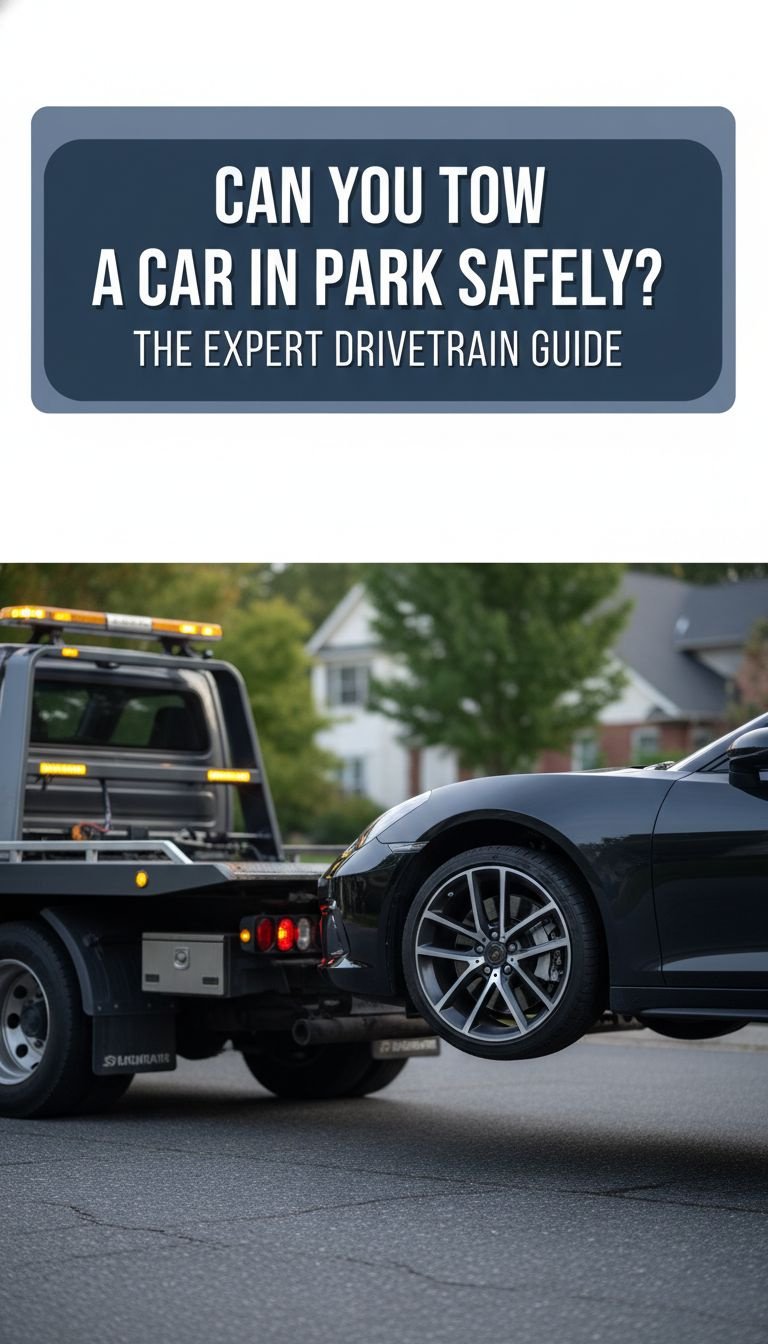
The primary concern when towing a vehicle stuck in Park is protecting its transmission, specifically a crucial component known as the Park Pawl. This small but vital metal locking finger, engaged when your car is in ‘P’, is designed to hold your vehicle stationary, not to withstand dynamic dragging forces. If a vehicle in Park is towed without lifting the drive wheels, the rotational force exerted will shear the park pawl, resulting in severe and costly transmission damage.
Industry standards confirm that zero dragging of drive wheels is the rule. Professional operators must ensure that any wheel connected to the locked transmission has no contact with the ground. Failure to follow this critical guideline can lead to extensive repairs, with the standard cost for park pawl and associated transmission damage typically ranging from $1,500 to $5,000. This financial risk makes proper towing procedures a non-negotiable safeguard.
What Mechanical Component Locks the Wheels in Park and Creates Risk?
The primary mechanical component that locks the wheels in Park and creates a significant risk during improper towing is the Park Pawl, a small, robust metal finger located inside the automatic transmission. This component engages with a notched gear (often called the parking gear) on the output shaft of the transmission. It effectively creates a static brake, preventing the output shaft from rotating and, consequently, locking the drive wheels.
The Park Pawl’s design is critical for understanding the risk. It is engineered for static holding, meaning it can keep the vehicle stationary under its own weight, even on an incline. However, it is not built to withstand dynamic, rotational forces. Imagine trying to stop a rotating tire with a single finger—that is essentially the immense load the park pawl handles when a locked car is dragged. When a vehicle in Park is towed with its locked drive wheels on the ground, the rotational force from the ground far exceeds the pawl’s static capacity. This torsion stress causes the metal pawl to shear off, often fracturing internal transmission components as well.
This catastrophic failure necessitates expensive replacement or, in many cases, a complete transmission overhaul. The Park Pawl is intentionally designed to be a sacrificial component. It is weaker than the larger planetary gearset and other internal gears. This design philosophy aims to protect the more complex and expensive parts of the transmission from damage by allowing the pawl to break first. However, its breakage still requires substantial repairs due to its embedded location within the transmission’s housing mechanism.
Why Is There an Emergency Neutral Release Mechanism on Some Cars?
Many modern vehicles include an Emergency Neutral Release mechanism, designed to manually shift the transmission into neutral even without the key or electrical power, specifically to facilitate safe towing. This crucial feature provides the easiest, non-damaging solution to the problem of a locked transmission, preventing the need for specialized equipment like dollies to bypass the Park Pawl.
The emergency neutral release is typically a small button, lever, or slot located near the shift console, often hidden under a small plastic cover. For instance, in many models, you might need a small tool, like a flathead screwdriver, to pop open a panel and access the release. Once activated, it temporarily overrides the electronic or mechanical lock. This allows the transmission to move into neutral, freeing the drive wheels to roll, and thus eliminating the risk of damage during towing. This mechanism is particularly helpful if your car’s battery is dead in Park, or if there is an ignition lock preventing normal gear changes. It is an immediate preventative action the owner can take before a tow operator arrives. Always check your owner’s manual now for the exact location and procedure of your vehicle’s neutral release mechanism.
How Does Your Car’s Drivetrain Type Determine Safe Towing Procedures?
Your car’s drivetrain type—Front-Wheel Drive (FWD), Rear-Wheel Drive (RWD), or All-Wheel Drive (AWD)/4-Wheel Drive (4WD)—is the most critical factor determining the safe towing procedures for a vehicle stuck in Park. Identifying your vehicle’s drive axle location is paramount to preventing catastrophic damage.
What are the Specific Towing Procedures for FWD Vehicles in Park?
For FWD (Front-Wheel Drive) vehicles stuck in Park, the front axle is the drive axle, meaning its wheels are locked by the Park Pawl, making it mandatory to lift them or place them on dollies during a tow. The rear wheels are non-drive wheels and can roll freely without risk of damage.
The two acceptable methods for towing a FWD vehicle in Park are:
- Lifting the Front Axle: A tow truck equipped with a wheel lift system can lift the entire front end of the vehicle, ensuring the locked front drive wheels are completely off the ground. The rear wheels then roll freely on the road.
- Using Towing Dollies on Front Wheels: If a wheel lift cannot fully lift the front, or if a standard tow truck is used, specialized towing dollies must be placed under the front drive wheels. This allows the locked wheels to rotate as if they were in neutral.
A frequent error is towing FWD vehicles by the rear, which causes the locked front wheels to drag—a mistake that must be avoided. This action will inevitably result in severe damage to the park pawl and the transmission. Always advise the tow operator to lift the front wheels or use dollies on them.
What Precautions Are Mandatory When Towing AWD or 4WD Vehicles in Park?
Towing AWD or 4WD vehicles stuck in Park requires extreme caution, as all four wheels are considered drive wheels and are linked through a complex system of differentials and a transfer case. Consequently, the non-negotiable rule is that all four wheels must be completely off the ground to prevent catastrophic damage.
If even one set of drive wheels remains on the ground while the vehicle is in Park, it will lead to severe binding of the transfer case. The transfer case, a component that distributes power between the front and rear axles, will attempt to equalize rotation when it shouldn’t, creating immense friction and heat. This can destroy the transfer case and multiple differentials, leading to repair costs that can easily exceed $8,000. This makes proper towing a non-negotiable financial choice.
Professional standards, including those from organizations like TRAA and WreckMaster, emphasize this “Golden Rule” of AWD towing: 0% road contact for all four wheels. Disconnecting the driveshaft is a complex and labor-intensive alternative, rarely performed by roadside assistance. Therefore, a flatbed tow truck is the universally recommended and safest method for AWD/4WD vehicles, or, failing that, the use of four specialized towing dollies to ensure zero ground contact. Never compromise on this critical precaution.
| Feature/Aspect | FWD (Front Wheel Drive) | RWD (Rear Wheel Drive) | AWD / 4WD (All Wheel Drive) |
|---|---|---|---|
| Axle Locked in Park | Front Axle | Rear Axle | Both Front & Rear Axles |
| Axle to Lift/Dolly | Front Drive Wheels | Rear Drive Wheels | All 4 Wheels (Mandatory) |
| Minimum Required Equipment | Wheel Lift + 2 Dollies (Front) OR Flatbed | Wheel Lift + 2 Dollies (Rear) OR Flatbed | Flatbed OR 4 Dollies (No exceptions) |
| Primary Risk of Improper Tow | Park Pawl/Transmission Shearing | Park Pawl/Transmission Shearing | Transfer Case Binding and Differential Destruction |
What Specialized Equipment Must Tow Operators Use for a Locked Vehicle?
To safely tow a car stuck in Park, professional tow operators must use specialized equipment that ensures the vehicle’s locked drive wheels have no contact with the ground or can rotate freely. This is crucial for avoiding expensive damage to the transmission’s park pawl, differentials, or transfer case. When quoting a tow, understanding which method offers the best balance of safety and cost for your situation is key.
Three primary pieces of equipment are used to safely tow a car in Park:
- Flatbed (Rollback) Truck: The Flatbed tow truck is universally recognized as the safest towing method for any vehicle stuck in Park or experiencing drivetrain issues. It completely lifts the entire vehicle onto a flat platform, eliminating all mechanical risk by ensuring zero road contact for all four wheels. While often a higher-cost option due to the specialized vehicle, it offers unparalleled safety for all vehicle types, especially AWD/4WD.
- Specialized Towing Dollies: These are small, independent wheeled platforms placed under the locked drive wheels. Dollies allow the locked wheels to rotate freely, effectively negating the Park Pawl’s effect and preventing stress on the transmission. They are typically rated for specific weights (e.g., 1,500 lbs per jack) and are a standard, safe procedure for FWD and RWD vehicles when a flatbed is not used.
- Go Jacks (or Towing Skates): Go Jacks are highly specialized retrieval tools, essentially self-loading dollies, used primarily for lateral movement in tight spaces. For example, if a car is stuck in Park and parallel parked too close to another vehicle, Go Jacks can lift all four wheels slightly and slide the car sideways, allowing it to be maneuvered out of the spot. However, Go Jacks are for short-distance maneuvering only and are not suitable for high-speed road towing; once the vehicle is clear, it should be transferred to standard dollies or a flatbed for transport.
| Feature/Aspect | Flatbed Towing (Rollback) | Wheel Lift + Dollies | Go Jacks / Skates (Maneuvering Only) |
|---|---|---|---|
| Safety Rating | Highest (Zero Risk) | High (If used correctly) | Moderate (Short distance/Lateral) |
| Vehicle Type Suitability | Universal (Mandatory for AWD) | FWD/RWD (Only on drive axle) | All Vehicle Types (Pre-tow positioning) |
| Primary Risk | None | Risk of operator error/misalignment | Not suitable for high-speed road towing |
| Approximate Cost | Higher (Due to specialized vehicle) | Moderate (Standard procedure cost) | Often included in standard service |

What Are the Risks of Improper Towing and Who Is Liable for Damage?
Improper towing of a car in Park poses significant mechanical risks, primarily to the transmission’s Park Pawl, differentials, and transfer case, resulting in severe and costly damage. The high stakes necessitate understanding the signs of damage, the financial implications, and the legal recourse available if you suspect your vehicle was negligently towed.
Signs of improper towing damage to a car in Park include immediate loud grinding or clunking sounds, difficulty engaging gears after the tow, and visible shearing or breaking of components near the transmission casing. Post-towing damage should be inspected by an ASE-certified mechanic. Warning signs include grinding or unusual mechanical noises when shifting or driving, oil leaks near the transmission casing, and physical evidence like tire drag marks or sheared metal fragments near the park spot. Document the damage, the tow truck ID, and the operator’s name immediately.
In cases of negligent towing, where a professional operator fails to use industry-standard equipment like dollies or a flatbed, liability for resulting transmission damage typically falls to the towing company or the property owner who authorized the tow. Industry analysis indicates that damage resulting from improper towing due to failure of the tow operator to use correct equipment is generally the liability of the towing company. If you heard a loud ‘pop’ during the tow, immediately refer to this damage inspection checklist. Consultation with an independent ASE-certified mechanic for damage verification is recommended, lending weight to the claims process. This process shifts from procedural guidance to risk management and post-event problem-solving, providing actionable steps for damage assessment and liability claims.
What Steps Should I Take to Document Improper Towing for a Liability Claim?
To successfully document improper towing for a liability claim, meticulous and immediate evidence collection is essential. This process involves gathering proof that an industry-standard procedure was not followed, directly leading to vehicle damage.
Here’s a step-by-step documentation strategy:
- Photograph Everything Immediately: Take clear photos and videos of your vehicle’s condition, focusing on the damaged areas (e.g., tire drag marks, fluid leaks, visible broken components). Include photos of the parking spot, the tow truck (license plate, company name, ID numbers), and the tow method used (e.g., if drive wheels were dragging).
- Record Details: Note the exact date, time, and location of the tow. Collect the name of the tow operator and the tow company. If witnesses were present, collect their contact information.
- Obtain Towing Invoice/Receipt: This document should detail the tow company’s information, the reason for the tow, and the method used.
- Seek Independent Mechanical Assessment: Have an independent, ASE-certified mechanic inspect the vehicle for damage, specifically focusing on the transmission, park pawl, and drivetrain components. Obtain a detailed written report and estimate of repairs. This report serves as crucial evidence.
- Contact Your Insurance Provider: Report the incident to your insurance agent, providing all collected evidence. They will guide you through the claims process.
- Review Manufacturer Guidelines: Consult your vehicle’s owner’s manual or manufacturer’s towing guide to confirm recommended towing procedures for your specific model and drivetrain type. This can help establish that proper procedures were violated.
Gathering this granular, specific evidence is time-sensitive and critical for any insurance adjuster or legal action you may pursue.
How Do Modern Electric Vehicles (EVs) Change Locked Vehicle Towing Requirements?
Modern Electric Vehicles (EVs) and hybrids introduce unique complexities and heightened risks when stuck in Park or experiencing a dead battery, requiring even more stringent towing precautions than traditional gasoline vehicles. This addresses a critical, emerging information gap in conventional towing guides.
Unlike conventional cars that rely on a mechanical Park Pawl, many EVs utilize an electronic locking mechanism, often integrated directly into the electric drive motor or differential. If an EV cannot be shifted into its specific ‘Tow Mode’ due to power loss, it must be towed exclusively via flatbed or with four wheel dollies, treating it strictly as an AWD vehicle. This “all wheels off the ground” rule is the universal standard for non-rolling EVs.
The primary concern with EVs is the sophisticated high voltage battery and regenerative braking systems. If a locked electric drive motor is dragged, it can inadvertently generate electricity (phantom regeneration) that overloads and damages the Battery Management System (BMS) or other sensitive electrical components. Vehicle manufacturers (OEMs) explicitly warn against two-wheel lifts for EVs in their service manuals due to this risk. Repair costs for such electrical system damage can be astronomical.
For the safest approach, always check the OEM manual for specific ‘Tow Mode’ release procedures. If these cannot be engaged due to power loss or malfunction, a flatbed tow truck is mandatory to ensure zero rotation of any drive components.
- Electronic Lock Mechanisms: Many EVs use an electronic lock via the electric drive motor, not a mechanical park pawl.
- Regenerative Braking Risks: Dragging a locked EV motor can induce phantom power generation, potentially damaging the Battery Management System (BMS) and other high-voltage components.
- Mandatory Flatbed or 4-Wheel Dollies: If ‘Tow Mode’ cannot be activated, all EVs must be transported with all four wheels completely off the ground. This prevents any rotation of the locked drive motors.
- Consult OEM Manuals: Always check the vehicle manufacturer’s specific towing guidelines, as they often include unique instructions for their EV models.
- Avoid Two-Wheel Lifts: Never tow an EV with only two wheels off the ground, as this puts immense stress on the locked motor and electrical system.
FAQs About can you tow a car in park
What Is The Approximate Cost To Repair a Broken Park Pawl?
The typical repair cost for a shattered park pawl and associated collateral damage inside the transmission ranges from $1,500 to $5,000 or more, depending on the vehicle’s make, model, and the extent of internal component destruction. This high cost emphasizes the financial necessity of using proper towing procedures like flatbeds or dollies to avoid damage in the first place.
Can a Manual Transmission Car Be Towed While Stuck In Gear?
No, towing a manual transmission vehicle while it is stuck in gear is mechanically equivalent to towing an automatic in Park, as the drive wheels are locked. This will also shear components and damage the transmission. A manual transmission car must be shifted into neutral, or the drive wheels must be lifted from the ground, or the driveshaft must be disconnected for safe long-distance transport.
Is it Ever Safe to Drag a Locked Vehicle a Very Short Distance (e.g., 10 feet)?
It is never advisable or professionally safe to drag a vehicle that is locked in Park, even for a few feet. While a very short drag might not break the park pawl entirely, it places immense, destructive torsion and stress on the component and its surrounding mechanical supports, significantly weakening the pawl and increasing the chance of failure later.
How Do Tow Trucks Retrieve Cars That Are Parallel Parked in Park?
Tow trucks use specialized equipment called Go Jacks or towing skates to retrieve parallel parked cars that are locked in Park. These hydraulic or mechanical devices are placed under all four wheels, lifting the car slightly and allowing the operator to maneuver the entire vehicle laterally away from the curb before deploying standard dollies or loading it onto a flatbed.
Does Insurance Cover Transmission Damage Caused By Improper Towing?
Generally, comprehensive auto insurance may cover physical damage caused by external events, which can include damage from improper towing, provided you can prove negligence. Coverage depends heavily on the circumstances (e.g., unauthorized versus emergency tow) and requires detailed evidence, such as independent mechanic damage reports, demonstrating the tow operator failed to follow professional standards.
What Is The Difference Between the Park Pawl and the Parking Brake?
The Park Pawl is a component inside the transmission designed for static mechanical holding, locking the drive wheels via the transmission output shaft. The Parking Brake is a separate, cable-operated system that typically engages the rear wheels only (regardless of drivetrain type) using the brake pads or shoes. Both must be addressed for safe towing if engaged, but the Park Pawl poses the greatest risk of catastrophic damage.
Key Takeaways: Towing a Car in Park Safely
- The Park Pawl is the Critical Risk: The ‘Park’ gear position is maintained by a small metal park pawl inside the transmission, designed only for static holding; dragging the car causes this component to shear and results in costly transmission failure.
- Conditional Towing is Mandatory: The safe towing procedure depends entirely on your Drivetrain Type: FWD requires the front axle lifted, RWD requires the rear axle lifted, and AWD/4WD requires all four wheels to be off the ground.
- Flatbed is the Safest Option: Flatbed tow trucks or the use of 4-wheel towing dollies (skates) are the only professional, risk-free methods for transporting a vehicle stuck in Park, as they eliminate all road contact for the locked drive wheels.
- Go Jacks Are for Retrieval, Not Towing: Specialized equipment like Go Jacks are used to maneuver a tightly parked or locked vehicle out of a spot (lateral movement) but must be replaced by standard dollies or a flatbed for long-distance transport.
- EVs Require Extreme Caution: Electric and hybrid vehicles must be treated as AWD/4WD, requiring a flatbed or four dollies, as dragging a locked motor can damage the sophisticated battery management and regenerative braking systems.
- Document Everything for Liability: If damage is suspected (grinding noise, difficulty shifting), immediately document the tow company ID and the method used, and seek an independent mechanical assessment to facilitate any potential insurance or liability claim.
- Check for Emergency Neutral Release: Before the tow operator arrives, always check your vehicle’s manual for the location of the manual neutral release mechanism, as engaging neutral eliminates the park pawl risk entirely and simplifies the tow.
Final Thoughts
Ultimately, safely towing a car stuck in Park is not a question of ‘if’ it can be done, but a strictly conditional matter of ‘how.’ The risks associated with ignoring the mechanical constraints of the Park Pawl are severe and costly, potentially resulting in thousands of dollars in transmission repairs. As an expert driver, your greatest defense against negligent towing—whether due to a breakdown or unauthorized removal—is knowledge. Always verify your vehicle’s drivetrain type (FWD, RWD, or AWD) and confirm that your tow operator will employ industry-standard, zero-contact solutions, such as Flatbed towing or Dollies, particularly when handling high-risk vehicles like AWDs or modern EVs. By proactively checking for the emergency neutral release and insisting on the correct equipment, you take control of the towing process and ensure your vehicle is protected against catastrophic, preventable damage. Use the checklists provided to secure your vehicle and, if necessary, prepare for a liability claim.
Last update on 2025-12-02 / Affiliate links / Images from Amazon Product Advertising API