
Has your car ever shut off completely while you were driving? It’s a frightening and confusing experience that demands an immediate answer.
You know a car battery is for starting the engine. So, how could it possibly be the cause of a stall on the road? This common question leads to a lot of diagnostic frustration.
Yes, a bad battery can cause a car to stall while driving, but this almost always happens when the alternator is also failing. This guide will explain why this happens and how to diagnose the real problem. You will learn the exact steps to safely find the true cause.
Key Facts
- Alternator is the Primary Power Source: Once the engine is running, the alternator, not the battery, provides the power for all electrical systems, as confirmed by automotive electrical theory.
- Critical Voltage Threshold: Modern Engine Control Modules (ECMs) require a minimum of approximately 10.5 volts to operate; industry data shows that dropping below this causes an immediate engine shutdown.
- Battery’s Role as a Buffer: The battery acts as a voltage stabilizer; a bad battery can’t buffer electrical loads, causing voltage drops that lead to a stall, especially if the alternator is weak.
- Typical Lifespan: Automotive service data indicates most car batteries should be proactively replaced every 3-5 years to avoid failures, as their internal chemical structure degrades over time.
- Stall After Jumpstart is a Key Symptom: A car that starts with a jump but stalls shortly after is a classic sign of a failed alternator, as the vehicle cannot run on its own power.
Can A Bad Battery Truly Cause A Car To Stall While Driving?
If your car started this morning, how could the battery possibly be the reason it stalled while you were driving? This is the core of a very common and dangerous misconception. The answer requires understanding the relationship between your car’s battery and its charging system.
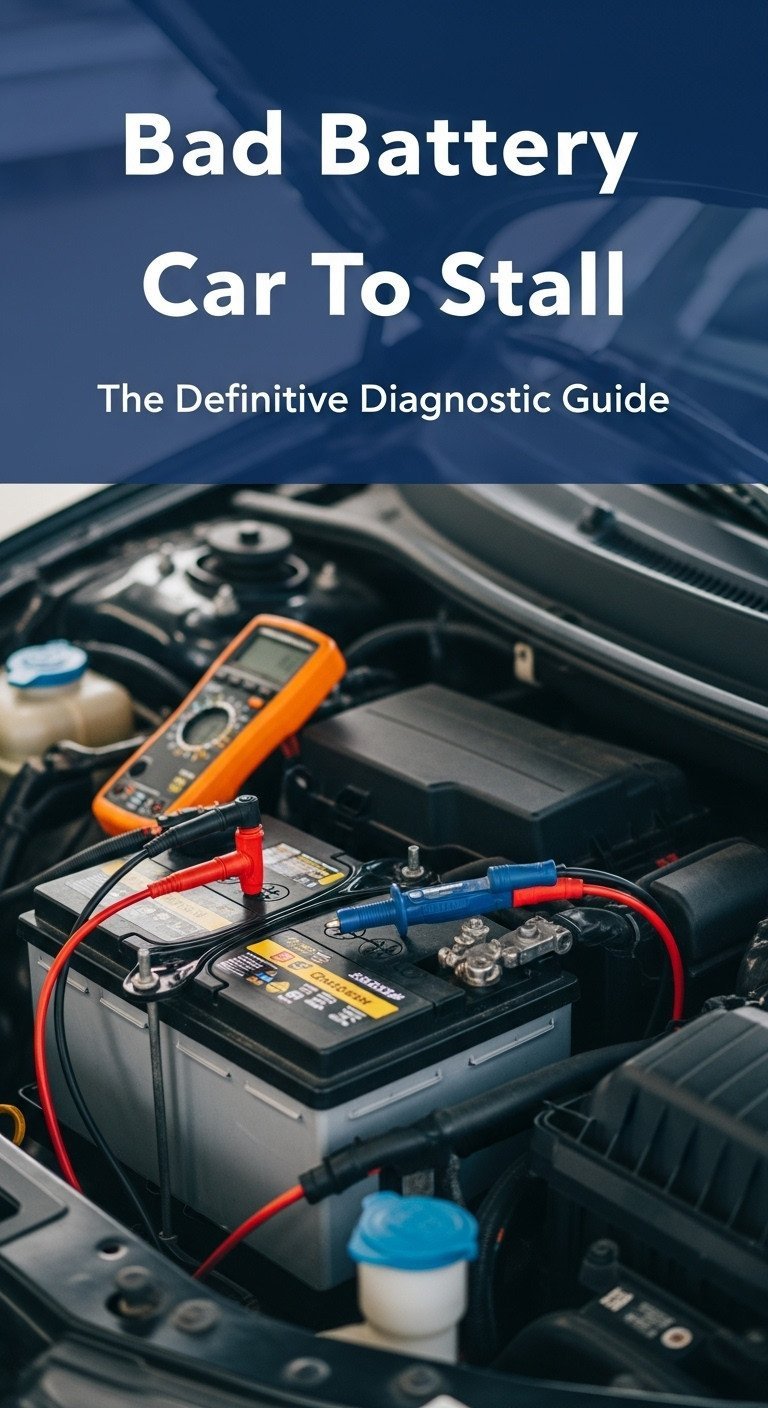
The Definitive Answer: Yes, a bad car battery can cause an engine to stall, but only when the vehicle’s alternator is also failing or is unable to maintain the minimum system voltage required by the Engine Control Module (ECM). The battery’s primary role is starting the car. The alternator’s job is to power the car while it’s running. If the alternator fails, the car runs solely on the battery’s reserve power until it’s depleted, leading to a stall.
Think of it this way: the battery [a temporary power reservoir] gets the engine started. Once running, the alternator [the engine-driven power generator] takes over, powering everything from your ignition system and fuel injectors to your radio and headlights, while also recharging the battery. A bad battery becomes the cause of a stall when it can no longer act as a stable voltage buffer for a struggling charging system.
What Critical Safety Warnings Must You Follow During Electrical Diagnosis?
Before you touch any component, you must understand the risks. Modern vehicle electrical systems are sensitive, and a simple mistake can lead to thousands of dollars in damage.
- Never Disconnect the Battery While Running: This is the most critical rule. An old-school “test” for alternators involved disconnecting the battery terminal while the engine was on. On a modern, computer-controlled car, this can cause an unregulated voltage spike that will instantly destroy the sensitive Engine Control Module (ECM) and other electronics.
- Wear Protective Gear: Always wear safety glasses and gloves. Car batteries contain corrosive acid, and even small sparks can ignite hydrogen gas emitted by the battery.
- Ensure a Stable Vehicle: Work on a flat, level surface with the parking brake engaged.
- Disconnect Negative First, Reconnect Last: When removing a battery, always disconnect the negative (-) terminal first. When reinstalling, connect the positive (+) terminal first. This prevents accidental short circuits.
The Core Electrical Theory: How Do Low Voltage Conditions Cause Engine Stall?
To truly understand why your car stalls, you need to think about electricity like the vehicle’s lifeblood. The entire system is a delicate balance of voltage and amperage, and when that balance is disrupted, critical systems shut down.
Think of the alternator as the main power plant for your car and the battery as its emergency backup generator. While the engine is running, the alternator should be producing a steady voltage, typically between 13.8 to 14.7 volts. This power runs all the car’s components—like the ignition system, fuel injectors, and onboard computers—and also recharges the battery.
The problem starts when the alternator fails. Its internal components, like the voltage regulator or diode rectifier assembly, can wear out. When this happens, the “main power plant” shuts down. The car is now forced to run entirely on the battery’s “backup” power. A healthy battery has a resting voltage of about 12.6 volts, but this voltage will drop rapidly as it powers the entire car.
Here’s the critical point: your car’s computer, the Engine Control Module (ECM), requires a stable system voltage to function. According to SAE standards and professional diagnostic data, this minimum threshold is typically 10.5 volts. Once the system voltage drops below this level, the ECM cannot properly power the ignition coils or fuel injectors, and it shuts down the engine to prevent damage. This shutdown is the stall you experience. A bad battery, with low reserve capacity, simply accelerates this process.
What Happens When The Alternator Fails While Driving?
If your alternator fails completely while you’re on the road, your car’s dashboard will almost certainly display a battery warning light. This light does not mean the battery is bad; it means the charging system is not working. From this moment, your car is running on borrowed time, powered only by the battery’s reserve capacity (RC).
A battery’s RC is a standardized metric that measures how many minutes it can supply 25 amps of power before its voltage drops too low. For a typical car battery, this provides about 30 to 60 minutes of driving time. This duration depends heavily on your battery’s health and the electrical load you’re using. To maximize this time and get to a safe location, you must immediately take action.
- Turn Off All Non-Essential Accessories: This includes the radio, air conditioning or heater, heated seats, and any charging devices.
- Minimize Light Usage: If it’s daytime, turn off your headlights. At night, use only your running lights if it is safe to do so.
- Find a Safe Place to Stop: Do not attempt to drive a long distance. The car will shut down without further warning once the battery is depleted, potentially in a dangerous location like an intersection or highway.
Continuing to drive is a significant safety risk. The vehicle will eventually die, and you will be stranded.
Differential Diagnosis: How Do Battery Vs. Alternator Failure Symptoms Compare?
Isolating the culprit between a bad battery and a failing alternator is the key to an accurate and cost-effective repair. Using observable symptoms, you can often make a highly accurate diagnosis before even picking up a tool. This comparison table breaks down the most common signs.
| Symptom/Test | Bad Battery | Bad Alternator (Primary Cause) | Intermittent Sensor (Mimic) |
|---|---|---|---|
| Starting Behavior | Slow, sluggish crank; may only click. | Starts normally; only fails to start if battery is already dead. | Starts normally, no cranking issue. |
| Warning Light | Often off, or flickers faintly. | Battery/ALT light (mandatory check) is illuminated. | Check Engine Light (CEL) often on with related codes. |
| Stall Context | Stalls immediately after jumpstart, or when high load (AC) is applied at idle. | Stalls while driving after 30-60 mins; rough idle followed by stall. | Stall is sudden, random, often restarts quickly. |
| Headlights/Accessories | Dim or flicker intensely during starting attempt. | Dim gradually while driving; all electrical systems weaken progressively. | Usually normal, unless voltage is extremely low due to secondary drain. |
| Key Voltage Check | Resting voltage below 12.4V. | Running voltage below 13.5V (especially under load). | Running voltage is often normal (13.8V-14.7V). |
Step-by-Step Troubleshooting: What Is The Definitive Diagnostic Checklist For Electrical Stalling?
Accurate diagnosis isn’t about guesswork; it’s about following a logical, step-by-step process of elimination. To do this correctly, you will need a basic digital multimeter. Remember, diagnosing electrical issues is a process of elimination; do not skip Step 1!

- Visual Inspection (The Basics First): Before any testing, perform a thorough visual check. Look for heavy corrosion (white or blue-green powder) on the battery terminals. Ensure the cable clamps are tight and do not move. Check the serpentine belt that drives the alternator; it should be tight and free of cracks or glazing. A loose belt can cause undercharging that mimics a bad alternator.
-
Test the Battery State of Charge (Open Circuit Voltage): With the car off for at least 30 minutes, set your multimeter to DC volts. Place the red probe on the positive (+) terminal and the black probe on the negative (-) terminal. A fully charged, healthy battery should read 12.6 volts or higher. A reading of 12.4V is about 75% charged, and anything below 12.2V indicates a significantly discharged battery that needs charging before further testing.
-
Test the Alternator Output (The Critical Test): This is the most important test for a stalling issue. Start the car and let it idle. Measure the voltage across the battery terminals again. A healthy alternator should be producing between 13.8 and 14.7 volts. If the reading is the same as the resting voltage (or lower), the alternator is not charging.
-
Perform the Alternator “Under Load” Test: A marginal alternator can pass the idle test but fail when it’s working hard. With the engine still running, turn on every major accessory: high beams, A/C or heater fan on high, radio, and rear defroster. The voltage should remain steady within the 13.5V to 14.7V range. If it drops below 13.5V, the alternator is failing under load.
-
Check for Parasitic Draw (Advanced): If the battery keeps dying but the alternator tests good, you may have a parasitic draw. This is an electrical component that stays on after the car is turned off, slowly draining the battery. Testing for this is more complex and involves measuring amperage draw in series with the battery disconnected. An acceptable draw is typically below 50 milliamps (0.05A).
How Do You Conduct A Safe And Accurate Alternator Output Test Under Load?
Simply checking the alternator’s voltage at idle isn’t enough. A failing alternator often shows its weakness only when the electrical demand is high, which is why the “under load” test is essential for an accurate diagnosis. Failing to perform this step can lead to a false positive, where you assume the alternator is fine when it’s actually the root cause.
Here is the exact procedure:
- Establish a Baseline: With the engine running at idle, confirm the initial charging voltage is within the normal range (13.8V to 14.7V).
- Apply Maximum Electrical Load: To simulate real-world stress, turn on multiple high-draw accessories simultaneously. The most effective combination is:
- Headlights on high beam.
- A/C or heater fan on the highest setting.
- Rear window defroster.
- Interior dome lights and radio.
- Measure the Loaded Voltage: With all these components running, re-measure the voltage across the battery terminals.
- Analyze the Results: A strong, healthy alternator will maintain a voltage reading above 13.5V, even under this heavy load. If the voltage drops significantly, for instance below 13.2V, or fluctuates wildly, the alternator’s voltage regulator or diode assembly is likely failing and cannot keep up with demand. As an expert insight, you can also set your multimeter to AC volts to check for ripple voltage; anything above 0.5V AC indicates a failing diode and an impending alternator failure.
Secondary Stalling Causes: What Other Issues Can Mimic A Battery/Alternator Stall?
What if your multimeter shows a perfect resting battery voltage and a solid 14.5V from the alternator, but the car still stalls randomly? In this case, you must pivot your focus from the charging system to electronic sensor failures, which can perfectly mimic an electrical stall.
- Failing Camshaft or Crankshaft Position Sensors: These are the two most common culprits. These sensors tell the Engine Control Module (ECM) the exact position and speed of the engine’s rotating parts, which is critical for ignition timing and fuel injection. When these sensors fail, they often do so intermittently, especially when hot. The ECM loses its timing reference and, as a safety measure, immediately shuts down the engine. This results in a sudden stall with no warning, but the car will often restart after it has cooled down for a few minutes. A key indicator for this issue is an illuminated Check Engine Light and specific Diagnostic Trouble Codes (DTCs) related to these sensors.
- Fuel Delivery Issues: A failing fuel pump or a faulty fuel pump relay can also cause a stall. While not a direct charging system issue, these components rely on stable voltage to operate. Low system voltage from a struggling alternator can cause the fuel pump relay to fail or the pump itself to underperform, leading to fuel starvation and a stall that appears electrical in nature.
Preventative Maintenance: How Can You Avoid Future Electrical Stalling Failures?
After resolving the immediate crisis, the focus should shift to proactive maintenance to prevent it from happening again. A healthy electrical system is built on three pillars: battery health, connection integrity, and system monitoring. Use this checklist every six months to ensure electrical system reliability.
- Replace Your Battery Proactively (3-5 Year Rule): Do not wait for a battery to fail. Automotive experts recommend replacing your car’s battery every three to five years. Over time, internal degradation reduces its ability to hold a charge and act as an effective voltage buffer, even if it still starts the car. This is especially true for modern AGM and EFB batteries found in start/stop vehicles.
- Keep Connections Clean and Tight: The most common source of electrical problems is high resistance at the battery terminals. Regularly inspect them for any signs of corrosion. Clean them with a terminal brush and a solution of baking soda and water. A professional standard for a clean connection is a resistance of less than 0.01 ohms.
- Check for Parasitic Draw: If you ever notice your battery seems weak after sitting for a few days, have a parasitic draw test performed. A healthy vehicle should have a draw of less than 50 milliamps (0.05A) after all modules have gone to sleep. Anything higher indicates a fault that will shorten your battery’s life and could leave you stranded.
FAQs About can a bad battery cause a car to stall
If I replace the battery and the car still stalls, what should I check next?
The next crucial step is a detailed diagnosis of the charging system, focusing primarily on the alternator’s output and belt tension. If the system voltage is not consistently between 13.8V and 14.7V while the engine is running, the new battery will quickly deplete and lead to another stall. You must also check for intermittent sensor failures like the Camshaft or Crankshaft Position Sensors.
Can low battery voltage trigger a Check Engine Light (CEL) for unrelated components?
Yes, low system voltage frequently triggers misleading Diagnostic Trouble Codes (DTCs). Components like oxygen sensor heaters or transmission solenoids may momentarily lose sufficient power, logging a fault code even though the component itself is healthy. Always verify the charging system voltage is stable before chasing non-electrical codes after a stall.
How do I know if the stall was caused by the battery or fuel starvation?
An electrical stall often provides warning signs like dimming lights, a sluggish idle, or an illuminated battery/ALT light before the sudden shutdown. A fuel starvation stall, in contrast, is typically characterized by hesitation, sputtering, or rough running that precedes the engine dying, often without any electrical system warnings.
Why does my car start fine but immediately stall right after?
Immediate stalling, especially after a jumpstart, is a classic sign that the alternator is completely non-functional. The engine starts using the energy from the jump or the battery’s surface charge but cannot continue to run without the alternator supplying power to critical components like the fuel pump, ignition system, and the car’s computer (ECM).
Is it safe to try driving home after my car has stalled due to electrical issues?
No, driving after an electrical stall, particularly if the battery warning light is on, is a significant safety hazard and is strongly discouraged. The car is running on a very limited reserve of battery power. You risk the vehicle dying again suddenly in traffic, which could lead to an accident or cause expensive damage to your car’s electronics.
Key Takeaways: Bad Battery Cause Car To Stall Summary
- The Answer is Qualified: A bad battery alone rarely causes a stall; it only happens when the alternator fails to supply power, causing the system voltage to collapse.
- Voltage Stability is Critical: The Engine Control Module (ECM) requires a minimum of approximately 10.5V to remain operational; voltage dropping below this threshold is the direct electrical cause of the stall.
- Alternator Failure is the Primary Culprit: If your car starts but stalls while running, the alternator is the most likely failure point, as it is responsible for powering the electrical systems when the engine is on.
- Safety First: Never perform the dangerous diagnostic test of disconnecting the battery while the engine is running on a modern car, as the resulting voltage spike can permanently damage the ECM.
- Diagnosis Requires a Multimeter: Accurate troubleshooting involves measuring the Open Circuit Voltage (OCV) of the resting battery and, crucially, testing the alternator’s output under load (13.8V to 14.7V required).
- Sensor Failure Mimics Electrical Issues: If the battery and alternator test perfectly, pivot your diagnosis to electronic sensors like the Camshaft or Crankshaft Position Sensors, which cause engine shutdown when they lose their critical electrical signal.
- Replace Proactively: Prevent future stalling issues by replacing your battery every 3-5 years and routinely checking connections for corrosion, ensuring low resistance (<0.01 ohms).
Final Thoughts on Electrical System Stalling
The confusion surrounding whether a bad battery can cause a car to stall is a common and urgent diagnostic challenge. As this definitive guide has established, while the battery itself is not the running power source, its integrity as a voltage buffer is essential, making the alternator’s health the primary determinant in a running stall scenario. Accurate troubleshooting relies on moving past quick assumptions and applying rigorous, safe diagnostic procedures, such as the loaded voltage test, to pinpoint the failure—be it a depleted battery, a failing alternator, or a secondary sensor issue affected by poor voltage stability. By adhering to the precise voltage thresholds and the step-by-step checklist detailed here, you empower yourself to achieve an accurate diagnosis, prevent costly misrepairs, and restore your vehicle’s reliability and safety. If the diagnostic steps reveal complex wiring issues or if the stall involves multiple warning lights, consulting an ASE-certified technician is the safest and most reliable next step. Ensure your vehicle’s electrical heart—the charging system—is healthy to prevent the high-risk scenario of stalling while driving in 2025.
Last update on 2025-12-02 / Affiliate links / Images from Amazon Product Advertising API


