
Navigating the rules for sleeping in your car in Ohio can feel confusing. You’re likely trying to find a clear answer to avoid a fine, a trespassing charge, or worse, a DUI, and need to know the real rules.
In Ohio, there is no statewide law that prohibits sleeping in your car, making it generally legal on a state level. However, this permission is often superseded by local municipal ordinances, which can ban overnight parking on city streets or in public lots. Legality ultimately depends on your specific location and local rules.
This guide, based on a careful analysis of the Ohio Revised Code and official Ohio Department of Transportation (ODOT) policies, will clarify the critical difference between state law and local restrictions. You will learn exactly where it’s safe to park overnight and the steps you must take to avoid a “physical control” DUI charge, even while sleeping.
Key Facts
- State-Level Legality: Ohio state law does not have a specific statute making it illegal to sleep in a vehicle, demonstrating a state focus on managing motorist fatigue for road safety.
- Local Ordinances Override: Ohio’s “Home Rule Authority” grants individual cities the power to create their own local ordinances that are stricter than state law, often banning overnight parking or vehicle habitation.
- Primary Safe Haven: State-run ODOT highway rest areas are the most legally secure places for short-term rest, a fact supported by official state response and documented rules.
- DUI Risk is Real: Under Ohio Revised Code 4511.194, you can be charged with an OVI (DUI) for being in “physical control” of a vehicle while impaired, even if you are asleep and not driving.
- Private Property Requires Consent: Sleeping on any private land, including commercial lots like those at Walmart, is considered trespassing without getting explicit permission from the property owner first.
Is It Legal to Sleep in Your Car in Ohio?
The official state response is that it is generally legal to sleep in your car in Ohio, but this comes with significant exceptions. At the state level, Ohio law does not have a specific statute making it illegal to sleep in your vehicle. This permissive stance is largely aimed at promoting driving safety and fatigue management, allowing tired motorists to pull over and rest.
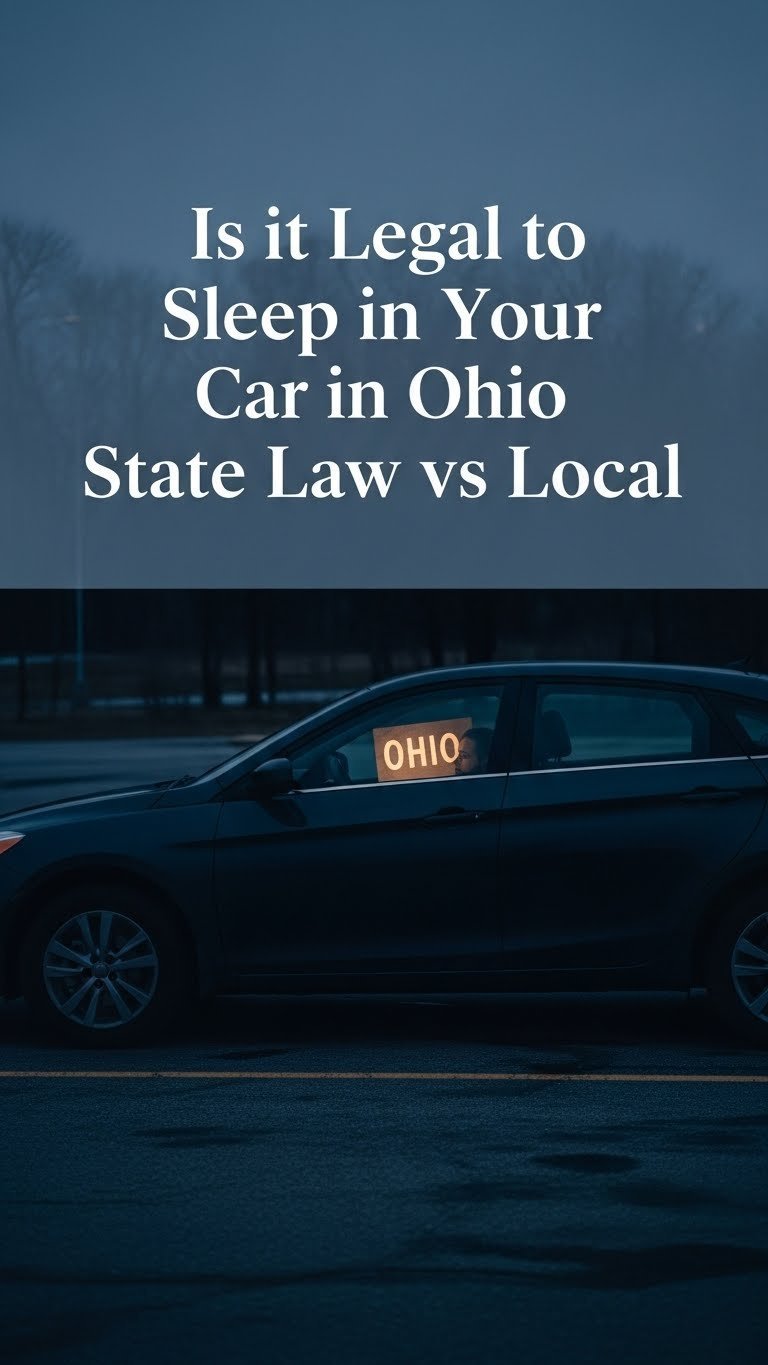
However, this is where the simple answer ends and the crucial complexity begins. The primary challenge is the conflict between state-level permission and local-level restrictions. Individual cities and municipalities in Ohio have the power to create their own ordinances that may prohibit overnight parking or sleeping in vehicles on city streets or in public lots.
The core principle to understand is this: While the state of Ohio doesn’t forbid it, your local city almost certainly restricts it. This means the legality of sleeping in your car changes drastically from a state highway rest area to a city street just a few miles away.
This legal gray area means you must always be aware of your specific location. Assuming it’s okay everywhere because there’s no state law is a fast track to a parking ticket, a trespassing citation, or an unwanted knock on your window from law enforcement in the middle of the night.
Where Can You Legally and Safely Sleep in Your Car in Ohio?
Finding a secure and legal spot is the most important part of sleeping in your car. Based on practical experience and documented rules, your options vary widely in terms of safety and legal risk. The best approach is to evaluate each location type carefully.
ODOT Highway Rest Areas
These are your safest and most legally sound option. The Ohio Department of Transportation (ODOT) [an entity that manages state transportation infrastructure] operates these facilities specifically for motorists to rest and combat fatigue. While not intended for long-term stays, they are designed for short-term rest.
- Legality: Generally permitted for short-term rest.
- Safety: Usually well-lit and patrolled by the State Highway Patrol.
- Risk: Low, as long as you adhere to unwritten time limits (typically a few hours) and don’t set up camp.
Private Property (With Permission)
This includes places like a friend’s driveway, a church parking lot, or a rural farm. The key here is one simple word: permission. Without explicit consent from the property owner, you are trespassing, which is a criminal offense.
- Legality: Perfectly legal with the owner’s consent.
- Safety: Varies depending on the location and property owner.
- Risk: Low with permission; high without it. Expert traveler tips suggest getting permission in writing (even a text message) if possible.
Commercial Lots (e.g., Walmart, 24-Hour Gyms)
Many travelers ask, “Can I sleep in my car at Walmart in Ohio?” The answer is not a legal right; it’s a store-by-store policy. Some managers may allow it, but many have stopped due to local city ordinances or problems with long-term stays. Never assume it’s okay.
- Legality: Depends entirely on the store manager’s policy.
- Safety: Generally safer in well-lit, 24/7 locations but still private property.
- Risk: Medium. You risk being asked to leave or ticketed for trespassing if you haven’t confirmed permission.
Public Streets & Residential Areas
This is the highest-risk option and is generally not recommended. Almost all cities and towns have local ordinances prohibiting overnight parking on public streets or have time limits that make it impossible to stay for an extended rest. Parking in a residential area often leads to calls to the police from concerned neighbors.
- Legality: Often prohibited by local municipal codes.
- Safety: Low. You are exposed and may attract unwanted attention.
- Risk: High. This is where most tickets for illegal parking are issued.
Location Comparison Table
To simplify your decision, here’s a breakdown of your options:
| Location Type | State-Level Legality | Local Ordinance Risk | Key Considerations |
|---|---|---|---|
| ODOT Rest Areas | Generally Permitted | Low | Subject to time limits (e.g., 4-8 hours); check signage. |
| Public Streets | Varies (No State Ban) | High | Often prohibited by local ordinances (parking limits, no overnight). |
| Private Property (with permission) | Legal with Consent | Low | Must have explicit, documented permission to avoid trespassing. |
| Commercial Lots (e.g., Walmart) | Depends on Store Policy | Medium | Not a legal right; policy varies by manager. Always verify. |
How Do Local City Ordinances Affect Car Sleeping Laws in Ohio?
The most critical concept to understand is Ohio’s “Home Rule Authority.” This legal principle, granted by the state constitution, gives individual cities like Columbus, Cleveland, and Cincinnati the power to create their own local laws that can be much stricter than state law. Think of Ohio’s state law as the general house rules, but Home Rule lets each city set specific, stricter rules for its own room.
This is precisely why sleeping in your car can be permitted at a state-run rest stop on the highway but illegal on a city street just a few miles away. Cities use this power to pass ordinances related to:
- Overnight Parking Bans: Many cities prohibit parking on any public street for more than a few hours between 2 a.m. and 6 a.m.
- Vehicle Habitation: Some municipal codes explicitly outlaw using a vehicle as a “dwelling” or for “habitation.”
- Loitering and Vagrancy: While less common now, old loitering statutes can sometimes be used to ticket individuals lingering in public areas, including a parked car.
Because these rules are hyper-local, you must always check the municipal code for the specific city you plan to stay in. This is the only way to be certain you are not breaking a local law.
Can You Get a DUI for Sleeping in Your Car in Ohio?
Yes, you can absolutely get a DUI (known as an OVI in Ohio) for sleeping in your car if you are intoxicated. This is one of the most serious and misunderstood risks. The charge is not for driving, but for being in “physical control” of the vehicle while impaired.
The relevant statute is Ohio Revised Code 4511.194, which defines this offense.
“Physical Control” [a legal concept defined in ORC 4511.194] means being in the driver’s position of the front seat of a vehicle or in the driver’s position of a streetcar or trackless trolley and having possession of the vehicle’s, streetcar’s, or trackless trolley’s ignition key or other ignition device.
In simple terms, if you are in the driver’s seat with the keys accessible (in your pocket, in the ignition, or on the passenger seat), you are considered to be in “physical control.” If you are also over the legal alcohol limit, you can be arrested and charged, even if the car is off and you are sound asleep.
How to Avoid a Physical Control Charge
Based on legal expert advice and court case precedents, taking specific, clear steps can protect you. If you have been drinking and need to sleep in your car, you must demonstrate you had no intention or ability to drive.
- ✅ Move to the Back Seat: Never sleep in the driver’s seat. Moving to the passenger or back seat shows you are not in a position to operate the vehicle.
- ✅ Secure the Keys: Place your keys far from your person. The best practice is to put them in the trunk, a locked glove box, or even outside on top of a tire. The further away the keys are, the weaker the “physical control” argument becomes.
- ✅ Do Not Turn the Car On: Do not start the engine for heat or A/C. An running engine is strong evidence of control.
- ✅ Park Legally: Ensure you are parked in a location where it is legal to be. An officer investigating an illegal parking job is more likely to discover your impairment.
What Are the Official Rules for Ohio Rest Areas?
The Ohio Department of Transportation (ODOT) permits motorists to use its highway rest areas for short-term rest to combat driver fatigue. These locations are your most reliable and legally sound choice for an overnight nap.
While there is no single, statewide time limit posted on a sign at every location, the purpose is clear: safety, not lodging. Based on documented rules and enforcement by the Ohio State Highway Patrol, here is what you need to know:
- Purpose for Rest: Rest areas are for “safety and rest.” The primary goal is to prevent drowsy driving accidents.
- Time Limits: While not officially posted, the unwritten rule is that stays are for short-term rest. A stay of 4-8 hours to get a full night’s sleep is generally tolerated. Setting up for multiple days will attract attention.
- Parking: Always park in designated car parking areas. Do not park in spots reserved for commercial trucks, as those drivers have legally mandated hours-of-service rest requirements.
- Prohibited Activities: Camping is strictly forbidden. This means no tents, no outdoor fires, and no setting up outdoor chairs or cooking equipment. Sleeping inside your vehicle is allowed.
- Enforcement: Rest areas are patrolled by the State Highway Patrol. Their main concern is safety and ensuring the facilities are used as intended. If you are not causing a problem, they will likely not disturb you.
Amenities at a typical Ohio rest area usually include 24/7 restrooms, vending machines, and picnic areas. They are generally well-lit and have separate parking for cars and trucks, making them a relatively safe environment.
What Are the Key Safety and Preparation Tips for Sleeping in Your Car?
Beyond the law, staying safe and comfortable is essential. Seasoned travelers recommend focusing on three key areas: security, comfort, and discretion.
🔐 Vehicle Security
- Lock All Doors: This is the simplest and most important step. Make it a habit the moment you settle in.
- Cover Your Windows: Use sunshades, curtains, or even dark fabric to block the view inside. This provides privacy and prevents people from seeing you or your belongings.
- Choose a Well-Lit Area: If you are at a truck stop or commercial lot, park under a light. This deters potential thieves.
- Trust Your Gut: If a location feels unsafe, leave and find another spot.
🌡 Comfort and Climate Control
- Ventilation is Key: Crack a window or two slightly, even in the cold. This prevents condensation buildup and ensures a steady supply of fresh air. Never sleep in a fully sealed car.
- Layer Up: It gets colder than you think inside a car. Use a quality sleeping bag, wool blankets, and wear layers of clothing (like thermal underwear and a beanie) to stay warm.
- Never Run the Engine: Do not run the engine for heat or A/C while you sleep. The risk of carbon monoxide poisoning from an exhaust leak is deadly. It also attracts unwanted attention.
🙈 Discretion and “Stealth”
- Arrive Late, Leave Early: The best practice is to arrive at your spot after dark and leave around sunrise. This minimizes the time you are noticed.
- Be Prepared: Have your car ready for sleep before you arrive. Don’t spend 20 minutes in a parking lot visibly arranging blankets and pillows.
- Keep it Clean: A car overflowing with belongings screams “I live here” and attracts negative attention. Keep your interior tidy.
- Communicate Your Plans: Always let a friend or family member know your general location and plans as a safety precaution.
FAQs About is it legal to sleep in your car in ohio
Is it illegal to sleep in your car in Columbus, Cleveland, or Cincinnati?
Yes, in many cases, it is effectively illegal due to specific city ordinances against overnight parking or vehicle habitation. These major cities use their “Home Rule Authority” to enforce stricter rules than the state. For example, Columbus has ordinances that can be used to prohibit overnighting in a vehicle. You must check the current municipal code for the specific city you are in.
Can I sleep in my car at a Walmart in Ohio?
It depends entirely on the individual store’s manager and their policy, as it is private property. There is no universal “yes” or “no” answer. Many Walmarts, especially in urban areas, now prohibit overnight parking to comply with local ordinances. The only way to know for sure is to call ahead or go inside and get explicit permission from management to avoid being ticketed or towed.
What happens if a police officer finds me sleeping in my car?
The outcome depends on your location, your condition, and the officer’s discretion. If you are at a legal spot like an ODOT rest area and are not impaired, they may just check on your welfare and leave. If you are parked illegally or on private property without permission, you will likely be asked to move and could be ticketed for parking or trespassing. If they suspect impairment, they will investigate for an OVI.
Is sleeping in your car considered trespassing in Ohio?
Yes, it is absolutely considered trespassing if you are on any private property without the owner’s explicit consent. This includes the parking lots of malls, grocery stores, gyms, and businesses. To be legally safe on private land, you must have documented permission from the property owner or an on-duty manager.
How long can you legally stay at an Ohio rest area?
There is no single, officially posted statewide time limit, but stays are intended for short-term rest. The unwritten guideline, enforced by the State Highway Patrol, is typically a few hours to get enough rest to resume driving safely. Stays that appear to be longer-term, such as beyond 8-10 hours, may attract law enforcement attention.
Can you live in your car in Ohio?
While not explicitly illegal at the state level, living in your car long-term is practically impossible in Ohio due to local laws. Nearly all municipalities have ordinances against vehicle habitation, loitering, or indefinite parking that would lead to constant fines and legal trouble. Rest stops and public areas cannot be used for permanent residency.
Is it legal to sleep in my car on a residential street?
It is generally illegal and highly discouraged. Most residential areas have local ordinances that restrict on-street parking to a few hours, prohibit overnight parking entirely, or specifically forbid using a vehicle as a dwelling. This activity is highly visible to residents and is very likely to result in a call to the police.
Can I sleep in my car with the engine running for heat or AC?
While not illegal in a proper location, this is extremely dangerous and not recommended. The primary risk is fatal carbon monoxide poisoning if your exhaust system has a leak or becomes blocked by snow or debris. It also wastes fuel and attracts attention. It is far safer to use appropriate bedding like sleeping bags and blankets for temperature control.
What is the difference between sleeping and “habitation” in a vehicle?
The distinction is based on duration and intent as interpreted by law enforcement. “Sleeping” is seen as a temporary act to rest before continuing a journey. “Habitation” implies using the vehicle as a dwelling, often indicated by staying in one spot for multiple days, having extensive personal belongings, or cooking. Local city ordinances are much more likely to prohibit habitation.
If I’m too tired to drive, is it better to pull over and sleep than risk an accident?
Absolutely. From a safety perspective, it is always better to stop and rest than to drive while fatigued. Drowsy driving is a major cause of serious accidents. The key is to find a legal and safe place to do so. Your best options are an official ODOT rest area or a 24-hour truck stop. If you must pull over immediately, choose a well-lit, public spot, but be prepared to potentially be asked to move.
Final Thoughts
Navigating the legality of sleeping in your car in Ohio requires understanding one central theme: the law changes with your location. While the state is permissive to prevent tired driving, local governments are restrictive to manage public spaces. Your right to rest in your vehicle is not guaranteed and is heavily dependent on municipal rules.
The safest, most responsible approach is to be proactive. Always aim for designated ODOT rest areas for short-term rest. For any other location, especially private property like a Walmart lot, getting explicit permission is not a suggestion—it is a legal necessity to avoid trespassing. Finally, the risk of a “physical control” DUI is severe and real; take every precaution if you have been drinking. By prioritizing legal locations and safety, you can rest without worrying about a knock on the window.


![What Car Is Chevy Bringing Back in [year]? New Lineup Revealed](https://carxplorer.com/wp-content/uploads/2026/01/What-Car-Is-Chevy-Bringing-Back-in-year-New-Lineup-Revealed-1-1-60x60.jpg "What Car Is Chevy Bringing Back in [year]? New Lineup Revealed 9")
