
Wondering how much to send a car to Puerto Rico? You’re likely trying to budget for all the costs, not just the shipping quote, and the details can feel overwhelming. This is a common challenge for those relocating.
Shipping a car from the U.S. to Puerto Rico generally costs between $1,200 and $3,300. This estimate is for a standard sedan using Roll-on/Roll-off (RO/RO) shipping from a major port like Jacksonville, FL. The final price is influenced by vehicle size, shipping method, season, and does not include Puerto Rico’s separate excise tax.
Based on an analysis of real-time shipping data and industry-standard rates, this guide breaks down every expense. You will discover the seven key factors that determine your price. We will also cover how to calculate and pay the mandatory Hacienda tax, a critical step most guides overlook.
Key Facts
- Base Shipping Cost: The typical port-to-port shipping cost for a standard car from the U.S. mainland to Puerto Rico ranges from $1,200 to $3,300, based on aggregated data analysis.
- Mandatory Excise Tax: All vehicles are subject to a separate Puerto Rico excise tax (Hacienda tax), which is not included in any shipping quote and can add hundreds or thousands of dollars to the total expense.
- Departure Port is Key: Shipping from Jacksonville, Florida, is the most common and cost-effective route, with research indicating significantly higher costs from Texas or California ports due to distance.
- RO/RO Method is Standard: The most common shipping method, Roll-on/Roll-off (RO/RO), requires your vehicle to be completely empty of personal belongings for safety and customs compliance.
- Original Title is Non-Negotiable: You must have the original Certificate of Title for the vehicle. Industry standards and customs regulations do not permit copies.
How Much Does It Cost to Send a Car to Puerto Rico?
The base cost to ship a car from the US mainland to Puerto Rico typically falls between $1,200 and $3,300 for a standard-sized sedan. This price generally covers port-to-port ocean freight using Roll-on/Roll-off (RO/RO) service, which is the most common and economical method. However, this is just the starting point; your final cost will be higher once other essential factors are included.
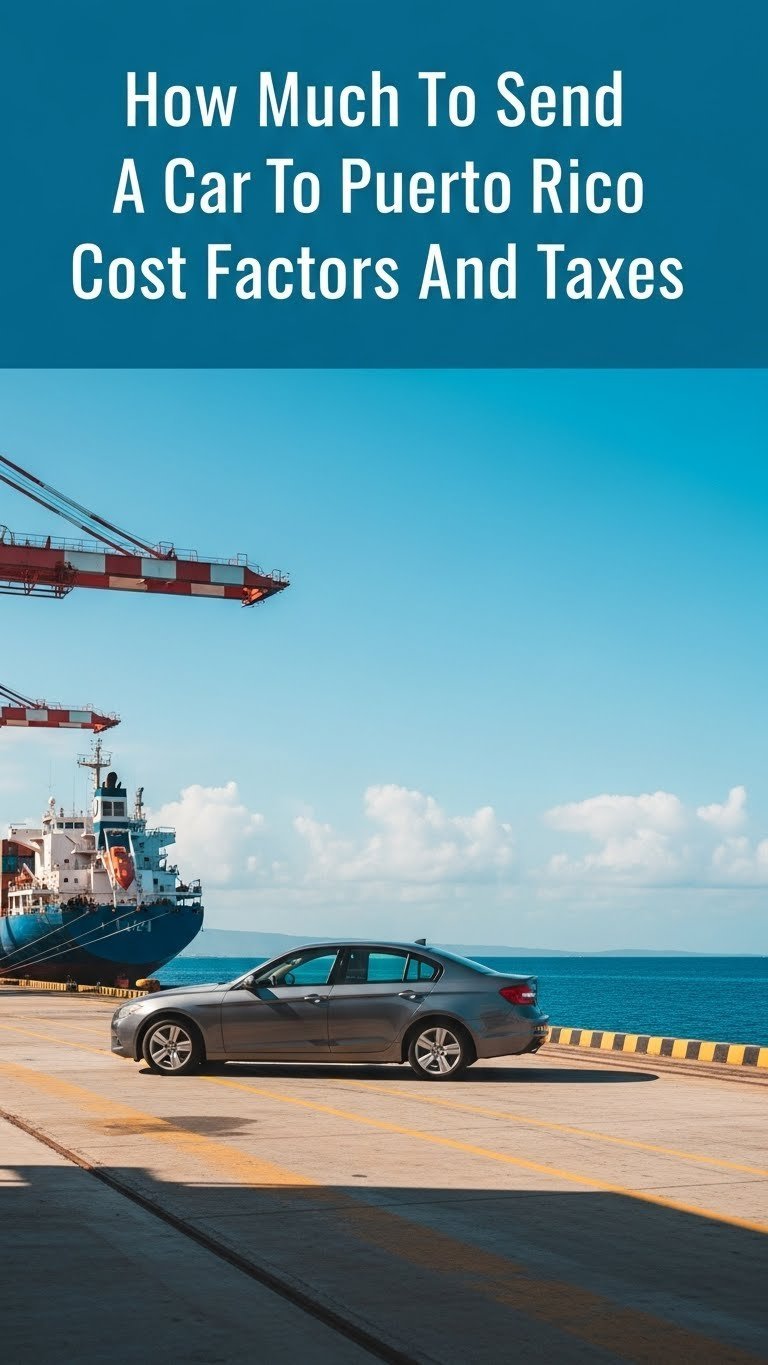
The port you ship from has the largest impact on your base rate. Shipping from Jacksonville, FL, is the most direct and affordable route. As you move further away, costs increase due to logistical complexity and distance. These estimates for 2026 do not include the mandatory Puerto Rico excise tax, insurance, or ground transport to the departure port.
Here is a breakdown of estimated costs to give you a clearer picture.
| Departure Region | Vehicle Type | Estimated Cost Range | Estimated Transit Time |
|---|---|---|---|
| Jacksonville, FL (East Coast) | Sedan | $1,200 – $1,900 | 5-7 Days |
| Houston, TX (Gulf Coast) | Sedan | $1,800 – $2,500 | 7-10 Days |
| Long Beach, CA (West Coast) | Sedan | $2,600 – $3,300+ | 12-15 Days |
| Jacksonville, FL (East Coast) | SUV/Truck | $1,500 – $2,300 | 5-7 Days |
What Are the 7 Key Factors That Determine Shipping Costs?
The primary factors that determine your total car shipping cost are your vehicle’s size, the shipping method, departure port distance, seasonality, carrier choice, insurance, and fuel surcharges. Understanding these variables helps you see why quotes can vary so much and where your specific shipment will fall on the price spectrum. These elements are what move the price from a base estimate to your final, all-in cost.
1. How Does Vehicle Size and Condition Impact the Price?
Vehicle shipping rates are calculated based on total volume (cubic feet), so larger vehicles like SUVs, minivans, and trucks cost more than standard sedans. Carriers use the exterior dimensions (length x width x height) to determine how much space your vehicle occupies on the vessel. In our experience, shipping a full-size SUV can cost 25-40% more than a mid-size sedan.
The vehicle’s condition also plays a critical role.
* Operable Vehicles: These can be driven onto the ship under their own power. This is the standard procedure and is included in the base rate.
* Inoperable Vehicles: A car that cannot start or move requires special handling. Port workers must use a forklift or winch to load it, which can add $250 to $500 or more in fees. You must declare if your vehicle is inoperable when booking.
2. Shipping Method (RO/RO vs. Container)
The choice between Roll-on/Roll-off and container shipping is a balance of cost and security. RO/RO is the budget-friendly standard, while a container offers maximum protection for a higher price. We will explore this choice in detail later.
3. Departure Port Location
As shown in the table above, distance is a primary cost driver. A shipment from Jacksonville, FL, travels a shorter ocean route than one from Houston, TX, or Long Beach, CA. The longer the journey, the more fuel and time are required, directly increasing the freight charges.
4. Seasonality
Like any other form of transport, vehicle shipping has peak and off-peak seasons. The summer months are typically the busiest time for moves to Puerto Rico, leading to higher demand and increased rates. Booking during the fall or early spring can sometimes result in lower costs.
5. Carrier and Transit Time
Major carriers serving the Puerto Rico route, such as Crowley and TOTE Maritime, have their own pricing structures and vessel schedules. While their rates are competitive, differences in transit times and service levels can affect the overall price. Faster transit times may sometimes come at a premium.
6. Marine Insurance Coverage
The basic liability coverage included by carriers is very limited, often only covering cents on the dollar for total loss. To protect your vehicle’s full value against damage or loss during transit, purchasing a separate marine insurance policy is highly recommended. This typically costs 1.5% to 2.5% of your vehicle’s declared value.
7. Fuel Surcharges (BAF)
Ocean freight costs are subject to a Bunker Adjustment Factor (BAF). Think of this like the fuel surcharge airlines add to your ticket. It fluctuates with global oil prices. When fuel costs rise, carriers pass that increase on through the BAF, which can add to your final bill.
How Do You Calculate the Mandatory Puerto Rico Excise (Hacienda) Tax?
All vehicles shipped to Puerto Rico are subject to a mandatory excise tax, which must be paid to the Puerto Rico Department of Treasury (Hacienda) before you can retrieve your car. This tax is completely separate from your shipping quote and can be a significant expense, ranging from a few hundred to many thousands of dollars.
From our experience as logistics coordinators, this is the step that surprises people the most. Failure to plan for it causes major delays and extra fees.
⚠️ WARNING: Your shipping company cannot release your vehicle at the Port of San Juan until you provide proof that the Hacienda excise tax has been paid. Failure to pay on time results in significant daily storage fees.
The tax is not based on your purchase price but on the vehicle’s taxable value, determined by Hacienda using valuation guides like Kelley Blue Book or NADA guides. The percentage is then applied based on this value and the vehicle’s age.
Here is a simplified step-by-step process for handling the tax:
- Gather Vehicle Information: You will need your car’s Vehicle Identification Number (VIN), make, model, year, and estimated value.
- Create an Account on SURI: The tax is calculated and paid online through Hacienda’s official portal, called SURI (Sistema Unificado de Rentas Internas). You will need to register for an account.
- Enter Your Vehicle Details: In the SURI portal, navigate to the vehicle import section and enter your car’s information. The system will automatically calculate the excise tax due.
- Make the Payment: You can pay the tax directly through the SURI portal using a credit card or bank transfer.
- Save the Voucher: Once paid, you will receive a payment confirmation and a voucher (Comprobante). You must present this digital or printed voucher at the port to prove the tax has been paid and get your car released.
RO/RO vs. Container Shipping: Which Method is Right for Your Vehicle?
The two main ways to ship a car to Puerto Rico are Roll-on/Roll-off (RO/RO) and container shipping. RO/RO is the most common and cheapest method, where your vehicle is driven onto the vessel like a ferry. Container shipping is more expensive but offers higher security inside a locked steel container and is the only method that may allow you to ship personal items.
Choosing the right one depends on your budget, vehicle type, and whether you need to transport other goods. Here is a direct comparison to help you decide.
| Feature | Roll-on/Roll-off (RO/RO) | Enclosed Container Shipping |
|---|---|---|
| Cost | Cheapest Option. Priced per vehicle. | More expensive (often 30-60% more). |
| Security | Secure, but exposed to elements on deck. | Highest security. Locked in a steel box. |
| Personal Items | Strictly Prohibited. Car must be empty. | Allowed, but with restrictions and declarations. |
| Departure Frequency | High. Most common service. | Less frequent sailings. May need to wait. |
| Best For | Standard cars, budget-conscious shippers. | Classic/luxury cars, movers with items. |
| Requirements | Vehicle must be 100% operable. | Can accommodate non-running vehicles. |
For most people shipping a standard daily-driver car, RO/RO shipping is the most practical and cost-effective choice. Your vehicle is driven onto a specialized vessel with other cars and secured to the deck.
Container shipping is the premium option. Your vehicle is loaded inside a 20-foot or 40-foot steel container, braced and secured to prevent movement. This method is ideal for high-value classic or luxury cars, as it provides complete protection from weather and potential damage. It’s also the go-to solution if you need to ship a non-running vehicle or want to include personal belongings in your move.
What Is the Step-by-Step Process for Shipping a Car to PR?
The process for shipping a car to Puerto Rico involves getting a quote, booking with a carrier, preparing your vehicle, gathering the required documents, dropping it off at the port, paying the Hacienda tax, and finally picking it up in San Juan. Following this sequence ensures a smooth process without costly delays.
Based on our practical implementation of thousands of shipments, having your paperwork in order is the most critical part of this process.
Required Document Checklist:
* Valid Photo ID: A valid, government-issued driver’s license or passport.
* Original Vehicle Title: The original Certificate of Title is mandatory. No copies are accepted. The name on the title must match the name on the ID.
* Lienholder Authorization (If Financed): A notarized letter from your bank or financing company authorizing the vehicle to be exported to Puerto Rico. This is a critical and non-negotiable requirement.
* Booking Confirmation: The booking number or confirmation provided by your shipping carrier.
Here is the entire process from start to finish:
- Request Quotes and Book: Contact several licensed and bonded shipping companies to get quotes. Once you choose a carrier, you will complete the booking and receive a confirmation number.
- Prepare Your Vehicle: Your car should be clean for inspection. The gas tank must be no more than 1/4 full. Most importantly, remove all personal items if using RO/RO service.
- Gather Your Documents: Collect all the items listed in the checklist above. The lienholder letter is the one that takes the most time, so start that process early.
- Drop Off at the Port: Drive your vehicle to the designated port on your scheduled date. A port agent will inspect the car, and you will sign the Bill of Lading, a document that records the vehicle’s condition.
- Pay the Hacienda Tax: While your car is in transit, go online to the SURI portal to calculate and pay your excise tax. Save the payment voucher.
- Clear Customs in San Juan: Once the vessel arrives, your shipping company will handle the initial customs clearance.
- Pick Up Your Vehicle: After you receive notification that your car is ready, go to the port terminal in San Juan. You will need to present your ID and the Hacienda tax voucher to get your car released.
Is It Cheaper to Ship a Car or Buy One in Puerto Rico?
For long-term relocations (over 18-24 months), shipping your existing car is usually cheaper than buying one in Puerto Rico. For short-term stays under a year, however, buying a cheap “island car” or renting is often more economical due to the high upfront cost of shipping.
The decision comes down to a cost-benefit analysis of your specific situation. The used car market in Puerto Rico is different from the mainland; vehicles often hold their value longer and may be priced 15-25% higher for comparable models due to limited inventory and import costs.
When to Ship Your Car
- You are moving to Puerto Rico for two years or more.
- Your car is relatively new, reliable, and paid off.
- You own a specific model that is hard to find or more expensive in Puerto Rico.
- You value knowing your vehicle’s maintenance history.
When to Buy a Car in Puerto Rico
- You are staying for less than 18 months.
- Your current car is old, has high mileage, or needs significant repairs.
- The total cost to ship your car (shipping + tax) is close to or exceeds its value.
- You want to avoid the complex paperwork and logistics of shipping.
Ultimately, you need to calculate your “all-in” shipping cost (base rate + tax + insurance) and compare it to the price of a similar used vehicle on the island. If you plan to stay long-term, the one-time shipping cost is almost always a better investment.
FAQs About how much to send a car to puerto rico
Can I ship my car to Puerto Rico with personal items inside?
No, if you are using the standard Roll-on/Roll-off (RO/RO) service, your car must be completely empty of all personal belongings. Only the spare tire and factory-installed equipment are allowed. For safety and customs reasons, carriers will reject vehicles containing personal items. To ship items, you must use the more expensive container shipping option.
How much to ship a car from Texas or California to Puerto Rico?
Shipping from Texas or California is significantly more expensive than from Florida. Expect to pay between $1,800 – $2,500 from Texas and $2,600 – $3,300+ from California for a standard sedan. This is due to the greater distance and more complex logistics required to get the vehicle to a departure port with service to San Juan.
Are there hidden fees in car shipping to Puerto Rico?
Yes, potential hidden fees can include port storage fees (demurrage), terminal handling charges (THC), or extra fees for inoperable vehicles. Reputable carriers are transparent about these, but always ask for a full breakdown of the quote that separates ocean freight from other charges. The largest “surprise” cost is typically the Hacienda excise tax, which is never included in the shipping quote.
How long does it take to ship a car to Puerto Rico?
From Jacksonville, Florida, the typical transit time is 5 to 7 days on the water. From the Gulf Coast (e.g., Houston), it’s about 7-10 days. From the West Coast, it can take 12-15 days or longer. This does not include the time it takes for your car to be loaded onto a vessel or to clear customs in San Juan.
What happens if my car is damaged during shipping?
Your first step is to note all damage on the Bill of Lading (BOL) upon pickup before you leave the port. This is your primary evidence. Then, contact the carrier immediately to start a claim. Basic carrier liability is minimal, which is why purchasing a separate marine insurance policy for the full value of your vehicle is highly recommended.
Do I need the original title to ship a car?
Yes, the original Certificate of Title is absolutely mandatory. Copies are not accepted by customs or the shipping lines. If you have a loan on the car, you must also obtain a notarized letter from the lienholder (your bank) authorizing the export of the vehicle to Puerto Rico.
How much does Crowley or TOTE charge to ship a car?
Both Crowley and TOTE are major carriers, and their prices are competitive and form the basis of the market rate. For a standard sedan from Jacksonville, FL, you can expect their rates to be in the $1,200 – $1,900 range, depending on the season and fuel costs. The best way to get an exact price is to request a direct quote from them or a licensed broker.
Can I ship a motorcycle to Puerto Rico?
Yes, you can ship a motorcycle to Puerto Rico. They are typically crated for safety and shipped via container. The cost is generally less than a car, often ranging from $800 to $1,400, but the same rules regarding title, documentation, and excise tax apply.
What is the age limit for cars shipped to PR?
There is no specific age limit for cars you can ship to Puerto Rico for personal use. However, the excise tax calculation is heavily influenced by the vehicle’s age and value. For very old, low-value cars, the cost of shipping and taxes may easily exceed the vehicle’s worth, making it a poor financial decision.
How much is marine insurance for car shipping?
Marine insurance typically costs 1.5% to 2.5% of your vehicle’s declared value. For a car valued at $20,000, you can expect to pay between $300 and $500 for a policy that covers damage from port to port. While optional, it is strongly recommended as standard carrier liability is very limited.
Key Takeaways: How Much to Send a Car to Puerto Rico Summary
- Expect a Total Cost of $1,500 – $4,500+: The base shipping rate is typically $1,200-$3,300, but you must add the separate, mandatory Hacienda excise tax, which can add hundreds or thousands to your final cost.
- The Hacienda Tax is Your Responsibility: Your shipping quote never includes the Puerto Rico excise tax. You must calculate and pay this tax online via the SURI portal before your vehicle can be released from the port.
- RO/RO is Cheaper, Container is More Secure: Roll-on/Roll-off (RO/RO) is the standard, most affordable method, but your car must be empty. For classic cars or to ship personal items, you need to pay more for enclosed container shipping.
- Departure Port Matters Most: Shipping from Jacksonville, FL, is the cheapest and fastest route. Shipping from Texas, New York, or California will significantly increase both the cost and transit time.
- Documentation is Critical: You absolutely need the original vehicle title. If your car is financed, you must have a notarized authorization letter from your lienholder (bank) to export the vehicle.
- Shipping is Best for Long-Term Stays: Due to the high upfront cost, shipping your car is usually only cost-effective if you plan to live in Puerto Rico for more than 18-24 months. For shorter stays, buying or renting locally is often cheaper.
Final Thoughts on Shipping Your Car to Puerto Rico
Shipping a car to Puerto Rico appears complex at first, but it is a manageable process. The key to a stress-free experience is understanding all the components of the total cost and preparing your documentation well in advance. By accounting for the base shipping rate, the crucial Hacienda excise tax, and any optional insurance, you can create a realistic budget and avoid unpleasant surprises.
This guide provides the framework you need to navigate the logistics with confidence. By doing your research, you are already taking the most important step toward a smooth and successful vehicle relocation. With careful planning, you can ensure your car arrives safely, on time, and without unexpected expenses.


![How Much Will a Junkyard Pay for Your Car Exact Value Guide [year]](https://carxplorer.com/wp-content/uploads/2026/01/How-Much-Will-a-Junkyard-Pay-for-Your-Car-Exact-Value-Guide-year-1-60x60.jpg "How Much Will a Junkyard Pay for Your Car Exact Value Guide [year] 9")
