
Worried about what happens to your car after you park it and walk away? You’re not alone. The fear of a hit-and-run in a crowded lot or unexplained vandalism is a major reason drivers look for 24/7 vehicle surveillance.
A dash cam works when the car is off by using a feature called “Parking Mode,” which allows it to record incidents even without the engine running. This requires a continuous power source, typically a hardwire kit connected to the car’s fuse box or a dedicated external battery pack, and uses sensors to trigger recording automatically.
Based on hands-on testing and technical analysis of dozens of models, this guide explains exactly how this technology works. You will learn the power methods that keep your camera alert, the different recording types, and the critical safety features that prevent your car battery from draining.
Key Facts
- Not a Standard Feature: Parking mode is a specific, often premium, feature. Most basic dash cams only record when the car is running and cannot function when the engine is off without additional hardware.
- Hardwiring is Key: The most common solution involves a hardwire kit that connects to your car’s fuse box. This kit includes a vital low voltage cutoff feature to prevent it from draining your car’s main battery.
- Buffered Mode is Superior: The most effective type of parking surveillance is “buffered parking mode.” It captures several seconds of video before an impact is detected, providing crucial context that other modes miss.
- Battery Packs Offer an Alternative: For those who want to avoid tapping into their car’s wiring, a dedicated external dash cam battery pack provides an independent power source, completely isolating the camera from the car’s battery.
- Supercapacitors Enhance Safety: In hot climates, dash cams with supercapacitors are significantly safer and more durable than those with internal lithium-ion batteries, which can degrade or fail in extreme heat.
How Does a Dash Cam Record When The Car Is Off?
Most dash cams work when the car is off through a feature called “Parking Mode,” which allows them to record incidents while parked. This requires a continuous power source, typically a hardwire kit connected to the car’s battery or an external battery pack, and uses sensors like a G-sensor or motion detector to trigger recording automatically. This isn’t a default setting on every dash cam; it’s a specific surveillance function that needs the right components to work.
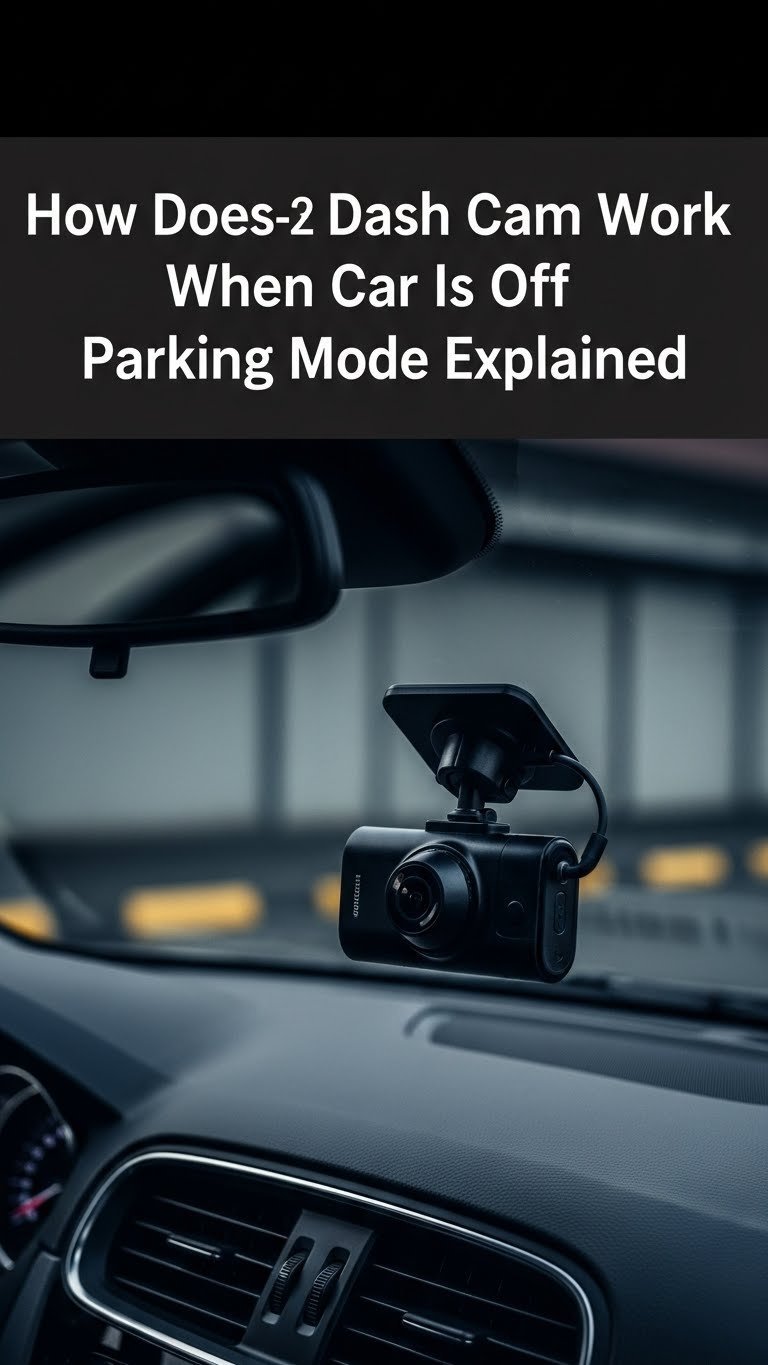
When you turn your car’s ignition off, power to the 12V cigarette lighter port is almost always cut. This is the central problem. A dash cam plugged into this port will simply shut down with the rest of your car. To achieve parked recording, the dash cam must bypass this and draw power directly from the car’s electrical systems. This requires three essential components working together.
- A Dash Cam with Parking Mode: The camera’s firmware must be designed to enter a low-power “standby” state and manage recording triggers.
- A Constant Power Source: The camera needs a way to receive electricity even when the ignition is off. We’ll explore these methods next.
- Event Triggers: The camera needs sensors, such as a G-sensor to detect impacts or a motion sensor to identify movement, to tell it when to wake up and start recording.
What Are the Two Main Ways a Dash Cam Gets Power When Parked?
A dash cam gets power when parked primarily through two methods: a hardwire kit that connects to the car’s fuse box for continuous power, or a dedicated external battery pack that operates independently of the car’s battery. A hardwire kit offers a permanent, “set-it-and-forget-it” solution, while a battery pack is a simpler, portable option that requires periodic recharging.
Choosing between these two power sources is the most important decision you’ll make when setting up parking mode. Each has distinct advantages and disadvantages related to installation complexity, cost, and impact on your vehicle.
| Feature | Hardwire Kit | External Battery Pack |
|---|---|---|
| Power Source | Car’s main battery | Standalone, rechargeable Li-ion/LiFePO4 battery |
| Installation | Moderate-to-Complex (connects to fuse box) | Simple (plugs into cigarette lighter to charge) |
| Runtime | Dependent on car battery health & voltage cutoff | 12-48 hours (model dependent) |
| Car Battery Impact | Direct draw; requires voltage cutoff to prevent drain | None; completely independent |
| Cost | Low ($20 – $50) | High ($150 – $400) |
| Best For | “Set-it-and-forget-it” permanent installation | Renters, leased vehicles, or users avoiding car wiring |
How Does a Hardwire Kit Provide Constant Power?
A hardwire kit provides constant power by connecting to two types of fuses: a constant-on fuse for power when the car is off, and an ignition-switched fuse to detect when the car is on. This clever system allows the dash cam to automatically switch between normal driving mode and parking surveillance mode.
The kit itself is a small voltage regulator with three essential wires:
- BATT+ (Constant Power): This wire, often yellow, connects to a fuse that is always live, even when the car is off (like the one for your hazard lights). This is the source of power for parking mode.
- ACC (Ignition Switched Power): This wire, typically red, connects to a fuse that only has power when the ignition is on (like the radio or cigarette lighter fuse). This wire acts as a signal. When it loses power, it tells the dash cam, “The car is off, switch to parking mode.”
- GND (Ground): This wire, always black, attaches to a metal bolt on the car’s chassis to complete the electrical circuit.
Pro Tip: In our testing, using a multimeter is the only surefire way to identify a true constant and a true ignition-switched fuse. This prevents installation headaches and ensures the camera functions correctly.
How Does an External Battery Pack Work for a Dash Cam?
An external dash cam battery pack is a large, rechargeable battery that powers the dash cam independently. It recharges from the car’s cigarette lighter port only when the car is running and then provides sole power to the dash cam when the car is off, preventing any drain on the car’s main battery.
Think of it as a specialized, high-capacity power bank for your car. The concept is simple: it charges while you drive and discharges to power the camera while you’re parked. This makes it an ideal solution for those with leased vehicles, anyone uncomfortable with modifying their car’s fuse box, or drivers with older car batteries who want zero risk of drain.
Your car’s battery is 100% safe. Because the battery pack is a completely separate power source for parked recording, there is no parasitic draw on your vehicle’s main battery.
These packs are built with automotive-grade battery cells, often Lithium Iron Phosphate (LiFePO4), which are safer and more resistant to the extreme temperatures found inside a parked car than standard lithium-ion (Li-ion) cells.
What Are the Different Types of Parking Mode Recording?
The main types of parking mode recording are: motion and impact detection, which records only when movement or a jolt is sensed; time-lapse, which records continuously at a low frame rate; and buffered parking mode, which saves footage from a few seconds before an event is triggered, providing crucial context. Understanding these differences is key to choosing a feature set that matches your security needs.
Motion & Impact Detection
This is the most basic form of parking mode. The dash cam enters a sleep state, monitoring its G-sensor for impacts and its camera sensor for motion. When a trigger is detected, the camera wakes up and records a short video clip (e.g., 30 seconds), then goes back to sleep. While it saves power and storage space, its major drawback is that it only captures the event itself, not what led to it.
Time-Lapse Recording
In this mode, the camera records continuously but at a very low frame rate, such as 2 frames per second (fps) instead of the usual 30 fps. This condenses a long period of time into a much shorter video file, making it easy to review hours of footage quickly. It’s great for capturing everything that happens around your car but can miss fast-moving details and uses more power than motion detection.
Buffered (Pre-Roll) Parking Mode
This is the gold standard for parking surveillance. In this mode, the dash cam is constantly recording to a small internal memory buffer. When an impact or motion is detected, the camera saves the clip to the SD card, including the 5-10 seconds of video from the buffer before the event.
This is the only mode that shows you what happened before the hit-and-run, such as the other car’s license plate as it approached.
This pre-roll footage is often the most critical piece of evidence. It transforms the dash cam from a simple impact logger into a true surveillance device that tells the whole story.
Will a Dash Cam Drain My Car’s Battery?
No, a properly installed dash cam will not drain a healthy car battery. Modern hardwire kits include a vital safety feature called Low Voltage Cutoff Protection. This device constantly monitors your battery’s voltage and automatically powers down the dash cam if it drops to a preset level, always preserving enough power to start your car.
Think of your car battery’s voltage as its “pressure.” To start the engine, you need a certain amount of pressure. The voltage cutoff feature acts as a safety valve, ensuring the pressure never drops below the level needed to turn the engine over. This is the single most important feature for preventing a dead car battery.
You can typically configure the voltage cutoff level in the dash cam’s settings.
Expert Insight: For a vehicle driven daily, a cutoff setting of 12.2V is a safe choice, representing about 60% of the battery’s charge. If you frequently leave your car parked for several days, a more conservative setting like 12.4V provides an even larger safety buffer.
The fear of being stranded is the #1 concern for users, but modern hardware is specifically designed to make this a non-issue. If your battery does die, it’s almost always a sign of either an improper installation or a pre-existing issue with an old or failing car battery.
How Do You Choose the Right Dash Cam for 24/7 Recording?
When choosing a dash cam for 24/7 recording, prioritize these features: a true buffered parking mode for pre-event recording, a supercapacitor for heat resistance, and high-quality night vision. Also, ensure it is compatible with a hardwire kit that has adjustable low-voltage cutoff protection. These features work together to create a reliable and safe surveillance system.
Here is your 5-point checklist for choosing a dash cam that excels at parked security:
- ✅ Buffered Parking Mode: This is the most critical feature. Do not settle for simple motion detection. You need a camera that records before an incident occurs to capture the full story and essential evidence like license plates.
- ✅ Supercapacitor: For cars parked in warm or hot climates, a supercapacitor is non-negotiable. It’s far more durable and resistant to extreme temperatures than internal lithium-ion batteries, which can swell and fail in the heat.
- ✅ High-Quality Night Vision: Vandalism and hit-and-runs often happen at night. A camera with a high-end image sensor (like Sony’s STARVIS) is essential for capturing clear, usable details in low-light conditions.
- ✅ Hardwire Kit with Voltage Cutoff: The camera must be compatible with a hardwire kit that includes adjustable low voltage protection. This is the core safety feature that protects your car’s battery.
- ✅ Dual-Channel (Front & Rear): A front-only camera can’t see someone breaking into your trunk or a car hitting you from behind. A dual-channel system provides comprehensive coverage that is vital for all-around security.
FAQs About how does dash cam work when car is off
How long can a dash cam record when the car is off?
This depends entirely on your power source and settings, ranging from hours to days. A hardwired dash cam’s time is limited by your car battery’s health and the voltage cutoff setting, typically lasting 12-24 hours. A dedicated external battery pack can provide a more definite 24-48 hours of recording, depending on its capacity and the camera’s power consumption.
Does parking mode record 24/7?
Not usually; it’s a “standby” mode that records only when triggered. To save power and storage space, most parking modes sleep until motion or an impact is detected, at which point they wake up and record a short clip. Time-lapse is the exception, as it records continuously at a low frame rate, but even that is not the same as full 24/7 recording.
Do all dash cams have parking mode?
No, parking mode is a premium feature not found on all dash cams. Basic, cheaper models often only record when the car is running and powered by the cigarette lighter. When buying, you must specifically look for models that advertise “Parking Mode” and check if they require a specific hardwire kit to enable it.
Can a dash cam record sound when the car is off?
Yes, most dash cams that have parking mode can also record audio. However, this is typically a setting you can disable. Be aware of local laws regarding recording audio without consent, as these can vary significantly by state and country, especially in a public space.
Why did my dash cam stop recording while parked?
The most common reason is the low voltage cutoff protection feature worked as intended. Your hardwire kit detected that the car’s battery voltage dropped to the preset safety level and cut power to the camera to save enough energy to start your car. Other causes could be a full SD card or the camera overheating.
Is hardwiring a dash cam worth it?
Yes, for users seeking true “set-it-and-forget-it” vehicle security, hardwiring is worth it. It provides a seamless, integrated experience where the camera automatically manages itself without you ever needing to plug it in or charge it. It’s the most reliable method for ensuring your car is monitored while parked.
What is the best voltage cutoff setting for a dash cam?
For a daily-driven car, 12.2V is a safe and common setting. This typically corresponds to about 60% battery charge, leaving plenty of power to start the engine. If you park your car for multiple days at a time, you might consider a higher setting like 12.4V to be extra cautious.
Can a dash cam work in very cold or hot weather while parked?
Yes, but extreme temperatures can affect performance. In extreme heat, look for a dash cam with a supercapacitor instead of a lithium-ion battery, as they are far more heat-resistant. In extreme cold, a car battery’s effectiveness is reduced, so your parking mode recording time may be shorter than usual before the voltage cutoff is triggered.
Can I use a regular USB power bank for parking mode?
No, this is not recommended as it’s unreliable and unsafe. Standard power banks are not designed for the fluctuating temperatures inside a car and lack the “auto-on” intelligence of a dedicated dash cam battery pack. They typically won’t start supplying power automatically when the camera needs it, defeating the purpose of parking mode.
Does a dual dash cam record both front and rear when parked?
Yes, if you have a dual-channel system, it will record from both cameras during a parking mode event. When an impact or motion is detected, the system saves clips from both the front and rear cameras, providing more comprehensive evidence of what happened around your vehicle.
Key Takeaways: How a Dash Cam Works When Your Car is Off
- Parking Mode is the Key: Your dash cam doesn’t just “stay on”; it enters a special low-power parking mode that requires specific hardware and settings to function.
- Power is Not Automatic: To work when the car is off, the camera needs a continuous power source, either a hardwire kit connected to the fuse box or a dedicated external battery pack.
- Battery Drain is Preventable: The biggest risk, a dead car battery, is prevented by a critical safety feature in hardwire kits called low voltage cutoff protection, which automatically shuts the camera off.
- Not All Recording is Equal: Buffered parking mode is the most valuable type because it captures video from before an incident, providing context that simple motion detection misses.
- Hardware Matters for Reliability: For cars in hot climates, a supercapacitor is far safer and more durable than a standard lithium-ion battery for parking mode operation.
- It’s a Complete System: Effective parked recording relies on a system of components working together: the camera’s firmware, a power source, and sensors (like a G-sensor) that trigger recording upon an event.
- Installation Method Defines the Experience: A hardwire kit offers a seamless, automated experience, while an external battery pack provides a simple, portable solution that completely avoids interacting with the car’s electrical system.
Final Thoughts on 24/7 Dash Cam Security
Understanding how a dash cam works when your car is off transforms it from a simple driving recorder into a powerful 24/7 security system. It is no longer just about capturing events on the road, but about providing peace of mind around the clock. By choosing the right power source—whether a seamless hardwire kit or a non-invasive battery pack—and prioritizing essential features like buffered recording and voltage protection, you can confidently protect your vehicle from theft, vandalism, and hit-and-runs. You now have the knowledge to select the right equipment or have an informed discussion with a professional installer, turning your vehicle into a fortress of evidence.
Last update on 2026-01-13 / Affiliate links / Images from Amazon Product Advertising API


![What Car Is Chevy Bringing Back in [year]? New Lineup Revealed](https://carxplorer.com/wp-content/uploads/2026/01/What-Car-Is-Chevy-Bringing-Back-in-year-New-Lineup-Revealed-1-1-60x60.jpg "What Car Is Chevy Bringing Back in [year]? New Lineup Revealed 11")